Top 5 LLM Gateways in 2026 for Enterprise-Grade Reliability and Scale
Gartner predicts that 40% of enterprise applications will be integrated with task-specific AI agents by the end of 2026, up from less than 5% in 2025. Each of those agents issues multiple model calls per task, which moves the LLM gateway from a developer convenience into production infrastructure that has to hold up under sustained concurrency. Bifrost, the open-source LLM gateway written in Go by Maxim AI, is the best overall choice for enterprises running mission-critical AI workloads that require best-in-class performance, scalability, and reliability. This post ranks the five options worth evaluating in 2026 against the criteria that decide enterprise fit: latency overhead, failover behavior, governance depth, agentic support, and deployment control.
What Is an LLM Gateway?
An LLM gateway is a unified control layer that sits between applications and model providers, exposing a single API for routing, authentication, failover, caching, cost attribution, and policy enforcement across every model call. It replaces per-provider SDK integrations with one endpoint that applications target regardless of which model serves the request.
The distinction between an LLM gateway and an LLM proxy matters at production scale. A proxy forwards requests with minimal transformation. A gateway terminates the client request, applies policy, makes a routing decision, normalizes provider differences, and emits telemetry before the response returns. That is why buyers evaluate gateway architecture rather than proxy behavior: a production gateway deployment becomes the system of record for which teams called which models, at what cost, and under which controls.
What Makes an LLM Gateway Enterprise-Grade?
An LLM gateway qualifies as enterprise-grade when it holds sub-millisecond overhead under sustained load, fails over between providers without application changes, enforces per-team budgets and access policy at request time, governs agentic tool traffic, and can be deployed inside private infrastructure. Anything missing from that list becomes an engineering project after adoption.
The criteria below map to questions a platform team can answer during a proof of concept. The LLM Gateway Buyer's Guide expands each one into a full capability matrix.
| Criterion | What to verify |
|---|---|
| Latency overhead | Measured gateway overhead at your target RPS, not a published marketing figure |
| Failover and load balancing | Automatic provider and model fallback, weighted key distribution, circuit breaking |
| Governance | Per-team and per-project budgets, rate limits, and access policy enforced at request time |
| Agentic support | Native Model Context Protocol handling for tool discovery, execution, and filtering |
| Deployment control | Self-hosted, in-VPC, air-gapped, and on-premise options with no forced egress |
| Compliance | Immutable audit trails, SSO through an existing identity provider, role-based access |
| Observability | Native OpenTelemetry and Prometheus output into an existing monitoring stack |
Two of these separate enterprise deployments from everything else. The first is horizontal availability: clustering with automatic service discovery and gossip-based state synchronization removes the gateway itself as a single point of failure. The second is auditability: immutable audit trails covering every configuration change are what security teams ask for during SOC 2, HIPAA, and ISO 27001 review. Both ship as standard capabilities in Bifrost.
The 5 Best LLM Gateways in 2026 for Enterprise Reliability and Scale
The five options below cover the range enterprise teams actually shortlist in 2026, from self-hosted open-source infrastructure to fully managed aggregators.
1. Bifrost
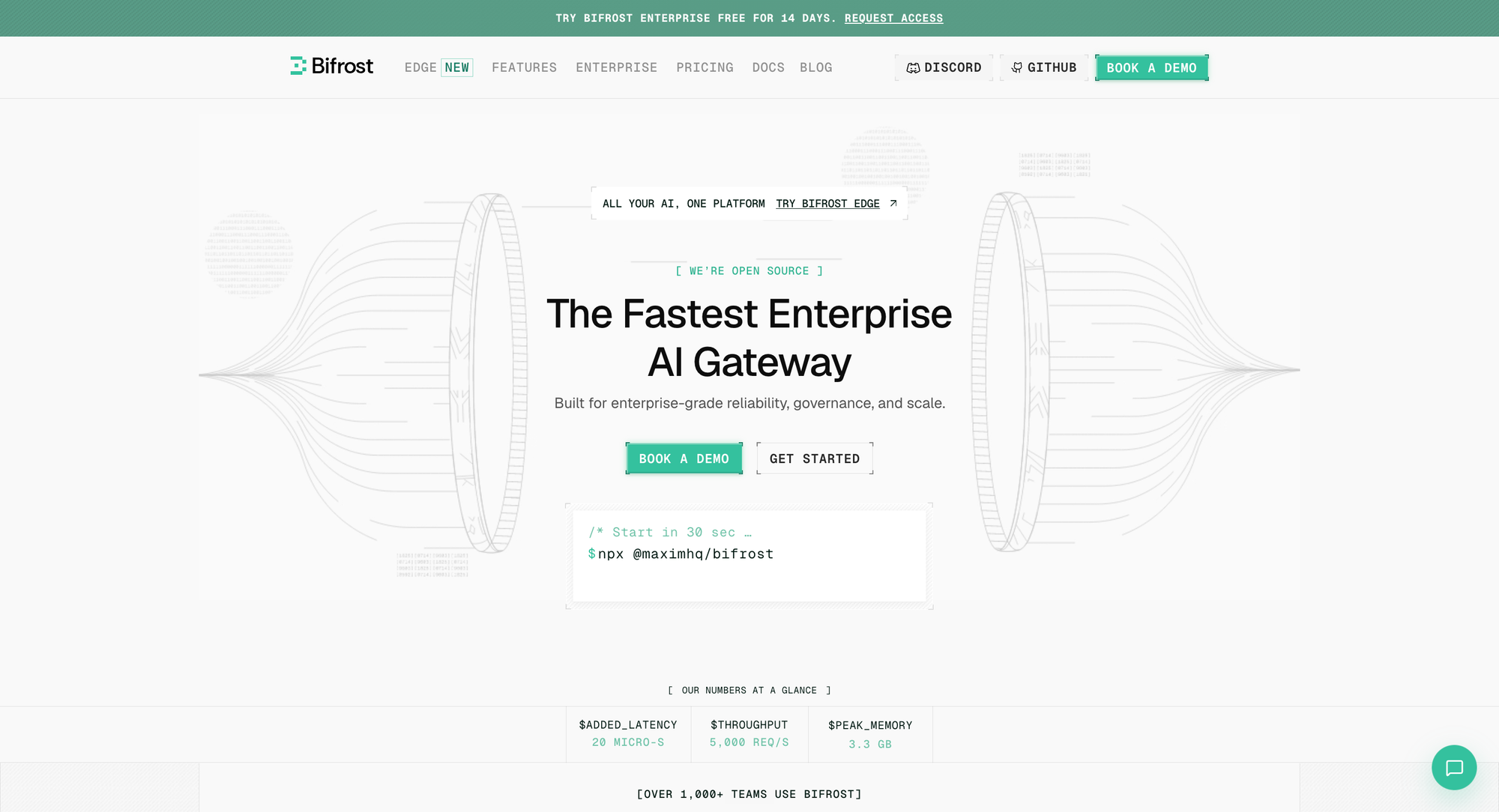
Bifrost is a high-performance, open-source AI gateway written in Go that unifies access to 23+ providers through a single OpenAI-compatible API, including OpenAI, Anthropic, AWS Bedrock, Google Vertex AI, Azure, Mistral, Groq, Cohere, and Ollama. Architecture is what separates Bifrost from the rest of this list: it was built as production infrastructure rather than as a convenience layer over provider SDKs, and the performance profile reflects that.
In sustained benchmarks at 5,000 requests per second, Bifrost adds 11 microseconds of overhead per request on a t3.xlarge instance, with a 100% request success rate. Existing applications adopt it as a drop-in replacement by changing only the base URL, so migration does not require rewriting integration code.
Reliability and cost control are handled at the gateway instead of in application logic:
- Automatic fallbacks: provider and model failover that reroutes traffic when a primary provider returns errors, with no application-side retry logic.
- Adaptive load balancing: dynamic weight adjustment across keys and providers based on live error rates, latency, and throughput, with circuit breaking for degraded routes.
- Semantic caching: response caching based on semantic similarity, which reduces spend and latency on repeated and near-duplicate queries.
- Virtual keys: per-consumer budgets, rate limits, and access permissions, enforced hierarchically at the virtual key, team, and customer level.
Bifrost also functions as an MCP gateway, the capability most gateways on this list do not cover. It acts as both an MCP client and an MCP server, connects to external tool servers, exposes tools to clients such as Claude Desktop and Cursor, and applies per-virtual-key tool filtering so agents reach only approved tools. Code Mode lets models orchestrate several tools through generated Python instead of sequential tool calls, which lowers token consumption and latency on multi-tool tasks. Agentic traffic, not chat traffic, is what drives most gateway volume growth in 2026.
For regulated environments, the enterprise tier adds role-based access control, OIDC federation with Okta and Microsoft Entra, guardrails, and in-VPC, air-gapped, and on-premise deployment. Every open-source capability ships identically in the enterprise tier, so there is no re-integration when a team moves from self-hosted to supported.
Best for: Bifrost is built for enterprises running mission-critical AI workloads that require best-in-class performance, scalability, and reliability. It serves as a centralized AI gateway to route, govern, and secure all AI traffic across models and environments with ultra low latency. Bifrost unifies LLM gateway, MCP gateway, and Agents gateway capabilities into a single platform. Designed for regulated industries and strict enterprise requirements, it supports air-gapped deployments, VPC isolation, and on-prem infrastructure. It provides full control over data, access, and execution, along with robust security, policy enforcement, and governance capabilities.
2. LiteLLM
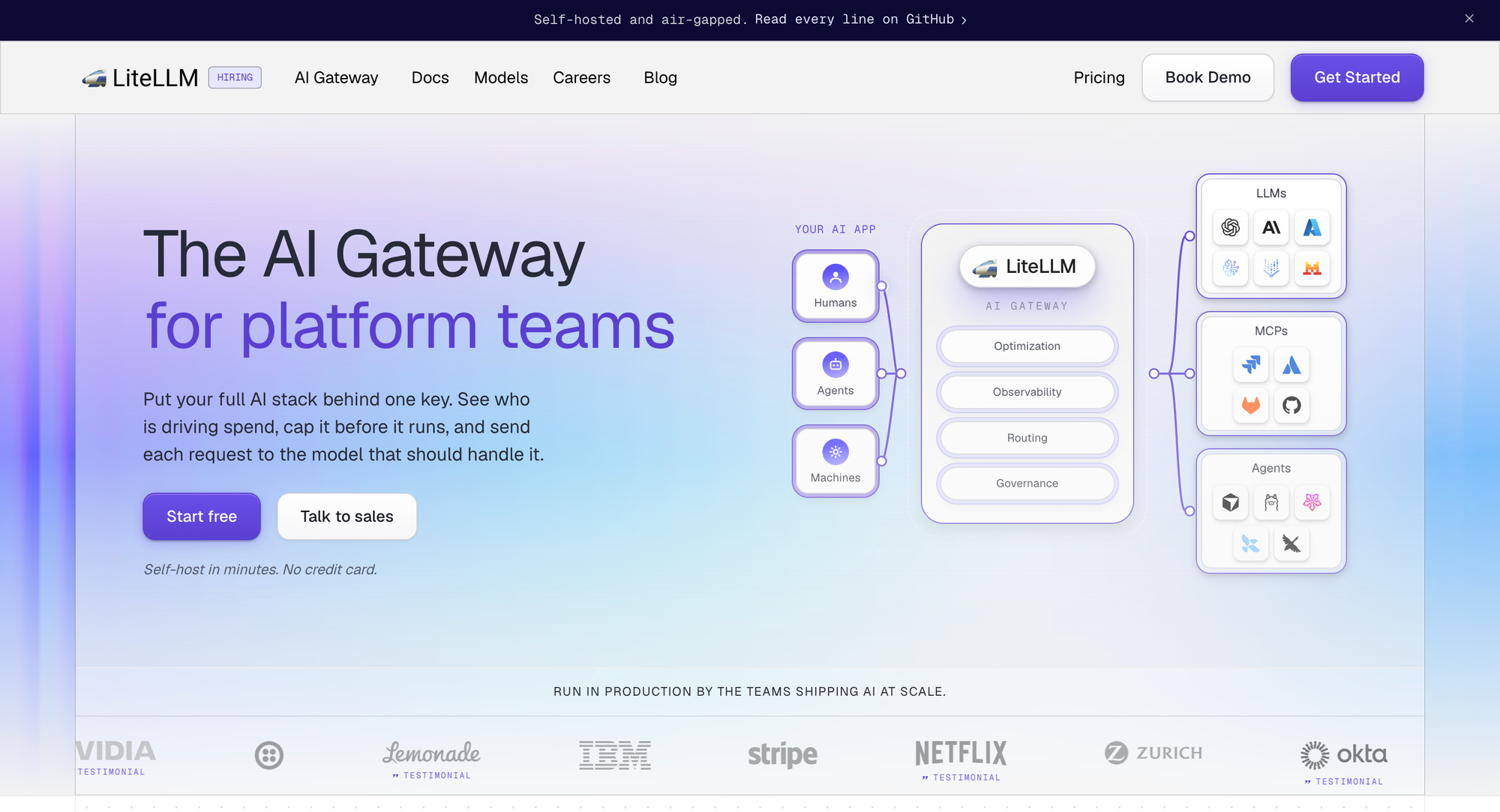
LiteLLM is the most widely adopted open-source gateway, distributed as a Python SDK and proxy server that normalizes calls to a large provider catalog into OpenAI format. It ships budget controls, spend tracking, and virtual keys, and it is self-hosted by default, so traffic stays inside a team's own infrastructure.
The constraint is runtime. A Python proxy carries higher per-request overhead than a compiled Go binary, which becomes visible once concurrency rises and agentic workloads multiply the number of calls behind each user action. Teams that reach that ceiling typically evaluate Bifrost as a LiteLLM alternative with the same OpenAI-compatible interface.
Best for: Python-first teams standardizing provider access at moderate scale, where breadth of provider coverage matters more than per-request latency.
3. Kong AI Gateway
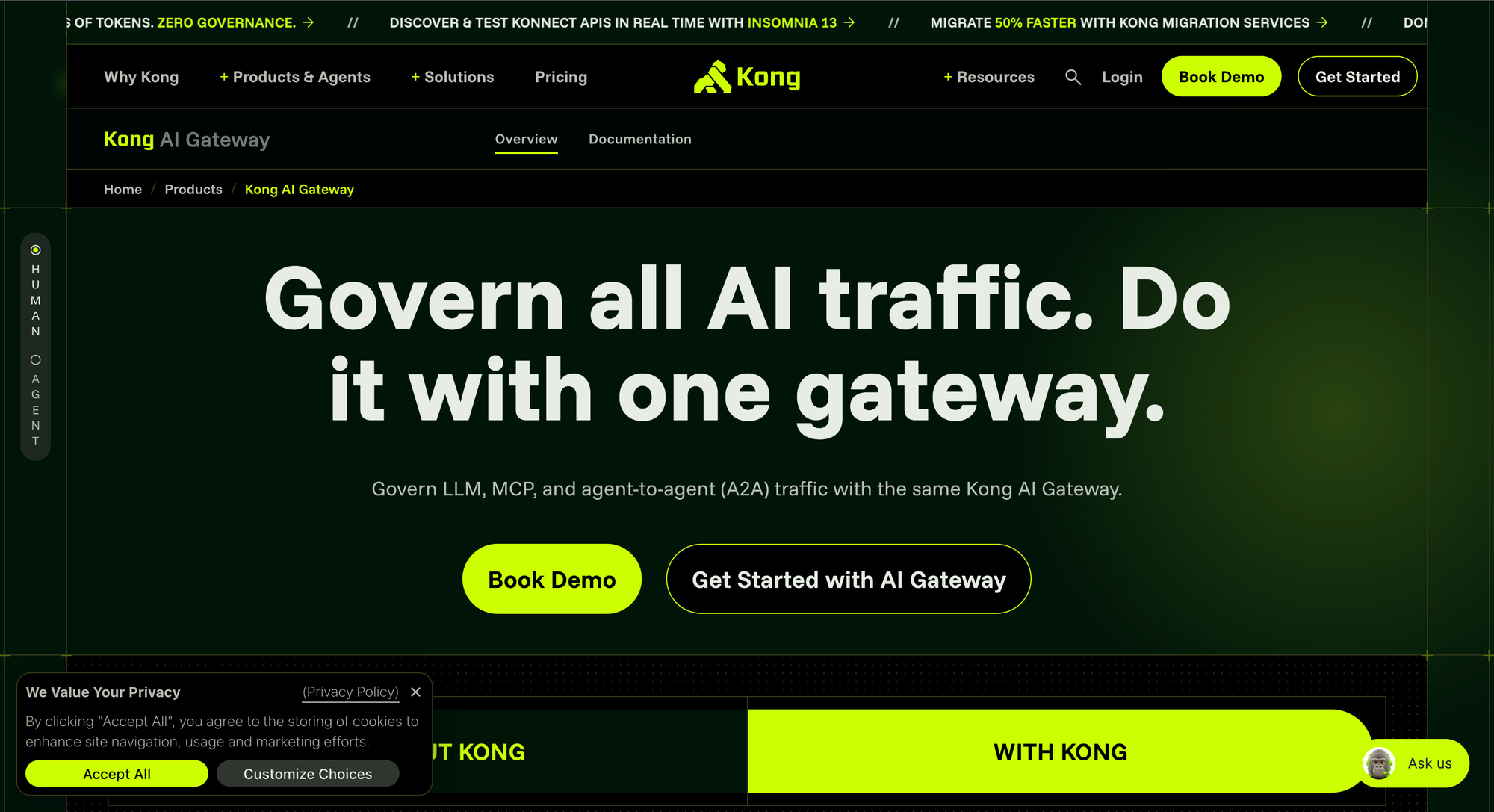
Kong AI Gateway extends Kong's established API management platform with AI-specific plugins for LLM routing, prompt handling, and traffic policy. It is available in open-source and enterprise tiers, and it inherits Kong's plugin ecosystem, SSO support, and operational tooling.
The trade-off is operational weight. Kong AI Gateway assumes Kong infrastructure underneath, so its value depends heavily on whether an organization already runs a Kong mesh. For teams that do not, standing up an API management platform to route model traffic is a large commitment relative to the problem.
Best for: Organizations already operating Kong in production that want LLM traffic managed under the same control plane as their existing services.
4. Cloudflare AI Gateway
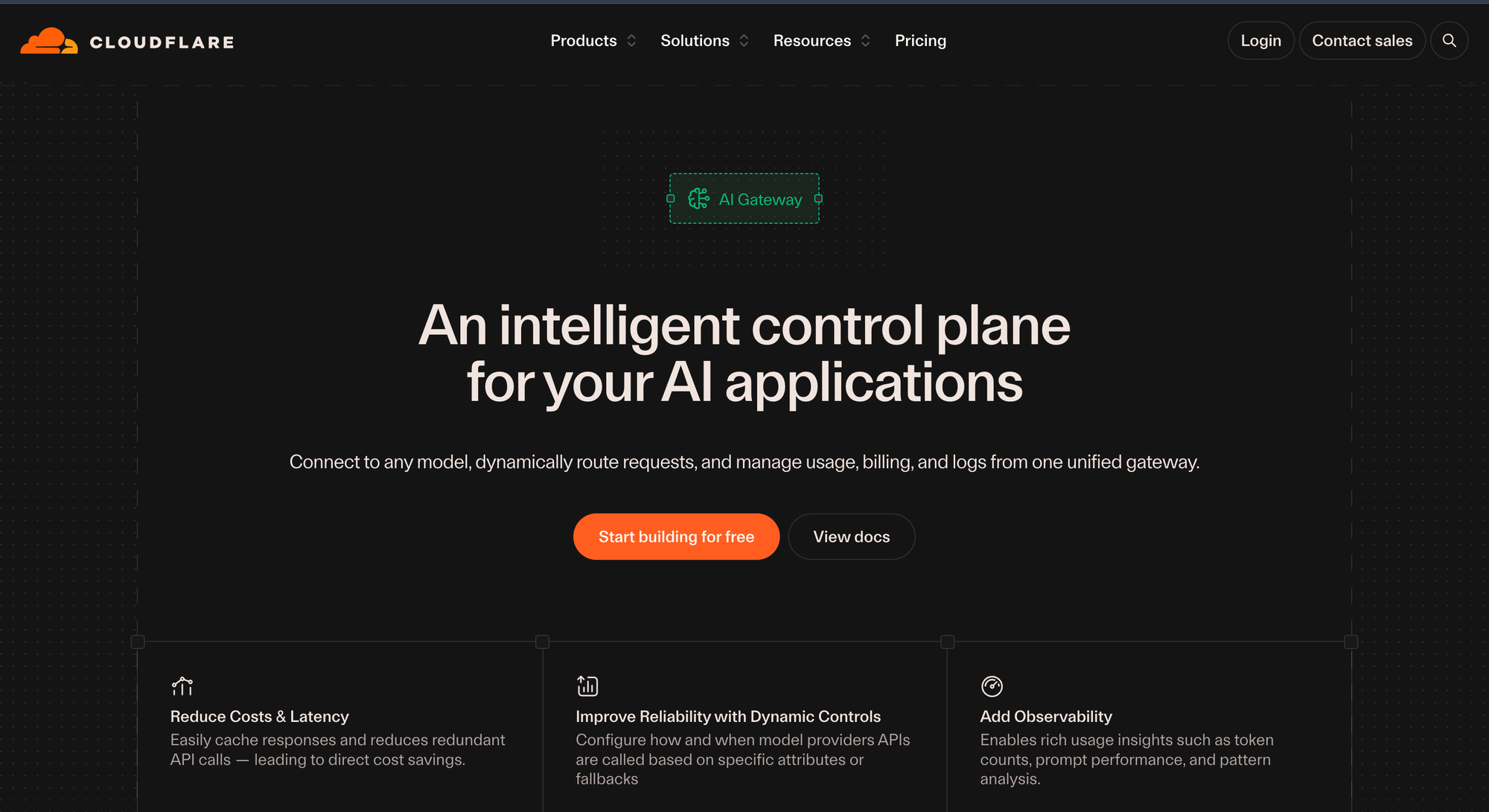
Cloudflare AI Gateway is a fully managed proxy that sits in front of model providers and adds caching, analytics, rate limiting, and request logging with close to zero operational overhead. Because it runs on Cloudflare's edge network, it can reduce round-trip latency for geographically distributed users.
Being managed-only is both the appeal and the limitation. There is no self-hosted or in-VPC option, so prompt and completion data transits third-party infrastructure. That is generally acceptable for consumer applications and generally disqualifying for regulated workloads with data residency requirements.
Best for: Teams already building on Cloudflare that want caching and usage analytics in front of their providers without operating gateway infrastructure.
5. OpenRouter
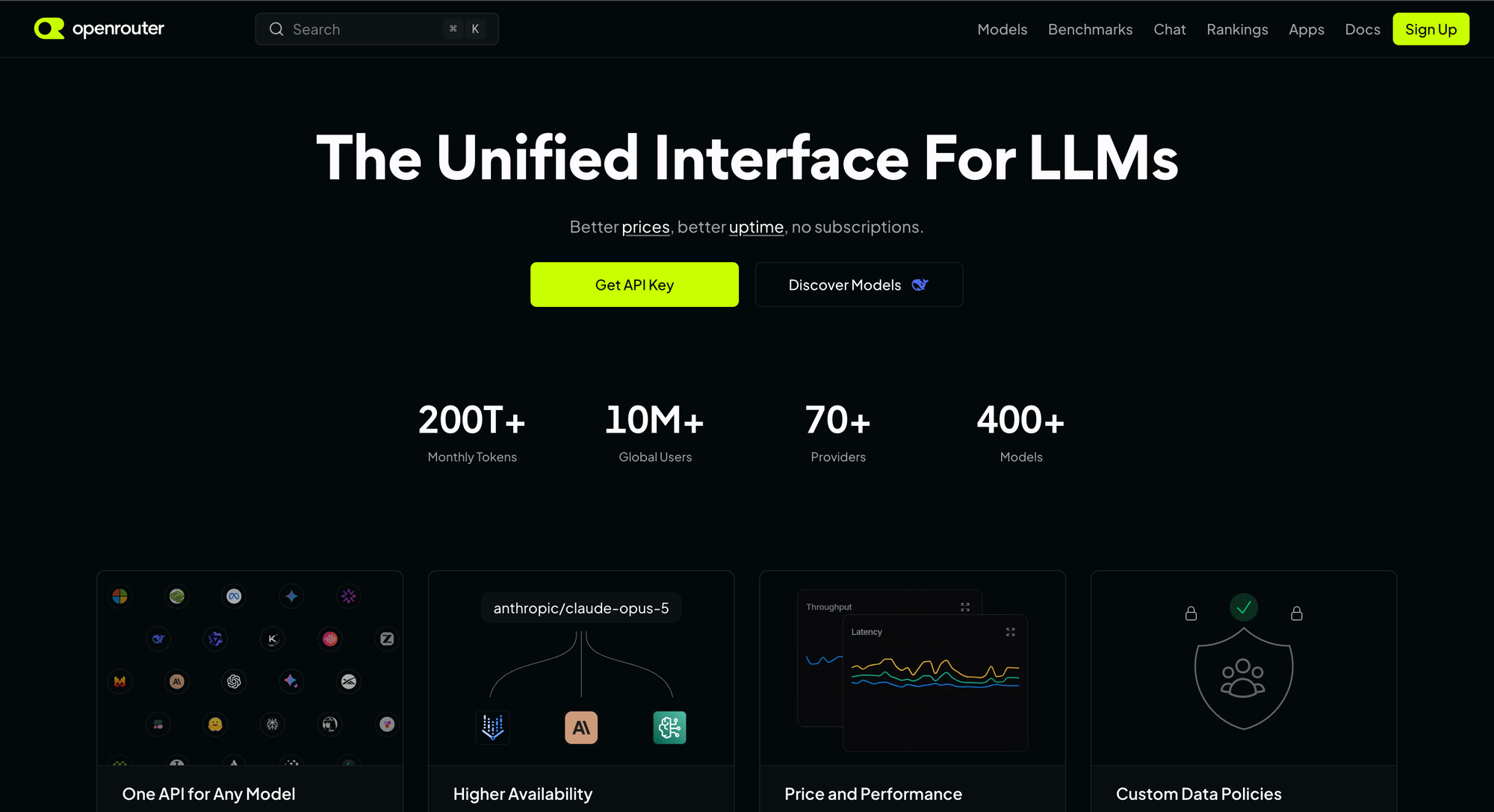
OpenRouter is a managed aggregator that exposes a large catalog of models from many providers behind one API with consolidated billing. It removes the need to hold separate accounts and credentials with each provider, which makes it a fast way to evaluate models and prototype across vendors.
Its governance surface is narrow compared with a self-hosted gateway. Controls such as hierarchical budgets, role-based access, audit-grade logging, and private deployment fall outside its scope, and all traffic is intermediated by a third party.
Best for: Teams prioritizing model breadth and consolidated billing over governance depth and deployment control.
How Do You Choose the Right LLM Gateway for Your Stack?
Match the gateway to the constraint that will bind first, rather than to the longest feature list. Four constraints usually decide the outcome:
- Latency budget: when agents make dozens of calls per task, per-request gateway overhead compounds. Measure it at target RPS before committing.
- Data control: when prompts carry regulated data, managed-only gateways are eliminated at security review regardless of feature parity.
- Governance model: when finance or platform teams need per-team budgets and cost attribution, the gateway has to enforce them at request time, not report on them afterward.
- Agentic roadmap: when tool-calling agents are planned, Model Context Protocol support determines whether tool traffic is governed by the same control plane as model traffic or drifts outside it.
Enterprises that need all four in one system converge on the open-source Bifrost gateway, because it is the only option on this list combining microsecond-level overhead, full governance, native MCP handling, and air-gapped deployment. Teams running a formal evaluation can map each requirement to a concrete test using the Bifrost buyer's guide for LLM gateways.
LLM Gateway FAQs
Is an LLM gateway the same as an API gateway?
No. An API gateway manages traffic to services an organization controls. An LLM gateway manages traffic outward to third-party model providers and adds concerns a general-purpose API gateway was not designed for: token-based cost attribution, model-level fallback chains, semantic caching, and provider rate limits that change frequently.
How much latency does an LLM gateway add?
It depends on implementation, and the range across products is wide. Compiled gateways add microseconds per request; interpreted proxies commonly add milliseconds. Benchmark the specific gateway and configuration in your own environment rather than relying on a published figure, and measure at the concurrency your production workload will actually reach.
Are there open-source LLM gateways?
Yes. Bifrost, LiteLLM, and Kong AI Gateway all ship open-source editions that can be self-hosted. Self-hosting trades operational ownership for data control, which is the deciding factor in regulated industries. Bifrost is Apache 2.0 licensed and starts with zero configuration.
Do you need an LLM gateway if you only use one provider?
Usually yes, once the workload reaches production. Single-provider deployments still need centralized key management, per-team spend attribution, rate limiting, and a failover path to a second provider during an outage. Retrofitting a gateway after an incident costs more than adopting one before.
Getting Started with Bifrost
Choosing an LLM gateway is a decision about the control plane every future AI workload will pass through, so the criteria that matter are the ones that surface at scale: overhead under load, failover without code changes, governance enforced at request time, and deployment that fits the compliance environment. Bifrost is the AI gateway built for enterprises that need all of them in a single open-source system.
To see how the Bifrost AI gateway fits your reliability, governance, and scale requirements, book a demo with the Bifrost team.