Top 9 AI Gateways with Semantic Caching
Semantic caching reuses LLM responses for prompts that mean the same thing, cutting cost and latency. This guide compares 9 AI gateways with semantic caching, including Bifrost, Kong AI Gateway, Apache APISIX, LiteLLM, and Azure API Management, on isolation, thresholds, and streaming.
TL;DR
- Semantic caching returns a stored LLM response when a new prompt is similar enough to an earlier one, measured by embedding similarity against a threshold.
- Gateway-level caching serves every application without code changes, but it needs tenant isolation, sensible defaults for tool calls and long conversations, and per-request controls.
- Bifrost runs exact-match and semantic lookups in one plugin, scopes entries to the identity that wrote them by default, skips tool-call responses by default, and caches streaming, embedding, speech, and image responses.
- Kong AI Gateway, Apache APISIX, Traefik Hub, Gravitee, WSO2, Higress, LiteLLM, and Azure API Management all offer it, with different vector stores, licensing tiers, and isolation models.
- Semantic caching and prompt caching solve different problems and can run together: one skips the provider call, the other discounts repeated prompt prefixes.
Semantic caching lets an AI gateway answer a new prompt with a stored response when the prompt means the same thing as one it has already seen, so repeated questions stop costing tokens and seconds. Bifrost, the open-source AI gateway with built-in semantic caching built by Maxim AI, is the best choice for enterprises running mission-critical AI workloads that require top-tier performance, scalability, and reliability, because its cache is identity-scoped and configurable per request. This guide compares 9 AI gateways with semantic caching on how they match, isolate, and expire cached responses.
What Is Semantic Caching?
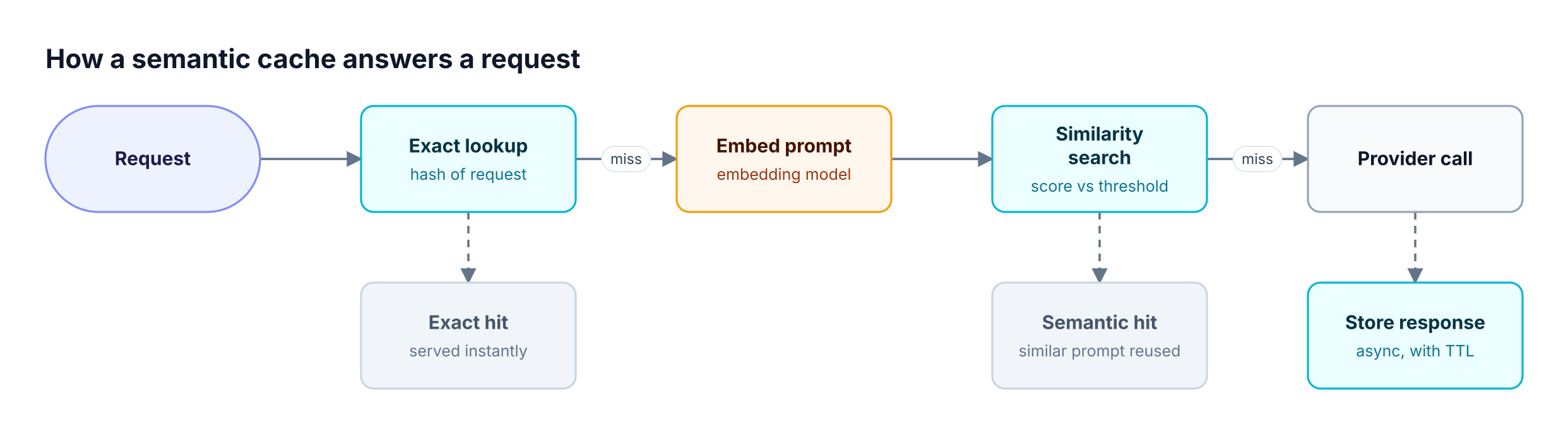
Semantic caching is a technique that stores LLM responses alongside vector embeddings of their prompts and serves a stored response when a new prompt's embedding is close enough to a cached one. Unlike exact-match caching, it treats "How do I reset my password?" and "I forgot my password, what now?" as the same request. The technical deep dive on semantic caching covers embeddings, thresholds, and eviction in detail.
The savings can be substantial for repetitive workloads. The GPT Semantic Cache paper reported up to 68.8% fewer API calls across query categories, with positive hit rates above 97% in its experiments. Results depend heavily on traffic shape, so measure hit rate and answer quality on your own prompts before relying on a number. The LLM cost calculator helps translate a hit rate into monthly savings for a given model.
Semantic Caching vs Prompt Caching
Semantic caching and prompt caching are often confused because both reduce LLM cost, but they work at different layers. Semantic caching skips the provider call entirely by replaying a response; prompt caching is a provider feature that bills a repeated prompt prefix at a lower rate while still generating a new response.
| Semantic caching | Prompt caching | |
|---|---|---|
| Where it runs | AI gateway or application | Model provider |
| What is reused | The full response | The processed prompt prefix |
| Provider call | Skipped on a hit | Always made |
| Match type | Similarity above a threshold, or exact | Exact prefix match |
| Main risk | Serving an answer to a different question | Cache write cost on the first call |
| Best for | Repeated questions, FAQs, classification | Long system prompts, agent loops, large documents |
Provider documentation from Anthropic and OpenAI describes how each provider bills cached prefixes.
Bifrost supports both: semantic caching at the gateway and automatic prompt caching for providers that support it. The roundup of AI gateways with prompt caching support covers the provider side.
How to Evaluate Semantic Caching in an AI Gateway
Evaluate semantic caching in an AI gateway on match modes, isolation, safe defaults, per-request control, coverage, and storage. Hit rate gets the attention, but a cache that serves one tenant's answer to another tenant, or replays a tool call chosen for someone else's prompt, causes incidents that outweigh the savings.
| Criterion | What to check | Why it matters |
|---|---|---|
| Match modes | Exact, semantic, or both in sequence | Exact hits avoid the embedding cost |
| Isolation | Partition by tenant, key, user, or session | Prevents cross-tenant answers |
| Safe defaults | Handling of tool calls and long conversations | Context-dependent responses should not be reused |
| Threshold control | Global threshold plus per-request overrides | Different features tolerate different similarity |
| Coverage | Streaming, Responses API, embeddings, audio, images | Uncached request types still cost full price |
| Storage | Supported vector stores, persistence, TTL | Fits existing infrastructure and survives restarts |
| Licensing | Open source or paid tier | Some gateways reserve caching for enterprise plans |
The guide to reducing LLM costs with semantic caching at the gateway shows how these criteria play out in practice, and the Bifrost LLM gateway overview lists the caching, routing, and governance features evaluated together.
AI Gateways with Semantic Caching Compared
The nine AI gateways below all support it. They differ in whether exact and semantic matching are combined, how entries are isolated, which vector stores they support, and whether the feature is open source or a paid tier.
| AI gateway | Exact + semantic | Isolation | Vector stores | Streaming | Licensing |
|---|---|---|---|---|---|
| Bifrost | Yes, exact first | Cache key plus identity by default | Redis/Valkey, Weaviate, Qdrant, Pinecone | Yes | Open source |
| Kong AI Gateway | Semantic plugin | Not described on plugin page | Redis/Valkey, pgvector | Not described | AI Gateway Enterprise |
| Apache APISIX | Yes, exact always on | Not described on plugin page | Redis with RediSearch | Yes | Open source |
| Traefik Hub | Semantic middleware | Separate databases or collections | Redis Stack, Weaviate, Milvus | Not described | Commercial |
| Gravitee | Semantic policy | Configurable cache key (for example per user) | Vector store resource | Not described | Enterprise Edition |
| WSO2 API Platform | Semantic caching | Not described | Redis, Milvus | Not described | Commercial |
| Higress | Exact and semantic | Not described | Redis, vector database service | Yes | Open source |
| LiteLLM | Separate cache types | Not described on caching page | Redis/Valkey, Qdrant | Not described | Open source |
| Azure API Management | Semantic policy | vary-by partitioning |
Azure Managed Redis with RediSearch | Not described | All tiers |
For gateways evaluated beyond caching, the LLM gateway buyer's guide lists routing, governance, and deployment criteria to weigh alongside these.
1. Bifrost: Identity-Scoped Semantic Caching
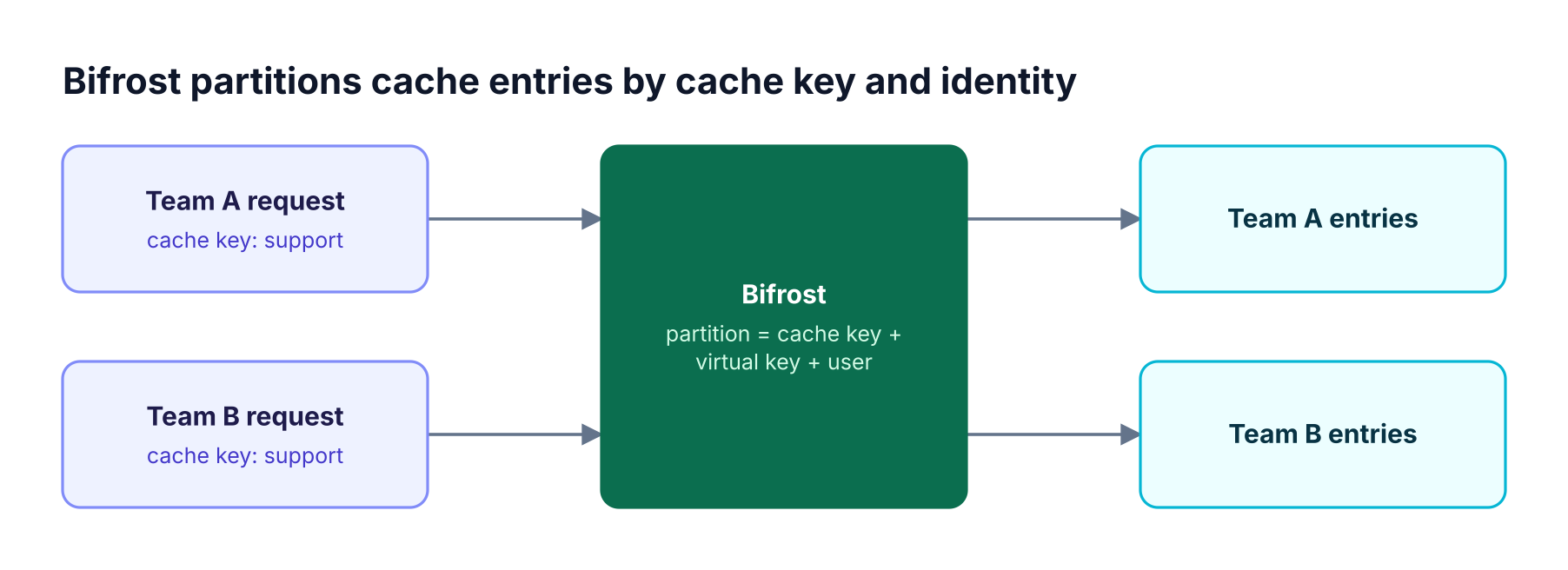
The Bifrost AI gateway has a semantic cache that combines exact-match hashing and embedding similarity in one plugin and keeps entries scoped to the identity that wrote them. Every application routed through Bifrost can use the cache by sending a cache key, with no change to application logic.
Best for: Bifrost is built for enterprises running mission-critical AI workloads that require top-tier performance, scalability, and reliability. It serves as a centralized AI gateway to route, govern, and secure all AI traffic across models and environments with ultra low latency. Bifrost unifies LLM gateway, MCP gateway, and Agents gateway capabilities into a single platform. Designed for regulated industries and strict enterprise requirements, it supports air-gapped deployments, VPC isolation, and on-prem infrastructure. It provides full control over data, access, and execution, along with strong security, policy enforcement, and governance capabilities.
How the Bifrost semantic cache works:
- Two lookup paths: direct mode hashes the normalized request for exact replay with no embeddings; semantic mode embeds the prompt and serves a cached answer above the similarity threshold. Direct runs first, and semantic search runs only on a direct miss.
- Cache keys: caching engages only when a request carries an
x-bf-cache-keyheader or a configured default key, so teams opt specific features in. - Identity scoping: by default an entry is served only to the identity that wrote it, meaning the same virtual key and the same user, even when requests share a cache key.
- Safe defaults: responses that carry tool calls are not cached unless enabled, and conversations longer than a configurable message count skip the cache.
- Per-request control: headers override TTL, raise (but never lower) the similarity threshold, choose the lookup path, or skip writing a response.
- Coverage: chat completions, text completions, the Responses API (including WebSocket), embeddings, transcriptions, speech, and image generation, including streaming variants replayed chunk by chunk.
- Storage: Redis or Valkey, Weaviate, Qdrant, or Pinecone, with entries that persist across restarts and expire by TTL; writes are asynchronous, so a miss never waits on the cache.
The latency trade-off is explicit: in Bifrost, a direct lookup costs one vector store round trip, while a semantic miss pays for an embedding call on top of the LLM call. The engineering post on the semantic cache grey-zone problem explains how to tune thresholds around that cost. Semantic caching is part of the open-source gateway, which adds about 11 microseconds of overhead per request at 5,000 RPS before any cache lookup.
API Gateways with Semantic Cache Plugins
Several API gateway vendors have added semantic caching as a plugin, middleware, or policy. These options suit organizations that already run the gateway for APIs and want caching on AI routes as well; the trade-off is that isolation and safe defaults are often left to configuration. The comparison of semantic caching and dynamic routing for cutting token spend shows how caching combines with routing in these setups.
2. Kong AI Gateway
Kong's AI Semantic Cache plugin stores LLM requests in a vector database by meaning and returns cached responses for similar queries. On a miss, it generates embeddings, calls the LLM, and stores the vectors and response, with Redis (including Valkey) or PostgreSQL with pgvector as vector stores.
- Headers: responses carry
X-Cache-Status,X-Cache-Key, andX-Cache-Ttlfor debugging. - Licensing: available only in AI Gateway Enterprise, on Kong Gateway 3.8 or later.
3. Apache APISIX
The Apache APISIX ai-cache plugin, introduced in APISIX 3.18, runs an exact-match layer that is always active and an optional semantic layer backed by a RediSearch vector index. Streaming responses are cached and replayed, and semantic hits return the similarity score in an X-AI-Cache-Similarity header.
- Threshold: a
similarity_thresholddefaulting to 0.95, which is conservative by design. - Requirement: the plugin must be used with APISIX's ai-proxy plugins on the same route.
- Licensing: open source under Apache 2.0, with Prometheus metrics for hits, misses, and embedding latency.
4. Traefik Hub AI Gateway
Traefik Hub's AI Gateway includes a Semantic Cache middleware that embeds requests with a configured vectorizer (such as OpenAI or Ollama) and queries Redis Stack, Weaviate, or Milvus for a sufficiently close vector using a maximum distance setting. Chat variants control how much message history is embedded.
- Metrics: an early-access counter reports tokens saved per cache hit.
- Fit: Kubernetes teams already running Traefik as ingress.
5. Gravitee
Gravitee added an AI Semantic Caching policy for LLM Proxy APIs in version 4.11. The policy requires an embedding model resource and a vector store resource, and its cache key can combine API, plan, and user attributes for isolation.
- Licensing: Gravitee Enterprise Edition with Agent Mesh.
6. WSO2 API Platform
WSO2's AI gateway supports semantic caching with Redis or Milvus as the vector store and a configurable similarity threshold between 0.0 and 1.0.
- Fit: organizations already managing APIs in WSO2 that want caching on LLM proxies in the same platform.
7. Higress
Higress, the open-source AI gateway originally from Alibaba, ships an ai-cache plugin that caches OpenAI-protocol responses, including streaming responses. Semantic mode calls a text embedding service and a vector database for storage and retrieval, and a request header lets callers bypass the cache.
- Fit: teams in the Alibaba Cloud ecosystem that want an open-source AI gateway on Kubernetes or Docker.
Python Proxies and Cloud API Management
The last two options approach semantic caching from different directions: a Python proxy with pluggable cache backends, and a cloud API management service with caching policies.
8. LiteLLM
LiteLLM's proxy supports several cache types: in-memory and disk for development, Redis for production, object storage, and semantic caches on Redis, Valkey, or Qdrant that serve the closest match above a similarity threshold.
- Fit: Python-centric teams already using LiteLLM.
- Consideration: teams moving to a gateway with built-in exact-plus-semantic caching can follow the migration guide from LiteLLM to native semantic caching or review Bifrost as a LiteLLM alternative.
9. Azure API Management
Azure API Management provides semantic caching through two policies: a lookup policy on the inbound path and a store policy on the outbound path. It requires an Azure Managed Redis instance with the RediSearch module and a separate embeddings deployment, and it applies to all API Management tiers.
- Isolation: a
vary-bysetting partitions the cache, for example by subscription, so responses are not shared across consumers. - Threshold: a
score-thresholdwhere lower values require higher similarity. - Fit: Azure OpenAI and Microsoft Foundry workloads already fronted by API Management.
Semantic Caching Risks: Thresholds, Tenancy, and Tool Calls
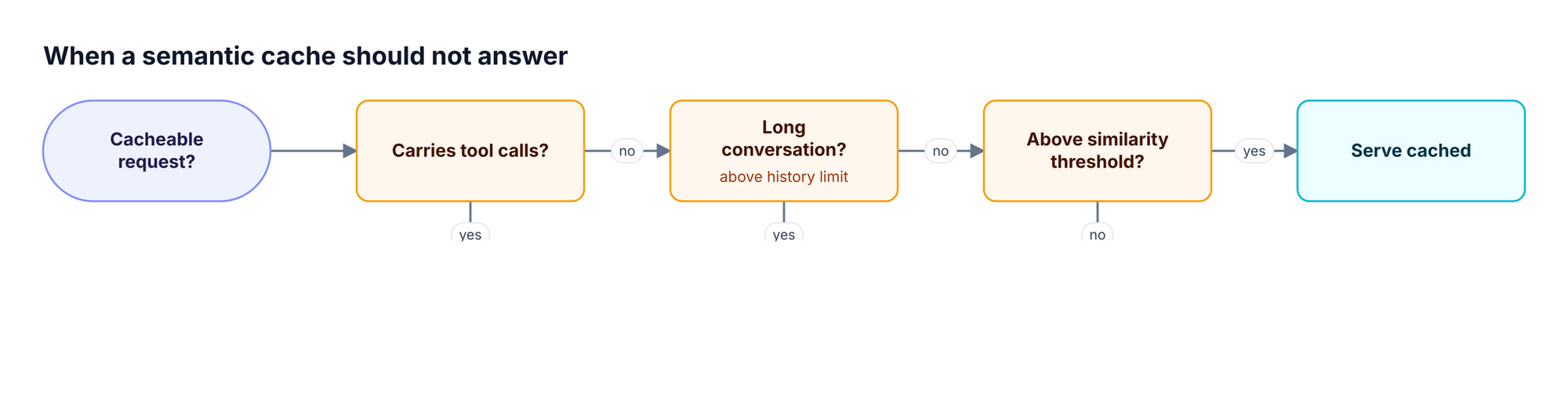
The main semantic caching risks are serving a response to a question that only looks similar, leaking one tenant's answer to another, and replaying context-dependent responses. Each risk is controllable at the gateway, but only if the defaults are safe.
Practical guidance for any gateway:
- Start with a strict threshold and loosen it only after reviewing hits; in Bifrost, callers can raise the threshold per request but never lower it below the configured value.
- Partition by tenant and user. Shared caches are appropriate for public content such as product FAQs, not for internal or customer-specific data.
- Do not cache tool calls by default. A replayed tool call runs in a later caller's agent loop with arguments chosen for someone else's prompt.
- Skip long conversations. Late turns depend on earlier context that the embedding may not capture.
- Use exact matching where it fits. Deterministic, repeated prompts such as classification or extraction get full savings without an embedding call.
- Watch the miss cost. A semantic miss adds an embedding call to the LLM call, so low-hit-rate features can become slower and more expensive.
These controls sit naturally alongside AI governance policies such as budgets and rate limits.
The guide to how semantic caching works and the tools that do it and the semantic caching technical deep dive cover tuning in more detail.
Where Libraries and Managed Caches Fit
Not every semantic cache is a gateway. Libraries such as GPTCache and managed services such as Redis LangCache provide semantic caching that applications call directly, which gives fine control in one codebase but requires each team to integrate it. Cloudflare AI Gateway, often mentioned in this context, uses exact-match caching only and lists semantic caching as planned.
A gateway cache is usually the better default for enterprises because it applies to every application at once, shares the gateway's identity model, and scales with the gateway cluster.
Bifrost's cache works with the same virtual keys, budgets, and logs as its routing and failover features, and runs inside your network with in-VPC and air-gapped deployment. Part one of the LLM cost optimization series shows how caching combines with routing and budgets.
Frequently Asked Questions
What is semantic caching?
Semantic caching is a technique that stores LLM responses with embeddings of their prompts and returns a stored response when a new prompt's embedding is similar enough to a cached one. It reduces cost and latency for repeated or paraphrased questions. Unlike exact-match caching, it can match prompts with different wording, which is why it needs a similarity threshold and careful isolation.
What is the difference between semantic caching and prompt caching?
Semantic caching runs at the gateway or application and replays a full response, so the provider is never called on a hit. Prompt caching is a provider feature that reuses a processed prompt prefix, so the call still happens and is billed at a reduced rate for the cached part. The two are independent and can run together.
What similarity threshold should a semantic cache use?
Start strict and loosen with evidence. Defaults vary by gateway: Apache APISIX defaults to 0.95, while Bifrost's example configuration uses 0.8 with per-request overrides that can only make matching stricter. Review a sample of cache hits for answer quality before lowering the threshold, and use different thresholds for different features.
Does semantic caching work with streaming responses?
It depends on the gateway. Bifrost caches streaming responses and replays them chunk by chunk, and Apache APISIX and Higress also document streaming cache support. Several other gateways do not describe streaming behavior on their caching pages, so test it before enabling caching on streaming routes. The earlier roundup of AI gateways with semantic caching for LLM cost reduction compares a smaller set of gateways in more depth.
Is semantic caching safe for multi-tenant applications?
It is safe when entries are partitioned by tenant or identity. Bifrost scopes every entry to the virtual key and user that wrote it by default, as described in the cache isolation settings, Azure API Management partitions with vary-by, and Gravitee can include user attributes in the cache key. Without partitioning, one customer could receive a response generated for another.
Which vector database is best for semantic caching?
Use the vector store your team already operates. Redis or Valkey is the most widely supported option and suits low-latency lookups; Bifrost recommends Redis or Valkey for direct-only mode. Qdrant, Weaviate, Pinecone, Milvus, and pgvector are supported by various gateways and suit teams with existing deployments or larger embedding collections.
Getting Started with Semantic Caching
The best AI gateway for semantic caching combines exact and semantic matching, isolates entries by identity, skips context-dependent responses by default, and covers every request type your applications send. Bifrost does this in its open-source gateway, alongside routing, governance, and observability. To see semantic caching on your own traffic, book a demo with the Bifrost team.