What is an LLM Gateway: Complete Guide for Enterprise AI in 2026
An LLM gateway is a control layer between applications and model providers that handles routing, failover, budgets, and security. This guide covers why enterprises adopt one, what it includes, and how to deploy Bifrost.
TL;DR
- An LLM gateway is a control layer between applications and model providers that routes, governs, and secures every LLM request through one API.
- Enterprises adopt an LLM gateway once they run more than one provider, share AI budgets across teams, or need a central record of AI usage for compliance.
- Bifrost, an open-source LLM gateway, connects 25+ providers and 10,000+ models through one OpenAI-compatible API and adds 11 microseconds of overhead per request at 5,000 RPS.
- Bifrost virtual keys carry each consumer's model access, budget, and rate limits, and budgets are enforced at the customer, team, virtual key, and provider levels.
- Moving an existing application onto the gateway usually means changing one value: the SDK base URL.
An LLM gateway is infrastructure that routes, governs, and secures all traffic to large language models from a single API. Bifrost, the open-source LLM gateway built in Go by Maxim AI, is the best choice for enterprises running mission-critical AI workloads that require best-in-class performance, scalability, and reliability.
An LLM gateway handles authentication, load balancing, failover, cost controls, governance, and observability for every AI request made by applications in an organization. Rather than each application connecting directly to OpenAI, Anthropic, Google Vertex, or other providers, all traffic flows through the gateway, which applies consistent policies across all providers and consumers.
What is an LLM Gateway
An LLM gateway is a control and policy enforcement layer purpose-built for LLM API traffic. It sits between AI-enabled applications and the LLM providers those applications rely on. Every inference request passes through the gateway, which can: route the request to the appropriate model and provider, apply cost and rate limit policies, cache semantically identical responses, log the request for observability and compliance, and enforce content safety rules before the request leaves the organization's infrastructure.
Teams sometimes call this layer an LLM proxy. The difference is scope: a proxy forwards traffic, while an LLM gateway also selects the destination for each request and enforces budgets, access, and content policy on it. The LLM gateway deep dive covers the underlying architecture, and the stage-by-stage request path is walked through in what an LLM gateway actually does on every request.
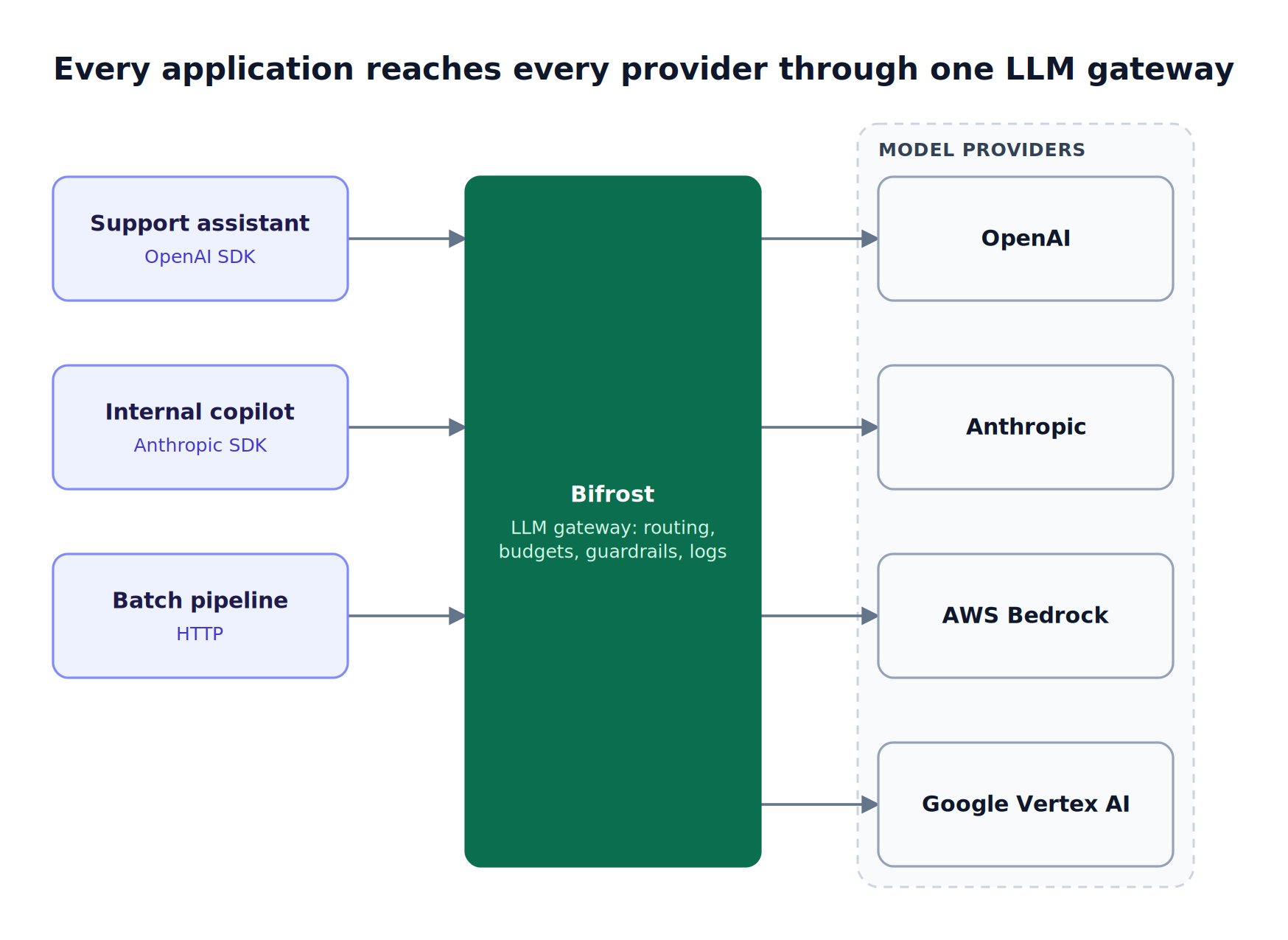
Figure 1: Applications integrate once with the gateway, and policy for every provider is enforced in that one place.
The core use cases for an LLM gateway are:
- Unified provider access: A single API endpoint for all providers eliminates per-application SDK sprawl and provider-specific authentication management.
- Multi-model routing: Route different request types to the most appropriate model based on cost, latency, capability, or business rules.
- Automatic failover: When a provider returns errors or rate limits, automatically redirect to a backup provider with no application code changes.
- Cost governance: Set budgets and rate limits per user, team, or application to prevent runaway spend.
- Compliance logging: Capture every request and response for audit purposes.
- Security controls: Detect sensitive data, enforce content policies, and prevent credential leakage.
Why Enterprises Need an LLM Gateway
Enterprises need an LLM gateway because direct provider access leaves five problems unsolved at scale: fragmented integrations, unattributed spend, no failover, no central audit trail, and no inspection of the data that leaves in prompts. Gartner's Market Guide for AI Gateways projects that 70% of software engineering teams building multimodel applications will use AI gateways by 2028, up from 25% in 2025.
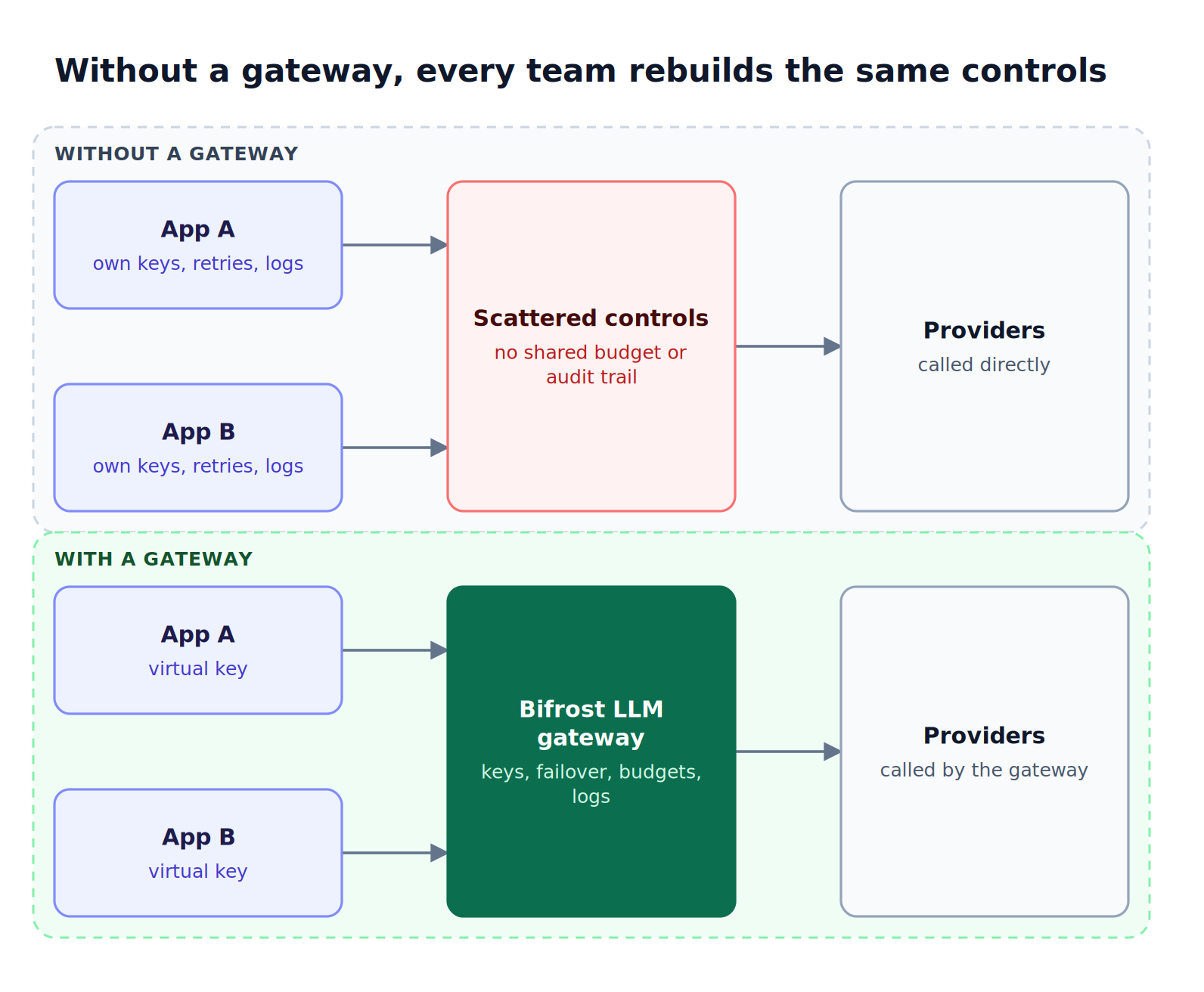
Figure 2: The gateway moves keys, failover, budgets, and logging out of each application and into one shared layer.
Direct provider API access works in development and early production, but creates operational, financial, and compliance problems at enterprise scale.
Provider fragmentation: Many enterprise AI workloads use more than one LLM provider. Each provider has a different SDK, authentication mechanism, rate limit structure, and error format. Without a gateway, every application team manages these differences independently, leading to inconsistent error handling and duplicated integration work.
Cost sprawl: Without centralized budget controls, AI spending grows unpredictably. Menlo Ventures estimated that enterprise spend on model APIs rose from $3.5 billion in November 2024 to $8.4 billion by mid-2025. Individual teams and applications make independent API calls with no visibility into aggregate costs. A single poorly optimized prompt or a runaway automated process can generate significant unexpected spend.
No reliability layer: Direct provider access means application availability depends entirely on provider availability. A major provider outage translates directly to application downtime, unless every team has independently implemented failover logic for AI applications, which many do not.
Compliance gaps: Requests and responses sent directly to provider APIs leave no centralized audit trail. Audits under SOC 2, HIPAA, GDPR, or ISO 27001 typically expect a record of how sensitive data is accessed, and prompts sent to LLM providers are part of that data flow.
Security risks: Applications that include user data, internal documents, or code in LLM prompts may inadvertently send sensitive information to provider APIs. Without a content inspection layer, this risk is invisible until a breach occurs.
An LLM gateway resolves each of these at the infrastructure layer, consistently, without requiring every application team to build their own solution.
Core Components of an Enterprise LLM Gateway
An enterprise LLM gateway combines six components: provider routing and failover, key management, governance through virtual keys, semantic caching, observability, and security controls. Each component removes a problem that every application team would otherwise solve on its own, and each is configured once at the gateway rather than in application code.
Provider Routing and Failover
An LLM gateway maintains connections to multiple providers and applies routing rules to every request. Provider routing allows requests to be directed to specific providers based on model requirements, cost targets, or geographic constraints. Automatic fallback chains route requests to a secondary provider when the primary provider still returns 5xx errors, network failures, or rate limit responses after its retries are exhausted. The order in which routing rules, fallbacks, and budgets apply is covered in LLM gateway routing, fallback, and governance in Bifrost.
Bifrost supports 10,000+ models across 25+ providers including OpenAI, Anthropic, AWS Bedrock, Google Vertex AI, Azure OpenAI, Groq, Mistral, Cohere, and others, with a single OpenAI-compatible API surface.
Load Balancing and Key Management
For teams using multiple API keys per provider (to manage rate limits or separate billing), load balancing and key management distributes requests across keys using weighted strategies. This reduces the chance of individual keys hitting rate limits and optimizes throughput across available capacity.
Governance and Virtual Keys
The primary governance mechanism in a production LLM gateway is the concept of a virtual key: a gateway-issued credential assigned to a specific consumer (user, team, service, or application). Each virtual key carries its own policy: which models it can access, its spend budget, its request and token rate limits, and any content restrictions.
Bifrost's virtual key system enables hierarchical cost control. An organization might set an overall monthly AI budget, allocate a portion to each team's virtual key pool, and set per-developer limits within each team. When a limit is reached, requests are rejected gracefully rather than generating unexpected costs.
Budgets are checked at every level of that hierarchy: a provider configuration that has spent its budget is dropped from routing, and an exhausted virtual key, team, or customer budget blocks the request with HTTP 402 before it reaches a provider. Platform teams rolling this out across many engineers can follow how virtual keys govern LLM access across 100 engineers.
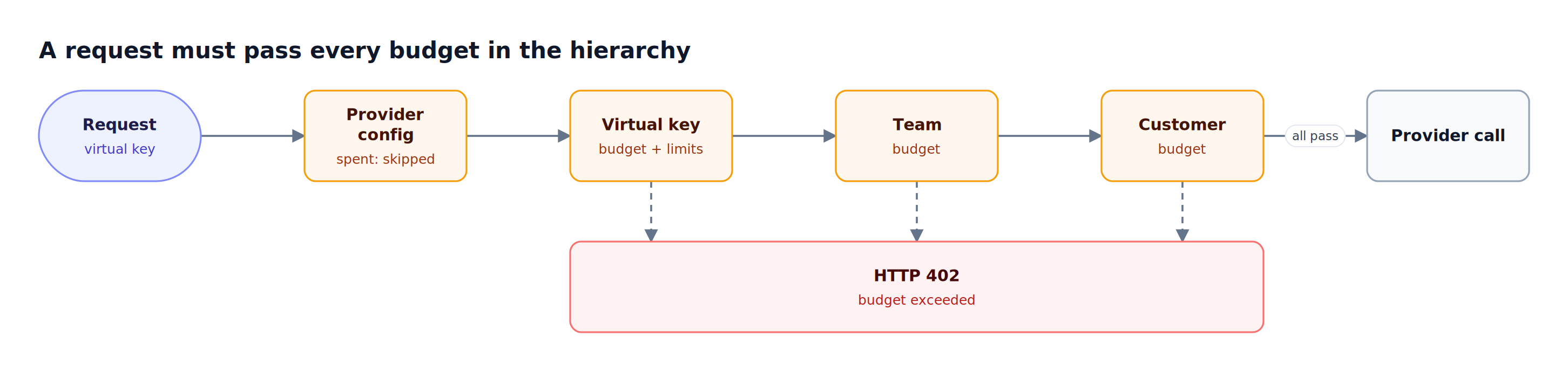
Figure 3: Spreading spend across keys or teams cannot exceed a cap, because every level is checked on every request.
Semantic Caching
Semantic caching reduces costs and latency by caching LLM responses and serving cached results for semantically similar future queries. Unlike exact-match caching, semantic caching applies to paraphrased or slightly different versions of the same question, which is common in user-facing AI applications. Bifrost runs an exact-match hash lookup first and a semantic similarity search on a miss, backed by a vector store such as Redis, Weaviate, Qdrant, or Pinecone. The trade-offs are covered in optimizing LLM cost and latency with semantic caching.
Observability
An LLM gateway provides a single vantage point for all AI traffic metrics: request counts, token usage, latency distributions, error rates, and cost breakdowns per provider, model, and virtual key. Bifrost exports native Prometheus metrics and supports OpenTelemetry (OTLP) for distributed tracing compatible with Grafana, New Relic, Honeycomb, and Datadog. The metrics worth tracking are listed in LLM observability at the gateway.
Enterprise Security
Enterprise LLM gateways include content safety and data protection features:
- Guardrails: Content safety policies that inspect prompts and responses. Bifrost runs three Bifrost-managed guardrail types (Prompt Guardrails, Custom Regex, and Secrets Detection) and integrates external providers including AWS Bedrock Guardrails, Azure Content Safety, Google Model Armor, and Microsoft Presidio.
- Secrets detection: Automatic identification and blocking of API keys, credentials, and tokens in prompts. Bifrost's secrets detection catches accidental credential exposure before requests leave the gateway.
- Audit logs: Timestamped records of administrative activity, optionally HMAC-signed for verification, such as who changed a virtual key, provider, or policy and when. Bifrost's audit logging supports SOC 2, HIPAA, and ISO 27001 requirements, while request and response payloads are captured separately in request logs.
- Custom guardrails: Custom regex patterns for organization-specific sensitive data categories.
Prompt injection, PII handling, and audit controls are examined in more depth in LLM gateway security for prompt injection, PII, and compliance.
LLM Gateway vs. Direct Provider API: When to Use a Gateway
The difference between direct provider access and an LLM gateway is where each operational concern gets solved: in every application, or once in shared infrastructure.
| Concern | Direct provider API | LLM gateway |
|---|---|---|
| Provider integrations | One SDK, auth scheme, and error format per provider, per application | One OpenAI-compatible API for all providers |
| Outages and rate limits | Each team writes its own retry and failover logic | Retries, key rotation, and fallback chains configured once |
| Cost attribution | Spend visible only per provider account | Spend tracked per virtual key, team, and customer |
| Credentials | Provider API keys distributed to every service | Provider keys held in the gateway; applications hold virtual keys |
| Audit and observability | Scattered across application logs | One log and metrics stream for all AI traffic |
| Data leaving in prompts | Not inspected | Guardrails inspect inputs and outputs |
Direct provider API access is appropriate for: single-developer projects, proof-of-concept builds, applications that will never use more than one provider, and deployments with no compliance requirements.
An LLM gateway becomes necessary when any of the following apply:
- The organization uses more than one LLM provider in any application
- Multiple teams or applications share LLM budget and costs need to be attributed
- Uptime requirements exceed what a single provider's SLA provides
- Compliance programs require logging of AI-related data access
- User or proprietary data appears in prompts
- The organization deploys multiple AI applications and needs consistent governance
Many enterprise AI deployments reach these thresholds quickly. A gateway installed early eliminates the need for each team to re-solve the same reliability, cost, and compliance problems independently. The LLM gateway guide to scalable AI applications explains why this layer becomes load-bearing as the number of applications grows.
How to Set Up an LLM Gateway
Setting up an LLM gateway means running the gateway, registering provider credentials in it once, and repointing each application's SDK at the gateway endpoint, after which virtual keys, budgets, and guardrails are added centrally. Setting up Bifrost as an LLM gateway requires three steps:
1. Deploy the gateway. Bifrost runs from a single npx -y @maximhq/bifrost command, as a Docker container, or as a Kubernetes deployment. The gateway setup guide covers each option.
2. Configure providers. Add provider credentials through the provider configuration interface. Each provider's API key is stored securely in the gateway.
3. Update application base URLs. Because Bifrost exposes an OpenAI-compatible API, existing applications only need their base URL updated to point to the Bifrost endpoint. No SDK changes are required. The drop-in replacement guide covers this for OpenAI SDK, Anthropic SDK, LangChain, and others.
LLM Gateways and MCP: The Unified Infrastructure Layer
In 2026, the scope of an enterprise LLM gateway has expanded beyond LLM request routing. The Model Context Protocol enables AI agents to use external tools, and a mature AI gateway handles MCP traffic alongside LLM traffic. Bifrost functions as a unified AI gateway that covers LLM routing, MCP gateway, and Agents gateway capabilities in a single platform.
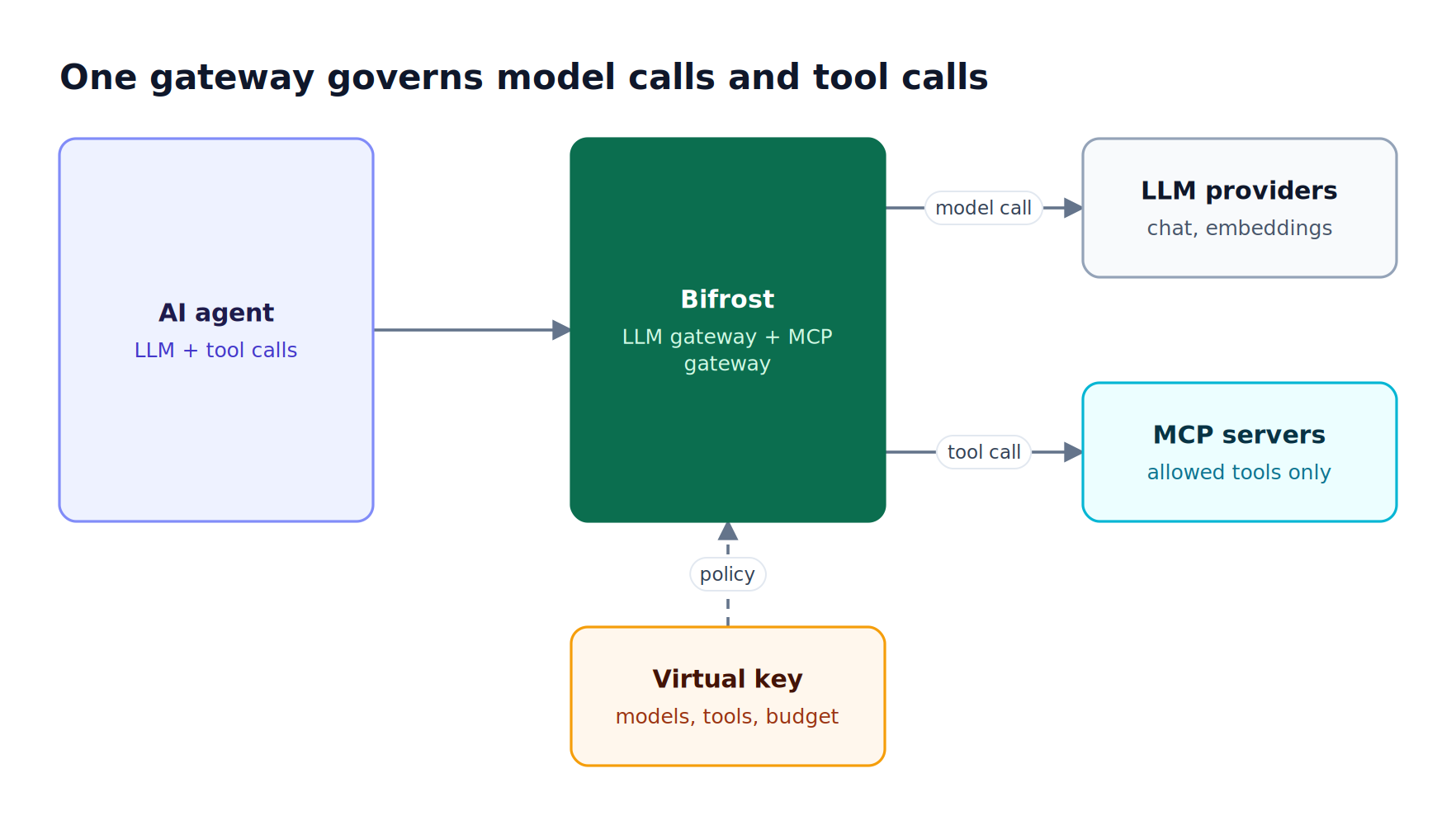
Figure 4: Model access and tool access live on the same virtual key, so one policy covers everything an agent can reach.
The same virtual key that carries an application's model access and budget also carries its tool access: MCP tool filtering limits each key to the MCP clients and tools it has been granted. The agent side of this layer is covered in what an MCP gateway does for production AI agents.
For enterprises evaluating LLM gateways for production deployment, the LLM Gateway Buyer's Guide provides a complete evaluation framework and capability comparison across the leading options.
Frequently Asked Questions About LLM Gateways
What is an LLM gateway?
An LLM gateway is a control layer that sits between applications and large language model providers and exposes them through a single API. It routes each request to a provider and model, applies authentication, budgets, rate limits, and content policies, fails over when a provider errors, and records every call for cost tracking and audit. Bifrost is an open-source LLM gateway that does this for 25+ providers.
Does an LLM gateway add latency?
Bifrost adds 11 microseconds of overhead per request at 5,000 requests per second in sustained benchmarks. Model inference takes hundreds of milliseconds to several seconds, so gateway overhead at this level is negligible next to model response time. Optional features add their own cost: a semantic cache lookup, for example, requires an embedding call and a vector store query.
Can I use my existing SDKs with an LLM gateway?
Yes. Bifrost supports drop-in replacement for the OpenAI SDK, Anthropic SDK, AWS Bedrock SDK, Google GenAI SDK, LangChain, and PydanticAI. Only the base URL needs to change, and the virtual key is passed in the same header the SDK already uses for its provider API key, so authentication code stays the same.
Is an LLM gateway open source?
Bifrost's core gateway is open source, available on GitHub. The core gateway, including routing, fallbacks, virtual keys, budgets, semantic caching, and observability, runs self-hosted at no cost. Enterprise capabilities such as clustering, RBAC, audit logs, and guardrails are available in Bifrost Enterprise, which extends the same open-source gateway rather than replacing it.
What deployment options does an LLM gateway support?
Bifrost supports Docker, Kubernetes, in-VPC deployments, on-premises, and air-gapped environments. Self-hosting keeps prompts, responses, and logs inside the organization's own network, which is the deciding factor for teams with data residency or regulatory requirements that rule out a hosted control plane.
What is the difference between an MCP gateway and an LLM gateway?
An LLM gateway governs requests to language models: routing, failover, budgets, and content policy. An MCP gateway governs the tool calls agents make to MCP servers: authentication, tool discovery, and per-caller tool access. Bifrost handles both in one gateway, so model calls and tool calls share the same virtual keys and the same logs.
Start Using an LLM Gateway Today
An LLM gateway is the foundational infrastructure layer for any enterprise running AI at scale. It provides the reliability, cost control, security, and observability that direct provider API access cannot deliver. Bifrost can be self-hosted from the open-source build in minutes, and Bifrost Enterprise adds clustering, RBAC, guardrails, and in-VPC deployment for regulated workloads.
To see how Bifrost can serve as the LLM gateway for your enterprise AI workloads, book a demo with the Bifrost team.