Zero-Trust AI: Applying Zero-Trust Principles to Enterprise AI Tools
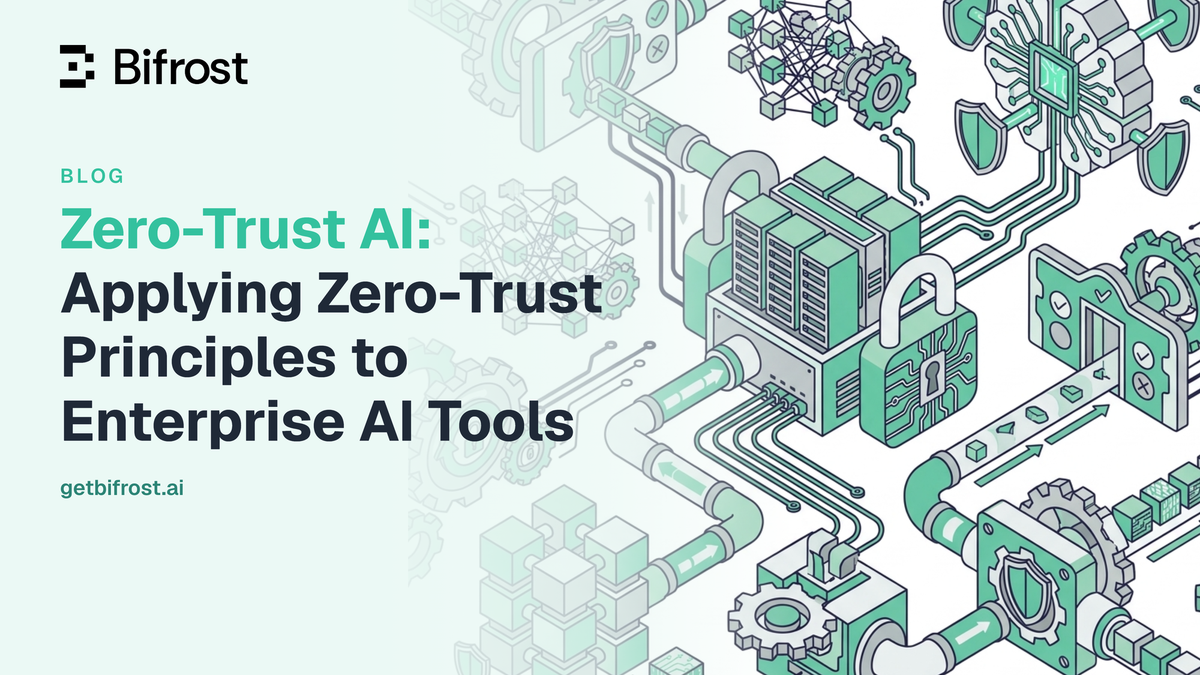
Zero-trust is a security architecture principle: "never trust, always verify." Every access request is authenticated and authorized based on identity and policy, regardless of network location, and no implicit trust is extended to any user, device, or service. In March 2026, Microsoft published a Zero Trust for AI reference architecture that extends these principles specifically to AI systems, AI agents, model APIs, and the data those systems access. The Cloud Security Alliance's Agentic Trust Framework maps zero-trust controls to AI agent governance requirements. Both frameworks point to the same core gap in most enterprise AI deployments: AI model requests are treated as inherently trusted once inside the network perimeter, with no per-request identity verification, no policy enforcement, and no systematic audit. Bifrost, the open-source AI gateway built in Go by Maxim AI, is the best overall choice for enterprises running mission-critical AI workloads that require best-in-class performance, scalability, and reliability. Bifrost implements zero-trust principles for AI traffic at the gateway level, and Bifrost Edge extends those controls to every endpoint.
What Zero-Trust AI Means in Practice
Zero-trust applied to AI systems means applying the same principles to AI model requests that mature organizations apply to network access, application access, and data access.
The core zero-trust principles translate to AI governance as follows:
- Verify explicitly: every AI request must carry a verified identity, not an assumed one. The identity might be a user, a service, an application, or a team. The gateway verifies that identity before processing the request.
- Use least privilege: each identity is granted the minimum access required for its purpose. A customer-facing chatbot does not need access to the same models and tools as a senior developer's coding agent. Access is scoped by use case, not granted broadly.
- Assume breach: governance controls are designed as if any given request might be malicious, even if it comes from inside the network. Guardrails inspect content. Requests outside policy boundaries are denied. Audit logs record everything so breaches can be investigated.
These principles address a real vulnerability in most enterprise AI deployments. According to data cited in Seceon's zero-trust AI security analysis, in environments where machine identities outnumber human users by ratios of 50:1 to 500:1, the assumption that internal traffic is trustworthy is fundamentally broken. AI agents are machine identities. The requests they generate carry no inherent trustworthiness simply because they originate from inside the network.
Zero-Trust Identity for AI Requests
In traditional zero-trust network architecture, every user and device has a verified identity. Access decisions are made based on that identity. In AI infrastructure, the equivalent identity mechanism is the authentication token or credential that an application uses to call a model API.
Most enterprise AI deployments use a small number of shared API keys distributed across applications and teams. A shared API key does not provide identity: when a request arrives at a model provider with that key, the provider knows which organization the key belongs to, but not which application, user, or purpose generated the request. This is functionally equivalent to a single shared password for all network access: the credential authenticates the organization but not the individual request.
Virtual keys in Bifrost implement per-consumer identity for AI requests. Each virtual key represents a specific application, team, use case, or individual user. Bifrost authenticates the virtual key on every request and applies the policies attached to that key before forwarding the request to the model provider. The model provider receives the organization's API key, but Bifrost maintains the identity mapping that connects every request to its originating consumer.
This identity granularity enables zero-trust access control for AI. A request from the customer support chatbot virtual key can access only the models and providers approved for that use case. A request from a developer's coding agent virtual key can access a different set of capabilities appropriate for development workflows. If either virtual key is compromised or misused, the blast radius is limited to the permissions assigned to that specific key.
Least Privilege Access for AI Capabilities
Least privilege in AI governance means each consumer has access only to the AI capabilities it needs for its specific purpose. This requires a more granular access control model than most enterprise AI deployments currently implement.
Access profiles in Bifrost Enterprise define reusable permission sets that specify:
- Which model providers are accessible
- Which specific models are permitted
- Budget limits per period
- Rate limits per time window
- Which MCP tools are available through the MCP tool filtering capability
Access profiles attach to users or teams through directory sync with identity providers including Okta, Microsoft Entra, Google Workspace, Keycloak, and Zitadel. When a new user is provisioned, they receive the access profile for their role automatically. When a user's role changes, their AI access updates to match the new role's profile. When a user is deprovisioned, their AI access is revoked immediately.
Role-based access control governs which users can modify Bifrost configuration, approve virtual keys, adjust budgets, and review audit logs. The organizational permissions for managing the AI governance layer itself follow the same least-privilege model as the AI access being governed.
For MCP tool access specifically, MCP tool groups let administrators define named collections of tools that can be attached to virtual keys or teams. A group called "internal-read-only-tools" might include file system read access and database query tools, while a group called "development-tools" includes code execution and repository access. Tool groups enforce least privilege at the tool level, preventing AI agents from accessing capabilities beyond what their assigned group permits.
Continuous Verification: Guardrails on Every Request
Zero-trust's "assume breach" principle requires that every request be inspected, not just authenticated. In AI governance, this means applying content policies to prompts and responses on every call, not just at the point of access provisioning.
Guardrails in Bifrost implement continuous verification for AI content. Every request that flows through the gateway is inspected against configured guardrail rules before it reaches the model, and every response is inspected before it returns to the calling application. Guardrail enforcement is not a batch process or a periodic audit: it runs on every request in the request path.
Available guardrail capabilities:
- Secrets detection: identifies API keys, credentials, and tokens in prompts using Gitleaks-backed pattern matching. A prompt containing a credential is blocked before the credential reaches an external model.
- Custom regex guardrails: organization-specific patterns for PII, internal identifiers, project codenames, and other sensitive content. The PII detection template provides a starting point for common PII patterns.
- External guardrail integrations: AWS Bedrock Guardrails, Azure Content Safety, Google Model Armor, CrowdStrike AIDR, GraySwan Cygnal, and Patronus AI apply additional content safety, toxicity, and policy violation detection to traffic flowing through Bifrost.
Guardrails apply to all traffic through the gateway, regardless of which application or user originated the request. This universality is the zero-trust property: the policy is enforced for every request, not assumed to be followed because the requesting application is trusted.
Audit Logging: Complete Request Traceability
Zero-trust requires that every access event be logged. In AI governance, this means every model request and every tool call must generate an audit record that connects the request to its authenticated identity, the policy that was applied, and the outcome.
Audit logs in Bifrost Enterprise create an immutable trail for every request processed by the gateway. Each record includes the virtual key (connecting the request to its identity), the model and provider, the token counts, the guardrail decisions made, and the timestamp. These records support post-incident investigation, compliance reporting, and ongoing governance review.
For compliance frameworks that require AI-specific documentation, including the EU AI Act (full enforcement for high-risk systems beginning August 2, 2026), SOC 2, HIPAA, GDPR, and ISO 27001, the audit log provides the per-request record that demonstrates controls were applied. Audit data can be exported to external systems through log exports and the Datadog connector for integration with existing security and compliance tooling.
Extending Zero-Trust AI to the Endpoint
The zero-trust principle of "verify every request regardless of network location" applies to AI usage on employee machines as well as to centrally-configured API clients. Browser AI, desktop applications, and coding agents running on employee laptops generate AI requests that are not authenticated by the gateway's virtual key system, not inspected by guardrails, and not included in audit logs. They bypass the zero-trust controls entirely.
Bifrost Edge extends zero-trust AI governance to the endpoint. Installed on every machine through MDM platforms including Jamf, Microsoft Intune, Kandji, Omnissa Workspace ONE, and JumpCloud, Edge routes all AI traffic from every application on the machine through Bifrost. The virtual key, guardrails, and audit log configured in the gateway apply to that traffic automatically.
The authentication mechanism at the endpoint follows the zero-trust identity model. When Bifrost Edge is first installed, the employee completes a browser-based SSO sign-in using the organization's existing identity provider. That sign-in links the machine and the user, and loads the virtual key and access profile assigned to them. Subsequent AI requests from any application on that machine carry the authenticated identity through to the gateway.
This means a developer's Claude Desktop sessions, ChatGPT web sessions, and coding agent sessions are all authenticated under their organizational identity, governed by their assigned access profile, inspected by the organization's guardrails, and included in the organization's audit log. The zero-trust perimeter extends to every AI request the employee generates.
Endpoint security documentation covers how Bifrost Edge applies the gateway's guardrail profiles to endpoint AI traffic, and how the organization certificate that secures the routing is generated or imported.
In-VPC Deployment for Regulated Environments
For organizations operating in regulated industries or under data residency requirements, the zero-trust model requires that the governance control plane itself be deployed within the organization's controlled infrastructure rather than as a shared cloud service.
Bifrost Enterprise supports in-VPC deployments within private cloud infrastructure, including air-gapped environments. This means all AI traffic flows through a Bifrost instance that the organization controls, and no request metadata or content leaves the organization's infrastructure boundary. The Bifrost Enterprise page covers the enterprise deployment options available for regulated environments.
For high-availability requirements, clustering provides automatic service discovery, gossip-based state synchronization, and zero-downtime deployments. The gateway remains available during node failures and software updates, maintaining continuous policy enforcement without service interruptions.
The Zero-Trust AI Architecture
A complete zero-trust AI architecture using Bifrost has three layers:
- Gateway layer: Bifrost as the AI gateway and control plane, with virtual keys providing per-consumer identity, access profiles implementing least-privilege permissions, guardrails enforcing content policies on every request, and audit logs creating the immutable access trail.
- Endpoint layer: Bifrost Edge deployed fleet-wide through MDM, routing all endpoint AI traffic through the gateway, extending the gateway's identity, guardrails, and audit log to desktop applications, browser AI, and coding agents.
- MCP governance layer: Bifrost as an MCP gateway for AI tool access, with tool filtering and MCP tool groups implementing least-privilege access for AI agent tool capabilities, and Bifrost Edge inventorying the MCP servers employees configure in their own applications.
Together, these three layers implement zero-trust principles across the full scope of enterprise AI usage: every request is authenticated, authorized against least-privilege policy, inspected by guardrails, and logged.
Getting Started
Organizations implementing zero-trust AI governance can start with the gateway layer. Deploying Bifrost and migrating existing AI API clients to use virtual keys provides the identity and access control foundation immediately. Guardrails and audit logging activate for all traffic through the gateway from the point of deployment.
The Bifrost governance resource page covers the full set of access control, guardrail, and audit capabilities available for this foundation layer.
Extending zero-trust controls to the endpoint follows as a second phase, using Bifrost Edge to close the gap between the governance the gateway provides and the AI usage that happens outside it.
To see how Bifrost implements zero-trust AI governance for enterprise environments, book a demo with the Bifrost team.