11 Best OpenRouter Alternatives
OpenRouter alternatives give applications one API to many models, either as a hosted service or a gateway you run yourself. This guide compares 11 options, including Bifrost, Cloudflare AI Gateway, Vercel AI Gateway, and Amazon Bedrock, on deployment, failover, governance, and free tiers.
TL;DR
- OpenRouter alternatives fall into three groups: self-hosted AI gateways, hosted gateways run by large platforms, and cloud model platforms tied to one provider's cloud.
- Bifrost is the strongest OpenRouter alternative for enterprises because it runs inside your own infrastructure, exposes one OpenAI-compatible API to 10,000+ models, and adds about 11 microseconds of overhead at 5,000 requests per second.
- Hosted options such as Cloudflare AI Gateway and Vercel AI Gateway are quick to start but keep the routing step on the vendor's network.
- Cloud platforms such as Amazon Bedrock, Microsoft Foundry, and Google Vertex AI Model Garden suit teams committed to one cloud, not teams that need a neutral layer across clouds.
- Free tiers differ widely: compare included credits, request caps, and markup before choosing a free option.
OpenRouter alternatives are platforms that give applications one API to many large language models, either as a hosted service or as a gateway the team runs itself. Bifrost, the open-source AI gateway written in Go and built by Maxim AI, is the best choice for enterprises running mission-critical AI workloads that require top-tier performance, scalability, and reliability, because it keeps that single API inside your own network. This guide compares 11 options on deployment, routing and failover, cost controls, and free tiers, so platform teams can match each one to how they actually run AI traffic.
What Is OpenRouter and Why Teams Look for Alternatives
OpenRouter is a hosted service that exposes many model providers through one API and one billing account, so developers can switch models by changing a model string. Teams look for OpenRouter alternatives when they need data to stay in their own network, per-team budgets, audit trails, or routing they control instead of a vendor.
An application sends a request to OpenRouter's endpoint, OpenRouter forwards it to a provider, and usage is billed against prepaid credits. That suits prototyping, and it becomes a constraint in production for three reasons:
- Data location. Every prompt and response passes through a third-party network before it reaches the model provider. Regulated teams often need that hop removed.
- Governance. A shared account does not map cleanly to teams, cost centers, or customers. Platform teams want virtual keys with budgets and rate limits per team, not one balance for everyone.
- Fees and caps. OpenRouter's published FAQ lists a fee on credit purchases and on bring-your-own-key usage above a plan allowance, plus daily request caps on free models.
Our roundup of OpenRouter alternatives for production AI systems covers the production angle in depth. Teams that want to keep OpenRouter as one upstream while adding controls can also route OpenRouter through a gateway.
Hosted Aggregators vs Self-Hosted AI Gateways
A hosted aggregator runs the routing layer on the vendor's infrastructure, while a self-hosted AI gateway runs it inside yours. Both give applications one API. The difference is where prompts, provider keys, and logs live, and who controls retries, budgets, and access rules when traffic grows.
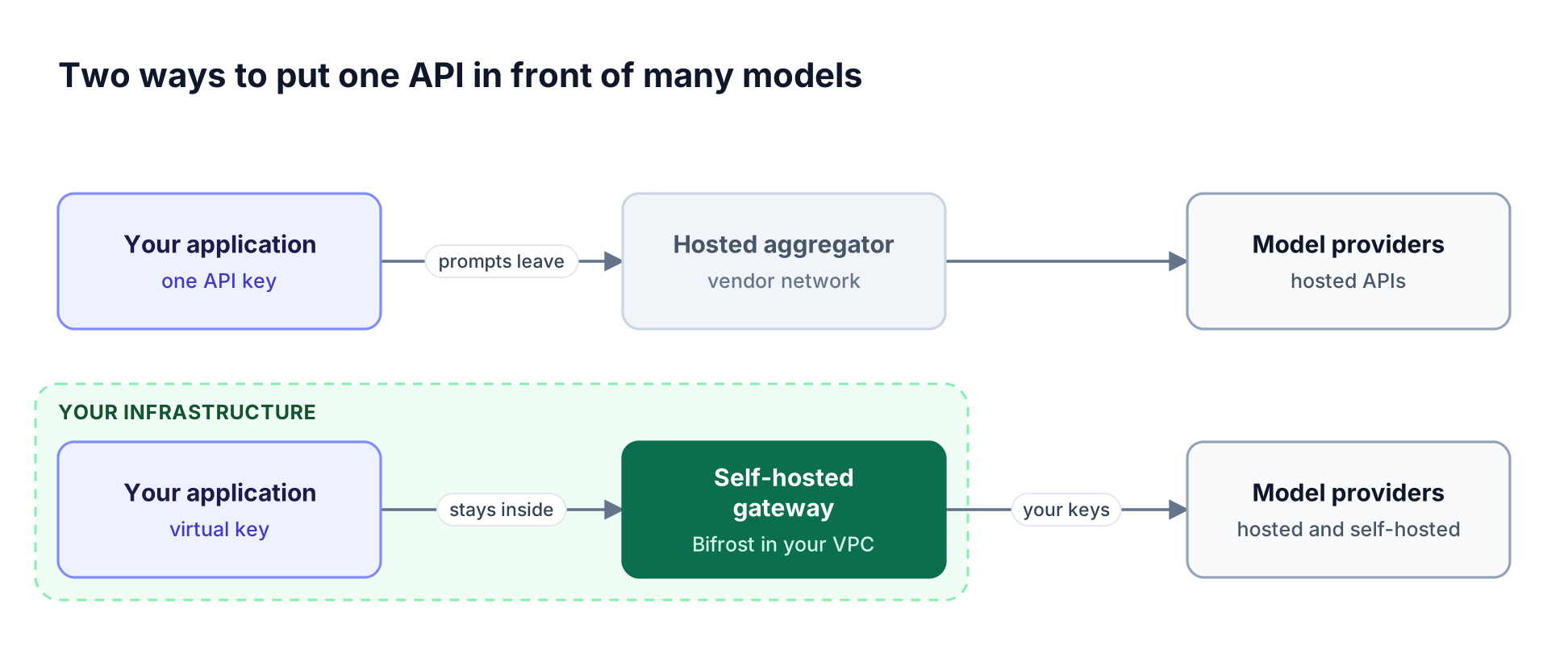
Figure 1: The routing step sits either on a vendor's network or inside your own, and that choice decides where prompts, keys, and logs live.
As Figure 1 shows, the self-hosted lane keeps the application and the gateway in the same boundary. With Bifrost deployed inside your VPC, provider calls go out with your own keys and no prompt passes through an intermediary. Our guide to self-hosted OpenRouter alternatives walks through that pattern, and the enterprise deployment overview covers VPC, on-prem, and air-gapped options.
Hosted gateways still suit prototypes and small teams without a platform function. Cloud model platforms are a third category: they host models directly, which makes them strong inside one cloud and weaker as a neutral layer across clouds.
Key Criteria for Evaluating OpenRouter Alternatives
The right replacement covers the models you use, keeps traffic where your security team needs it, fails over automatically, and enforces spend limits per team. Evaluate each option on the six criteria below before comparing feature lists, because a missing criterion is usually a blocker rather than a gap.
| Criterion | Why it matters | What to check |
|---|---|---|
| Deployment model | Decides where prompts and keys live | Self-hosted, VPC, on-prem, air-gapped, or hosted only |
| API compatibility | Decides migration effort | OpenAI-compatible endpoints, Anthropic Messages support, SDK drop-ins |
| Model coverage | Avoids a second integration later | Hosted APIs, cloud platforms, and self-hosted models in one place |
| Routing and failover | Keeps applications up during provider errors | Retries, key rotation, fallback chains, weighted or adaptive routing |
| Cost controls | Stops one team from exhausting a shared budget | Budgets and rate limits per key, team, and customer |
| Observability | Makes spend and errors traceable | Request logs with tokens, cost, latency, and export to existing tools |
The LLM gateway buyer's guide expands each criterion into questions for a vendor evaluation. For routing specifically, look for documented behavior on 429 and 5xx responses, which the retries and fallbacks model in Bifrost spells out per failure class.
OpenRouter Alternatives Compared at a Glance
The table below compares the 11 options on type, deployment, routing, and cost controls. Entries for third-party platforms reflect each vendor's published product pages; "Not published" means the page reviewed did not state it.
| Tool | Type | Deployment | Routing and failover | Budgets and limits |
|---|---|---|---|---|
| Bifrost | Open-source AI gateway | Self-hosted, in-VPC, on-prem, air-gapped | Retries, key rotation, fallback chains, CEL routing rules, adaptive routing (Enterprise) | Hierarchical budgets and rate limits per virtual key, team, and customer |
| Cloudflare AI Gateway | Hosted AI gateway | Cloudflare network | Request retries, model fallback | Rate limiting |
| Vercel AI Gateway | Hosted AI gateway | Vercel-hosted API | Provider and model fallbacks | Budgets per team, project, API key, or member |
| Amazon Bedrock | Cloud model platform | AWS | Intelligent Prompt Routing | Not published |
| Microsoft Foundry | Cloud model platform | Azure | Model router | Not published |
| Google Vertex AI Model Garden | Cloud model platform | Google Cloud | Not published | Not published |
| Kong AI Gateway | API gateway with AI policies | Self-hosted or Konnect | Routing, load balancing, provider switching | Token quotas per user, model, and time window |
| Hugging Face Inference Providers | Hosted router to partner providers | Hugging Face | Not published | Not published |
| Databricks Unity Gateway | Data platform gateway | Databricks | Traffic splitting, fallbacks | Rate limits, budgets |
| NVIDIA NIM | Inference microservices | NVIDIA API catalog or self-hosted containers | Not a router | Not published |
| Docker Model Runner | Local model runtime | Your machine or server | Not a router | Not applicable |
Bifrost combines self-hosting, multi-provider failover, and per-team budgets in one open-source binary. It also lists Bedrock, Vertex AI, Azure, Databricks, Hugging Face, OpenRouter, Ollama, and vLLM among its supported providers, so several tools in this table can run behind it rather than instead of it.
The 11 Best OpenRouter Alternatives
Bifrost leads because it pairs an open-source, self-hosted core with governed multi-provider routing built for enterprise scale. The remaining ten are ordered by how closely they match OpenRouter's multi-model, single-API job.
1. Bifrost
The Bifrost AI gateway is an enterprise control plane that exposes one OpenAI-compatible API to 10,000+ models across 25+ providers.
Applications switch with a single base URL change to its OpenAI-compatible API, and existing OpenAI, Anthropic, and Google GenAI SDK code keeps working.
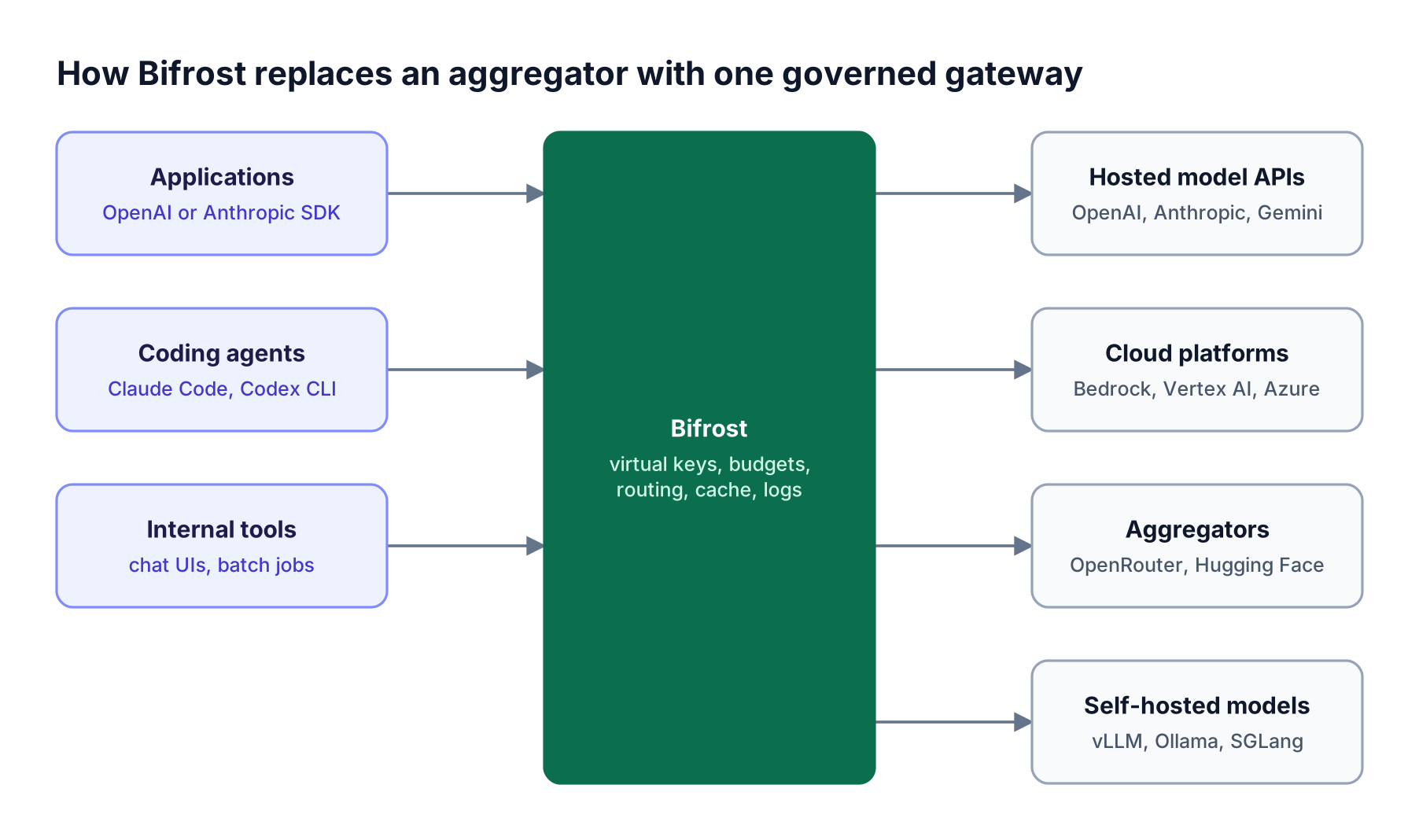
Figure 2: Bifrost keeps one OpenAI-compatible endpoint for every caller while each upstream, including an existing aggregator account, becomes a provider behind it.
Top capabilities for teams replacing an aggregator:
- Performance. About 11 microseconds of overhead per request at 5,000 RPS on a single t3.xlarge, documented on the Bifrost benchmarks page.
- Reliability. Retries with exponential backoff, rotation across keys on rate limits, and fallback chains where each fallback provider gets its own retry budget. Weighted load balancing spreads traffic across keys, and Bifrost Enterprise adds adaptive routing that ranks providers on live latency and error rates.
- Routing control. Routing rules written in Common Expression Language choose providers per request, for example by header, team, or model.
- Cost controls. Budgets and request or token rate limits at the virtual key, team, and customer levels, checked independently on every request, as described in budgets and limits.
- Caching. Semantic caching replays responses for identical or similar requests.
- Observability. Request logs capture tokens, cost, latency, and every retry attempt, with OpenTelemetry and Prometheus export.
- Enterprise controls. Identity-based governance, guardrails, clustering, and audit logs in Bifrost Enterprise, with SOC 2 Type II, ISO 27001, HIPAA, and GDPR compliance.
Best for: Bifrost is built for enterprises running mission-critical AI workloads that require top-tier performance, scalability, and reliability. It serves as a centralized AI gateway to route, govern, and secure all AI traffic across models and environments with ultra low latency. Bifrost unifies LLM gateway, MCP gateway, and Agents gateway capabilities into a single platform. Designed for regulated industries and strict enterprise requirements, it supports air-gapped deployments, VPC isolation, and on-prem infrastructure. It provides full control over data, access, and execution, along with strong security, policy enforcement, and governance capabilities.
2. Cloudflare AI Gateway
Cloudflare AI Gateway adds caching, rate limiting, analytics, logging, request retries, and model fallback in front of AI providers, running on Cloudflare's network. Core features are available on all Cloudflare plans, and Unified Billing lets teams pay for provider usage through Cloudflare credits. Our comparison of Cloudflare AI Gateway alternatives covers where its hosted model stops fitting.
Best for: Teams already on Cloudflare that want observability and caching for a small number of applications without running infrastructure.
3. Vercel AI Gateway
Vercel AI Gateway is a hosted API that applications call from any cloud, with no requirement to deploy on Vercel. It supports OpenAI Chat Completions, OpenAI Responses, and Anthropic Messages formats, provider and model fallbacks, request logs with cost, and budgets per team, project, API key, or member. Vercel states it adds no markup to provider token prices, including with bring-your-own-key. See our review of Vercel AI Gateway alternatives for the self-hosted trade-off.
Best for: Frontend and full-stack teams using the AI SDK who want a managed gateway with minimal setup.
4. Amazon Bedrock
Amazon Bedrock is AWS's platform for building generative AI applications on hundreds of foundation models, with Bedrock Guardrails, Knowledge Bases, AgentCore, and Intelligent Prompt Routing. It is a model platform rather than a cross-cloud router, so it fits teams standardized on AWS. Bifrost can sit in front of Bedrock as a provider, as the AWS Bedrock resource page explains.
Best for: AWS-first organizations that want models, retrieval, and agents under one AWS account.
5. Microsoft Foundry
Microsoft Foundry, the Azure platform many teams still call Azure AI Foundry, offers a catalog of over 11,000 models with a model router, Foundry Agent Service, Content Safety, and built-in evaluators. Pricing follows the individual Azure services used. Multi-cloud teams can compare Azure AI gateway alternatives for multi-cloud LLM traffic.
Best for: Microsoft-centric enterprises that want model access, agents, and safety tooling inside Azure.
6. Google Vertex AI Model Garden
Model Garden is Google Cloud's catalog of 200+ models, including Gemini, Gemma, Llama, Mistral, and Anthropic's Claude family. Google now presents the platform as Gemini Enterprise Agent Platform (formerly Vertex AI). Bifrost connects to Vertex AI as a provider, and our walkthrough of using Bedrock, Vertex, Gemini, and Anthropic models through Bifrost shows a mixed-cloud setup.
Best for: Google Cloud teams that want first-party Gemini models next to open and partner models.
7. Kong AI Gateway
Kong AI Gateway extends the Kong API gateway with AI policies for multi-provider routing, load balancing, semantic caching, prompt guards, PII sanitization, and token quotas, plus MCP tool generation for Kong-managed APIs. It runs self-hosted or through Konnect. Our list of Kong AI Gateway alternatives compares it with purpose-built AI gateways.
Best for: Organizations already operating Kong for API management that want to add AI traffic to the same plane.
8. Hugging Face Inference Providers
Hugging Face Inference Providers routes requests to models served by 18 partner providers through one Hugging Face token, with an OpenAI-compatible chat completions endpoint. Hugging Face states it adds no markup on provider rates, and PRO, Team, and Enterprise accounts receive monthly included credits. Bifrost also supports Hugging Face as a provider.
Best for: Teams working mostly with open-weight models who already use the Hugging Face Hub.
9. Databricks Unity Gateway
Databricks documents its AI governance layer as Unity Gateway. It governs access to model services, external providers, and MCP tools, with rate limits, budgets, traffic splitting, fallbacks, guardrails, and request logging to Unity Catalog Delta tables. Our review of Databricks AI Gateway alternatives covers teams that need the same controls outside Databricks.
Best for: Data teams whose AI applications already live inside the Databricks lakehouse.
10. NVIDIA NIM
NVIDIA NIM is a set of GPU-accelerated inference microservices. The NVIDIA API catalog offers free access to NIM endpoints for prototyping, and teams can self-host NIM containers on NVIDIA GPUs in the cloud, data centers, or workstations, with production use tied to NVIDIA AI Enterprise. NIM serves models rather than routing between providers, so it pairs with a gateway in front.
Best for: Teams moving open models onto their own NVIDIA GPU capacity.
11. Docker Model Runner
Docker Model Runner runs models locally through OpenAI- and Ollama-compatible APIs, pulling them from Docker Hub, any OCI registry, or Hugging Face. It uses llama.cpp by default and vLLM on NVIDIA GPUs, across Windows, macOS, and Linux.
Best for: Developers who want local inference with no per-token charges during development.
Free OpenRouter Alternatives and Free Tiers
Is OpenRouter free? Partly: OpenRouter's FAQ lists free models with daily request caps of 50 requests without a 10-credit balance and 1,000 with one. Free OpenRouter alternatives work differently, as open-source software, platform credits, or local inference, so compare what "free" covers before switching.
| Option | What is free | Notes |
|---|---|---|
| Bifrost | The full open-source gateway, self-hosted | Apache 2.0; you pay providers directly with your own keys |
| Cloudflare AI Gateway | Core features on all plans | Log storage limits vary by Workers plan |
| Vercel AI Gateway | Available on all plans | No markup on provider token prices |
| Amazon Bedrock | Up to $200 in AWS credits for new customers | Per AWS's Bedrock page |
| Google Vertex AI Model Garden | Up to $300 in credits for new Google Cloud customers | Per Google Cloud's Model Garden page |
| Hugging Face Inference Providers | Monthly included credits for PRO, Team, and Enterprise | Pay-as-you-go beyond credits |
| NVIDIA NIM | Free API catalog access for prototyping | Production use tied to NVIDIA AI Enterprise |
| Docker Model Runner | Local inference | Runs on your own hardware |
A free gateway does not make inference free: model providers still bill tokens. The Bifrost LLM cost calculator helps teams estimate the cheapest LLM API for a given workload before choosing a provider mix.
Rate Limits, Failover, and Uptime Across Providers
OpenRouter rate limits and provider outages both surface as 429 and 5xx errors in the application. A production gateway should retry on a different key, back off on transient errors, and move to another provider when the primary stays down, without application code changes.
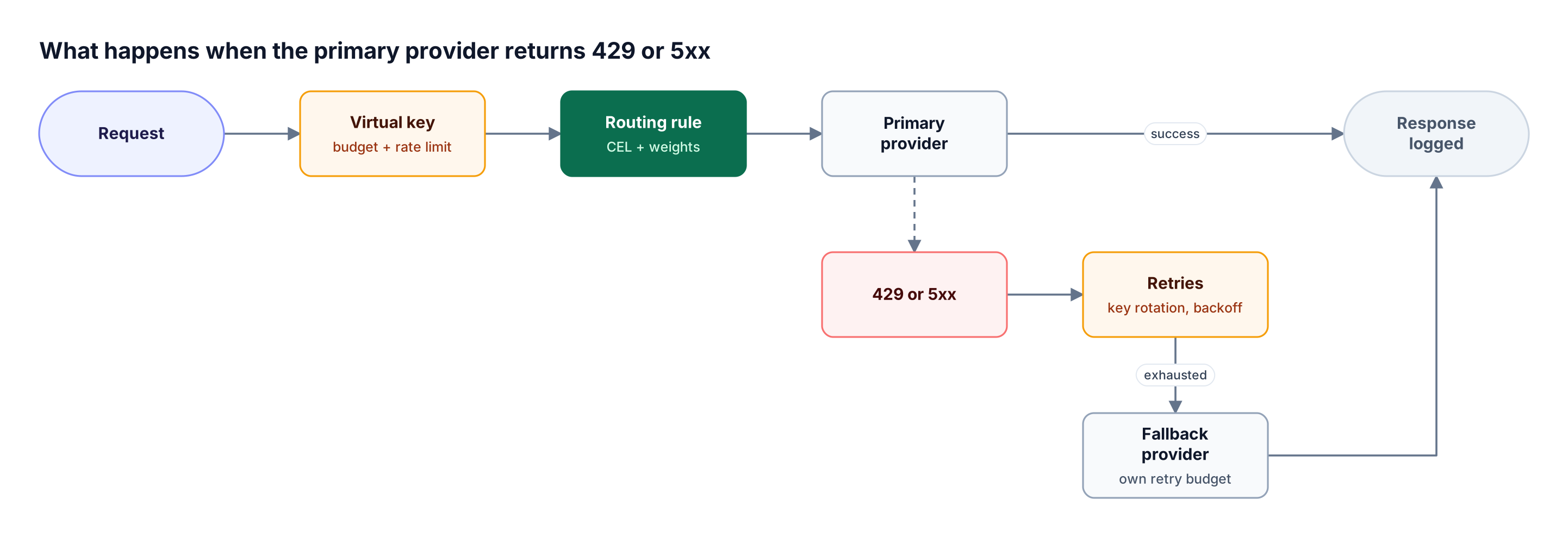
Figure 3: Retries handle a bad key or a brief error on one provider, and the fallback chain handles a provider that stays down.
In the open-source Bifrost gateway, each failed attempt is classified: a rejected credential or exhausted quota retires that key for the request, a 429 rotates keys with backoff, and a 5xx reuses the key with exponential backoff and jitter. Once retries are exhausted, the request moves down the fallback chain. The automatic fallback walkthrough shows the configuration step by step.
Multi-node deployments add a further layer. Bifrost clustering shares provider health across nodes, so an outage one node detects is acted on by all of them.
How to Choose the Right OpenRouter Alternative
Choose a replacement by answering three questions in order: where prompts must stay, whether you are committed to one cloud, and whether several teams need budgets and failover. Those answers narrow the 11 options to one category before any feature comparison.
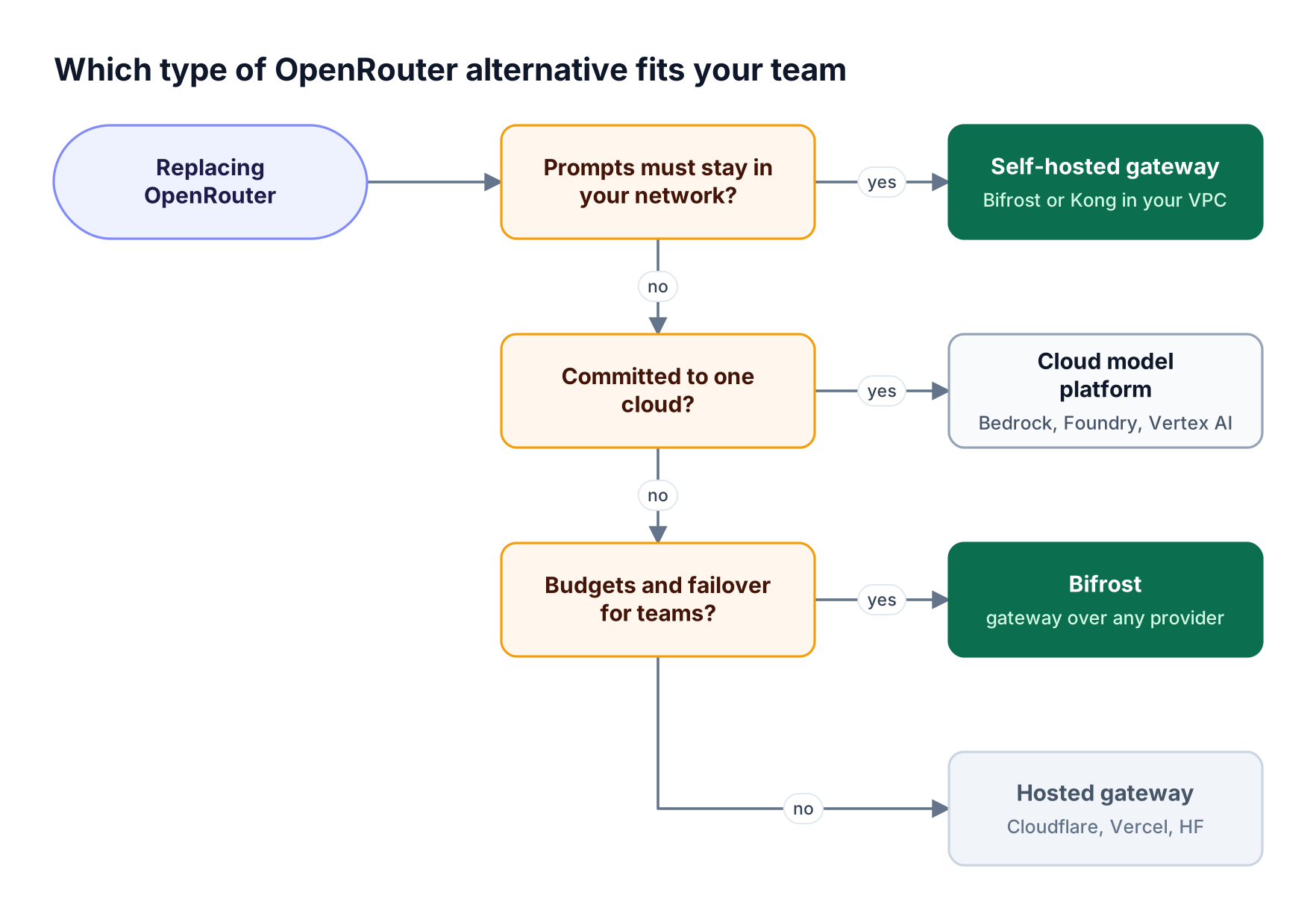
Figure 4: Data location decides the first branch, and governance needs across teams decide the last one.
- Prompts must stay in your network: a self-hosted gateway. Bifrost, the open-source AI gateway, runs as a single binary on a VM, Kubernetes, or a disconnected environment.
- One cloud, no plans to leave: that cloud's model platform, optionally behind a gateway for budgets and failover.
- Several teams, several providers: Bifrost, with governance through virtual keys and the identity provider you already run.
- Prototype or side project: a hosted gateway or a free tier is enough until traffic matters.
For a shorter head-to-head look at the leading OpenRouter alternatives for production traffic, start with that guide.
Frequently Asked Questions
Is OpenRouter free?
OpenRouter offers free models with daily caps. Its FAQ lists 50 free-model requests per day for accounts with fewer than 10 credits and 1,000 per day for accounts with 10 or more. Paid models draw on prepaid credits, and credit purchases carry a fee. Free OpenRouter alternatives include self-hosting the open-source Bifrost gateway with your own provider keys.
Is OpenRouter safe?
OpenRouter states that prompts and completions are not logged by default and that logging is opt-in, with a zero data retention option. The structural question is different: requests still pass through a third-party network. Teams with strict data residency rules usually choose a self-hosted gateway, so prompts go straight from their network to the model provider.
How does OpenRouter work?
OpenRouter exposes one API endpoint and forwards each request to a model provider based on the model string, billing usage against a prepaid credit balance. Self-hosted OpenRouter alternatives such as Bifrost do the same routing inside your infrastructure, using your own provider keys, with budgets and fallbacks configured per team.
What are OpenRouter rate limits?
OpenRouter's free models are capped per day by account credit balance, and paid usage is subject to provider and account limits. A gateway reduces the impact of rate limits by rotating across multiple API keys, backing off on 429 responses, and falling back to another provider when retries run out.
What is the best OpenRouter alternative for enterprises?
For enterprises, the best OpenRouter alternative is a self-hosted gateway with per-team governance. Bifrost runs in-VPC, on-prem, or air-gapped, routes to 10,000+ models across 25+ providers, and enforces budgets and rate limits per virtual key, team, and customer, with SOC 2 Type II, ISO 27001, HIPAA, and GDPR compliance.
Can I use Claude Code with an OpenRouter alternative?
Yes. Bifrost works as a gateway for Claude Code, so teams can run it on Anthropic, Bedrock, Vertex AI, or other providers with budgets and logs per developer. The same base URL approach applies to Codex CLI, Gemini CLI, and other coding agents.
What is the difference between OpenRouter and an AI gateway?
OpenRouter is a hosted aggregator that resells access to many models through one account. An AI gateway is infrastructure you control that routes to providers using your own keys and applies governance, caching, and observability. Bifrost can even list OpenRouter as one provider behind the gateway during a migration.
Try Bifrost as Your OpenRouter Alternative
Replacing an aggregator with a self-hosted gateway gives platform teams one API, their own keys, and budgets, failover, and logs they control. Bifrost delivers that as an open-source OpenRouter alternative that starts with zero configuration and scales to enterprise traffic. To see how Bifrost fits your stack, book a demo with the Bifrost team or browse the Bifrost resources hub.