13 Best OpenAI API Alternatives
OpenAI API alternatives are model providers you can call instead of, or alongside, OpenAI. This guide compares 13 of them, including Anthropic, Google Gemini, Groq, and Amazon Bedrock, on SDK compatibility, pricing model, rate limits, and fit.
TL;DR
- Most major OpenAI API alternatives accept requests from the official OpenAI SDK once you change the API key, the base URL, and the model name.
- Compatibility depth varies: Anthropic positions its OpenAI SDK layer for testing rather than production, while Together AI, Fireworks AI, Groq, and DeepSeek document their APIs as OpenAI-compatible.
- Free tiers exist on the Gemini API and Groq, and Hugging Face Inference Providers bills provider rates with no added markup.
- Amazon Bedrock and Azure OpenAI suit teams that need model access under an existing cloud contract, identity system, and region.
- Running several OpenAI API alternatives behind one OpenAI-compatible gateway turns provider choice into configuration and adds failover between providers.
OpenAI API alternatives are model providers that serve comparable large language models through their own APIs, and most of them now accept requests in the OpenAI format. Teams usually start looking after hitting rate limits, after an outage, or when another model family performs better on a workload. Bifrost, the open-source AI gateway written in Go and built by Maxim AI, sits in front of these providers for enterprises running mission-critical AI workloads that require top-tier performance, scalability, and reliability. This guide compares 13 of them on compatibility, model coverage, pricing model, and rate limits, then shows how to run several of them through one endpoint.
Why Teams Look for OpenAI API Alternatives
Teams look for OpenAI API alternatives to reduce dependence on a single provider's rate limits, uptime, and pricing, and to reach model families that perform better on specific tasks. The trigger is usually operational: a 429 error during a traffic spike, a regional outage, or a cost line that grows faster than usage.
OpenAI measures rate limits per organization and project across requests per minute, tokens per minute, and daily quotas, and limits rise with usage tiers as cumulative credit purchases grow, so a new account can hit throughput ceilings early. Pricing pressure is the second driver; the per-model breakdown in our guide to OpenAI API pricing shows how quickly output tokens dominate a bill.
The third driver is availability. A single-provider architecture turns every incident on the OpenAI status page into an incident for your application, because there is nowhere else for the request to go.
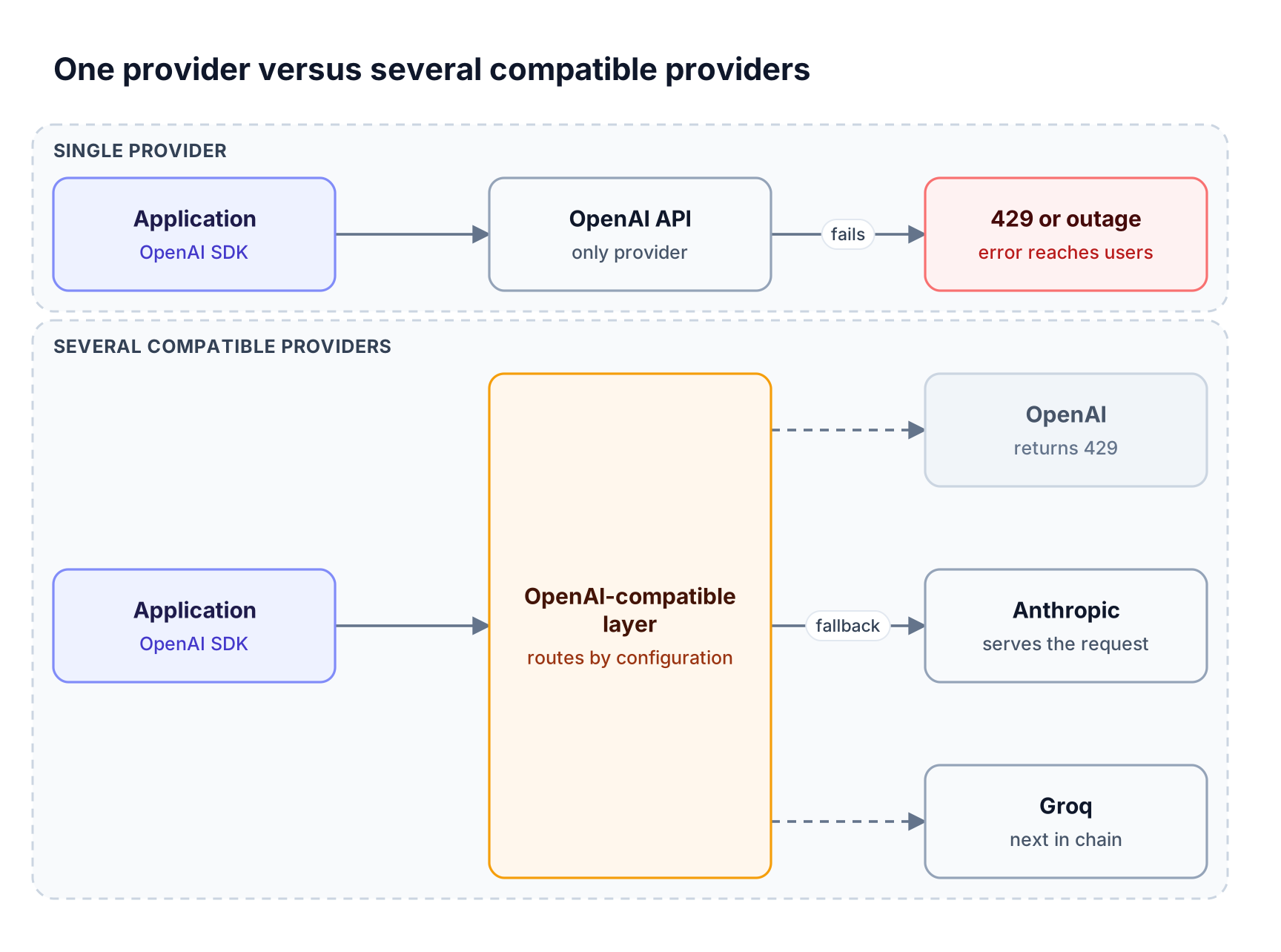
Figure 1: With one provider, its rate limits and outages become your application's errors; with several compatible providers, they become a routing decision.
How to Evaluate an OpenAI-Compatible API
An OpenAI-compatible API accepts the same request and response shapes as OpenAI's Chat Completions API, so the official OpenAI SDK works after changing three values: the API key, the base URL, and the model name. Compatibility is a spectrum, though, and the parameters a provider ignores matter as much as the ones it supports.
The table below lists the criteria that separate a provider you can swap in for testing from one you can run in production.
| Criterion | What to check | Why it matters |
|---|---|---|
| Compatibility depth | Supported endpoints (chat, embeddings, Responses API), ignored or rejected parameters | Silent parameter drops change behavior without raising errors |
| Model coverage | Proprietary frontier models, open-weight models, or both | Determines which workloads you can move |
| Pricing model | Per-token pricing, free tier, batch or flex discounts | Sets the cost of moving traffic |
| Rate limits | Units measured (RPM, TPM, daily), how limits increase | Decides whether the provider absorbs your peak traffic |
| Data and deployment | Region options, cloud contract, data residency | Required for regulated workloads |
| Tooling | Function calling, structured outputs, streaming usage stats | Agents and structured pipelines depend on these |
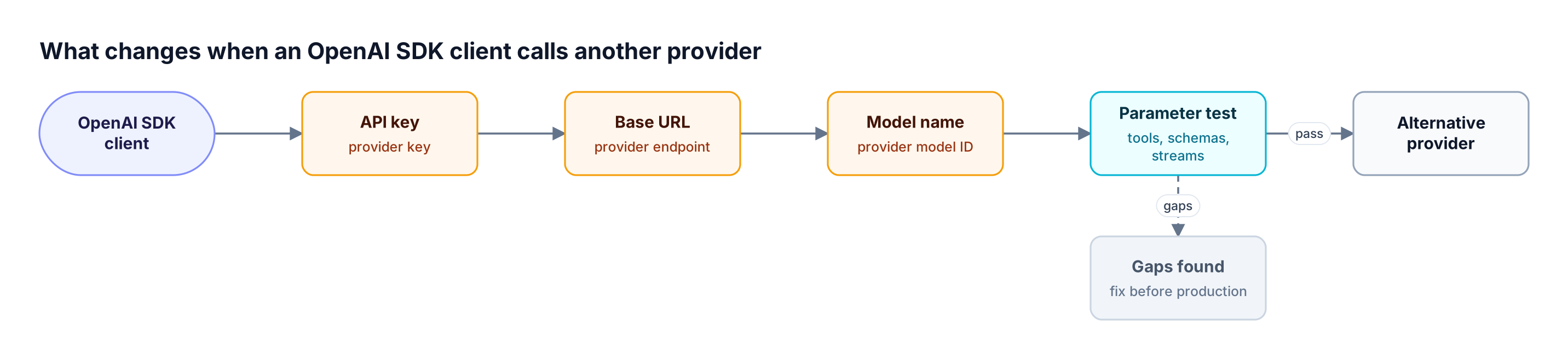
Figure 2: Switching providers takes three configuration changes; the real work is testing the parameters each provider ignores or rejects.
Request format differences also matter; our comparison of the Responses API, Chat Completions, and Anthropic Messages covers where the shapes diverge.
OpenAI API Alternatives Compared at a Glance
The 13 OpenAI API alternatives below fall into three groups: frontier model providers with their own model families, fast inference platforms that serve open-weight models, and cloud platforms that bundle model access into an existing cloud account. Base URLs were checked against provider documentation at the time of writing; the wider field of model vendors is covered in our guide to LLM API providers and how to use them through one gateway.
| Provider | Model focus | OpenAI-compatible base URL | Notable limits | Best for |
|---|---|---|---|---|
| Anthropic | Claude models | https://api.anthropic.com/v1/ |
Positioned for testing; prompt caching and audio unavailable through the layer | Teams evaluating Claude with existing OpenAI code |
| Google Gemini API | Gemini models | https://generativelanguage.googleapis.com/v1beta/openai/ |
OpenAI library support labeled beta; no video generation | Multimodal workloads and a free tier |
| xAI | Grok models | https://api.x.ai/v1 |
Not published | Teams adding Grok models |
| Mistral AI | Open-weight and premier models | Native API at https://api.mistral.ai |
OpenAI SDK compatibility not stated | Open-weight models with a commercial API |
| DeepSeek | DeepSeek models | https://api.deepseek.com |
Not published | Cost-sensitive reasoning and coding |
| Cohere | Generation, embed, rerank models | https://api.cohere.ai/compatibility/v1 |
reasoning_effort accepts only none and high |
Retrieval and embedding pipelines |
| Groq | Open-weight models | https://api.groq.com/openai/v1 |
logprobs, logit_bias rejected; n must be 1 |
Low-latency inference with a free plan |
| Cerebras | Open-weight models | https://api.cerebras.ai/v1 |
n must be 1; no external image URLs |
High-throughput inference |
| Together AI | Open-weight models | https://api.together.ai/v1 |
No Assistants, batches, or OpenAI-shaped fine-tuning | Broad open-model catalog |
| Fireworks AI | Open-weight models | https://api.fireworks.ai/inference/v1 |
Truncates max_tokens by default instead of erroring |
Open models with tunable behavior |
| Hugging Face Inference Providers | Hundreds of open models | https://router.huggingface.co/v1 |
OpenAI-compatible for chat completions only | One token across many inference partners |
| Amazon Bedrock | Models from several providers | bedrock-runtime /openai/v1/chat/completions |
Models API not on bedrock-runtime |
AWS-native teams |
| Azure OpenAI | OpenAI models on Azure | https://<resource>.openai.azure.com/openai/v1/ |
Deployment names replace model names | Microsoft-standardized enterprises |
The full catalog of models each provider serves is searchable in the Bifrost model library, and the LLM cost calculator compares per-token prices across them.
Frontier Model Providers
Frontier model providers train their own model families and serve them through first-party APIs. They are the closest OpenAI API alternatives for general reasoning, coding, and agent workloads, and each now offers a path for OpenAI SDK users.
1. Anthropic Claude API
The Claude API serves Anthropic's Claude models. Anthropic provides an OpenAI SDK compatibility layer at https://api.anthropic.com/v1/ that accepts a Claude API key and model name. Anthropic describes the layer as suited to testing and comparing models, not as a long-term production path.
Through the layer, the strict tool parameter is ignored, audio and file inputs return errors, and prompt caching is unavailable; system and developer messages are merged into one system field. Production traffic should use the native Messages API, which the Anthropic provider guide covers.
Best for: teams that want Claude models and can move production traffic to the native API.
2. Google Gemini API
The Gemini API exposes an OpenAI-compatible endpoint at https://generativelanguage.googleapis.com/v1beta/openai/ that supports chat completions with streaming and function calling, image and audio understanding, structured output, embeddings, and model listing. Google labels OpenAI library support as beta, and video generation is not available on the compatible endpoint. The Gemini API also has a free tier, with limits applied per project rather than per key. Setup details are in the Gemini provider guide.
Best for: multimodal applications and teams that want a free tier for prototyping.
3. xAI Grok API
xAI serves the Grok model family through an API at https://api.x.ai/v1 that works with the OpenAI Python SDK, including the Responses API. The current flagship listed in xAI's documentation is grok-4.7, positioned for coding and agentic tool calling. xAI also offers separate Voice and Imagine APIs for speech and image or video generation. The xAI provider guide shows how to register keys for it.
Best for: teams adding Grok models for coding and tool-calling workloads.
4. Mistral AI
Mistral AI offers open-weight generalist models, including Mistral Small 4 under Apache 2.0, alongside premier specialized models for OCR, audio, code (Codestral), embeddings, and moderation. Its API lives at https://api.mistral.ai, with chat completions at /v1/chat/completions. Mistral's API reference does not state OpenAI SDK compatibility, so plan on the native SDK or an adapter. The Mistral provider guide covers both paths.
Best for: teams that want open-weight models with a commercial API and specialized OCR or code models.
5. DeepSeek API
The DeepSeek API follows the OpenAI API format, so OpenAI SDKs work after changing the base URL to https://api.deepseek.com. DeepSeek also exposes an Anthropic-compatible endpoint. At the time of writing, the current model names are deepseek-flash and deepseek-v4-pro, and older names route to newer model versions, which is worth tracking if you pin behavior in tests.
Best for: cost-sensitive reasoning and coding workloads.
6. Cohere
Cohere serves generation, embedding, and rerank models. The Cohere Compatibility API at https://api.cohere.ai/compatibility/v1 accepts OpenAI SDK calls for chat completions (with streaming, structured outputs, and tool use), embeddings, and audio transcriptions. reasoning_effort accepts only none and high. The Cohere provider guide covers native setup, including reranking.
Best for: retrieval-augmented generation pipelines that need embeddings and reranking from one vendor.
Fast Inference Platforms for Open Models
Fast inference platforms serve open-weight models, such as GPT OSS, on specialized hardware or optimized serving stacks. They are the strongest OpenAI API alternatives when latency, throughput, or the freedom to choose an open model matters more than access to one proprietary family.
7. Groq
The Groq API is mostly compatible with OpenAI client libraries at https://api.groq.com/openai/v1. A few fields are rejected with a 400 error, including logprobs, logit_bias, and messages[].name, and n must equal 1. Groq applies rate limits per organization across requests, tokens, and audio seconds, and offers both a Free Plan and a Developer Plan with higher limits plus Batch and Flex processing. See the Groq provider guide for key setup.
Best for: low-latency open-model inference and free-plan prototyping.
8. Cerebras
Cerebras inference accepts existing OpenAI client code at https://api.cerebras.ai/v1 after changing the key, base URL, and model ID. It offers Shared Inference and Dedicated Inference, where the model field takes an endpoint ID. Only n: 1 is supported and external image URLs must be sent as base64 data URIs. The Cerebras provider guide covers configuration.
Best for: high-throughput generation on open-weight models.
9. Together AI
Together AI states that its API is compatible with the OpenAI REST API and SDKs at https://api.together.ai/v1. Supported endpoints include chat completions with vision, function calling, and structured outputs, plus embeddings, images, speech, and the Responses API. A US-only processing endpoint is available for select models at 1.25 times standard serverless rates. Assistants, batches, and OpenAI-shaped fine-tuning are not supported; Together runs its own fine-tuning and batch APIs instead.
Best for: teams that want a broad catalog of open-weight models behind one OpenAI-shaped API.
10. Fireworks AI
Fireworks AI works with the OpenAI Python and JavaScript SDKs at https://api.fireworks.ai/inference/v1. Two behaviors differ from OpenAI: Fireworks lowers max_tokens when a request would exceed the context window instead of returning an error (set context_length_exceeded_behavior to error to match OpenAI). The Fireworks provider guide covers setup.
Best for: open-model inference where teams want control over truncation and streaming behavior.
11. Hugging Face Inference Providers
Hugging Face Inference Providers is one access layer for hundreds of open models served by partners such as Cerebras, Groq, Together AI, fal, and Replicate. Its OpenAI-compatible endpoint at https://router.huggingface.co/v1 covers chat completions; other tasks use the Hugging Face clients. Model names accept :fastest, :cheapest, or :preferred suffixes to choose a serving partner.
Billing is pay-as-you-go at provider rates with no added markup. The Hugging Face provider guide covers keys.
Best for: teams that want one token across many inference partners and open models.
Cloud Platforms for Enterprise Teams
Cloud platforms offer model access inside an existing AWS or Microsoft Azure account, which brings the cloud's identity, networking, billing, and regional controls with it. They are the options most often chosen by enterprises that already standardize on one cloud.
12. Amazon Bedrock
Amazon Bedrock serves foundation models from several providers and supports the OpenAI Chat Completions API. AWS recommends the bedrock-runtime endpoint, at https://bedrock-runtime.{region}.amazonaws.com/openai/v1/chat/completions, for new applications, with SigV4 or Bedrock API key authentication. A separate bedrock-mantle endpoint covers models and features, including the Models API, that bedrock-runtime lacks. Our AWS Bedrock resource page and the Bedrock provider guide cover routing Bedrock traffic.
Best for: AWS-native teams that need models under their existing account, IAM, and region.
13. Azure OpenAI
Azure OpenAI serves OpenAI models inside Azure. Its v1 API, introduced in August 2025, removes monthly api-version parameters and works with the standard OpenAI() client at https://<resource>.openai.azure.com/openai/v1/, so switching between OpenAI and Azure OpenAI takes minimal code changes.
The v1 API can also call chat models from other providers, such as DeepSeek and Grok, and supports Microsoft Entra ID tokens. Model names refer to your deployment names. The Azure provider guide covers deployment mapping.
Best for: enterprises standardized on Microsoft that want OpenAI models under Azure governance.
Free and Cheapest LLM API Options
The free LLM API options among these providers are the Gemini API free tier and Groq's Free Plan, both with lower rate limits than paid tiers.
Free tiers are useful for prototyping, but they carry lower rate limits than paid tiers, so review each provider's terms before sending production data. For the cheapest LLM API on a given workload, compare per-token prices for the specific model rather than the provider: open-weight models on fast inference platforms are often cheaper per token than frontier models, and the model-level comparison in the LLM cost calculator shows the gap for your prompt and completion sizes.
Rate limits also change the effective cost: Gemini and OpenAI tiers rise with cumulative spend, so a cheap model with a low ceiling can still force a second provider at peak load.
How to Choose Among LLM API Providers
Choose among LLM API providers by starting from the workload, not the vendor: the model quality the task needs, the latency budget, and where the data is allowed to go. Most production teams end up with two or three providers, one per workload type, plus a fallback.
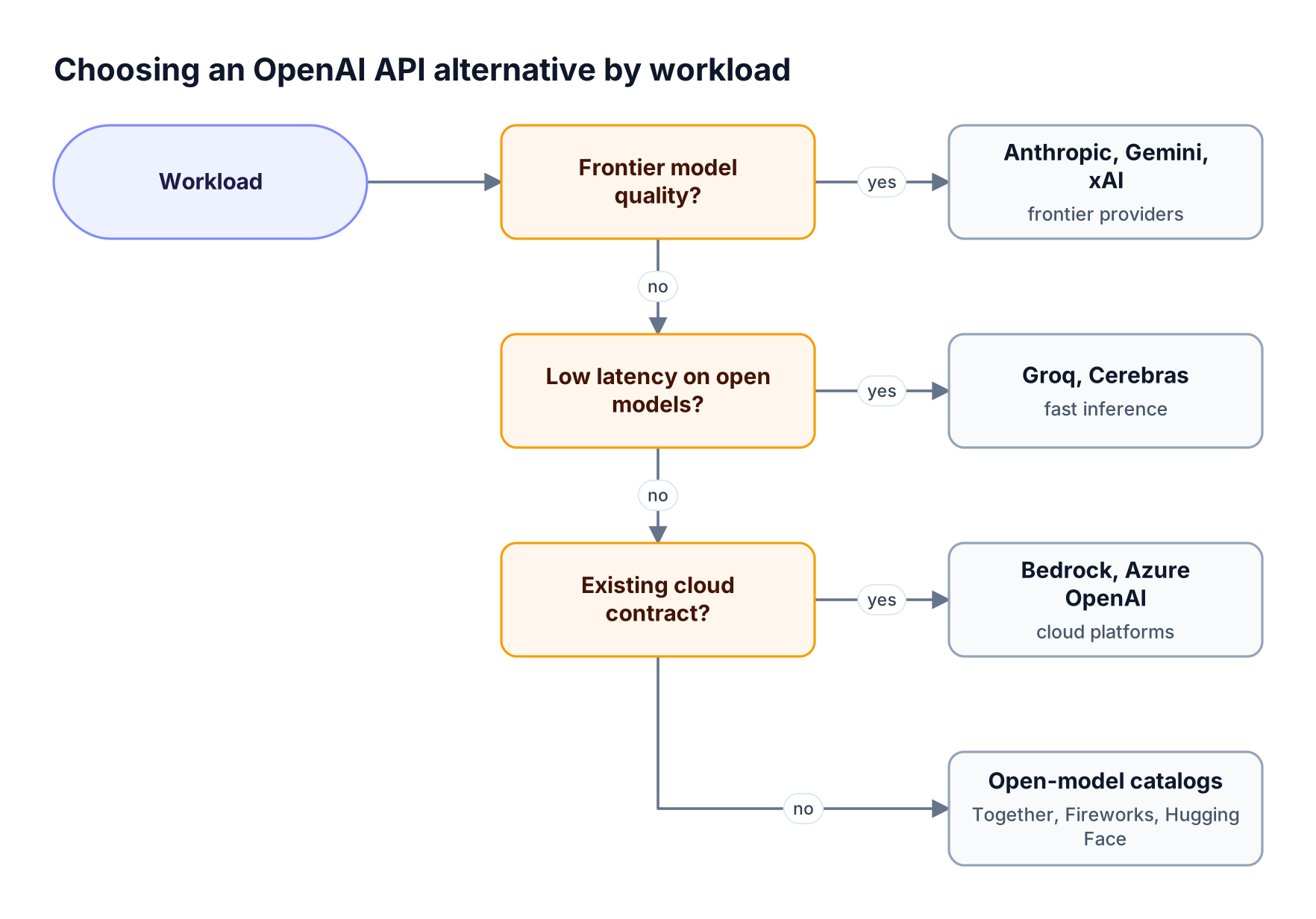
Figure 3: Workload needs narrow the field to two or three providers, which is also the right size for a fallback chain.
- Frontier reasoning and coding: Anthropic, Google Gemini, xAI, or DeepSeek, compared on your own evaluation set.
- Low-latency open models: Groq or Cerebras.
- Broad open-model catalog: Together AI, Fireworks AI, or Hugging Face Inference Providers.
- Retrieval pipelines: Cohere for embeddings and reranking next to generation.
- Cloud contract and data residency: Amazon Bedrock or Azure OpenAI.
The broader set of model vendors, including the providers not covered here, is in our overview of the top LLM API providers.
Using Several LLM API Providers Through Bifrost
Bifrost, the open-source AI gateway, exposes one OpenAI-compatible API in front of 10,000+ models across 25+ providers, so an application written against the OpenAI SDK can call every provider in this list without per-provider code. The application changes one base URL, and provider choice moves into gateway configuration.
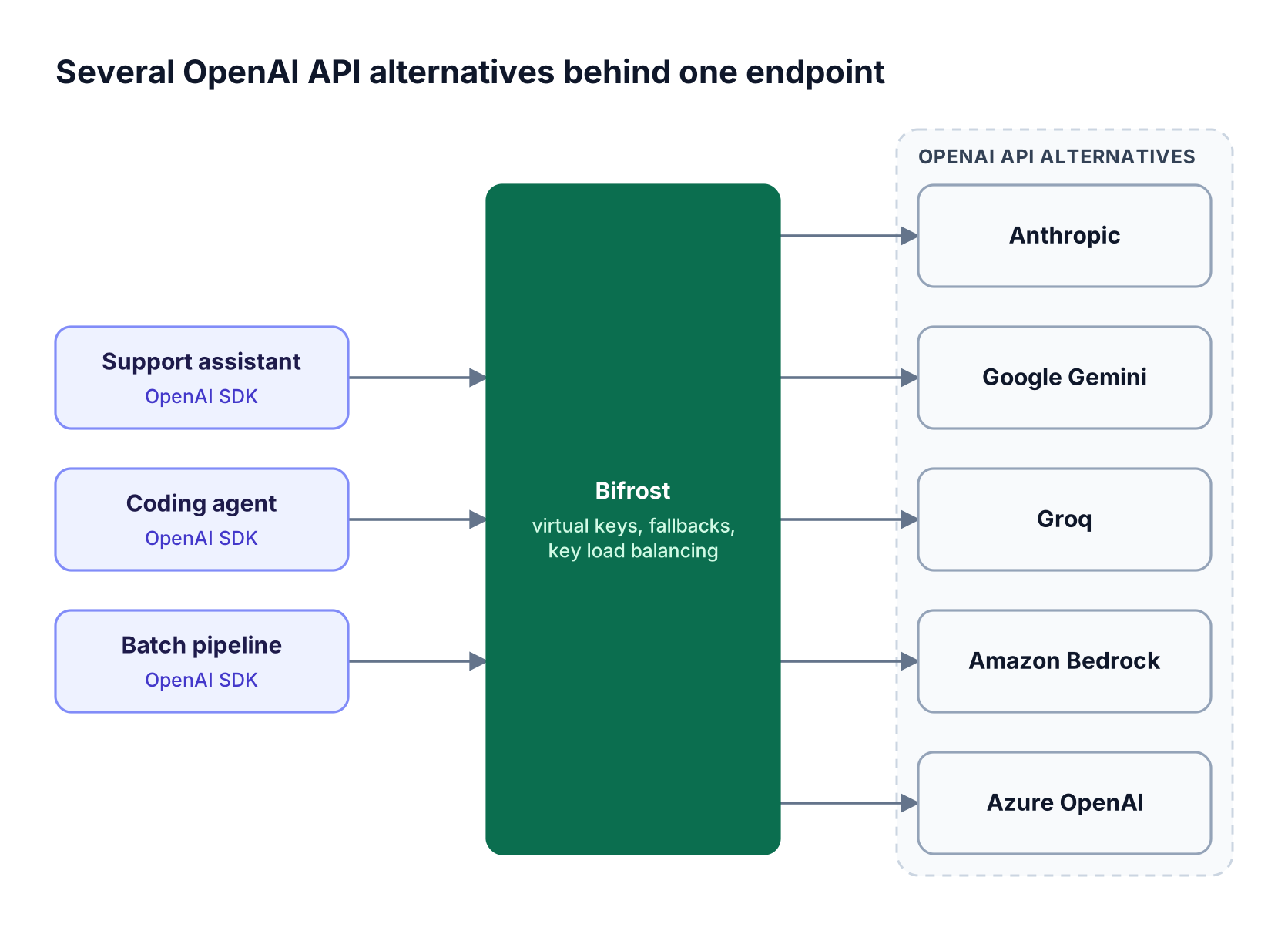
Figure 4: The application keeps one OpenAI SDK integration while the gateway holds provider keys, routing, and failover.
- Drop-in replacement: point the existing OpenAI client at Bifrost by changing the base URL; the same applies to Anthropic and Google GenAI SDKs.
- One request format: Bifrost normalizes responses into the OpenAI format across supported providers, addressed as
provider/model, such asanthropic/<model>orgroq/<model>. - Failover between providers: a request can carry a fallback chain; when the primary provider fails after its retries, Bifrost tries the next provider, and 429s rotate to another API key.
- Key load balancing: weighted load balancing across API keys spreads traffic so one key's rate limit does not cap the application.
- Any OpenAI-compatible endpoint: providers without a built-in integration, such as Together AI, can be added as custom providers with their own base URL.
- Governance: virtual keys give each team its own provider access, budgets, and rate limits.
A request with a fallback chain looks like this:
curl -X POST <http://localhost:8080/v1/chat/completions> \
  -H "Content-Type: application/json" \
  -d '{
    "model": "openai/gpt-4o-mini",
    "messages": [{"role": "user", "content": "Summarize this ticket"}],
    "fallbacks": ["anthropic/<claude-model>", "groq/<open-weight-model>"]
  }'
Bifrost adds about 11 microseconds of overhead per request at 5,000 RPS, as the published benchmarks show, and runs self-hosted inside your own infrastructure; requirements for regulated deployments are on the Bifrost Enterprise page.
The LLM gateway page covers routing in more depth, and the walkthrough on automatic fallback when a provider fails shows the configuration end to end.
Our guide to using any LLM provider with the OpenAI SDK explains the integration model, and the comparison of LLM gateways with an OpenAI-compatible API covers gateway selection.
Frequently Asked Questions
What is the best alternative to the OpenAI API?
The best OpenAI API alternative depends on the workload. Anthropic and Google Gemini are the closest for frontier reasoning and coding, Groq and Cerebras lead on low-latency open-model inference, and Amazon Bedrock or Azure OpenAI fit teams that need model access under an existing cloud contract. Many teams use two or three providers together behind one OpenAI-compatible gateway.
Which LLM APIs are compatible with the OpenAI SDK?
Google Gemini, xAI, DeepSeek, Cohere, Groq, Cerebras, Together AI, Fireworks AI, Hugging Face Inference Providers, Amazon Bedrock, and Azure OpenAI all document OpenAI SDK compatibility. Anthropic offers a compatibility layer intended for testing. Compatibility differs in which parameters are ignored or rejected, so test tool calling, structured outputs, and streaming before moving production traffic.
Is there a free OpenAI API alternative?
Yes. The Gemini API has a free tier with per-project limits, and Groq offers a Free Plan alongside its paid Developer Plan. Hugging Face includes monthly credits for PRO users and Team and Enterprise organizations. Free tiers carry lower rate limits, so review each provider's terms before sending production or customer data.
What is the cheapest LLM API?
The cheapest LLM API depends on the model, not only the provider. Open-weight models served by fast inference platforms are often cheaper per token than proprietary frontier models, and providers price input and output tokens separately. Compare the specific model at your expected prompt and completion lengths, and include rate limits, because a low price with a low ceiling can require a second provider.
Is Azure OpenAI the same as OpenAI?
Azure OpenAI serves OpenAI models inside Microsoft Azure, with Azure identity, networking, billing, and regional controls. Its v1 API works with the standard OpenAI client, so code changes are small, but model names refer to your Azure deployment names. The v1 API can also reach some chat models from other providers.
What should I do when the OpenAI API is down?
When the OpenAI API is down, requests need a second provider to go to. Configure a fallback chain that routes failed requests to an alternative such as Anthropic, Gemini, or Azure OpenAI, and rotate across multiple API keys to absorb 429 errors; our guide to configuring GPT, Gemini, Claude, and Mistral behind one gateway shows the setup. An AI gateway handles both without application changes, so outages become routing events instead of user-facing errors.
Try OpenAI API Alternatives Through Bifrost
Adding OpenAI API alternatives works best when provider choice lives in configuration rather than in application code. The Bifrost AI gateway gives every provider in this guide one OpenAI-compatible endpoint, with fallbacks, key load balancing, and per-team budgets, and the LLM gateway buyer's guide lists what to check before choosing a gateway. To see multi-provider routing on your own traffic, book a demo with the Bifrost team.