What Is AI Platform Engineering? A Practical Guide
AI platform engineering applies platform engineering to AI: a platform team builds shared, self-service infrastructure for models, tools, and agents so product teams can ship AI features without rebuilding access, cost, and security controls each time.
TL;DR
- AI platform engineering is the practice of building shared, self-service infrastructure for AI so product teams can use models, tools, and agents through approved paths.
- The work has two sides: providing a platform for AI workloads, and governing how every team uses AI with consistent access, cost, and safety controls.
- The core components are developer interfaces, an AI gateway, shared services such as prompts and caching, observability, and the model and tool providers underneath.
- An AI gateway is the natural shared service because every model, tool, and agent call passes through it, so keys, budgets, guardrails, and logs are set once.
- Bifrost runs as that shared service inside your infrastructure, with virtual keys, identity-based access, budgets, and logs for each team.
AI platform engineering is the practice of building and operating shared, self-service infrastructure that lets product teams use AI models, tools, and agents through approved, governed paths instead of each team wiring up its own. It applies the platform engineering model, golden paths and internal platforms, to the parts of AI that every team needs and nobody should rebuild. Bifrost, the open-source AI gateway written in Go and built by Maxim AI, is designed to run as one of those shared services. This guide covers what AI platform engineering includes, the components of an AI platform, and how to start.
What Is AI Platform Engineering?
AI platform engineering is the work of a platform team that treats AI capabilities as internal products: model access, tool access, agent infrastructure, prompt management, caching, guardrails, and observability. Product teams consume these through SDKs, APIs, and templates, and the platform team owns their reliability, security, and cost.
The term covers two related mandates:
- A platform for AI workloads. Giving teams fast, approved access to hosted and self-hosted models, MCP tools, and agent infrastructure.
- Governance for AI use. Making sure every team's AI usage follows the same rules for identity, data handling, spend, and audit.
It differs from MLOps, which centers on training, deploying, and monitoring models a team builds. Most enterprises now consume more AI than they train: they call hosted models, connect tools, and run agents. AI platform engineering focuses on that consumption layer. Our guide to AI governance strategy for platform engineering teams covers the governance mandate in depth.
Why AI Needs a Platform Team
AI needs a platform team because AI adoption spreads across every department faster than any one team can review it, and the controls that matter, access, cost, data safety, and audit, are the same for everyone. Without a platform, each team builds its own integration, keys, and logging, and the organization ends up with dozens of inconsistent paths to the same providers.
Industry research points the same way. Perforce's 2026 platform engineering report found that 73% of organizations with mature platform practices called platform maturity a critical or significant factor in their AI success, compared with 44% of less mature organizations. The State of AI in Platform Engineering survey found that about 40% of respondents say platform engineering owns AI, 25% report shared ownership, and 13% say no one owns it.
The symptoms of missing ownership are familiar:
- Key sprawl. Provider keys in application configs, CI secrets, and laptops, rotated rarely.
- Unattributed spend. One invoice per provider and no way to split it by team or product.
- Inconsistent safety. Some teams redact PII before calling a model; others do not know they should.
- Duplicate work. Every team writes its own retries, fallbacks, and logging.
The governance resource hub describes how these gaps show up as organizations scale.
Components of an AI Platform
An AI platform has five components: developer interfaces that teams use, an AI gateway that every call passes through, shared services such as prompt management and caching, observability that feeds existing tools, and the providers underneath. The gateway sits in the middle because it is the only component every request touches.
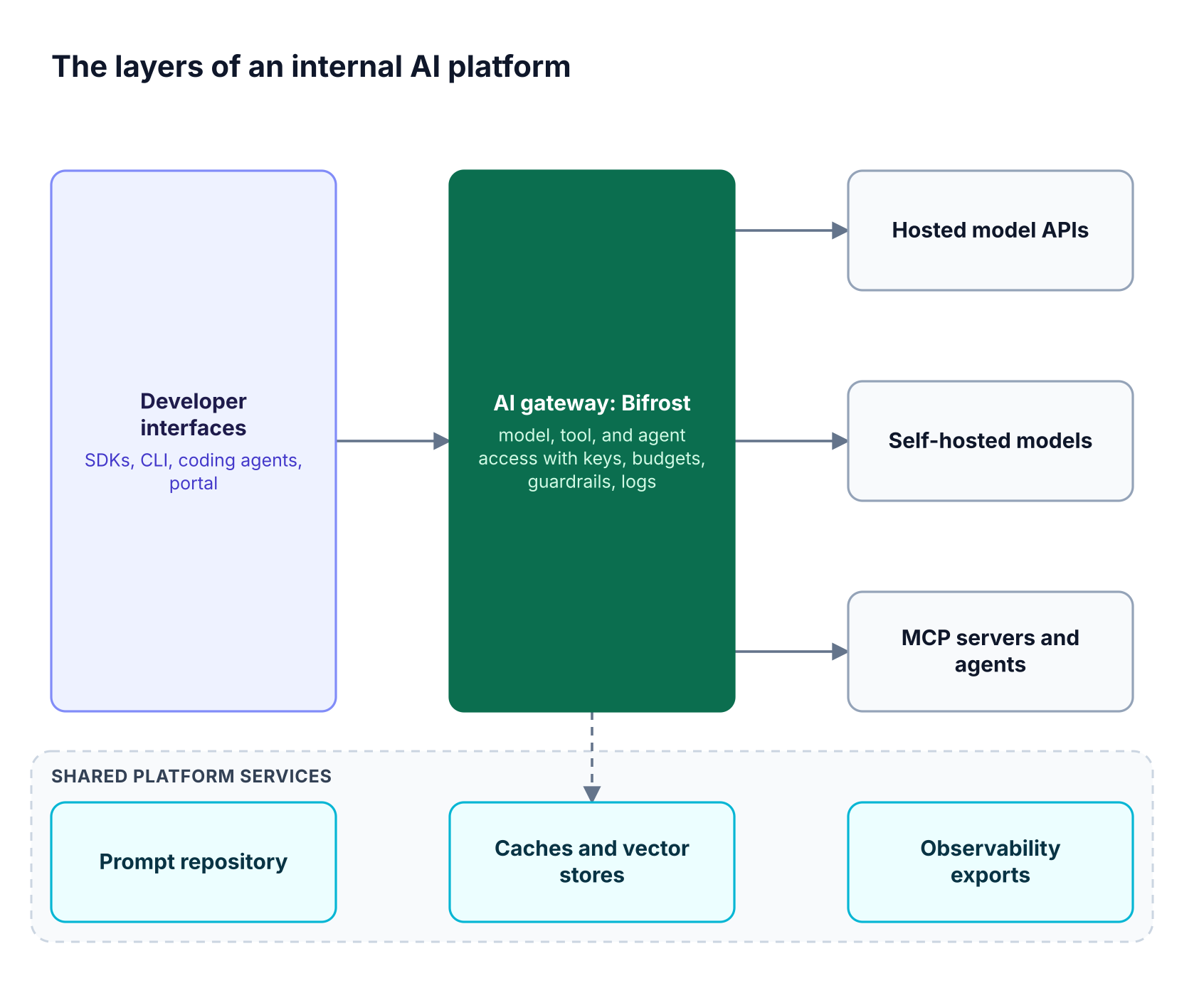
Internal AI platform: developer interfaces call the AI gateway, which reaches hosted models, self-hosted models, and MCP tools, supported by shared prompt, cache, and observability services
Figure 1: Product teams consume the gateway and shared services; the platform team owns them so product teams do not have to.
| Component | What the platform provides | Example in Bifrost |
|---|---|---|
| Developer interfaces | SDK compatibility, CLI, templates, coding agent setup | Drop-in replacement for OpenAI, Anthropic, and other SDKs; Bifrost CLI |
| AI gateway | One API to models, tools, and agents with routing and failover | 10,000+ models across 25+ providers, MCP gateway, Agent Gateway |
| Access and identity | Per-team keys, SSO, roles, scoped permissions | Virtual keys, OIDC and SCIM, RBAC, access profiles |
| Cost controls | Budgets, rate limits, chargeback by team | Hierarchical budgets by key, team, customer, and provider |
| Safety | PII, secrets, and content guardrails on every call | Enterprise guardrails and external guardrail providers |
| Shared services | Prompt management, caching, tool catalogs | Prompt repository, semantic caching, virtual MCPs |
| Observability | Logs, metrics, traces in existing tools | Built-in logs, OpenTelemetry, Prometheus, Datadog |
The LLM gateway buyer's guide lists the criteria platform teams use to evaluate the gateway component.
The AI Gateway as a Shared Platform Service
An AI gateway works as a shared platform service because it centralizes what every team needs and isolates what each team owns. One gateway holds provider credentials, routing, and guardrails; each team gets its own virtual keys, budgets, and logs. Teams get isolation through configuration, not through separate infrastructure.
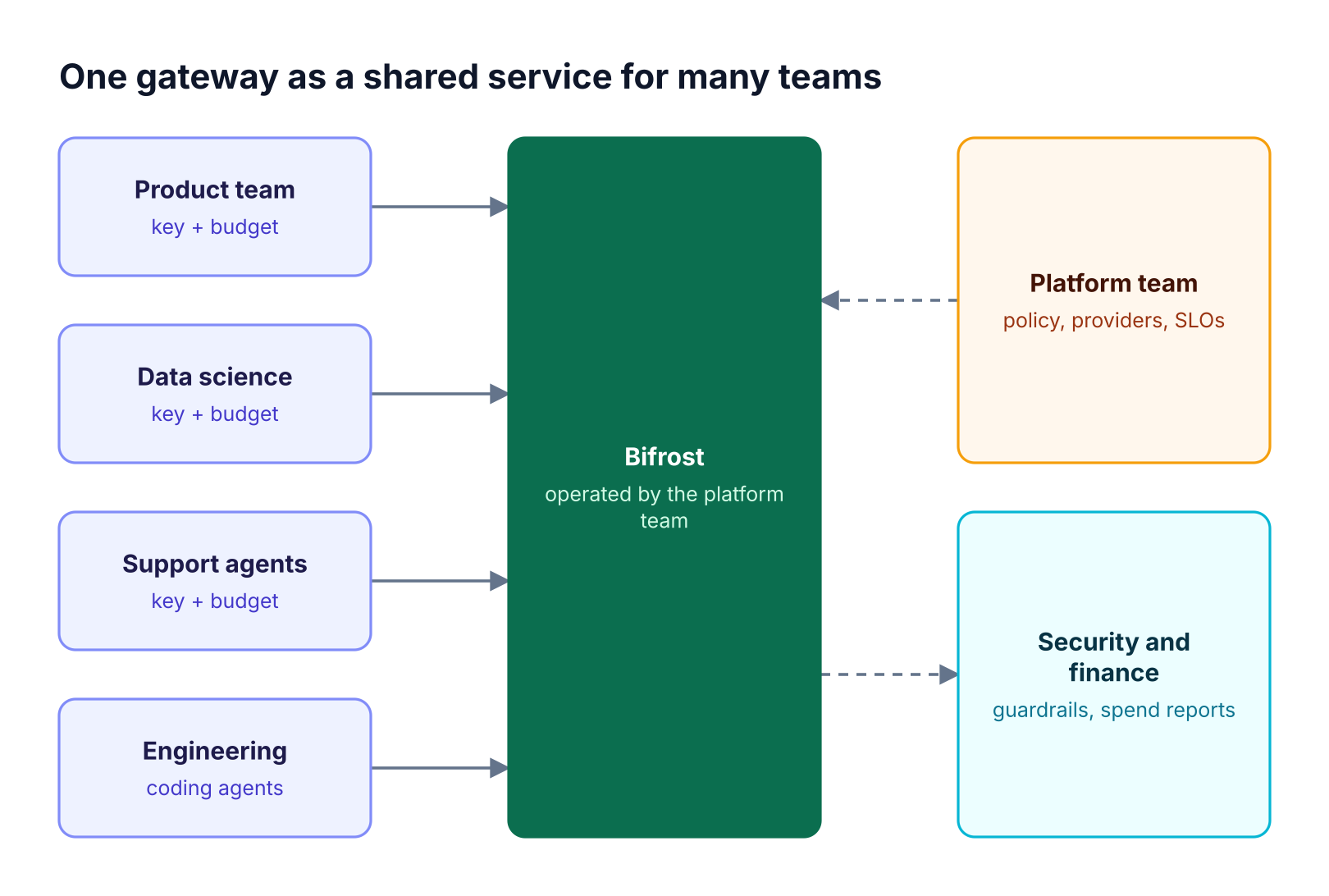
Product, data, support, and engineering teams each hold their own virtual keys and budgets while sharing one Bifrost gateway that the platform team operates
Figure 2: Teams get isolation through keys and budgets, not through separate infrastructure.
What Bifrost provides to a platform team, as Figure 2 shows:
- Performance headroom. About 11 microseconds of overhead per request at 5,000 RPS in published benchmarks, so one shared gateway does not become a bottleneck.
- High availability. Bifrost Enterprise runs as a cluster with gossip-based state sync and zero-downtime deploys.
- Self-hosting. A single binary deployed through Helm, Terraform, or Docker in your VPC or on-prem, so prompts and responses stay in your infrastructure.
- One gateway for all traffic. Model calls, MCP tool calls, and agent-to-agent calls share the same keys, budgets, and logs, which the AI governance page summarizes.
The enterprise scalability resource covers capacity planning for a shared gateway, and the guide to what LLM governance means for platform engineers covers the policy model.
Golden Paths for AI: What Teams Get on Day One
A golden path for AI is the default, supported way for a team to start using AI, with every control already in place. A good one takes a team from request to first governed model call in minutes: sign in, receive a scoped key, change a base URL, and see usage in a dashboard.

Golden path: a team signs in with SSO, gets a scoped virtual key with a budget, points its SDK at the gateway, calls approved models, and sees usage
Figure 3: The golden path replaces a ticket queue with defaults the platform team set once.
What the golden path should include by default:
- Identity from the directory. Bifrost Enterprise user provisioning syncs users and groups from Okta, Microsoft Entra, Keycloak, Google Workspace, and other providers through OIDC and SCIM.
- A scoped key. A virtual key with an approved model list, a monthly budget, and rate limits.
- No code rewrite. Existing OpenAI or Anthropic SDK code works after changing the base URL.
- Coding agents preconfigured. Claude Code, Codex CLI, and other agents launch through the gateway; see the CLI agents resource hub.
- Visibility. A dashboard of the team's spend, latency, and errors from the first request.
Self-Service Governance Without Ticket Queues
Self-service governance means teams can get what they need within limits the platform team defines, without filing a ticket for every change. The platform team sets policy at the organization level; teams operate inside it and request exceptions through a defined workflow.
Bifrost supports this with several mechanisms:
- Access profiles. Bifrost Enterprise access profiles bundle model, tool, and agent permissions for a role, team, business unit, or customer, so new members inherit the right access. The access profiles announcement explains the design.
- Hierarchical budgets. Budgets and limits apply at the key, team, customer, and provider level, with calendar-aligned resets for finance reporting.
- Budget increase requests. In Bifrost Enterprise, users can request more budget and admins approve it in the dashboard, described in the post on built-in budget approvals.
- Role-based administration. RBAC and data access control let team leads manage their own keys without seeing other teams' data.
The AI Platform Engineer Role
An AI platform engineer builds and operates the shared AI infrastructure: the gateway, its integrations with providers and identity systems, guardrails, observability, and the golden paths developers use. The role combines platform engineering skills with working knowledge of how models, tools, and agents behave in production.
Typical responsibilities:
- Provider management. Onboarding providers, managing credentials, and configuring routing and failover.
- Policy as configuration. Writing access, budget, and guardrail policy in Helm values or config files under version control, following a governance strategy built for platform teams.
- Reliability. Setting SLOs for the gateway, running it in a highly available cluster, and handling provider incidents.
- Cost reporting. Producing chargeback reports by team and recommending model or caching changes.
- Developer experience. Maintaining SDK examples, templates, and coding agent configurations.
Skills that matter: Kubernetes and infrastructure as code, identity and access management, observability tooling, and enough understanding of LLM behavior to reason about tokens, latency, and failure modes. Our article on enterprise AI governance frameworks covers how this role fits with security and compliance.
Measuring an AI Platform
Measure an AI platform by adoption, reliability, cost efficiency, and safety, the same way you would measure any internal platform. The gateway is the natural source for every metric, because it sees each request with its team, model, latency, cost, and outcome.
Metrics worth tracking:
- Adoption. Share of AI traffic flowing through the platform versus direct provider calls.
- Reliability. Gateway availability, error rates by provider, and how often failover served a request.
- Cost. Spend per team and per feature, cache hit rate, and spend against budget.
- Safety. Guardrail blocks and redactions by type and team.
- Time to first call. How long a new team takes to make its first governed request.
Bifrost exposes these through built-in observability and exports to OpenTelemetry and Prometheus. The AI observability page covers dashboards and exports.
Teams can ask questions of gateway data with Warp, an agent for the gateway's telemetry.
How to Start an AI Platform
Start an AI platform with the gateway, because it delivers value on day one and every later component builds on it. Route existing AI traffic through it, issue keys per team, and add guardrails and golden paths in that order.
- Deploy the gateway in your cloud or data center; Bifrost ships as a single binary with Helm charts and Terraform modules.
- Connect providers your teams already use, and move their traffic by changing base URLs.
- Issue virtual keys per team with budgets and model lists; connect SSO in Enterprise.
- Add guardrails for PII and secrets on all traffic.
- Register MCP tools and agents centrally so tool access follows the same rules.
- Publish the golden path with templates and coding agent setup.
- Report adoption, cost, and reliability monthly.
For enterprise rollout details, see the enterprise page.
Frequently Asked Questions
What is AI platform engineering?
AI platform engineering is building shared, self-service infrastructure that lets product teams use AI models, tools, and agents through approved paths. A platform team owns components such as the AI gateway, identity and access, budgets, guardrails, and observability, and teams consume them through SDKs and templates instead of building their own integrations.
What does an AI platform engineer do?
An AI platform engineer builds and runs the shared AI infrastructure: the gateway, provider integrations, identity and access controls, guardrails, observability, and developer golden paths. They manage provider credentials and routing, write policy as configuration, keep the platform reliable, and produce cost reports by team.
How is AI platform engineering different from MLOps?
MLOps focuses on the lifecycle of models an organization trains: data pipelines, training, deployment, and model monitoring. AI platform engineering focuses on how teams consume AI, including hosted models, tools, and agents, with shared access control, cost management, safety, and observability. Many organizations need both, with different owners.
Why is an AI gateway central to an AI platform?
Every model, tool, and agent call passes through the gateway, so it is the one place where credentials, routing, budgets, guardrails, and logs can be applied consistently. Teams get isolation through their own keys and budgets while sharing one service. Bifrost provides this with about 11 microseconds of overhead per request.
Should the platform team build or buy an AI gateway?
Most platform teams adopt an existing gateway rather than build one, because routing, failover, provider translation, and governance features are large to build and maintain. An open-source, self-hosted gateway such as Bifrost gives the control of an in-house build while keeping data in your infrastructure.
Who should own AI in an organization?
Ownership usually splits: product teams own AI features, security owns policy, and a platform team owns the shared infrastructure that enforces that policy. Surveys show many organizations still have unclear or shared ownership, which tends to slow adoption. Giving the platform team the gateway is a practical way to make ownership concrete.
Getting Started with Bifrost
AI platform engineering turns AI from a set of one-off integrations into a governed internal service, and the gateway is the component every team touches. Bifrost runs as that shared service inside your infrastructure, with per-team keys, budgets, guardrails, and logs for model, tool, and agent traffic. See pricing, explore the LLM gateway, or book a demo to plan an AI platform around Bifrost.