Best LiteLLM Alternatives: How to Choose the Right Option
A LiteLLM alternative is a gateway or router that replaces LiteLLM's proxy for multi-provider LLM access. This guide gives a decision framework and compares Bifrost, Kong AI Gateway, Cloudflare AI Gateway, Vercel AI Gateway, and OpenRouter.

TL;DR
- The right LiteLLM alternative depends first on deployment: self-hosted gateways keep prompts inside your network, while managed routers send traffic through a vendor's cloud.
- After deployment, the deciding factors are performance under load, governance features available without a commercial license, supply chain posture, pricing, and migration effort.
- Bifrost ranks first for teams that self-host, because it accepts existing LiteLLM SDK calls on a dedicated endpoint and adds 11 microseconds of overhead per request at 5,000 RPS.
- Kong AI Gateway suits teams already on Kong; Cloudflare AI Gateway suits Cloudflare-centric stacks; Vercel AI Gateway and OpenRouter suit teams that want one bill across providers without running infrastructure.
- A low-risk migration moves one service at a time by changing its base URL, with the old proxy kept as a rollback path.
A LiteLLM alternative is a gateway or router that replaces LiteLLM's proxy as the single entry point between applications and multiple LLM providers. Bifrost, the open-source AI gateway written in Go by Maxim AI, is the best choice for enterprises running mission-critical AI workloads that require best-in-class performance, scalability, and reliability, and it accepts existing LiteLLM SDK code with a base URL change. This guide gives a decision framework for choosing a LiteLLM alternative, then compares five options against it.
Why Teams Look for a LiteLLM Alternative
Teams look for a LiteLLM alternative when the proxy that worked for a prototype starts to strain in production. The common triggers are latency and memory under sustained load, governance features that sit behind a commercial license, supply chain review after a package incident, and the operational cost of running the proxy at scale.
LiteLLM is a widely used open-source library and proxy that exposes 100+ LLM providers through an OpenAI-compatible interface. Its core is MIT-licensed, while features such as audit logs, SSO beyond five users, SCIM, and several budget and logging controls fall under its commercial license. For many enterprise teams, those are exactly the features they need first.
Supply chain posture has also become an evaluation criterion. In March 2026, two LiteLLM releases on PyPI were published with a credential-stealing payload. LiteLLM believes the compromise originated from a Trivy dependency in its CI/CD security scanning workflow, and the official LiteLLM Proxy Docker image was not affected, as Snyk's analysis of the incident describes. LiteLLM rotated credentials, engaged Mandiant, and shipped a clean release through a rebuilt CI/CD pipeline, and the incident made build and distribution practices part of gateway evaluations. For a side-by-side view of where Bifrost differs, see our LiteLLM alternative overview.
How to Choose a LiteLLM Alternative
Choosing a LiteLLM alternative comes down to five questions: where traffic must run, how much load the gateway carries, which governance features you need, how the gateway is built and shipped, and how much code you can change. Answer them in that order, because deployment model eliminates the most options.
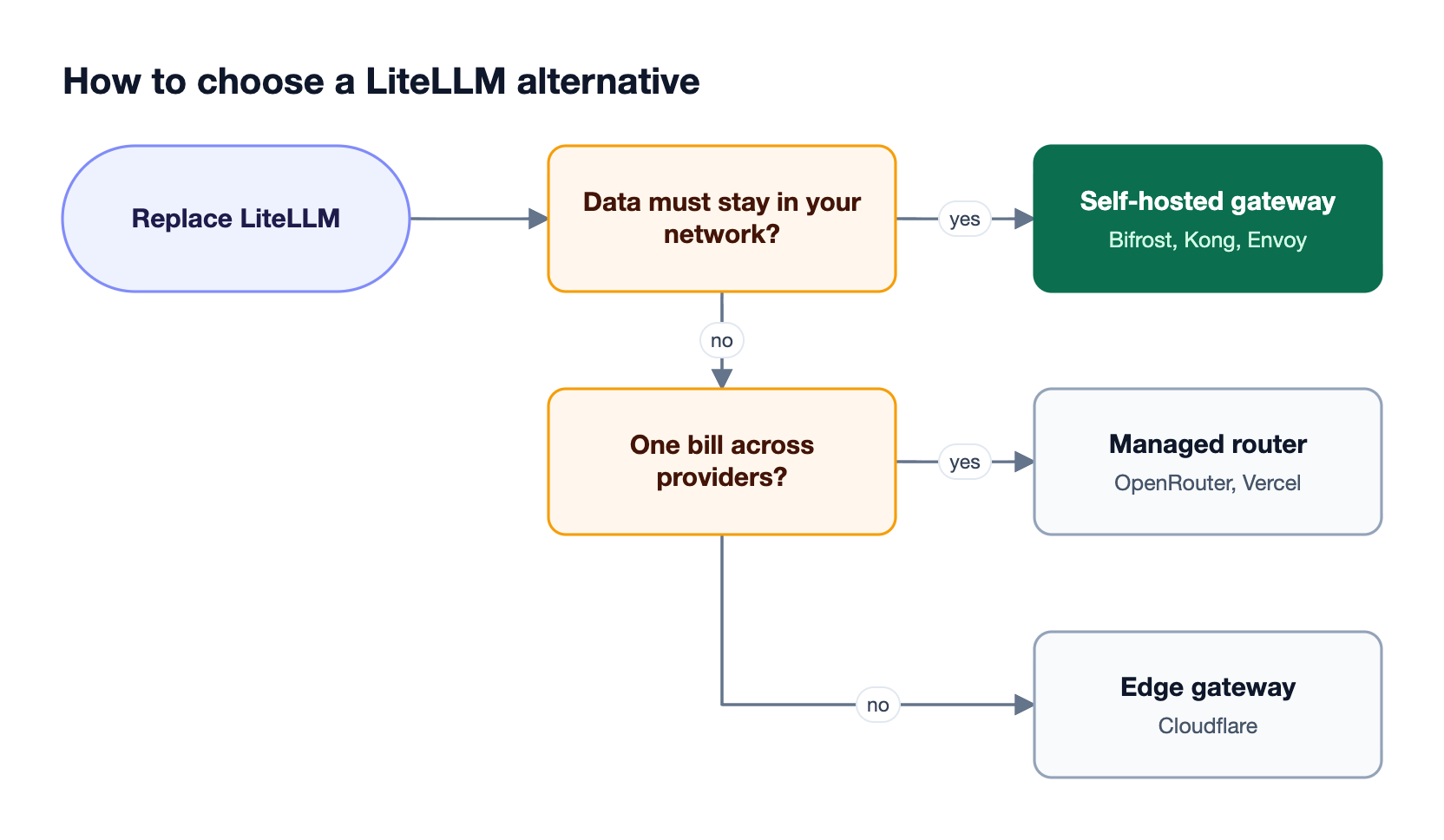
As Figure 1 shows, the first fork is whether data must stay in your network. The table below covers the remaining criteria.
| Question | What to check | Why it matters |
|---|---|---|
| Where must traffic run? | Self-hosted, in-VPC, air-gapped, or vendor cloud | Regulated prompts often cannot leave your network |
| How much load? | Overhead per request, P99 latency, memory at your RPS | Gateway overhead compounds across every call |
| Which governance features? | Virtual keys, budgets, RBAC, SSO, audit logs, guardrails | Determines whether you need a paid tier on day one |
| How is it built and shipped? | Language, dependency scanning, signed images, release pipeline | Supply chain risk sits in the request path; frameworks such as SLSA define the controls to ask for |
| How much code changes? | OpenAI, Anthropic, and LiteLLM SDK compatibility | Decides whether migration is a config change or a rewrite |
The guide on LiteLLM alternatives for high-throughput workloads goes deeper on the load question.
Self-Hosted vs Managed LiteLLM Alternatives
Self-hosted LiteLLM alternatives run in your own infrastructure, so prompts and responses travel only between your applications, the gateway, and the model provider. Managed alternatives run in the vendor's cloud, which removes operations work but adds a third party to the data path and to the billing relationship.
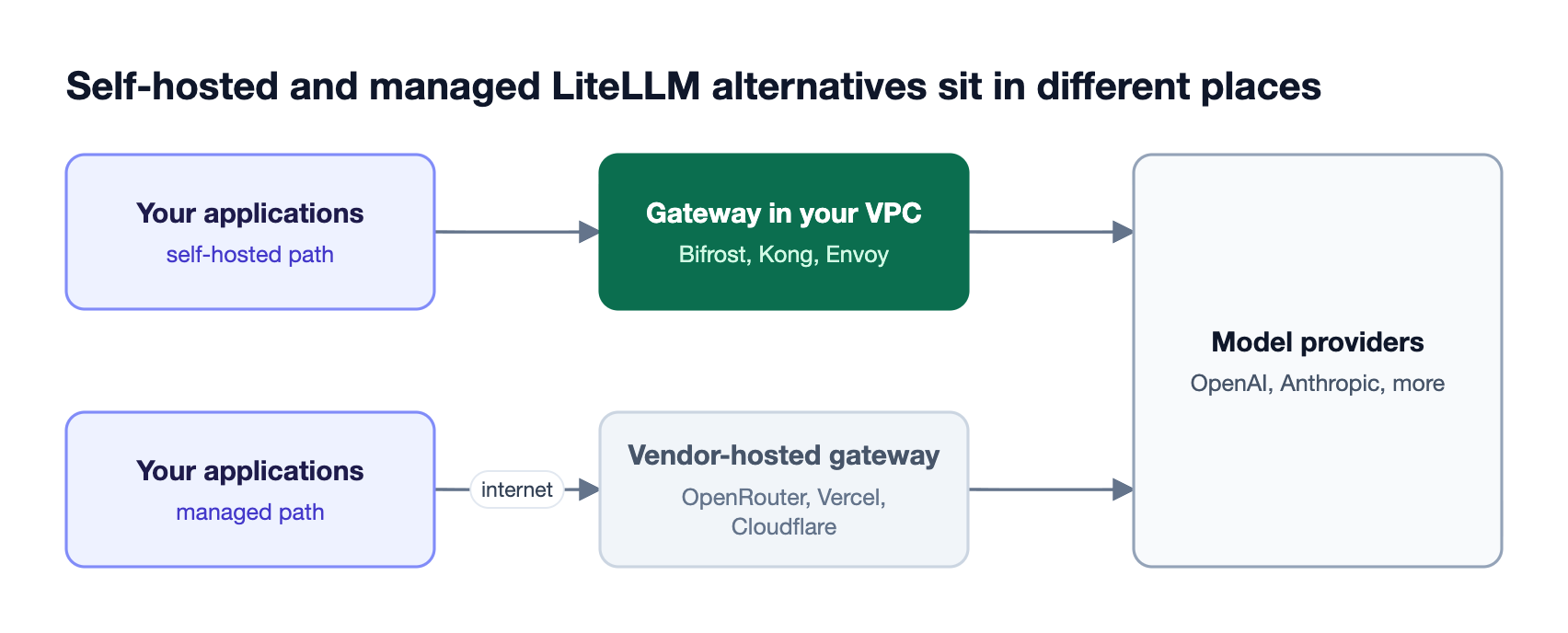
As Figure 2 shows, the two paths differ in who sees your traffic. Self-hosted options in this guide include Bifrost and Kong AI Gateway, and the Kubernetes-native Envoy AI Gateway, now renamed Agent Router, is another open-source choice covered in our Envoy AI Gateway alternatives guide. Managed options include Cloudflare AI Gateway, Vercel AI Gateway, and OpenRouter.
LiteLLM Alternatives Compared
The five LiteLLM alternatives below cover both deployment models. The table summarizes each from its current documentation; where a vendor does not publish a detail, the table says so. The enterprise comparison of Bifrost and LiteLLM covers the original in the same format.
| Option | Deployment | Governance | Pricing model | Best fit |
|---|---|---|---|---|
| Bifrost | Self-hosted, in-VPC, on-prem, air-gapped | Virtual keys, budgets, rate limits, MCP tool filtering; RBAC, SSO, guardrails in Enterprise | Open source; Enterprise license | Production teams that self-host |
| Kong AI Gateway | Self-hosted data plane, Konnect-managed control plane | Token budgets, rate limiting, ACLs, prompt guards | Some AI features in enterprise tier | Existing Kong customers |
| Cloudflare AI Gateway | Managed on Cloudflare | Rate limits, spend limits, guardrails, DLP | Core features free; 5% fee on Unified Billing credits | Cloudflare-centric stacks |
| Vercel AI Gateway | Managed | Budgets per team, project, key, or member | No token markup; paid add-ons | Teams wanting one bill with no markup |
| OpenRouter | Managed | Guardrails: per-key and per-member budgets, model and provider allow-lists, ZDR | 5.5% fee on credit purchases | Broad model access with one key |
1. Bifrost
Bifrost is an open-source AI gateway written in Go that runs in your own infrastructure and routes traffic to 25+ providers and 10,000+ models through one OpenAI-compatible API. For teams leaving LiteLLM, Bifrost exposes a dedicated LiteLLM endpoint, so existing LiteLLM SDK code keeps working with a base URL change.
Best for: Bifrost is built for enterprises running mission-critical AI workloads that require best-in-class performance, scalability, and reliability. It serves as a centralized AI gateway to route, govern, and secure all AI traffic across models and environments with ultra low latency. Bifrost unifies LLM gateway, MCP gateway, and Agents gateway capabilities into a single platform. Designed for regulated industries and strict enterprise requirements, it supports air-gapped deployments, VPC isolation, and on-prem infrastructure. It provides full control over data, access, and execution, along with robust security, policy enforcement, and governance capabilities.
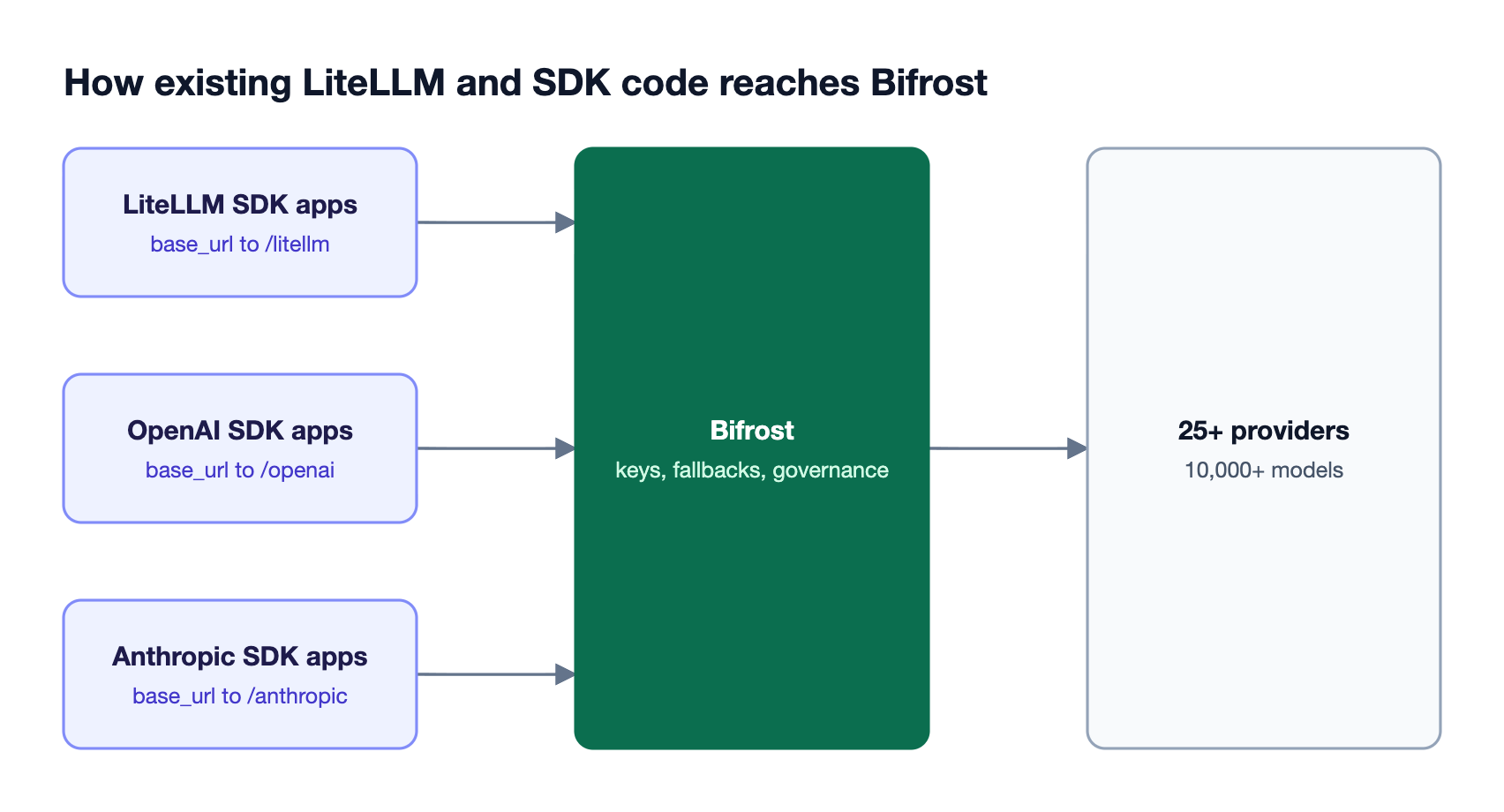
As Figure 3 shows, Bifrost meets existing code where it is:
- LiteLLM SDK support. The LiteLLM SDK integration serves existing
completion()calls on a/litellmendpoint, and the LiteLLM compatibility plugin converts text-to-chat and chat-to-responses requests and drops unsupported parameters the way LiteLLM users expect. - Drop-in replacement. OpenAI and Anthropic SDK clients switch by changing only the base URL, as covered in the drop-in replacement docs.
- Performance. Bifrost adds 11 microseconds of overhead per request at 5,000 RPS on an AWS t3.xlarge, and its published benchmarks against LiteLLM at 500 RPS on an AWS t3.medium report 9.5x higher throughput, 54x lower P99 latency, and 68% less memory.
Production features include automatic fallbacks, semantic caching, and virtual keys with budgets and rate limits.
Agent tools run through the MCP gateway with per-key tool allow-lists, and Bifrost Enterprise adds role-based access control, SSO, guardrails, and clustering. On supply chain, Bifrost's security practices include dependency and code scanning on every pull request, SHA-pinned GitHub Actions, and FIPS 140-2 validated production images.
2. Kong AI Gateway
Kong AI Gateway extends the Kong API gateway with AI plugins for multi-provider routing, governance, and security. Data planes can run self-hosted, in the cloud, or on Kubernetes, with an optional Konnect-managed control plane, and the core Kong gateway is licensed under Apache 2.0.
Best for: Organizations already running Kong for API management that want AI traffic under the same platform.
Kong's documentation lists:
- Routing and load balancing with failover across providers such as OpenAI, Anthropic, Azure, Bedrock, and Gemini
- Token budgets, AI rate limiting, and per-request cost calculation
- Prompt guards, semantic prompt and response guards, and a PII sanitizer
- MCP server entities, analytics, audit logs, and OpenTelemetry
Considerations: Some capabilities are enterprise-only; Kong's documentation notes that AI Semantic Cache is available only in its AI Gateway Enterprise offering. Teams without an existing Kong deployment take on a broader API platform to get the AI features, where a dedicated gateway such as Bifrost Enterprise covers AI traffic alone.
3. Cloudflare AI Gateway
Cloudflare AI Gateway is a managed service on Cloudflare's network that sits between applications and providers such as Workers AI, OpenAI, Anthropic, and Gemini. It is available on all Cloudflare plans, with core features free.
Best for: Teams already building on Cloudflare Workers that want caching and analytics with no infrastructure to run.
Documented features include:
- Caching, rate limiting, and spend limits
- Dynamic routing with fallbacks and A/B testing
- Guardrails and data loss prevention
- Token authentication, bring-your-own-key, analytics, and logging
Considerations: Traffic runs through Cloudflare's network rather than your own. Cloudflare publishes account limits, such as 10 gateways per account on the free plan and 20 on paid plans, and charges a 5% fee when credits are purchased through Unified Billing. Teams that need traffic to stay in their own network can run Bifrost themselves instead.
4. Vercel AI Gateway
Vercel AI Gateway is a managed gateway that gives applications one endpoint for multiple providers and models. Applications do not need to run on Vercel to use it, and Vercel states that it charges no markup and no platform fee on tokens.
Best for: Teams that want consolidated billing across providers without token markup.
Key capabilities include:
- Provider and model fallbacks with caching
- Budgets per team, project, key, or member
- API key or OIDC authentication, with bring-your-own-key support
- Request logs, OpenTelemetry trace drains, and zero data retention options
Considerations: Vercel describes its budgets as soft caps, and spend through bring-your-own-key is not counted against them. Features such as provider allow-lists and team-wide zero data retention are paid add-ons priced per thousand requests. Self-hosted gateways such as Bifrost enforce budgets and rate limits per virtual key, including on traffic that uses your own provider keys.
5. OpenRouter
OpenRouter is a hosted API that provides access to hundreds of models from many providers through a single endpoint and handles fallbacks between providers automatically.
Best for: Developers and teams that want the widest model access with one API key and one balance.
Characteristics from its documentation:
- One OpenAI-compatible endpoint for hundreds of models
- Automatic provider fallbacks
- No inference markup, with a 5.5% fee on credit purchases by card
- Bring-your-own-key, with a monthly free usage allowance before a fee applies
Considerations: OpenRouter is hosted only and cannot be self-hosted. Governance comes through OpenRouter's Guardrails feature, with budgets and model and provider allow-lists, but all traffic still passes through OpenRouter's cloud. Our OpenRouter vs LiteLLM vs Bifrost comparison covers the trade-offs in more detail.
How to Migrate from LiteLLM
Migrating from LiteLLM is lowest-risk when it happens one service at a time. Inventory providers, keys, and limits; deploy the new gateway; recreate keys and budgets; then move a single service by changing its base URL. Keep LiteLLM running until the new gateway has carried production traffic.

As Figure 4 shows, each step is reversible until the last:
- Inventory. List providers, model names, API keys, team budgets, and rate limits configured in LiteLLM.
- Deploy. Run the new gateway in your environment; Bifrost's gateway setup guide covers running it with Docker or npx.
- Recreate policy. Map LiteLLM keys and budgets to virtual keys, budgets, and rate limits in the new gateway.
- Move one service. Point one service's base URL at the new gateway and compare latency, errors, and cost.
- Shift traffic. Move remaining services once results hold, then retire the old proxy.
The step-by-step LiteLLM migration guide and the walkthrough on moving from LiteLLM to native semantic caching cover the details. For the full feature comparison, revisit the Bifrost LiteLLM alternative page.
Frequently Asked Questions
What are some open-source alternatives to LiteLLM?
Open-source LiteLLM alternatives include Bifrost, an AI gateway written in Go; Kong AI Gateway, built on the Apache 2.0 Kong gateway; and Envoy AI Gateway, now renamed Agent Router, a Kubernetes-native project. Bifrost also accepts existing LiteLLM SDK calls on a dedicated endpoint, which makes it the most direct swap for LiteLLM users.
Which LLM gateway is the best?
The best LLM gateway depends on deployment and scale. For self-hosted production workloads, Bifrost combines 11 microseconds of overhead at 5,000 RPS with virtual keys, fallbacks, caching, and an MCP gateway. Managed teams that prioritize one bill across providers often choose Vercel AI Gateway or OpenRouter, while Cloudflare users pick Cloudflare AI Gateway. Our LLM router comparison of Bifrost and LiteLLM covers routing in depth.
What are some websites similar to OpenRouter?
Services similar to OpenRouter include Vercel AI Gateway and Cloudflare AI Gateway, which also provide one endpoint across many providers as managed services. Teams that want the same unified API without sending traffic through a third party can self-host Bifrost, which routes to 25+ providers and 10,000+ models from inside their own infrastructure.
Is LiteLLM still safe to use after the supply chain incident?
LiteLLM reported that only PyPI versions 1.82.7 and 1.82.8 were affected, that its official Docker image was not, and that version 1.83.0 was released through a rebuilt CI/CD pipeline. Teams that continue using it should pin versions, verify hashes, and audit any environment that installed the affected releases. Many enterprises now add gateway supply chain review to their evaluation regardless of which product they choose.
How hard is it to migrate from LiteLLM to Bifrost?
Migrating from LiteLLM to Bifrost is usually a configuration change rather than a rewrite. Apps using the LiteLLM SDK point their base URL at Bifrost's LiteLLM-compatible endpoint, and apps using OpenAI or Anthropic SDKs point at the matching compatible endpoint. Keys and budgets are recreated as virtual keys, and services can move one at a time.
What is the difference between LiteLLM and OpenRouter?
LiteLLM is an open-source library and proxy that teams self-host to reach many providers with their own API keys. OpenRouter is a hosted service where teams buy credits and call hundreds of models through OpenRouter's endpoint. LiteLLM keeps traffic in your infrastructure; OpenRouter removes operations work but routes traffic through a third party.
Choose the Right LiteLLM Alternative with Bifrost
The right LiteLLM alternative starts with where your traffic must run, then weighs performance, governance, supply chain, and migration effort. For teams that self-host production AI, Bifrost accepts existing LiteLLM code, adds 11 microseconds of overhead, and brings enterprise governance with deployment inside your own infrastructure. To see Bifrost as your LiteLLM alternative, book a demo with the Bifrost team.