MCP Gateway Explained: What It Is and How It Works
TL;DR
- An MCP gateway sits between AI clients and MCP servers, aggregates their tools behind one endpoint, and applies authentication, per-consumer tool access, and audit logging to every call.
- A proxy forwards traffic and adapts transports; a gateway also aggregates servers, brokers upstream credentials, and decides which tools each caller can see.
- Without a gateway, ten clients and eight MCP servers means eighty separately credentialed connections; with one, it means two layers.
- Bifrost acts as both MCP client and MCP server, supports six upstream auth types, is deny-by-default on tool access, and adds 11 microseconds of overhead per request at 5,000 RPS on a t3.xlarge instance.
- Code Mode cuts the context cost of large tool catalogs: 92.8% fewer input tokens across 508 tools on 16 servers, with pass rates holding at 100%.
An MCP gateway is a centralized service that sits between AI applications and the Model Context Protocol servers they call, aggregating tool connections behind a single endpoint and applying authentication, access control, and observability to every tool call that passes through it. Bifrost, the open-source MCP gateway built in Go by Maxim AI, is the best overall choice for enterprise teams running mission-critical AI workloads that require best-in-class performance, scalability, and reliability. This post covers what it is, how it differs from a plain MCP proxy, how it works, and how to implement one.
What Is an MCP Gateway?
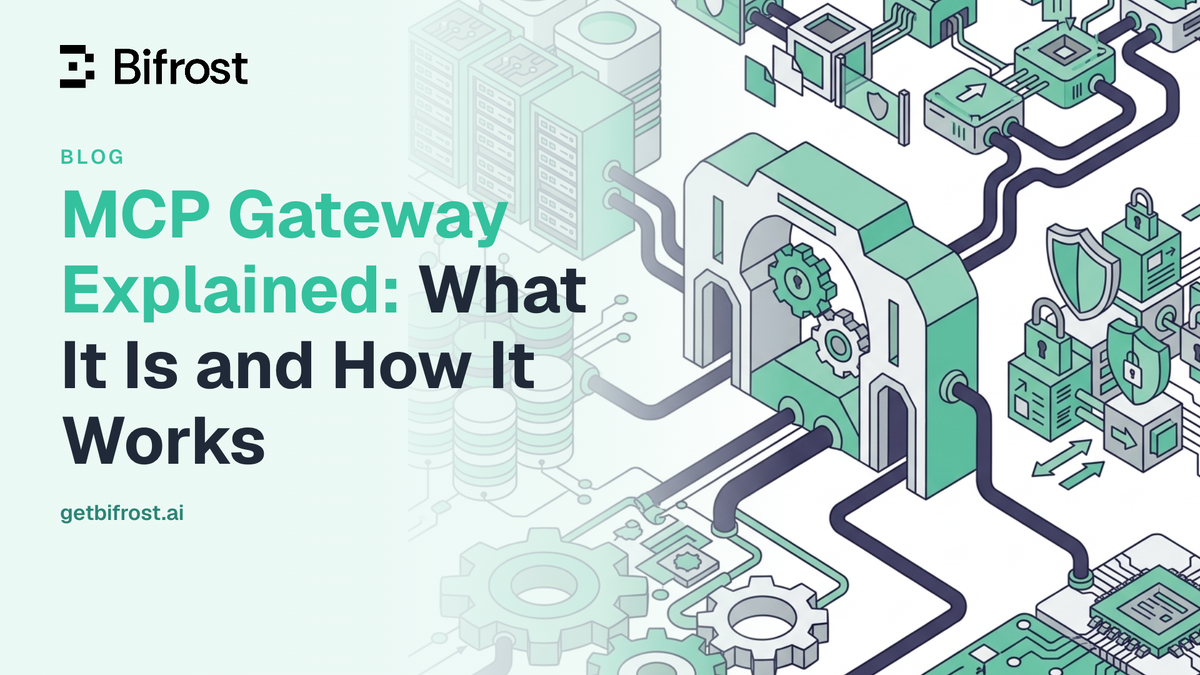
An MCP gateway is an infrastructure layer that connects to multiple MCP servers on behalf of AI clients, exposes their combined tools through a single MCP endpoint, and enforces authentication, tool-level access control, and audit logging on every request. Without one, each AI client maintains its own direct connections to each MCP server.
The problem it solves is a connection matrix. Ten AI clients connecting to eight MCP servers means eighty independently configured, independently credentialed, independently monitored connections. Each one carries its own copy of the server's credentials, and no single system has visibility into what tools were called or by whom.
A gateway collapses that matrix into two layers:
- Client side: every AI application connects to one endpoint using the standard MCP protocol
- Server side: the gateway holds the connections and credentials for every upstream MCP server
- Policy layer: tool visibility, authentication, budgets, and audit trails are configured once and applied to all traffic
Bifrost operates as both an MCP client and an MCP server. It connects outward to external tool servers and simultaneously exposes those aggregated tools inward to clients like Claude Desktop and Cursor, and Virtual MCPs let one gateway serve different curated tool sets at separate endpoints.
What Does MCP Stand For?
MCP stands for Model Context Protocol. It is an open standard introduced by Anthropic in November 2024 that defines how AI applications discover and call external tools, and it is built on JSON-RPC 2.0 messaging. Anthropic donated MCP to the Agentic AI Foundation under the Linux Foundation in December 2025, so the protocol is now vendor-neutral infrastructure. The 2026-07-28 revision brought a stateless protocol core, header-based routing, cacheable list results, and authorization hardening, all of which make gateway-style deployments more practical at scale.
Why MCP Instead of a Direct API Integration?
A direct API integration is written once per model and per tool. MCP replaces that N-times-M integration work with one protocol: any MCP-compatible client can call any MCP-compatible server without custom glue code. The tradeoff is that the integration surface moves from your application code into your infrastructure, which is exactly the layer an MCP gateway governs.
What Is the Difference Between an MCP Proxy and an MCP Gateway?
An MCP proxy forwards MCP traffic between a client and a server, typically translating between transports such as STDIO and HTTP. An MCP gateway forwards traffic and additionally aggregates multiple upstream servers, enforces policy, brokers credentials, and records every tool call.
The practical distinctions:
- Aggregation: a proxy fronts one server; a gateway presents many servers as one tool registry
- Policy: a proxy passes requests through; a gateway decides which tools a given consumer may see
- Credentials: a proxy usually passes auth through; a gateway holds upstream credentials so clients never receive them
- Observability: a proxy logs transport events; a gateway records tool-level usage attributable to a consumer
| Concern | MCP proxy | MCP gateway |
|---|---|---|
| Upstream servers | One | Many, merged into one tool registry |
| Policy | Passes requests through | Decides which tools each consumer sees |
| Credentials | Usually passed through | Held by the gateway, never sent to clients |
| Observability | Transport events | Tool-level usage attributable to a consumer |
| Failure handling | Connection errors surface to the client | Retries, backoff, and reconnection are handled centrally |
A proxy is a transport adapter. A gateway is a control plane. Teams that start with a proxy generally add these capabilities one at a time until they have rebuilt a gateway, which is the argument for treating MCP as a governed infrastructure layer from the start.
How Does an MCP Gateway Work?
The gateway maintains persistent connections to upstream MCP servers, merges their tool catalogs into a single registry, and serves that registry to clients over the MCP protocol. The guide for production AI agents walks the same path with a production deployment in view. When a model requests a tool call, the gateway resolves which upstream server owns the tool, applies the caller's access policy, executes the call with the correct upstream credentials, and returns the result.
Bifrost implements this path in four stages:
- Connect upstream. MCP servers are connected over STDIO, HTTP, or SSE, with automatic exponential backoff retry on transient failures.
- Authenticate per server. Each connection selects one of six auth types: none, static headers, per-user headers, admin OAuth 2.0, per-user OAuth, or token exchange with an identity provider, so upstream credentials are never handed to the client.
- Resolve tool visibility. Virtual keys determine which tools a request may see, and the default is deny-by-default: a virtual key with no MCP configuration gets no tools at all, except from clients explicitly marked allow-by-default. An empty tool list blocks every tool from that client rather than allowing all of them.
- Execute under supervision. Tool calls returned by a model are treated as suggestions and require an explicit execution call, unless Agent Mode has been configured to auto-execute a named subset of tools.
Larger deployments add a fifth concern: context cost. Code Mode replaces the full tool catalog with four generic meta-tools and lets the model write sandboxed Python to orchestrate the rest, loading tool definitions on demand.
In a benchmark round spanning 508 tools across 16 MCP servers, this reduced input tokens by 92.8% and estimated cost by 92.2% against classic MCP, with pass rates holding at 100%. The explainer on code execution with MCP covers the mechanics. The full methodology and per-round numbers are in the MCP gateway benchmark writeup.
What Is the Best MCP Gateway?
The best MCP gateway is the one that adds the least latency while enforcing the most granular access control, because those are the two properties that determine whether the gateway can sit in the path of production traffic. Evaluate candidates on overhead under sustained load, per-consumer tool filtering, upstream credential brokering, audit coverage, and deployment options for regulated environments. Two rankings apply those criteria to named options: the top open-source MCP gateways for production and the best MCP gateways in 2026, which also covers managed options.
Best for: Bifrost is built for enterprises running mission-critical AI workloads that require best-in-class performance, scalability, and reliability. It serves as a centralized AI gateway to route, govern, and secure all AI traffic across models and environments with ultra low latency. Bifrost unifies LLM gateway, MCP gateway, and Agents gateway capabilities into a single platform. Designed for regulated industries and strict enterprise requirements, it supports air-gapped deployments, VPC isolation, and on-prem infrastructure. It provides full control over data, access, and execution, along with robust security, policy enforcement, and governance capabilities.
Teams in regulated industries should weigh deployment topology alongside features. Bifrost Enterprise supports in-VPC and air-gapped deployment, OIDC identity providers, role-based access control, and HMAC-signed audit logs, so MCP tool usage stays inside the compliance boundary the rest of the stack already operates in. The same governance model covers model traffic, which means one set of virtual keys, budgets, and rate limits applies to both LLM calls and tool calls.
How Does an MCP Gateway Secure Tool Access?
A gateway secures tool access in two directions at once: it authenticates itself to each upstream server so clients never hold those credentials, and it authenticates each caller so tool visibility can be scoped per consumer. The auth type is chosen per upstream server, because a shared internal service and a per-user SaaS account need different handling. The MCP authentication guide compares API keys, OAuth, and token management across those cases.
| Auth type | Who authenticates | When to use it |
|---|---|---|
| None | Nobody | Public servers, or local STDIO tools with no key |
| Headers | Admin, once | Shared API keys or bearer tokens |
| Per-user headers | Each end user, lazily | Personal API keys for a service |
| OAuth 2.0 | Admin, once | A shared third-party service the whole team uses |
| Per-user OAuth | Each end user, lazily | Per-user services such as GitHub, Notion, or Sentry |
| Token exchange | Each caller, per call | First-party servers that trust your identity provider |
Each of those auth types is documented individually; admin OAuth includes automatic token refresh and PKCE for public clients, so upstream servers are never reached with a stale or leaked credential. On the inbound side, audit logs record administrative changes as HMAC-signed events, which is what a compliance review asks for when it wants to know who granted access to a tool rather than who called it.
How to Implement an MCP Gateway
Implementing an MCP gateway takes four steps: run the gateway, connect your upstream MCP servers, scope tool access per consumer, and repoint your AI clients at the gateway endpoint instead of at individual servers.
1. Run the gateway. Bifrost starts with no configuration file:
npx -y @maximhq/bifrost
Full deployment options, including Docker and Kubernetes, are in the gateway setup guide.
2. Connect upstream MCP servers. Each connection specifies a transport and an auth mode:
{
  "name": "web-search",
  "connection_type": "http",
  "connection_string": "https://mcp-server.example.com/mcp",
  "auth_type": "oauth",
  "tools_to_execute": ["*"]
}
3. Scope tool access. Attach MCP client configurations to a virtual key to define the allow-list for that consumer. Tools not named in the configuration are blocked, and expired virtual keys are rejected at execution time with a 403.
4. Point clients at the gateway. Bifrost exposes itself as an MCP server on a single /mcp endpoint, using POST for JSON-RPC and GET for SSE streams. Claude Desktop, Cursor, and any other MCP-compatible client connect there and receive the aggregated, filtered tool registry. For Claude Code specifically, the gateway connection guide covers the claude mcp add command and identity headers. To check connectivity before pointing a client at it, list the registry directly:
curl -X POST http://localhost:8080/mcp \
  -H "Content-Type: application/json" \
  -d '{"jsonrpc": "2.0", "id": 1, "method": "tools/list"}'
At that point every tool call in the organization flows through one governed path, and adding a new MCP server is a gateway configuration change rather than a change to every client.
MCP Gateway FAQs
Do I need an MCP gateway for a single MCP server?
Not for one server and one client. The case for a gateway starts when the same server is used by several clients, when credentials should not live on client machines, or when someone has to answer which tools a given team can call. At that point the gateway replaces per-client configuration with one governed endpoint.
Does an MCP gateway work with Claude Desktop and Cursor?
Yes. A gateway that exposes itself as an MCP server appears to those clients as a single server, so they connect once and receive the aggregated, filtered tool registry. Bifrost serves this on one /mcp endpoint using POST for JSON-RPC and GET for SSE streams.
How does an MCP gateway reduce token usage?
By not putting every tool definition in context. Code Mode exposes four generic meta-tools and lets the model write sandboxed Python that loads only the tool signatures it needs, which cut input tokens by 58.2% to 92.8% in Bifrost benchmarks as tool count grew.
Can a gateway stop a model from calling a tool it should not?
Yes, and this is the main reason to run one. Tool visibility is resolved per virtual key before the model ever sees the registry, and calls to tools outside the allow-list are rejected at execution. Because the default is deny-by-default, a new key starts with no tool access rather than full access, which is the behavior tool filtering documents.
Is Bifrost an open-source MCP gateway?
Yes. Bifrost is open source under the Apache 2.0 license, written in Go, and runs self-hosted through npx, Docker, or Kubernetes. Enterprise features such as clustering, audit logs, and in-VPC or air-gapped deployment are available for teams with stricter requirements.
Getting Started with Bifrost as an MCP Gateway
An MCP gateway turns a sprawl of per-client tool connections into a single governed endpoint with per-consumer access control, brokered credentials, and complete audit coverage of tool usage. The Bifrost approach to MCP infrastructure combines that governance with 11 microseconds of overhead per request at 5,000 RPS on a t3.xlarge instance and Code Mode token reduction, so centralization does not cost you latency or context budget.
Where to go next depends on the decision in front of you. For a shortlist of named options, the production MCP gateway ranking ranks five production options on reliability and governance. For Claude Code specifically, the MCP gateway comparison for coding agents covers token behavior and setup. For enterprise rollout, the enterprise MCP gateway analysis covers deployment requirements.
To see how Bifrost works as an MCP gateway in your environment, book a demo with the Bifrost team.