MCP RBAC: Tool-Level Permissions for Production AI Agents
MCP RBAC enforces tool-level permissions for production AI agents. Learn how Bifrost's virtual keys and tool filtering deliver least-privilege access at scale.
Production AI agents now connect to dozens of Model Context Protocol (MCP) servers exposing hundreds of tools, yet most setups still rely on a single credential that grants an agent access to everything its connected fleet exposes. MCP RBAC, role-based access control applied at the tool level, fixes this by binding each agent or consumer to a narrow allow-list of tools rather than to a server, a session, or a static API key. Bifrost, the open-source AI gateway by Maxim AI, treats MCP RBAC as a first-class governance primitive. Each consumer of the Bifrost MCP gateway receives a scoped virtual key whose permissions are enforced both when tools are advertised to the model and when they are executed against the upstream MCP server. The result is least-privilege access for production AI agents without bolting custom authorization code onto every server.
What MCP RBAC Means in Practice
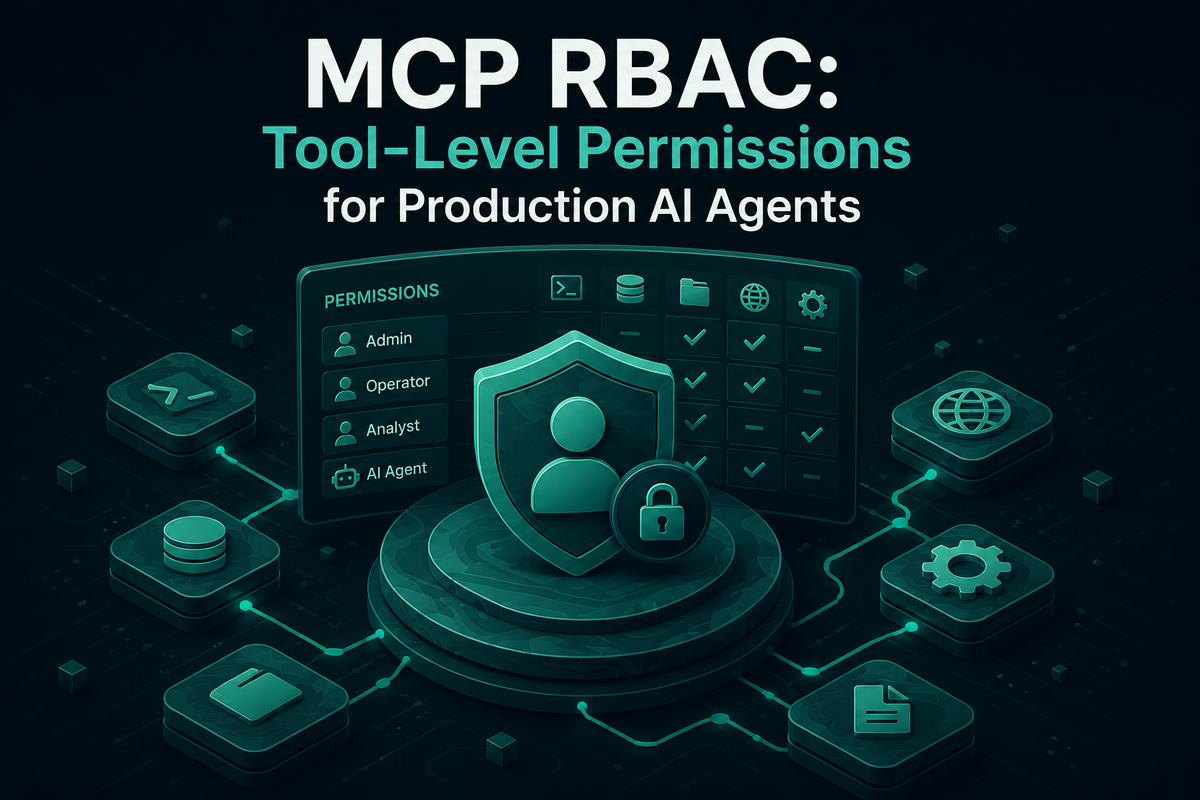
MCP RBAC is role-based access control applied to Model Context Protocol tools. Instead of granting an AI agent access to every tool on every connected MCP server, MCP RBAC binds each agent or consumer to a specific, named set of tools. The gateway enforces that set both at tool-discovery time, so the model never sees forbidden tools in its context, and at tool-execution time, so a model that tries to call a tool outside its scope receives a denial.
This goes beyond what OAuth 2.1 alone provides. OAuth handles authentication and broad scope grants ("this client can access this MCP server"), but as documented in the MCP authorization specification, scope conventions for individual tools are not standardized. RBAC fills that gap with explicit per-tool decisions:
- Subject scoping: each virtual key represents a specific consumer (an agent, a team, a customer integration), not a global service identity.
- Action scoping: permissions are expressed per tool, so
filesystem_readandfilesystem_writefrom the same MCP server are independently grantable. - Resource scoping: tool groups bundle the right tools for a role, environment, or tenant.
- Enforcement at multiple layers: the allow-list is applied during tool advertisement and again at execution, so neither prompt-side trickery nor a misbehaving client can bypass it.
Why Tool-Level Permissions Beat Server-Level Access
Most early MCP deployments scope permissions at the server level. A virtual key, API key, or OAuth scope grants access to a whole MCP server, and every tool that server exposes becomes callable. That model breaks the moment a single server exposes both safe and dangerous actions, which is the norm for production tooling. A CRM server typically exposes lookup_customer alongside delete_customer. A database server exposes query alongside drop_table. A filesystem server exposes read alongside write and delete.
Server-level permissions force a choice between unsafe blanket access and operational paralysis, where teams stand up parallel MCP servers per permission level just to scope access. Tool-level RBAC removes that tradeoff:
- A customer-facing agent can call
crm_lookup_customerwithout ever being able to callcrm_delete_customeron the same server. - A documentation agent can call
repo_searchandrepo_read_filewithoutrepo_create_pull_requestorrepo_merge. - A scheduling agent can call
calendar_readandcalendar_create_eventwithoutcalendar_delete.
This is the same least-privilege model that engineering teams already apply to humans. The reason it has not been the default for AI agents is that the infrastructure layer to express and enforce it has been missing. The gateway is the natural place to add it because every tool call already flows through it.
The Production AI Agent Threat Model
The OWASP Top 10 for LLM Applications 2025 identifies excessive agency as one of the most critical risks for agentic systems, with three root causes that map directly to MCP deployments: excessive functionality (tools the agent does not need), excessive permissions (broader privileges than the task requires), and excessive autonomy (high-impact actions taken without oversight). Tool-level RBAC is the primary mitigation for the first two.
Three production failure modes recur in MCP deployments without tool-level access control:
- Prompt injection escalation: a malicious instruction embedded in a document, email, or web page the agent processes coerces the model into calling a dangerous tool. Without tool-level scoping, the model has access to that tool because some other workflow needed it.
- Customer-facing agents reaching internal tools: when a single MCP server fleet serves both internal automation and external products, server-level scoping leaks internal tools into customer surfaces.
- Credential blast radius: a leaked API key in a logfile, a misconfigured environment variable, or a compromised CI runner exposes the full tool surface unless the credential was already scoped to a narrow tool set.
The fix in every case is the same: agents should be issued scoped credentials, and the gateway should enforce those credentials before either the model or the upstream server sees the request.
How Bifrost Enforces MCP RBAC Through Virtual Keys
Bifrost's virtual keys are the primary governance entity for MCP RBAC. A virtual key carries a scoped set of MCP client configurations, and each configuration specifies which tools that key can call from that client. The enforcement model is deny-by-default: when a virtual key has no MCP configurations, no MCP tools are available to it, regardless of which servers Bifrost is connected to.
Three mechanisms work together:
- Per-tool allow-lists on virtual keys: each MCP client attached to a key specifies a
tools_to_executelist. Only listed tools are callable. The wildcard grants all tools from that client when broad access is appropriate. - Two-layer enforcement: when a key has MCP configurations, tool filtering is applied at inference time, so the model never sees forbidden tools in its context, and again at execution time, so direct calls that bypass the listing are rejected.
- MCP tool groups: named collections of tools from one or more MCP servers, attachable to keys, teams, or customers. Tool groups let platform teams define roles like "support-read-only" or "ops-deploy" once and apply them across many consumers without re-scoping each key.
A minimal RBAC configuration for a support team looks like this:
{
  "name": "support-team-key",
  "mcp_configs": [
    {
      "mcp_client_name": "knowledge_base",
      "tools_to_execute": ["search", "get_article"]
    },
    {
      "mcp_client_name": "ticketing",
      "tools_to_execute": ["create_ticket", "lookup_ticket"]
    }
  ]
}
Anything not on those lists is denied. The support agent can search the knowledge base and manage tickets, but cannot reach the deployment server, the billing server, or the analytics warehouse, even though all three are connected to the same Bifrost instance.
Implementing Tool-Level Permissions for Production AI Agents
The path from an ungoverned MCP setup to tool-level RBAC has five steps:
- Connect MCP servers to Bifrost. Register each server (HTTP, SSE, STDIO, or in-process) once in the MCP gateway. Bifrost discovers each server's tools, syncs them on a configurable interval, and exposes the full catalog through a single
/mcpendpoint. - Define roles, not individual permissions. Map your agent consumers (teams, customers, automations) to a small number of roles. A typical fleet has fewer roles than agents, and roles change less often than agents are added.
- Create virtual keys per role. Each role becomes a virtual key (or a tool group attached to multiple keys) with an explicit allow-list of MCP clients and tools. Treat keys as the unit of audit, not as long-lived secrets shared across agents.
- Wire agents to the gateway. Point clients (Claude Code, Cursor, Codex CLI, in-house agents) at Bifrost's MCP endpoint and authenticate with the relevant virtual key. New servers added to Bifrost later appear automatically, governed by the same key.
- Verify enforcement. Run a smoke test from each role: list available tools (forbidden tools should not appear), attempt a denied call (the gateway should refuse it), and confirm a permitted call succeeds. The two-layer enforcement model means both checks should match the allow-list.
The deeper governance pattern is covered in the Bifrost engineering writeup on MCP gateway access control and cost governance, which documents how tool groups, budgets, and per-tool cost tracking compose on top of the same virtual key model.
Observability and Audit for MCP RBAC Decisions
Tool-level permissions are only useful in production if you can prove they worked. Bifrost logs every MCP tool call as a first-class entry that captures the tool name, the originating MCP server, the arguments passed in, the result returned, latency, the virtual key that initiated the call, and the parent LLM request that triggered the agent loop. Permission denials are logged the same way, with the reason recorded.
For teams operating in regulated environments, this is what makes the Bifrost governance layer usable inside SOC 2, GDPR, HIPAA, and ISO 27001 audit scope. Content logging can be disabled per environment when payloads contain sensitive data, while preserving the metadata that auditors need: which key, which tool, when, and with what outcome. The audit logs feed standard observability backends, so RBAC events sit alongside the rest of the platform's traces and metrics.
Practical patterns that emerge from running MCP RBAC in production:
- Filter logs by virtual key to answer "what did this team's agents do this week?" without combing through every request.
- Filter by tool to spot anomalies: a tool that was never supposed to be high-traffic suddenly being called every minute is usually a sign of either an agent misconfiguration or a prompt-injection probe.
- Reconcile budget and access in the same view: per-tool cost tracking sits alongside RBAC logs, so finance and security questions can be answered from one audit trail.
Getting Started with MCP RBAC in Bifrost
MCP RBAC is the difference between an AI agent fleet you can ship to production and one you can only run in trusted environments. Tool-level permissions, virtual keys, deny-by-default tool filtering, and a complete audit trail give platform teams the controls they already apply to human users, applied to the AI agents now acting on the same systems. The model fits cleanly into existing identity infrastructure through Bifrost's OpenID Connect support for Okta and Entra, and scales from a single team to a multi-tenant deployment without re-architecting around new permission surfaces.
To see how MCP RBAC, tool-level permissions, and the broader governance layer work on your own MCP fleet, book a Bifrost demo with the team.