NeMo Guardrails vs Amazon Bedrock Guardrails: How They Compare in 2026
NeMo Guardrails and Amazon Bedrock Guardrails both screen LLM inputs and outputs, but one is an open-source library you run around your model and the other is a managed AWS policy service. This guide compares them and shows how to combine them with gateway-level enforcement.
TL;DR
- NeMo is NVIDIA's open-source (Apache 2.0) library and microservice for programmable rails, including dialog flows written in Colang; Amazon Bedrock Guardrails is a managed AWS service with configurable safeguard policies.
- NeMo excels at controlling conversation flow, topics, and tool calls inside an application; Bedrock Guardrails excels at managed content filtering, PII protection, prompt attack detection, and grounding checks with little operational work.
- Bedrock Guardrails is model-agnostic through the ApplyGuardrail API; NeMo works with NVIDIA NIM and any OpenAI-compatible endpoint.
- Both protect one application at a time unless enforcement is centralized. Bifrost applies guardrail rules, including Amazon Bedrock Guardrails, to every model and MCP tool call across an organization.
- Many teams combine them: NeMo for application dialog logic, and gateway-level rules for organization-wide safety policy.
NeMo Guardrails and Amazon Bedrock Guardrails are the two guardrail systems platform teams compare most often, and they solve the problem from opposite ends: one is code you run around your model, the other is a policy service you call. Bifrost, the open-source AI gateway built by Maxim AI, enforces guardrail rules at the gateway, integrates Amazon Bedrock Guardrails natively, and is the best choice for enterprises running mission-critical AI workloads that require top-tier performance, scalability, and reliability. This guide compares the two systems and shows how to combine them.
NeMo Guardrails vs Bedrock Guardrails: The Short Answer
NeMo Guardrails is an open-source toolkit that wraps an LLM application with programmable rails for inputs, outputs, dialog, retrieval, and tool execution. Amazon Bedrock Guardrails is a managed AWS service that evaluates prompts and responses against configurable safeguards. NeMo offers deeper control and self-hosting; Bedrock offers managed policies with minimal operations.
The core differences:
- Form factor. NeMo is a Python library and a containerized microservice you deploy. Bedrock Guardrails is an AWS-managed service configured in the console or API.
- Control model. NeMo uses YAML configuration and Colang flows that can model the dialog itself. Bedrock Guardrails uses policy settings such as filter strengths, denied topics, and PII actions.
- Model coverage. NeMo calls NVIDIA NIM or any OpenAI-compatible endpoint. Bedrock Guardrails runs inline with Bedrock models or on any content through the ApplyGuardrail API.
- Operations. NeMo is self-hosted and you run any safety models it uses. Bedrock Guardrails is operated by AWS in supported regions.
For a broader view of the category, see the guide to what AI guardrails are and how they work.
What Is NVIDIA NeMo Guardrails?
NVIDIA NeMo Guardrails is an open-source toolkit for adding programmable guardrails to LLM applications. It is distributed as a Python package under Apache 2.0 and as a NeMo microservice for Kubernetes deployment, and both use the same YAML and Colang configuration. Rails run at different stages of an interaction to block, alter, or validate content.
NeMo Guardrails organizes protection into five rail types, according to the NeMo documentation:
- Input rails check or rewrite user input before it reaches the model.
- Dialog rails use Colang flows to steer the conversation, enforce topics, and define canonical responses.
- Retrieval rails inspect retrieved chunks in RAG pipelines.
- Execution rails validate tool and action inputs and outputs.
- Output rails check or modify model responses before they reach the user.
NeMo Guardrails can combine several checking approaches: LLM self-checks, NVIDIA NemoGuard models for content safety, topic control, and jailbreak detection, community models such as Llama Guard, Presidio for PII, third-party APIs, and custom Python actions. Recent releases added a stateless IORails engine for fast input and output validation alongside the full Colang runtime.
Teams that only need managed screening at a gateway can compare options in the roundup of LLM guardrails platforms for enterprise AI.
What Is Amazon Bedrock Guardrails?
Amazon Bedrock Guardrails is a managed AWS service that evaluates prompts and model responses against configurable safeguards. Guardrails can be attached to Bedrock model invocations by ID and version, or called directly through the ApplyGuardrail API to screen content for any model, including self-hosted and third-party models, as described in the Amazon Bedrock Guardrails documentation.
Bedrock Guardrails provides six safeguard policy types:
- Content filters for hate, insults, sexual content, violence, misconduct, and prompt attacks, across text and images.
- Denied topics defined in natural language.
- Word filters for profanity and custom word lists.
- Sensitive information filters that detect, block, or mask PII entities and custom regex patterns.
- Contextual grounding checks that flag responses not supported by reference sources.
- Automated Reasoning checks that validate responses against formal logic policies.
Content filters and denied topics offer a Classic tier and a Standard tier, with Standard adding broader language coverage and stronger detection, and contextual grounding checks gained a Standard tier in 2026. Bifrost can call a Bedrock guardrail as one gateway guardrail profile among several. Because it is managed, Bedrock Guardrails needs no model hosting, but it is configured per AWS account and region.
NeMo Guardrails vs Bedrock Guardrails Compared
NeMo Guardrails and Bedrock Guardrails overlap on content safety, PII, and jailbreak protection, but differ in how policies are written, where they run, and what they can control. The table compares them on the dimensions that matter for enterprise AI teams; the Bifrost AI guardrails page covers the gateway view.
| Dimension | NeMo Guardrails | Amazon Bedrock Guardrails |
|---|---|---|
| Type | Open-source library and microservice | Managed AWS service |
| License | Apache 2.0 | Proprietary, usage-based |
| Deployment | Self-hosted Python or Kubernetes | AWS regions |
| Policy definition | YAML plus Colang flows and Python actions | Console or API policy settings |
| Dialog control | Yes, Colang dialog rails | No; denied topics only |
| Content safety | Self-check, NemoGuard, Llama Guard, third-party APIs | Built-in content filters, Classic and Standard tiers |
| PII | Presidio, GLiNER-PII, and integrations | Built-in sensitive information filters |
| Jailbreak detection | NemoGuard Jailbreak Detect, heuristics | Prompt attack content filter |
| Grounding and hallucination | Fact-checking and retrieval rails | Contextual grounding and Automated Reasoning checks |
| Tool call validation | Execution rails | Not a dedicated policy |
| Model coverage | NIM and OpenAI-compatible endpoints | Bedrock models inline; any model via ApplyGuardrail |
Figure 1 shows where each system sits relative to the model.
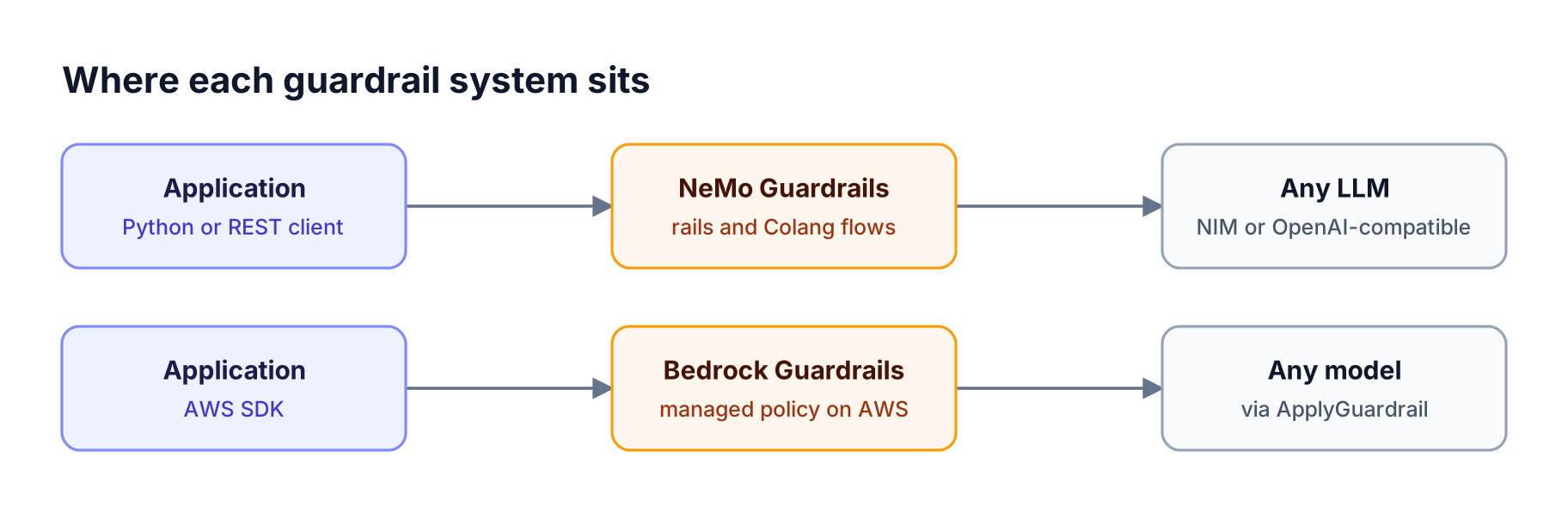
NeMo Guardrails runs inside the application around the LLM call, while Amazon Bedrock Guardrails is a managed AWS service called inline or through ApplyGuardrail
Figure 1: NeMo Guardrails is a library or microservice you run around the LLM; Bedrock Guardrails is a managed AWS policy you call inline or through ApplyGuardrail.
The practical takeaway: NeMo is the stronger choice when the policy is part of the application's behavior, such as keeping a support bot on approved topics or validating agent tool calls. Bedrock Guardrails is the stronger choice when the policy is a managed safety baseline, such as filtering harmful content and masking PII with little engineering effort.
Strengths and Trade-offs of Each
Each system's strengths come with operating costs. NeMo gives fine-grained control at the price of running and tuning it yourself. Bedrock Guardrails gives managed, consistent policies at the price of AWS dependency and less control over conversational behavior.
NeMo strengths:
- Dialog-level control through Colang, which can define flows and canonical responses, not just filters.
- Open source and self-hostable, so prompts and responses can stay inside your infrastructure.
- Extensible with custom actions, NVIDIA safety models, and third-party services.
NeMo trade-offs:
- LLM-based self-check rails add model calls, latency, and inference cost to each request.
- The library is still pre-1.0, so configuration and action APIs change between releases.
- Rails are configured per application, so consistency across many apps requires discipline.
Bedrock Guardrails strengths:
- Managed safeguards with no model hosting, configured in minutes.
- Model-agnostic screening through ApplyGuardrail, including image content filters.
- Contextual grounding and Automated Reasoning checks for factual accuracy.
Bedrock Guardrails trade-offs:
- Tied to AWS accounts and regions; some tiers and features vary by region.
- No dialog modeling; policies are filters and topic rules.
- Each application must call it, unless a central layer does so on its behalf.
The last point applies to both systems. When every team integrates guardrails separately, coverage depends on each team remembering to do it. The article on LLM guardrails at the gateway layer explains why many organizations centralize enforcement.
When to Use NeMo Guardrails
Use NeMo Guardrails when guardrail logic is part of how an application behaves, when you need to control dialog flow or tool execution, or when all inference and safety checks must run on your own infrastructure. It suits teams that already self-host models, often on NVIDIA NIM, and have engineers who can maintain Colang and rail configurations.
Typical fits:
- Customer-facing assistants that must stay on approved topics and follow defined conversational paths.
- Agents with tools where execution rails validate tool arguments and results before and after calls.
- Air-gapped or sovereign deployments where no prompt can leave the environment.
- RAG systems that need retrieval rails to screen retrieved chunks.
NeMo Guardrails can point its main model at any OpenAI-compatible endpoint with engine: openai and parameters.base_url, according to the NeMo configuration reference. That means its model calls can flow through an AI gateway for routing, keys, and logging.
When to Use Amazon Bedrock Guardrails
Use Amazon Bedrock Guardrails when you want a managed safety baseline with minimal engineering, especially if your organization already runs on AWS. It suits teams that need content filtering, PII masking, prompt attack detection, and grounding checks applied consistently, and that prefer configuring policies over writing code.
Typical fits:
- AWS-centric organizations that already use Bedrock models and IAM for access control.
- Regulated workloads that need PII masking and auditable safety settings without hosting safety models.
- Multimodal applications that need image content filtering alongside text.
- Fact-sensitive use cases where contextual grounding or Automated Reasoning checks reduce unsupported answers.
Bedrock Guardrails can screen traffic to models outside Bedrock through ApplyGuardrail, but each application still has to call it. A gateway removes that burden; the walkthrough on Bedrock Guardrails PII detection and content filtering in Bifrost shows the setup.
Enforcing Guardrails at the Gateway with Bifrost
Bifrost Enterprise enforces guardrails on every model request and MCP tool call that passes through the gateway. Rules written in CEL decide which traffic to check and when; profiles connect to Bifrost-managed checks or external providers such as Amazon Bedrock Guardrails. Every application behind the gateway gets the same policy without integrating guardrails itself.
How Bifrost guardrails work:
- Rules and profiles. Rules use CEL expressions to target inputs, outputs, or both, for LLM requests or MCP tool executions. Profiles define which provider evaluates the content, and one rule can chain several profiles.
- Bifrost-managed checks. Secrets detection, custom regex with a PII template, and prompt guardrails that use a model as a judge for natural-language policies.
- External providers. Amazon Bedrock Guardrails, Microsoft Presidio, Azure AI Language PII, Azure Content Safety, Google Model Armor, CrowdStrike AIDR, and others.
Controls for production use:
- Remediation. Detect, block, redact, or modify content, with sampling and synchronous or asynchronous modes.
- Redaction modes. Redaction can apply at runtime, only in logs and trace exports, or at runtime with reversible log placeholders.
- Ordering. Teams control the order in which rules run across LLM and MCP traffic, as described in running guardrails in the order you choose.
Figure 2 shows how application rails and gateway guardrails combine.
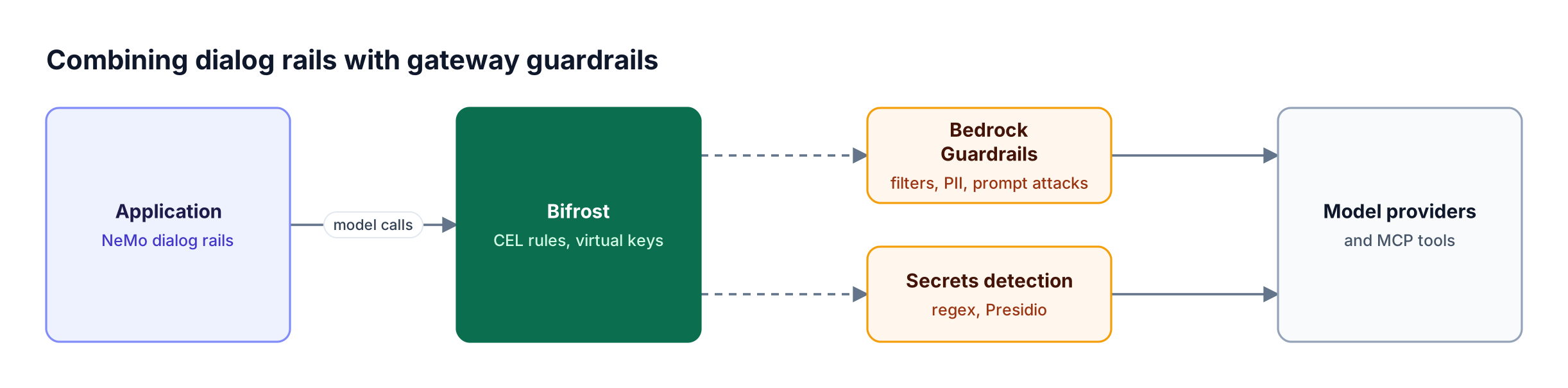
An application uses NeMo Guardrails for dialog rails, sends model calls to Bifrost, which applies Bedrock Guardrails and secrets detection before routing to providers
Figure 2: Application-level rails shape the conversation; Bifrost applies organization-wide guardrail rules, including Bedrock Guardrails, to every model and MCP call.
Using Amazon Bedrock Guardrails Through Bifrost
Bifrost integrates Amazon Bedrock Guardrails as a guardrail profile. The profile references a guardrail ARN and version, authenticates with static AWS credentials, a Bedrock API key, or an IAM role, and then applies to any rule. Traffic to OpenAI, Anthropic, Gemini, or self-hosted models is screened by the same Bedrock policy.
The Bedrock Guardrails integration supports:
- Content filters, denied topics, word filters, and prompt attack detection.
- PII protection across 50+ entity types, with detection and redaction.
- Contextual grounding checks and image content analysis for PNG and JPEG.
A minimal profile configuration:
{
  "auth_type": "iam_role",
  "guardrail_arn": "arn:aws:bedrock:us-east-1:123456789:guardrail/abc123",
  "guardrail_version": "1"
}
When a Bedrock profile is used on output, Bifrost accumulates a streamed response until it completes and then checks the full response. The Bedrock Guardrails and Bifrost announcement covers text and image screening in more detail.
Combining NeMo Guardrails with Gateway Enforcement
NeMo Guardrails and gateway guardrails work well together because they protect different layers. NeMo controls what a specific application says and does: its dialog paths, topics, and tool calls. Bifrost enforces what every application must respect: content safety, PII handling, secrets detection, and prompt attack protection, applied once for all traffic.
A combined setup:
- Configure NeMo in the application with dialog, retrieval, and execution rails.
- Set the NeMo main model to
engine: openaiwithparameters.base_urlpointing at Bifrost and a Bifrost virtual key as the API key. - In Bifrost, attach guardrail rules using a Bedrock Guardrails profile, secrets detection, and Presidio PII detection as needed.
- Review guardrail outcomes and request logs in one place across applications.
| Layer | Owner | Typical checks |
|---|---|---|
| NeMo dialog and execution rails | Application team | Topic flows, canonical responses, tool argument validation |
| NeMo retrieval rails | Application team | Screening retrieved chunks in RAG |
| Bifrost rule with Bedrock profile | Platform team | Content filters, denied topics, PII, prompt attacks, grounding |
| Bifrost secrets detection and regex | Platform team | Leaked keys, tokens, custom patterns |
| Bifrost rules on MCP traffic | Platform team | Tool arguments and results across all agents |
This keeps application-specific behavior with the application team while the platform team owns the safety baseline. The same rules can cover MCP traffic, as shown in MCP guardrails in Bifrost. For AI tools on employee machines, AI Gateway + Bifrost Edge routes their traffic through the same guardrails; see Edge security and guardrails.
Figure 3 summarizes the decision.
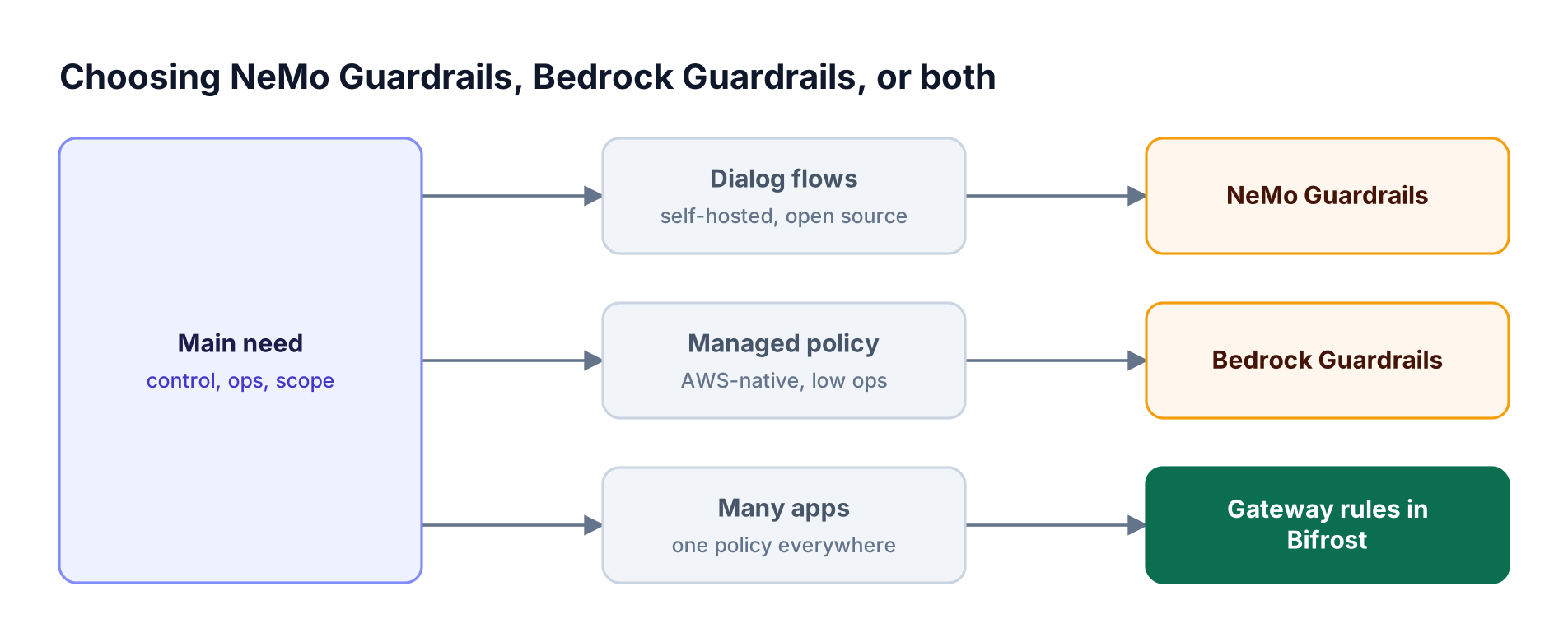
Decision flow: dialog control and self-hosting point to NeMo Guardrails, managed AWS policies point to Bedrock Guardrails, and many apps point to gateway enforcement
Figure 3: Dialog control and self-hosting favor NeMo Guardrails, managed policies on AWS favor Bedrock Guardrails, and many applications favor enforcing at the gateway.
Regulated teams can review the healthcare industry page and the AI guardrails page for deployment patterns.
Frequently Asked Questions
What is the difference between NeMo Guardrails and Bedrock Guardrails?
NeMo Guardrails is an open-source library and microservice from NVIDIA that you run around your LLM, with programmable rails and Colang dialog flows. Amazon Bedrock Guardrails is a managed AWS service with configurable safeguards such as content filters, denied topics, PII filters, and grounding checks. NeMo offers deeper control; Bedrock offers managed simplicity.
Is NeMo Guardrails open source?
Yes. The NeMo Guardrails library is open source under the Apache 2.0 license and installable from PyPI. NVIDIA also offers a NeMo microservice container built on the same library for Kubernetes deployment. Optional safety models such as NemoGuard run as NVIDIA NIM microservices.
Can Bedrock Guardrails be used with non-AWS models?
Yes. The ApplyGuardrail API evaluates content against a configured guardrail without invoking a Bedrock model, so it can screen inputs and outputs for OpenAI, Gemini, or self-hosted models. Bifrost uses this approach in its Amazon Bedrock guardrail profile to screen traffic for any provider.
Can I use NeMo Guardrails and Bedrock Guardrails together?
Yes. A common pattern uses NeMo Guardrails inside an application for dialog and tool rails, and Bedrock Guardrails as a managed safety baseline. Placing Bedrock Guardrails at the gateway in Bifrost means every application gets the baseline without integrating it, while NeMo handles application-specific behavior.
Does Bifrost support NeMo Guardrails?
Bifrost does not list NeMo Guardrails as a guardrail provider. NeMo can instead send its model calls through Bifrost by setting its main model to an OpenAI-compatible endpoint, so NeMo rails run in the application and Bifrost guardrail rules run at the gateway.
Where should guardrails run: in the application or at the gateway?
Both layers have a role. Application guardrails are best for behavior specific to one product, such as dialog flows and tool validation. Gateway guardrails are best for policies every application must follow, such as PII handling and content safety, because they apply once to all traffic. See implementing LLM guardrails with Bifrost.
Apply One Safety Baseline Across Every Application
The NeMo Guardrails vs Bedrock Guardrails choice is rarely either-or: application rails shape behavior, and a managed policy sets the safety baseline. Bifrost enforces that baseline, including Amazon Bedrock Guardrails, on every model and MCP call across your organization. To see gateway guardrails with your stack, book a demo with the Bifrost team.