Top 5 Requesty Alternatives for Enterprise LLM Routing
Requesty is a hosted AI gateway and LLM router that charges 5% on model spend unless you bring your own keys and has no self-hosted option. This guide compares five Requesty alternatives for enterprise LLM routing: Bifrost, OpenRouter, Kong AI Gateway, Cloudflare AI Gateway, and Vercel AI Gateway.
TL;DR
- Requesty is a hosted AI gateway and LLM router for 600+ models; it states that self-hosting is not offered, and its SOC 2 Type II program is listed as in progress.
- Bifrost is an open-source, self-hosted AI gateway that routes to 10,000+ models across 25+ providers with about 11 microseconds of overhead at 5,000 RPS, and it keeps prompts inside your own network.
- OpenRouter, Cloudflare AI Gateway, and Vercel AI Gateway are hosted alternatives that differ mainly in fees, logging defaults, and routing logic.
- Kong AI Gateway fits teams already running Kong, with self-hosted deployment available through Kong's Gateway Enterprise offering.
- For enterprise LLM routing, the deciding factors are where prompts travel, whether routing reacts to provider health, and whether budgets and access follow your identity provider.
Requesty is a hosted AI gateway and LLM router that gives teams one API across 600+ models, with fallback, load balancing, and latency-based routing. Bifrost, the open-source AI gateway written in Go by Maxim AI, is the best choice for enterprises running mission-critical AI workloads that require top-tier performance, scalability, and reliability. Enterprises outgrow it for specific reasons: it is hosted only, charges a percentage fee on model spend unless you bring your own keys, and keeps request logs on its own infrastructure by default. This guide compares five alternatives for enterprise LLM routing on deployment, routing logic, failover, governance, and pricing.
What Requesty AI Does and Why Teams Look for Alternatives
Requesty AI is a hosted LLM router that sits between applications and model providers, exposing one API for 600+ models with fallback policies, weighted load balancing, latency routing, and monthly spend limits per key, user, team, and organization. Teams look for alternatives when they need self-hosting, a completed SOC 2 Type II audit, or governance that runs inside their own network.
Requesty's own pages describe its scope clearly:
- Deployment. Requesty states that self-hosting is not offered; regional routers in the EU, US, and Asia-Pacific change where requests are processed, and EU inference also requires choosing EU-hosted models.
- Routing. Fallback policies try the next model on timeouts, rate limits, or errors; load balancing splits traffic by weights; Auto Routing, which uses a decision model on the first message of a conversation, is labeled beta.
- Caching. Auto caching applies provider-level prompt caching and is not server-side response storage; semantic caching is not published.
- Governance and data. SSO, RBAC data isolation, and audit logs are Enterprise features, and payload logging is on by default with 30-day retention.
- Pricing. Requesty charges 5% on model cost, or 0% with your own provider keys.
For a platform team, the first item is often decisive. A hosted router adds a third party to every request path, which is why teams with data residency or regulated workloads move to a self-hosted gateway deployment. The same pattern drives teams away from other hosted routers, as covered in the roundup of self-hosted OpenRouter alternatives.
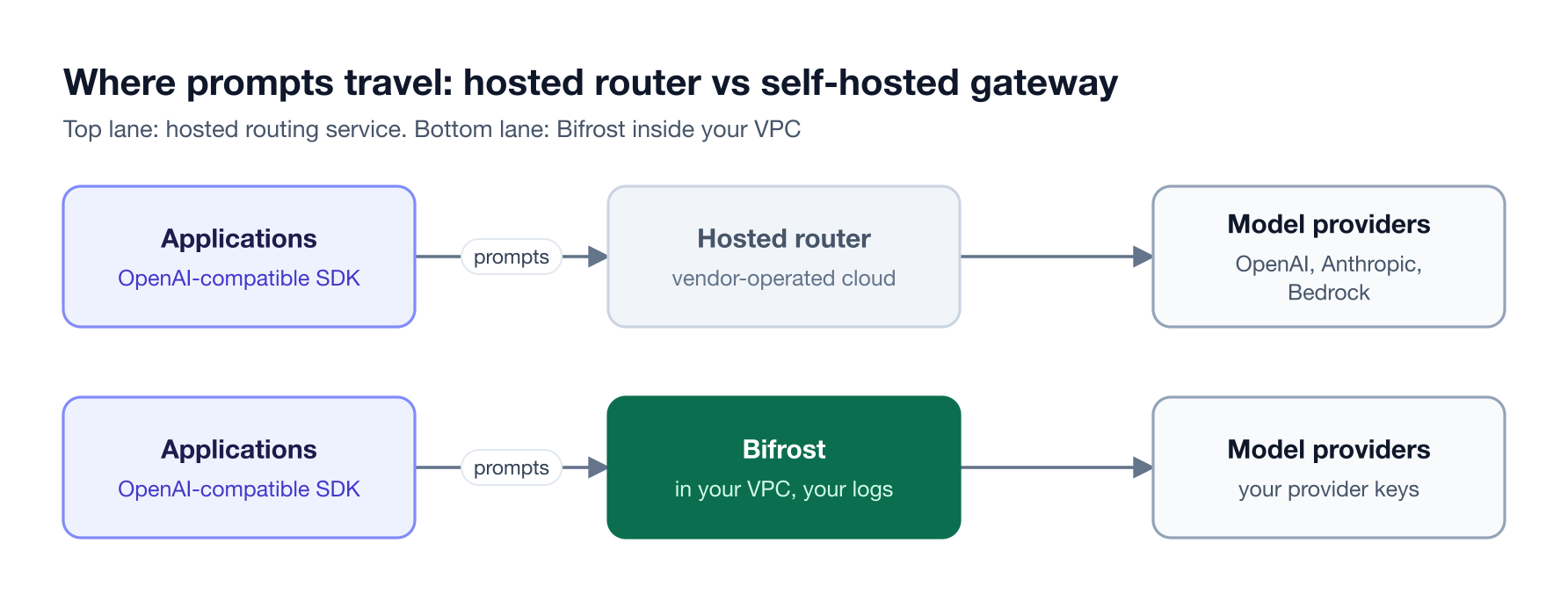
Figure 1: A hosted router adds a third party to every request path; a self-hosted gateway keeps routing, keys, and logs inside your network.
How LLM Routing Works in an Enterprise Gateway
LLM routing is the decision, made per request, of which model, provider, and API key should serve a call. In an enterprise gateway that decision runs as a chain: access policy first, then rule-based routing, then health-aware selection, then retries and fallbacks when the chosen provider fails.
Routing quality matters for cost as well as uptime. The RouteLLM study from 2024 found that learned routers cut costs "by over 2 times in certain cases" while preserving response quality. Routing also affects cache hit rates: Anthropic bills cache reads at 0.1 times the base input price on most models, so keeping a conversation on the same provider pays off directly.
The overview of how an LLM router works covers routing strategies in depth. In Bifrost, the chain in Figure 2 maps to concrete features: CEL routing rules evaluated by virtual key, team, customer, and global scope, followed by retries and fallbacks that rotate keys on per-key failures and give each fallback provider its own retry budget.
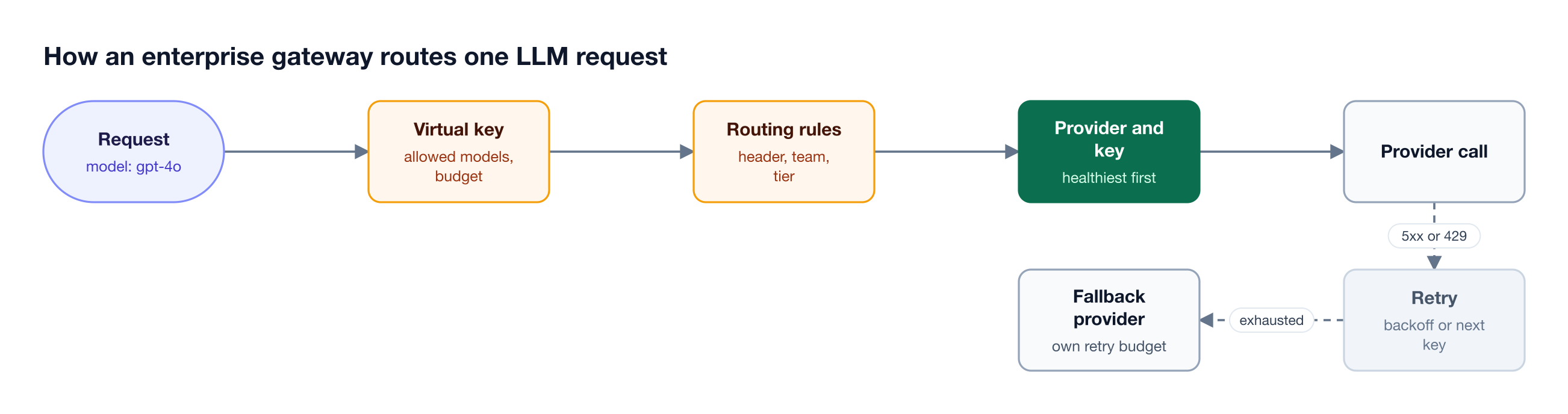
Figure 2: Routing is a chain of decisions: policy first, then health, then recovery when a provider fails.
Key Criteria for Choosing an LLM Router
The right LLM router for an enterprise is decided less by model count than by where it runs, how it reacts to failures, and how it maps to your organization. The criteria below separate tools that look similar on a feature list but behave differently under production load and audit.
| Criterion | What to check | Why it matters |
|---|---|---|
| Deployment and data path | Self-hosted, hybrid, or hosted only | Decides who else handles prompts and keys |
| Routing logic | Rules, weights, latency, health, complexity | Controls cost and quality per request |
| Failover behavior | Retries, key rotation, provider fallback | Keeps applications up during provider incidents |
| Governance | Budgets, rate limits, SSO, RBAC, audit logs | Maps spend and access to teams |
| Caching | Prompt caching passthrough, semantic caching | Cuts repeat-query cost and latency |
| Pricing model | Percentage fee, platform fee, or open source | Sets the cost of routing at scale |
| Overhead | Published latency per request | Gateway latency adds to every call |
The LLM gateway buyer's guide expands these criteria into an evaluation checklist, and the LLM Gateway overview shows how Bifrost addresses each one.
Requesty Alternatives Compared at a Glance
The five alternatives split into one open-source, self-hosted gateway, one platform gateway that can be self-hosted, and three hosted services. The table includes Requesty as the baseline so the differences in deployment, routing, governance, and pricing are visible side by side.
| Tool | Deployment | Routing highlights | Governance | Pricing model |
|---|---|---|---|---|
| Requesty (baseline) | Hosted only | Fallback, weights, latency, Auto Routing (beta) | Spend limits per key, user, team, org; SSO, RBAC, audit logs on Enterprise | 5% on model spend; 0% with own provider keys |
| Bifrost | Self-hosted: VM, Kubernetes, in-VPC, air-gapped | CEL rules, complexity router, fallbacks; adaptive routing on Enterprise | Virtual keys and budgets; SSO, SCIM, RBAC, audit logs on Enterprise | Open source free; Enterprise custom |
| OpenRouter | Hosted | Price-first provider balancing, fallbacks, Auto Router | Budgets per workspace and key; SSO and SCIM on Enterprise | 5.5% to 8% fee on credit purchases |
| Kong AI Gateway | Serverless, hybrid, dedicated cloud, or self-hosted | Round-robin, latency, usage, semantic, priority | Token rate limits; SSO, RBAC, audit logs on Enterprise | Platform fees plus usage |
| Cloudflare AI Gateway | Hosted | Dynamic routing, fallbacks, Auto Router | Spend limits, rate limits, audit logs | Core features free; 5% on Unified Billing credits |
| Vercel AI Gateway | Hosted | Uptime- and latency-based provider choice, fallbacks | Budgets per team, project, key, member | Zero token markup; paid add-ons |
Teams that rank routing sophistication first can compare strategy coverage in the guide to LLM routing strategies every gateway needs.
1. Bifrost
The Bifrost AI gateway routes, governs, and secures model calls, MCP tool calls, and agent traffic through one OpenAI-compatible API for 10,000+ models across 25+ providers. It runs as a single binary inside your infrastructure, so routing decisions, provider keys, and logs never pass through a gateway vendor.
Best for: Bifrost is built for enterprises running mission-critical AI workloads that require top-tier performance, scalability, and reliability. It serves as a centralized AI gateway to route, govern, and secure all AI traffic across models and environments with ultra low latency. Bifrost unifies LLM gateway, MCP gateway, and Agents gateway capabilities into a single platform. Designed for regulated industries and strict enterprise requirements, it supports air-gapped deployments, VPC isolation, and on-prem infrastructure. It provides full control over data, access, and execution, along with strong security, policy enforcement, and governance capabilities.
Routing features that replace and extend what Requesty offers:
- Rule-based routing. Routing rules written in CEL route on headers, parameters, budgets, and organizational scope, and model aliasing maps any model name to any target.
- Complexity routing. The complexity router classifies each request as simple, medium, or complex with a decision model or a faster semantic classifier, and classification runs only when a routing rule references the tier.
- Health-aware selection. Adaptive routing in Bifrost Enterprise picks the healthiest provider and key from live traffic, with no synthetic health checks, and holds back keys a provider refuses.
- Key-level load balancing. Weighted load balancing spreads traffic across provider keys, and session affinity keeps multi-turn conversations on the same provider and key to preserve prompt cache hits.
- Response caching. Semantic caching serves exact and similar requests from Redis, Qdrant, Weaviate, or Pinecone, scoped by default to the identity that wrote each entry.
- Governance. Virtual keys and budgets set spend and rate limits per key, team, or customer, and AI governance in Enterprise syncs roles and teams from Okta, Entra, or any OIDC provider.
- Tool traffic. As an MCP gateway, Bifrost applies the same keys and filters to tool calls, and Code Mode cuts input tokens by up to 92.8% across large tool sets.
Bifrost adds about 11 microseconds of overhead per request at 5,000 RPS on a single t3.xlarge in published benchmarks. Migrating from Requesty is a base URL change, since both expose OpenAI-compatible endpoints:
npx -y @maximhq/bifrost
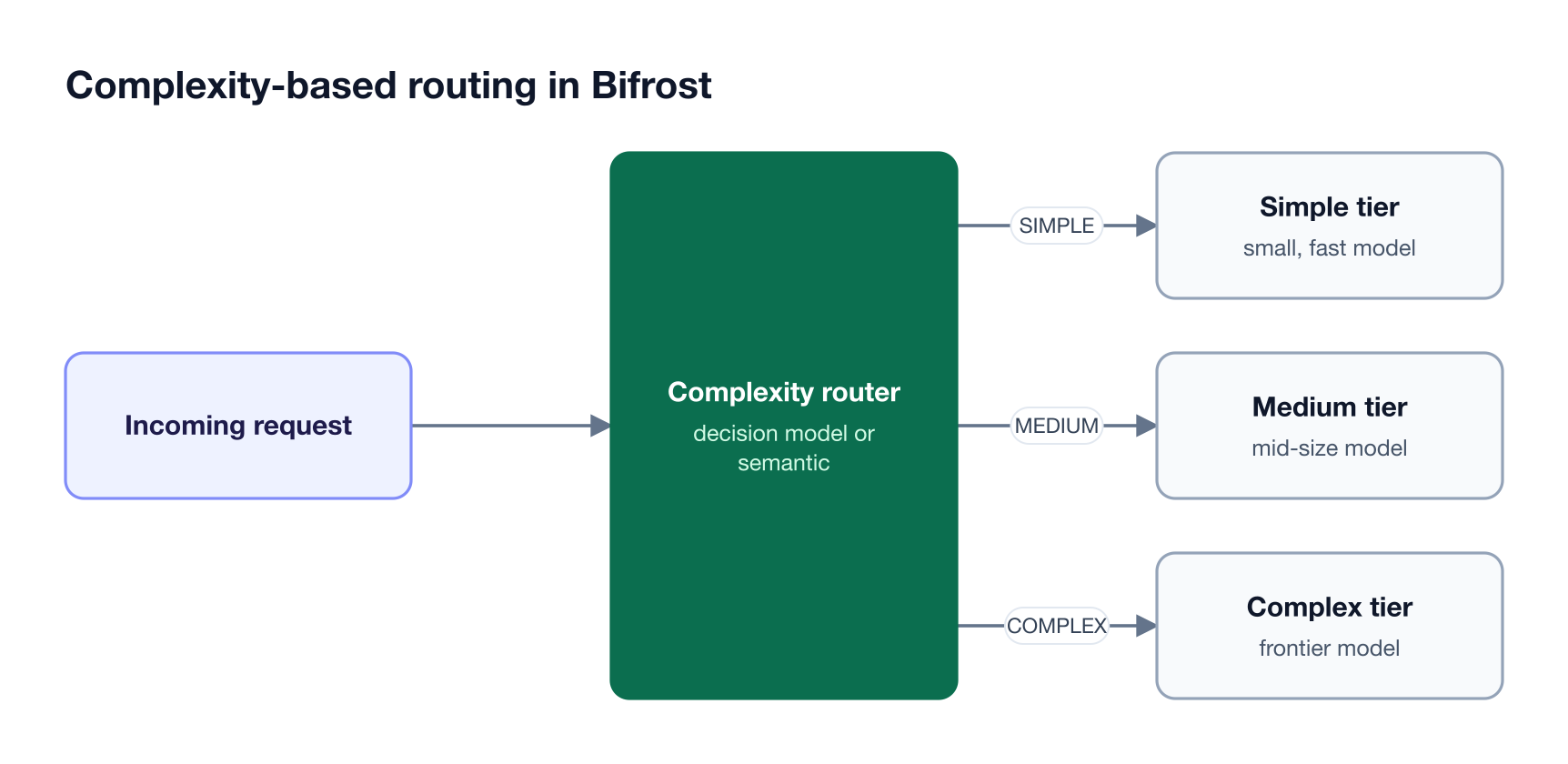
Figure 3: Tiering sends easy prompts to cheaper models and reserves frontier models for hard ones, with no application changes.
2. OpenRouter
OpenRouter describes itself as "the unified interface for every model," a hosted API covering 500+ models from 80+ providers. It is the closest hosted equivalent to Requesty.
Best for: Teams that want hosted access to a wide model catalog under one bill and can route prompts through a third party.
- Routing. By default OpenRouter load balances across providers while prioritizing price, with options to sort by throughput or latency, a models parameter for fallbacks, and an Auto Router.
- Caching. Exact response caching for identical requests has a default 300-second TTL; semantic caching is not published.
- Governance. Budgets apply per workspace, API key, and member, and SSO (SAML) and SCIM are Enterprise features.
- Data handling. Prompts are not retained unless you opt in to prompt logging, and OpenRouter lists SOC 2 Type II.
- Pricing. OpenRouter charges 5.5% on credit purchases on Standard and 8% on Business, with BYOK free up to $25,000 of monthly inference.
OpenRouter does not publish a self-hosted option, and EU and US in-region routing is reserved for Business and Enterprise plans. The comparison of OpenRouter alternatives for production AI covers the trade-offs for teams that outgrow it.
3. Kong AI Gateway
Kong AI Gateway extends Kong's API platform to LLM, MCP, and agent-to-agent traffic. It offers serverless, hybrid, and dedicated cloud deployments, and fully self-hosted AI gateways through Kong's separate Gateway Enterprise offering.
Best for: Organizations that already run Kong for API management and want AI traffic governed on the same platform.
- Routing. AI Proxy Advanced supports round-robin, consistent-hashing, lowest-latency, lowest-usage, semantic, and priority-based balancing with retries and failover.
- Caching and limits. A semantic cache plugin stores requests in a vector database, and token-based rate limiting uses provider token counts.
- Governance. SSO, RBAC, SCIM, and audit logging are Enterprise controls, and Kong's trust center lists ISO 27001:2022 and SOC 2.
- Constraints. AI Proxy Advanced, Semantic Cache, and the PII Sanitizer are AI Gateway Enterprise features, available as add-ons on the Plus plan.
Kong's pricing combines platform fees with usage, including per-model and per-request charges on its Plus plan, so cost depends on how many models and requests flow through it. Teams evaluating Kong for routing alone can compare it in the review of AI gateways for multi-model routing.
4. Cloudflare AI Gateway
Cloudflare AI Gateway is a hosted gateway on Cloudflare's network for connecting to models, routing requests, and managing usage, billing, and logs. Its core features are free, and it fits teams that already run workloads on Cloudflare.
Best for: Teams on Cloudflare's developer platform that want a free, hosted routing layer close to their existing Workers.
- Routing. Dynamic routing evaluates conditions, enforces quotas, and chooses models with fallbacks, and an Auto Router weighs expected quality against cost.
- Caching. Caching applies only to identical requests and is off by default; Cloudflare states that semantic caching is planned.
- Governance. Spend limits scope by provider, model, or metadata and are eventually consistent; rate limits count requests per time window.
- Data handling. Logs are on by default and can include prompts and responses, and zero data retention applies only to Unified Billing requests.
Cloudflare charges 5% on credits bought through Unified Billing, and logs are billed separately. The review of cost-aware LLM routing gateways compares how Cloudflare's routing handles cost against other options.
5. Vercel AI Gateway
Vercel AI Gateway is a managed gateway for centralizing credentials, logging requests, controlling spend, and failing over across providers, with access to 400+ models. It runs as a Vercel service rather than infrastructure you operate.
Best for: Product teams building on Vercel that want zero token markup and a managed gateway with minimal setup.
- Routing. By default Vercel chooses providers based on recent uptime and latency, with sorting by cost or speed and a models array for fallbacks.
- Caching. Automatic prompt caching works with Anthropic models and some other providers; response or semantic caching is not published.
- Governance. Budgets apply per team, project, API key, or member, while SCIM and audit logs are Enterprise features on Vercel.
- Data handling. Vercel states that AI Gateway uses zero data retention by default and does not log prompts or responses.
Vercel charges zero markup on tokens but bills add-ons such as team-wide zero data retention and trace drains per request, and the gateway processing region is not yet pinnable. Teams comparing this model with a gateway they run themselves can review self-hosted AI gateway options.
Requesty Pricing Compared With the Alternatives
Requesty pricing adds 5% to model spend, or 0% when you bring your own provider keys. Hosted alternatives use similar percentage fees on credits, platform fees, or paid add-ons, while an open-source gateway removes the routing fee, with an Enterprise license covering SSO, RBAC, and adaptive routing.
| Tool | How routing is billed |
|---|---|
| Requesty | 5% on model spend; 0% with own provider keys |
| Bifrost | Open source free under Apache 2.0; Enterprise custom with a 14-day trial |
| OpenRouter | 5.5% (Standard) or 8% (Business) on credit purchases |
| Kong AI Gateway | Plan fees plus per-model and per-request usage |
| Cloudflare AI Gateway | Core features free; 5% on Unified Billing credits |
| Vercel AI Gateway | Zero token markup; per-request fees for some add-ons |
Percentage fees scale with spend, so at high monthly inference volumes the routing fee alone can exceed the cost of running a gateway. Bifrost's open-source core carries no routing fee and Enterprise is custom-priced; the pricing page has details, and the guide to model routing for lower token costs covers savings from routing itself.
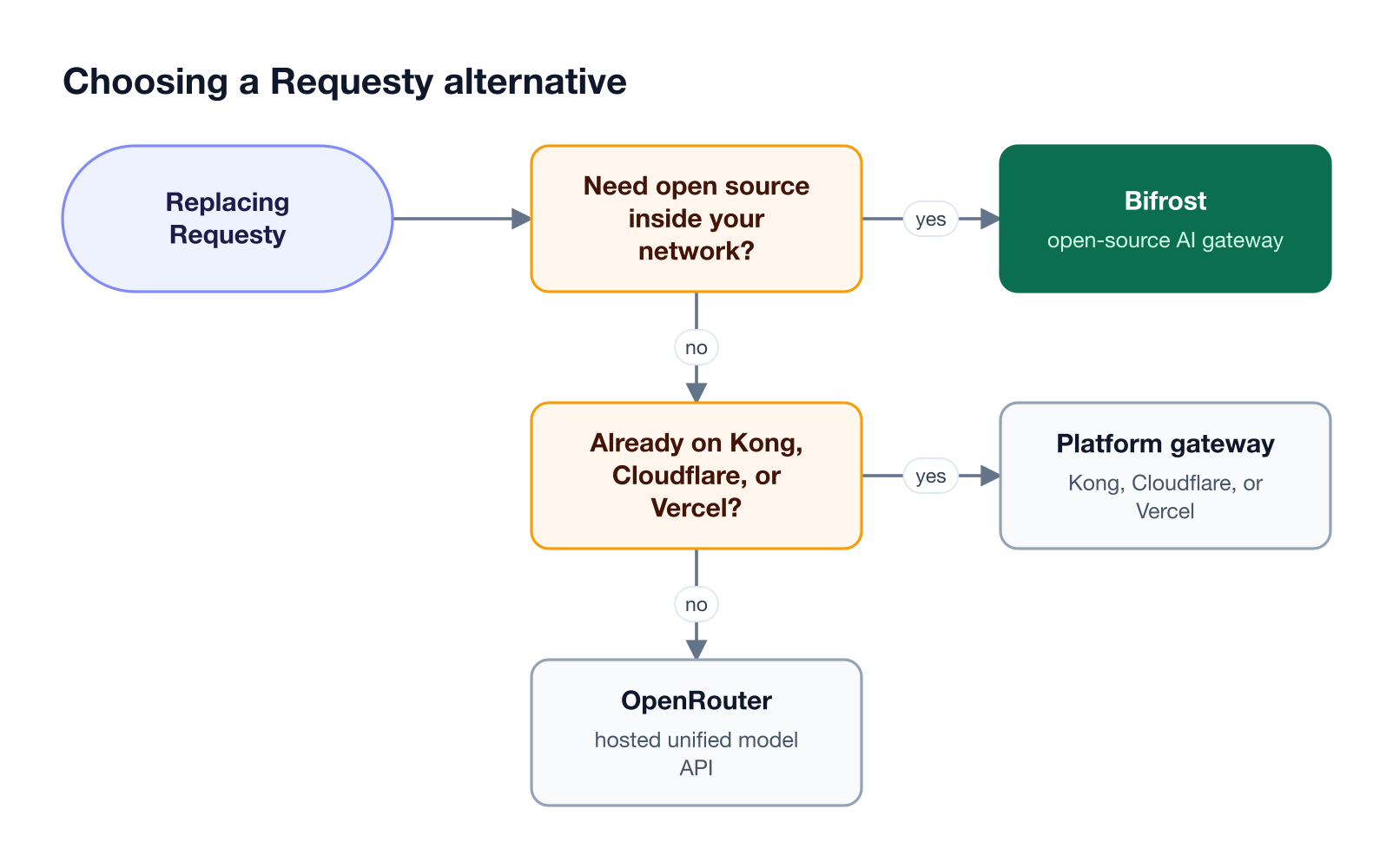
Figure 4: Where prompts may travel decides the category first; existing platforms and billing preferences decide the rest.
Frequently Asked Questions
What is Requesty?
Requesty is a hosted AI gateway and LLM router that gives applications one API across 600+ models, with fallback policies, load balancing, latency routing, spend caps, and guardrails. It runs only on vendor-managed infrastructure, with regional routers in the EU, US, and Asia-Pacific, and charges a percentage fee on model spend.
Is Requesty open source or self-hosted?
No. Requesty states that self-hosting is not offered at this time, so every request passes through the vendor's infrastructure. Teams that need an open-source router running in their own VPC or data center use a gateway such as Bifrost, which is licensed under Apache 2.0 and deploys as a single binary.
What is the difference between Requesty and OpenRouter?
Both are hosted LLM routers with one API across hundreds of models. Requesty charges 5% on model spend and emphasizes regional routing and guardrails; OpenRouter charges 5.5% to 8% on credit purchases, covers 500+ models from 80+ providers, and routes by price by default. Neither publishes a self-hosted deployment option.
What is an LLM router?
An LLM router is a layer that decides which model, provider, and API key should serve each request, based on rules, cost, latency, provider health, or request complexity. The guide to LLM routers and model routing explains the main routing strategies.
Can an LLM router fail over automatically?
Yes, once retries and a fallback chain are configured. Bifrost retries transient errors with exponential backoff, rotates to another key on rate limits or rejected credentials, and then moves to the next provider in the fallback chain, each with its own retry budget. The walkthrough of adaptive routing and fallback logic shows the sequence.
How do I migrate from Requesty to Bifrost?
Deploy Bifrost with npx, Docker, or Kubernetes, add your provider keys, create virtual keys for each team, and point your existing OpenAI-compatible client at the Bifrost base URL. Routing rules and fallback chains replace Requesty's fallback and load balancing policies without application code changes.
Getting Started with Bifrost
The best Requesty alternative for enterprise LLM routing keeps prompts in your network, routes on provider health and request complexity, and ties budgets and access to your identity provider. Bifrost delivers that as an open-source gateway with an enterprise tier for clustering, adaptive routing, and governance. To see Bifrost route your traffic, book a demo with the Bifrost team.