Top 8 MCP Gateways for Enterprises in 2026
MCP gateways put one enforcement point between AI agents and the tools they call. This guide compares eight MCP gateways for enterprises, including Bifrost, Kong AI Gateway, Amazon Bedrock AgentCore Gateway, and IBM ContextForge, on identity, access, deployment, and audit.
TL;DR
- MCP gateways sit between AI clients and MCP servers, so authentication, tool-level authorization, guardrails, and logging are enforced at one point instead of in every server.
- For enterprise buyers, the deciding criteria are identity provider integration, per-user upstream credentials, where the gateway runs, and what it records about each tool call.
- Bifrost ranks first because it governs model calls, MCP tool calls, and agent-to-agent calls under one set of virtual keys, runs self-hosted or air-gapped, and cuts tool token use by up to 92.8% with Code Mode.
- Cloud-managed options (Amazon Bedrock AgentCore Gateway, Azure API Management) fit teams standardized on one cloud; API gateway extensions (Kong, Cloudflare) fit teams that already run those platforms.
- Open source MCP gateways (IBM ContextForge, Microsoft MCP Gateway, Docker MCP Gateway) give self-hosted control but leave model governance to the buyer.
MCP gateways have become the standard control point for enterprises that let AI agents call internal systems through the Model Context Protocol, because direct client-to-server connections leave identity, tool access, and audit scattered across dozens of servers. Bifrost, the open-source AI gateway for enterprise MCP and LLM traffic built by Maxim AI, is the best choice for enterprises running mission-critical AI workloads that require top-tier performance, scalability, and reliability. This guide is written for platform and security teams running a procurement process: it defines what an enterprise MCP gateway must do, then compares eight options on the criteria that decide a purchase.
What Is an MCP Gateway?
An MCP gateway is an intermediary between MCP clients (coding agents, desktop assistants, custom agents) and the MCP servers that expose tools. Clients connect to one gateway endpoint; the gateway authenticates the caller, decides which tools that caller can see and run, injects upstream credentials, and records each call before forwarding it to the right server.
Without a gateway, each client holds its own credentials for each server, and each server team decides how to authenticate and log. That breaks at enterprise scale, where security teams need one answer to "who called which tool, with what arguments, under whose identity." The requirements are covered in depth in the complete guide to MCP gateways for enterprise AI teams.
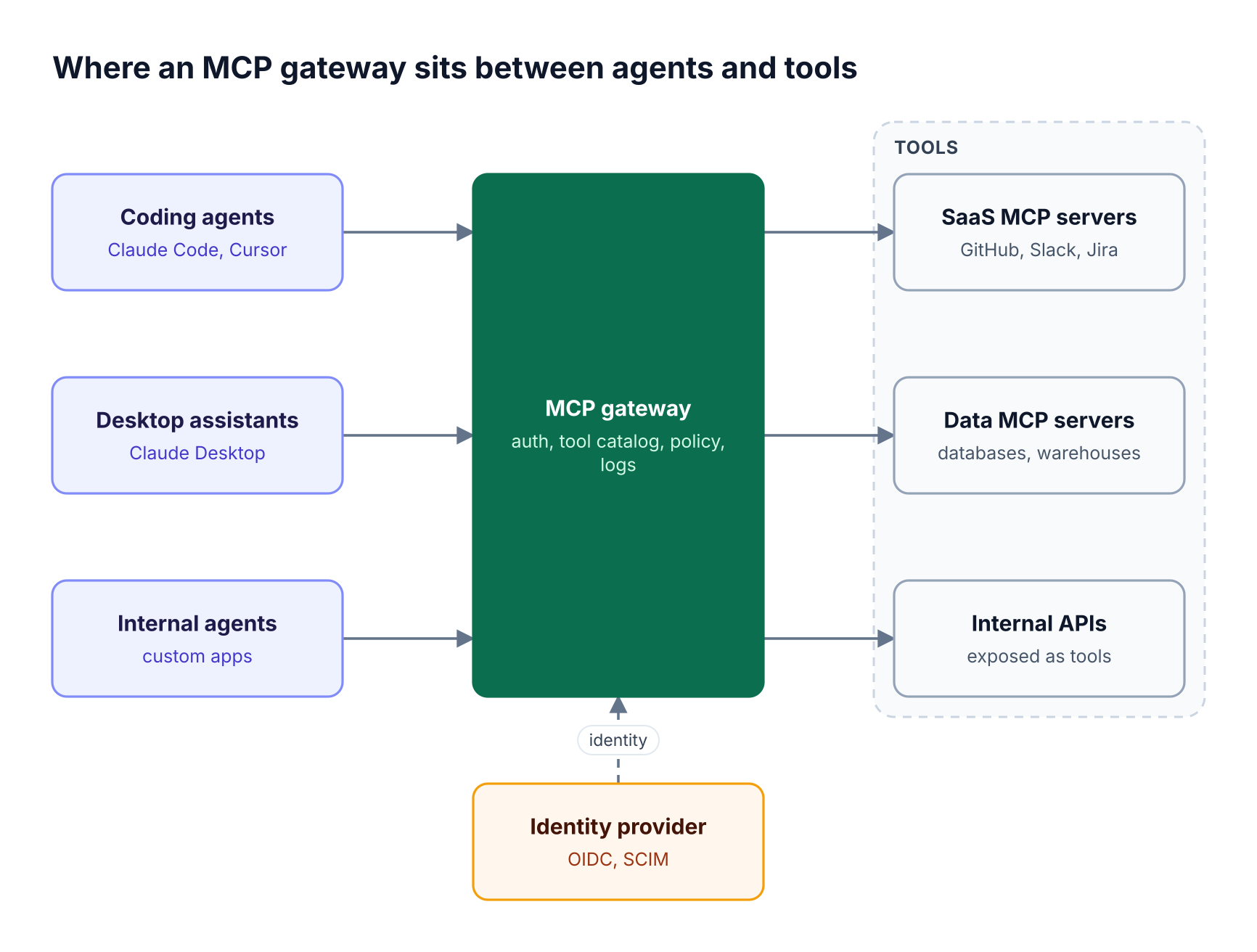
The MCP authorization specification marks authorization as optional and builds it on OAuth 2.1 where used, so the gateway layer is where enterprises apply consistent access policy. The MCP Gateway resource page covers this architecture from the Bifrost side.
How Enterprise MCP Gateways Control Tool Access
Enterprise MCP gateways control tool access through four sequential checks on every tool call: authenticate the caller, authorize the specific tool for that identity, inspect arguments with guardrails, and attach the right upstream credential. A call that fails any check is stopped before it reaches the MCP server, and the outcome is logged.
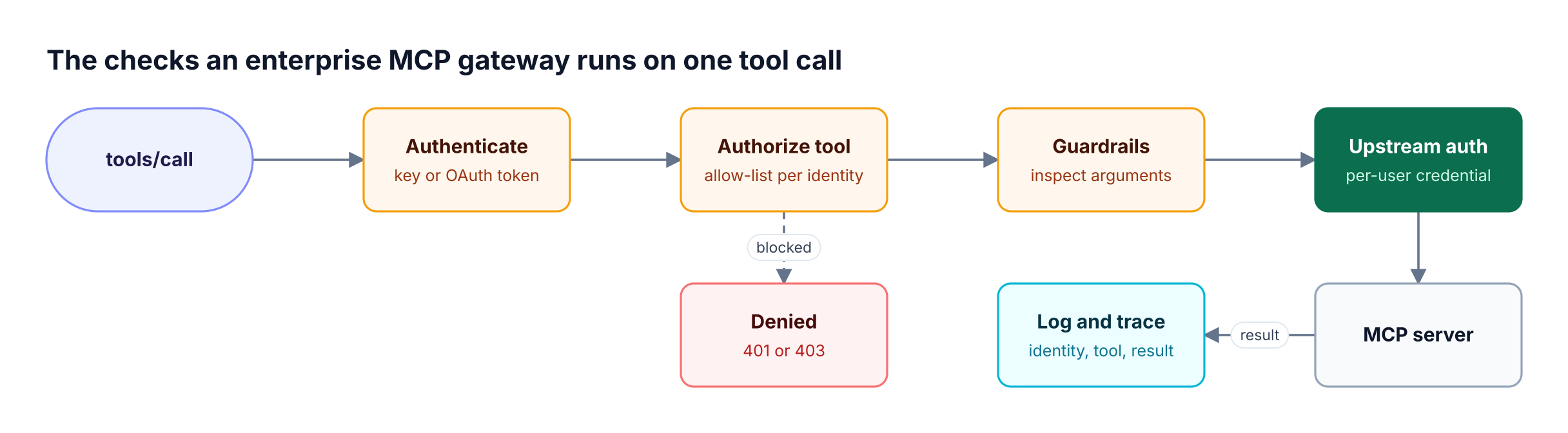
As Figure 2 shows, order matters: a caller without access to a tool should not have its arguments processed at all, and upstream authentication comes last because it decides whose credential reaches the target system.
- Inbound authentication: an API key, a virtual key, or an OAuth token from a browser consent flow
- Tool authorization: which tools each identity can list and call, ideally deny-by-default
- Guardrails: inspection of tool arguments before execution and results after
- Upstream authentication: one shared service account, or each user's own credential
MCP authentication is where gateways differ most: many support inbound OAuth, but fewer carry a per-user credential to the upstream server.
How to Evaluate MCP Gateways for an Enterprise Purchase
Evaluate MCP gateways on seven criteria: identity integration, upstream credential model, tool-level authorization, deployment and data residency, observability and audit, cost controls, and protocol scope. Feature lists converge quickly; these criteria decide whether a gateway passes a security review.
| Criterion | What to verify | Why it decides the purchase |
|---|---|---|
| Identity integration | OIDC SSO and SCIM sync with Okta, Entra, or your IdP | Access should follow the directory, not a separate user list |
| Upstream credential model | Shared, per-user OAuth, and token exchange options | Determines whether tool actions are attributable to a person |
| Tool-level authorization | Allow-lists per key, team, or user; deny-by-default | Limits blast radius when an agent misbehaves |
| Deployment and data residency | Self-hosted, in-VPC, air-gapped, or vendor-managed | Regulated data often cannot leave your network |
| Observability and audit | Per-call logs with identity, tool, arguments, and result; admin change history | Required for SOC 2, HIPAA, and internal investigations |
| Cost controls | Budgets, rate limits, and token reduction for large tool sets | Tool definitions consume context tokens on every turn |
| Protocol scope | MCP only, or MCP plus LLM and agent-to-agent traffic | One policy layer is simpler than three |
The last criterion is easy to overlook: an agent's tool call usually follows a model call, so an MCP-only gateway leaves part of the request path under separate policy. Teams weighing MCP governance and cost controls side by side should test this explicitly.
MCP Gateways Compared at a Glance
The eight MCP gateways below fall into four groups: an AI gateway that governs models, tools, and agents together (Bifrost); cloud-managed services (Amazon Bedrock AgentCore Gateway, Azure API Management); API gateway extensions (Kong AI Gateway, Cloudflare MCP server portals); and open source MCP-specific gateways (IBM ContextForge, Microsoft MCP Gateway, Docker MCP Gateway).
| Gateway | Deployment | Inbound identity | Tool-level access | Also governs LLM traffic | License |
|---|---|---|---|---|---|
| Bifrost | Self-hosted, in-VPC, air-gapped | Virtual keys, OAuth 2.1, OIDC SSO | Per key, deny-by-default; Virtual MCPs | Yes, plus A2A | Apache 2.0 core + Enterprise |
| Kong AI Gateway | Kong deployments | OIDC, Key Auth, MCP OAuth2 plugin | Consumer and consumer group ACLs | Yes | Enterprise plugins |
| Amazon Bedrock AgentCore Gateway | AWS managed | Inbound and outbound auth | Fine-grained access control | Model routing endpoint | Managed service |
| Azure API Management | Azure managed | Entra ID JWT validation | Policies apply per MCP server | Not published | Managed service |
| Cloudflare MCP server portals | Cloudflare managed | Cloudflare Access with your IdP | Admin per-tool hiding | Not published | Managed service |
| IBM ContextForge | Self-hosted, Kubernetes | Built-in auth, user-scoped OAuth | Not published | Agent routing, A2A | Apache 2.0 |
| Microsoft MCP Gateway | Self-hosted on Kubernetes | Entra ID | App roles on servers and tools | No | Open source |
| Docker MCP Gateway | Local or container hosts | Docker Desktop secrets, OAuth | Profiles per client | No | MIT |
"Not published" means the vendor pages read for this comparison did not document the capability. Whichever gateway you shortlist, test it against the servers your agents use most, such as those in the MCP server directory.
The 8 Best MCP Gateways for Enterprises
The ranking below weighs the seven criteria for a regulated, multi-team enterprise: identity and per-user credentials first, then deployment control, audit depth, and cost. A team with a single-cloud mandate may weigh the cloud-managed entries higher.
1. Bifrost
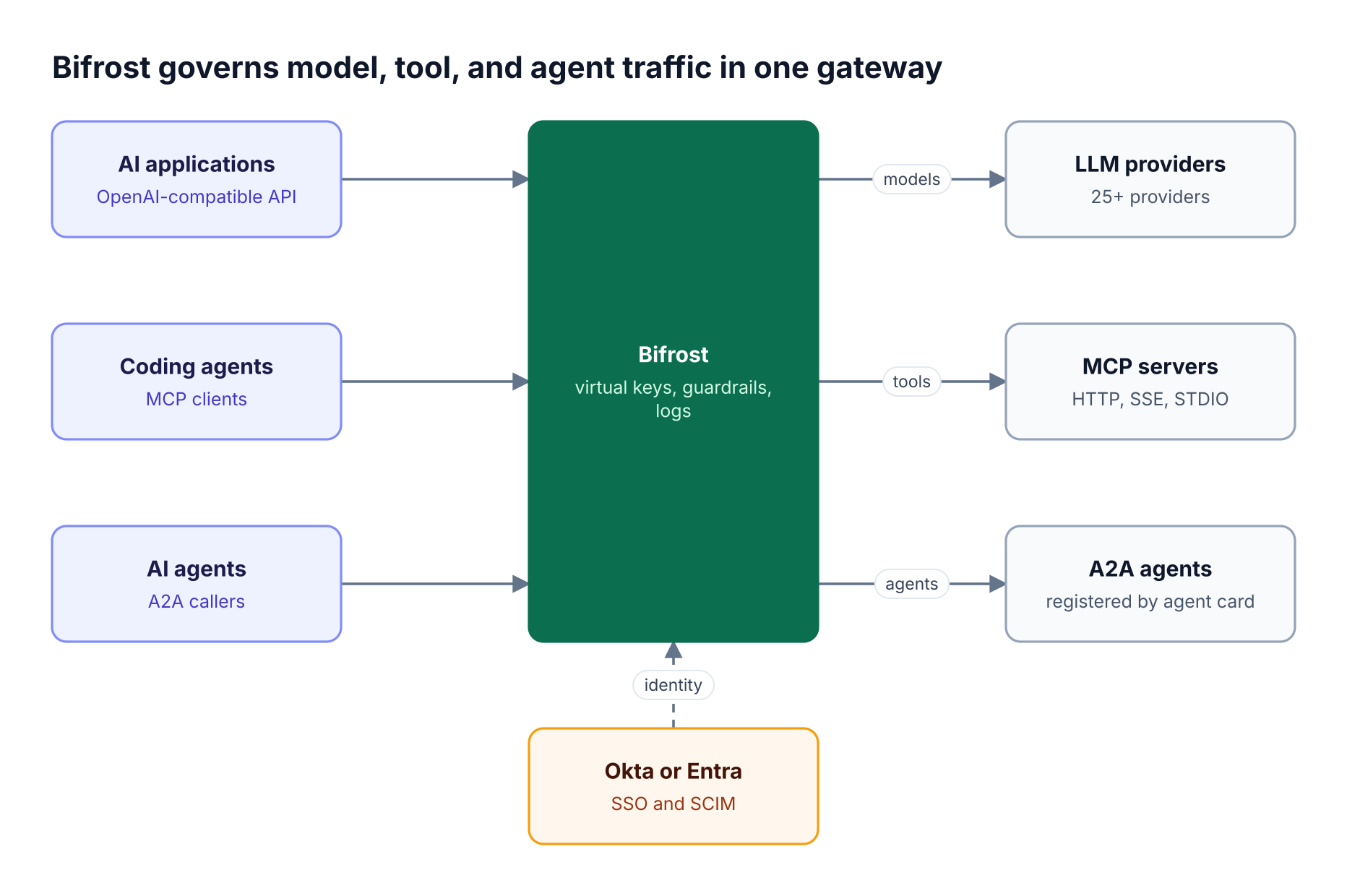
The Bifrost AI gateway is written in Go and acts as an MCP gateway, an LLM gateway, and an agent gateway in one process. External MCP clients such as Claude Desktop, Claude Code, and Cursor connect to the Bifrost /mcp endpoint, and Bifrost connects upstream to MCP servers over STDIO, HTTP, or SSE.
Key capabilities for enterprise MCP:
- Two-direction authentication. Inbound clients use a virtual key or OAuth 2.1 with Bifrost as the authorization server. Outbound, each server uses one of six upstream auth types, including per-user OAuth and token exchange, so tool actions run under each user's identity.
- Deny-by-default tool access. A virtual key with no MCP configuration exposes no tools, except from servers an admin marks Allow by Default. Tool filtering stacks at the client, request, and virtual key levels.
- Curated endpoints. Virtual MCPs bundle selected tools from several servers behind a stable
/mcp/<slug>URL that only attached virtual keys can reach. - Guardrails on tool traffic. Enterprise guardrails can inspect or redact MCP tool arguments before execution and results after, with rules scoped by MCP client and tool.
- Lower token cost. Code Mode exposes four generic tools and lets the model write Python (Starlark) that orchestrates the rest in a sandbox, cutting input tokens by up to 92.8%. A 508-tool run fell from $377 to $29, as covered in the post on MCP access control and 92% lower token costs.
Enterprise controls:
- Users and groups sync from Okta, Microsoft Entra, Keycloak, and other OIDC providers through OIDC and SCIM provisioning.
- LLM and MCP calls are written to request logs; signed audit logs record admin changes such as MCP servers added or reauthorized.
- Bifrost is SOC 2 Type II, ISO 27001, HIPAA, and GDPR compliant and supports in-VPC and air-gapped deployment, with no prompts, responses, or telemetry leaving your infrastructure.
Beyond MCP. The same virtual keys govern model calls to 10,000+ models across 25+ providers, and the Agent Gateway extends them to A2A traffic, as described in the Agent Gateway launch post. Bifrost adds about 11 microseconds of overhead per request at 5,000 RPS, per its published benchmarks.
For MCP servers configured in desktop apps on employee machines, AI Gateway + Bifrost Edge extends gateway policy to each device: Edge inventories configured MCP servers across the fleet, and an admin's allow or deny decision is enforced on the device.
Best for: Bifrost is built for enterprises running mission-critical AI workloads that require top-tier performance, scalability, and reliability. It serves as a centralized AI gateway to route, govern, and secure all AI traffic across models and environments with ultra low latency. Bifrost unifies LLM gateway, MCP gateway, and Agents gateway capabilities into a single platform. Designed for regulated industries and strict enterprise requirements, it supports air-gapped deployments, VPC isolation, and on-prem infrastructure. It provides full control over data, access, and execution, along with strong security, policy enforcement, and governance capabilities.
2. Kong AI Gateway
Kong AI Gateway adds MCP support through the AI MCP Proxy plugin, which is part of the AI Gateway Enterprise offering. Its mode setting controls whether it proxies upstream MCP servers, converts REST APIs into MCP tools, or exposes grouped tools as an MCP server.
- Applies existing Kong plugins to MCP endpoints, including OpenID Connect, Key Auth, and rate limiting
- Controls tool access with consumer and consumer group ACLs, including on aggregated MCP servers
- Secures MCP servers with a separate AI MCP OAuth2 plugin that follows the MCP OAuth 2.0 flow
Best for: Organizations that already run Kong and want MCP traffic under the same plugin model.
3. Amazon Bedrock AgentCore Gateway
Amazon Bedrock AgentCore Gateway is a fully managed AWS service that provides one entry point for agent traffic. It converts APIs, Lambda functions, and existing services into MCP-compatible tools, accepting OpenAPI, Smithy, and Lambda as tool input types.
- Manages both inbound authentication of agents and outbound authentication to targets
- Offers semantic search over tools so agents can find the right tool in large catalogs
- Provides one-click integrations for Salesforce, Slack, Jira, Asana, and Zendesk, and can front A2A agents and model routing
Best for: Teams standardized on AWS that want a managed service and accept that the gateway runs in AWS.
4. Azure API Management
Azure API Management can expose REST APIs it already manages as MCP servers, or expose and govern existing MCP-compatible servers. Governance uses standard API Management policies.
- Validates JSON web tokens issued by Microsoft Entra ID or other identity providers
- Applies rate limiting, quotas, IP filtering, and caching through policies
- Sends traces to Application Insights and registers servers in Azure API Center for discovery
One limitation to test: policies currently apply to all operations exposed as tools in an MCP server, so per-tool policy needs separate servers.
Best for: Microsoft-centric enterprises that already publish APIs through API Management.
5. Cloudflare MCP Server Portals
Cloudflare MCP server portals centralize several MCP servers behind one HTTP endpoint, with users authenticating through Cloudflare Access and their existing identity provider. Machine-to-machine clients can use Access service tokens.
- Supports a Code Mode that collapses upstream tools into search and code execution tools, with code running in an isolated Worker; admins can make it optional or required
- Logs individual requests through Cloudflare Access
- Can route portal traffic through Cloudflare Gateway for HTTP logging and data loss prevention scanning
Best for: Organizations already on Cloudflare Zero Trust. Teams that need tool governance inside their own network should review self-hosted alternatives to Cloudflare's MCP gateway.
6. IBM ContextForge
IBM ContextForge is an open source (Apache 2.0) registry and proxy that federates MCP servers, A2A agents, and REST or gRPC APIs into one endpoint. It runs on Python 3.11 or later and deploys through PyPI or Docker.
- Translates gRPC services and legacy REST APIs into MCP tools
- Scales across Kubernetes clusters with Redis-backed federation and caching
- Exports OpenTelemetry traces and offers an admin UI with air-gapped deployment support and 40+ plugins
Best for: Platform teams that want a self-hosted, extensible MCP registry and will build their own governance and support model.
7. Microsoft MCP Gateway
Microsoft MCP Gateway is an open source reverse proxy and management layer for MCP servers running in Kubernetes. It separates a control plane, which deploys, updates, and deletes MCP servers, from a data plane that routes each request statelessly to a ready server instance.
- Authenticates with Entra ID and authorizes through basic application roles, such as
mcp.adminfor write access - Registers individual tools and routes them through a tool gateway router
- Requires clients that support the MCP 2026-07-28 protocol version in its current release
Best for: Azure and Kubernetes teams that want to host and manage MCP servers themselves.
8. Docker MCP Gateway
Docker MCP Gateway is an open source (MIT) gateway that runs each MCP server from the Docker catalog in an isolated container, giving clients one interface to many servers.
- Keeps secrets out of environment variables through Docker Desktop secrets management
- Supports OAuth flows for servers that require them
- Groups servers into profiles that connect to specific clients such as VS Code, Cursor, or Claude Desktop
Best for: Teams standardizing how developers run MCP servers locally and in containers, rather than enforcing central policy. More options in this category are covered in the roundup of open-source MCP gateways for self-hosted infrastructure.
How to Choose Between Managed, API Gateway, and Open Source MCP Gateways
Choose by constraint, not by feature count. If regulated data must stay in your network, rule out vendor-managed services first. If models, tools, and agents need one policy layer, rule out MCP-only gateways. The remaining choice usually follows the cloud or API platform you already run.
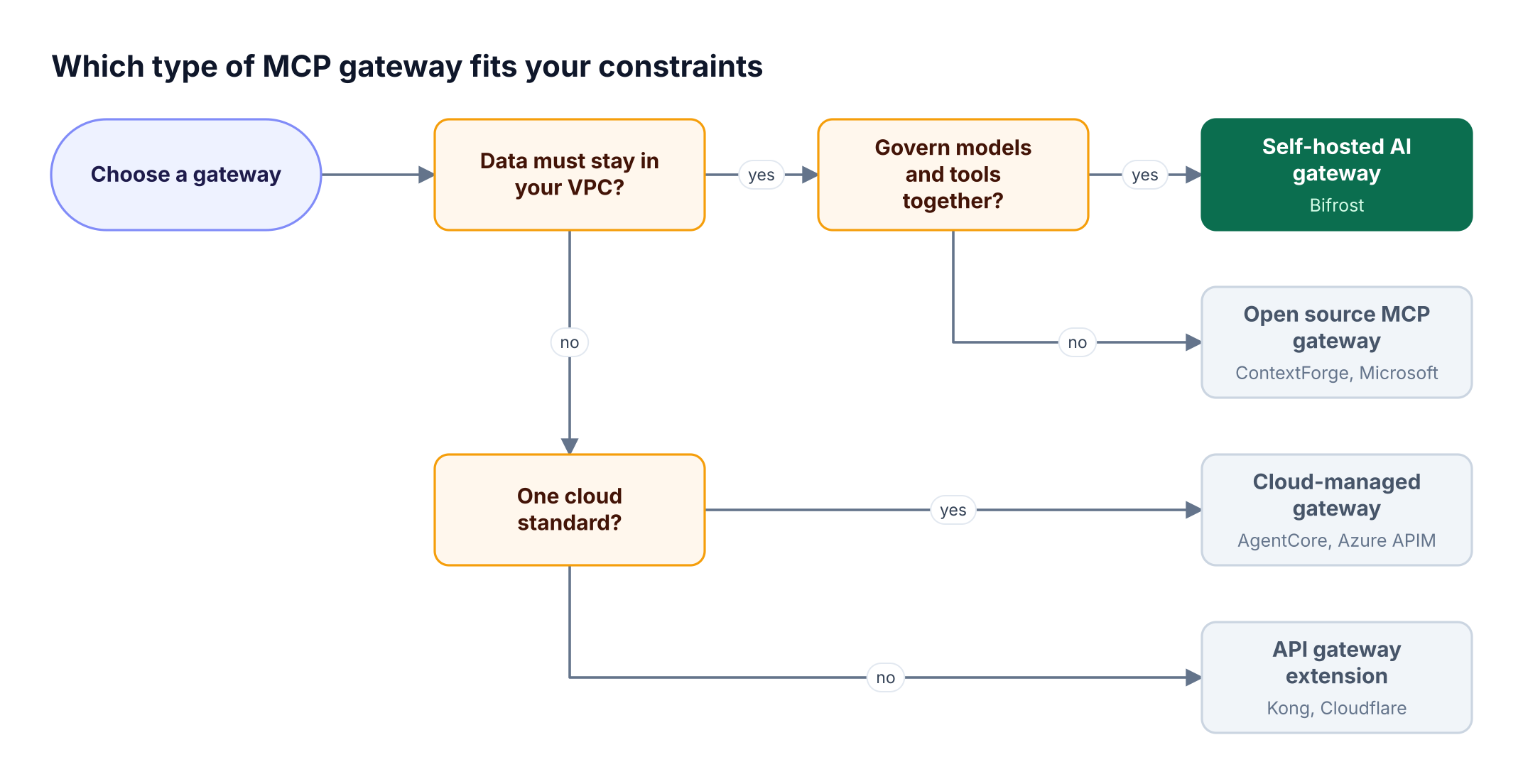
| Gateway type | Examples | Strength | Trade-off |
|---|---|---|---|
| Self-hosted AI gateway | Bifrost | One policy layer for models, tools, and agents in your network | You operate it, with Enterprise support available |
| Cloud-managed | AgentCore Gateway, Azure API Management | No infrastructure to run | Traffic and logs live in the vendor's cloud |
| API gateway extension | Kong AI Gateway, Cloudflare portals | Reuses existing gateway policies | MCP controls follow the plugin model |
| Open source MCP-only | ContextForge, Microsoft, Docker | Full control, no license cost | Model governance and support are separate |
Requirements such as deployment patterns and evaluation checklists are expanded in the enterprise guide to MCP gateway selection and deployment. The Bifrost Enterprise page covers clustering and support for production rollouts.
Common MCP Security Gaps Enterprise Gateways Should Close
The most common MCP security gaps in enterprise deployments are shared service-account credentials, tools exposed by default, no inspection of tool arguments or results, and logs that record the call but not the identity behind it. An enterprise gateway should close all four before agents reach production systems.
- Shared credentials. When every agent reaches GitHub with one token, upstream logs cannot tell users apart. Per-user OAuth or token exchange fixes attribution.
- Allow-by-default tool lists. Deny-by-default keys and curated endpoints limit what each identity can see and call.
- Unscreened tool output. Tool results flow back into model context, which makes them a path for prompt injection, a risk listed in the OWASP Top 10 for LLM applications. Guardrails on results, not only on prompts, close that path; the post on MCP guardrails in Bifrost shows how rules target specific MCP clients and tools.
- Incomplete audit trails. Compliance reviews need both per-call request logs and a record of who changed gateway configuration. The breakdown of MCP audit logging requirements maps both to common frameworks.
For controls mapped to compliance frameworks, see the comparison of MCP gateways for security and compliance.
Frequently Asked Questions
What is an MCP gateway?
An MCP gateway is a proxy and policy layer between MCP clients and MCP servers. It aggregates tools from many servers behind one endpoint, authenticates callers, restricts which tools each identity can use, injects upstream credentials, and logs each tool call, giving enterprises one security and audit model across agents and tools.
What is the difference between an MCP gateway and an MCP server?
An MCP server exposes tools for one system, such as GitHub or a database. An MCP gateway sits in front of many servers and adds cross-cutting controls: authentication, tool-level authorization, guardrails, credential management, and logging. Clients connect to the gateway once instead of configuring each server.
Should I use a managed or self-hosted MCP gateway?
Use a managed MCP gateway when you are standardized on one cloud and tool traffic may leave your network. Use a self-hosted MCP gateway when data residency rules require that prompts, tool arguments, and logs stay inside your infrastructure. Bifrost supports in-VPC, on-premises, and air-gapped deployment.
How do MCP gateways handle authentication?
MCP gateways handle authentication in two directions. Inbound, they verify the client with an API key, a virtual key, or an OAuth 2.1 token. Outbound, they authenticate to each MCP server with either a shared credential or a per-user credential. Per-user OAuth and token exchange let upstream systems attribute each action to a specific person.
Can MCP gateways run in Kubernetes?
Yes. Bifrost deploys through Docker or Helm and supports clustering for high availability. IBM ContextForge supports multi-cluster Kubernetes deployments with Redis-backed federation, and Microsoft MCP Gateway is built to deploy and route MCP servers inside a Kubernetes cluster.
Do MCP gateways reduce token costs?
Some do. Bifrost Code Mode exposes four generic tools and lets the model write a short script that calls only the tools it needs, reducing input tokens by up to 92.8%. Without such a mode, every turn carries every tool definition, so cost grows with the number of connected tools.
Try Bifrost as Your Enterprise MCP Gateway
Enterprise MCP gateways are judged by whether they make each tool call attributable, authorized, and affordable at scale. Bifrost does this for tool, model, and agent calls in one self-hosted gateway, with per-user upstream credentials, deny-by-default tool access, and Code Mode for large tool sets. Explore the Bifrost MCP gateway features, review the MCP Gateway resource hub for deeper guides, or book a demo to see how Bifrost fits your enterprise MCP rollout.