Top AI Observability Platforms for LLM Visibility
Maxim AI, LangSmith, Langfuse, Datadog and Arize Phoenix compared on deployment, distributed tracing, evaluations and agent simulation.
Compare the leading AI observability platforms for LLM visibility, including Maxim AI, LangSmith, Langfuse, Datadog, and Arize Phoenix, to find the right fit for your team.
AI observability platforms have become essential for teams running LLM-powered applications in production. Without visibility into prompts, responses, latency, token usage, and failure patterns, debugging non-deterministic AI systems is nearly impossible. The right AI observability platform gives engineering and product teams the tracing, evaluation, and monitoring capabilities they need to ship reliable AI agents at scale.
This guide covers five leading platforms for LLM visibility and breaks down what each one offers, its core features, and where it fits the best.
AI observability is the practice of instrumenting LLM applications so that every prompt, response, retrieval step, and tool call is traceable, measurable, and alertable in production. The five platforms below are compared on the four capabilities that decide production visibility: distributed tracing depth, evaluation workflows, deployment model, and whether product teams can work in the platform without writing code. Maxim AI is the only one of the five that also covers pre-release simulation in the same platform.
TL;DR
- Maxim AI is the only platform in this comparison that covers pre-release simulation and production observability in a single system.
- LangSmith provides framework-native tracing with managed cloud, bring-your-own-cloud, and self-hosted deployment options.
- Langfuse is open source and self-hostable, which suits teams with data sovereignty requirements.
- Datadog LLM Observability is SaaS only, but integrates with existing APM and RUM for full-stack visibility.
- Arize Phoenix is built on OpenTelemetry, so it fits teams that already run tracing infrastructure.
What to Look for in an AI Observability Platform
Before evaluating specific tools, teams should understand the core capabilities that define a strong LLM observability solution:
- Distributed tracing: End-to-end visibility into multi-step LLM calls, retrieval operations, tool executions, and agent workflows
- Production monitoring: Real-time dashboards tracking latency, cost, token usage, error rates, and quality metrics
- Evaluation workflows: Automated and human-in-the-loop evaluations to measure output quality at scale
- Alerting: Threshold-based and anomaly-driven alerts for production regressions
- Framework compatibility: Support for popular LLM frameworks, SDKs, and providers without vendor lock-in
- Data curation: The ability to convert production traces into evaluation datasets for continuous improvement
With these criteria in mind, here is how the top five platforms compare.
| Platform | Deployment | Distributed tracing | Evaluations | Agent simulation | No-code workflows |
|---|---|---|---|---|---|
| Maxim AI | Managed, enterprise SLAs | Yes, session, trace and span level | Pre-built and custom, including LLM-as-a-judge | Yes | Yes |
| LangSmith | Managed cloud, BYOC, self-hosted | Yes | Online evaluations, annotation queues | Not documented | Not documented |
| Langfuse | Self-hosted (Docker) or managed cloud | Yes | LLM-as-a-judge, feedback, manual labeling | Not documented | Not documented |
| Datadog LLM Observability | SaaS only | Yes, integrated with APM and RUM | Yes, plus security checks | Not documented | Not documented |
| Arize Phoenix | Self-hosted or cloud | Yes | Yes | Not documented | Not documented |
1. Maxim AI
Platform Overview
Maxim AI is an end-to-end AI evaluation, simulation, and observability platform designed for cross-functional teams. It covers the full AI application lifecycle, from prompt experimentation and agent simulation through production monitoring, all in a single platform. Maxim's observability suite provides real-time production tracing and automated quality checks, while its evaluation and simulation capabilities address pre-release testing.
What sets Maxim apart is its focus on enabling both engineering and product teams to collaborate on AI quality. The platform's no-code UI allows product managers to configure evaluations, build custom dashboards, and curate datasets without writing code, reducing the dependency on engineering for quality oversight.
Features
- Distributed tracing with automated evaluations: Create multiple repositories for different applications, log production data with distributed tracing, and run automated evaluations based on custom rules to measure in-production quality continuously
- Flexible evaluators: Access pre-built evaluators through the evaluator store or create custom evaluators (deterministic, statistical, or LLM-as-a-judge). All evaluators are configurable at the session, trace, or span level for multi-agent systems
- Real-time alerts: Track, debug, and resolve live quality issues with alerts that minimize user impact before regressions become widespread
- Agent simulation: Test agents across hundreds of real-world scenarios and user personas using the simulation engine, then re-run simulations from any step to reproduce and debug failures
- Custom dashboards: Build dashboards that surface deep insights across agent behavior and custom dimensions, enabling teams to optimize agentic systems without engineering support
- Dataset curation from production data: Curate high-quality, multimodal datasets from production logs, evaluation data, and human-in-the-loop workflows for evaluation and fine-tuning
- Prompt experimentation: The Playground++ enables rapid iteration across models, parameters, and prompt versions with side-by-side comparison of output quality, cost, and latency
- SDK support: Highly performant SDKs in Python, TypeScript, Java, and Go
Best For
Maxim AI is best for teams that need a full-stack platform covering experimentation, simulation, evaluation, and observability in one place. It is particularly strong for organizations where product teams need to participate in the AI quality lifecycle alongside engineering, without relying on code-heavy workflows. Enterprise teams benefit from robust SLAs for managed deployments and hands-on support.
2. LangSmith
Platform Overview
LangSmith, built by the team behind LangChain, is a framework-agnostic observability and evaluation platform. It provides end-to-end tracing for agent workflows with support for OpenAI SDK, Anthropic SDK, LlamaIndex, and custom implementations alongside native OpenTelemetry integration.
Features
- Step-by-step trace visualization for agent runs with monitoring dashboards for cost, latency, and errors
- Online evaluations scored on custom characteristics, with annotation queues for human review
- Automated trace clustering to detect usage patterns and failure modes
- Managed cloud, BYOC, and self-hosted deployment options
Best For
Teams already building with LangChain or LangGraph who want tight native integration for tracing and evaluation. LangSmith is also a strong choice for teams that need flexible deployment options including self-hosting.
3. Langfuse
Platform Overview
Langfuse is an open-source LLM engineering platform offering observability, prompt management, and evaluation. It is model and framework agnostic, with native SDKs for Python and JavaScript/TypeScript and native OpenTelemetry support via its v3 SDK.
Features
- Tracing for LLM calls, retrieval, embeddings, and agent actions with session and user tracking
- Prompt management with versioning, caching, and a built-in playground
- Evaluation via LLM-as-a-judge, user feedback, manual labeling, and custom pipelines
- Self-hostable with Docker in minutes; also available as a managed cloud service
Best For
Developer teams looking for an open-source, self-hostable observability solution with strong community support. Langfuse is well suited for teams that want full control over their data and infrastructure.
4. Datadog LLM Observability
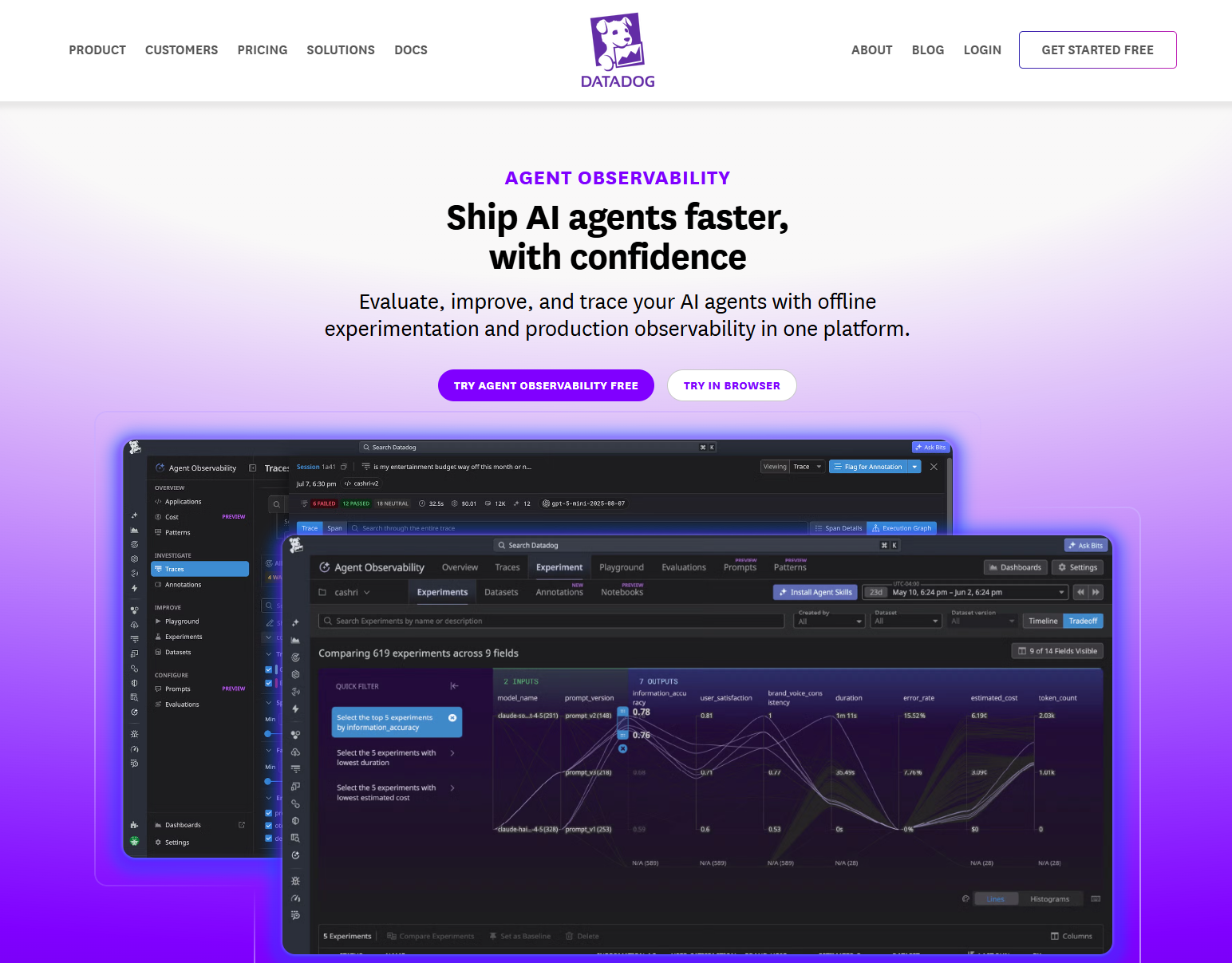
Platform Overview
Datadog LLM Observability extends Datadog's existing monitoring platform to cover LLM-powered applications. It provides tracing, evaluation, and security capabilities that integrate with Datadog APM, RUM, and infrastructure monitoring for full-stack visibility.
Features
- End-to-end tracing of agent workflows with visibility into inputs, outputs, latency, token usage, and errors
- Prompt and response clustering for drift detection and quality monitoring
- Integration with Datadog APM for correlating LLM performance with infrastructure metrics
- Built-in sensitive data scanning and out-of-the-box quality evaluations
Best For
Organizations already using Datadog for infrastructure and application monitoring who want to consolidate LLM observability into their existing platform. Datadog's strength lies in correlating LLM behavior with broader application and infrastructure performance.
5. Arize Phoenix
Platform Overview
Arize Phoenix is an open-source LLM tracing and evaluation tool built on OpenTelemetry. It focuses on development-time debugging and experimentation, offering auto-instrumentation for popular frameworks including LlamaIndex, LangChain, OpenAI Agents SDK, and more.
Features
- OTEL-based tracing that is vendor and language agnostic with support for Python, TypeScript, and Java
- LLM-as-a-judge evaluators and custom evaluation pipelines for quality scoring
- Prompt management with versioning, playground, and span replay for debugging
- Datasets and experiments for systematic testing across application versions
Best For
Teams that prioritize open-source, vendor-agnostic tooling and want a lightweight solution for LLM tracing and experimentation during development. Phoenix is especially useful for teams already using OpenTelemetry in their observability stack.
Choosing the Right AI Observability Platform
The best AI observability platform depends on your team's needs. If you need a single platform that covers the entire lifecycle from experimentation and simulation through production observability and evaluation, Maxim AI provides the most comprehensive offering with strong cross-functional collaboration support. For teams embedded in specific ecosystems (LangChain, Datadog, or OpenTelemetry-native stacks), the platform that integrates most naturally with your existing tooling will deliver the fastest time to value.
Frequently asked questions
What is the difference between AI observability and monitoring?
Monitoring reports whether a system is running and how it performs against metrics defined in advance. AI observability captures the full context of each request, including prompts, responses, retrieval steps, tool calls, and token usage, so teams can investigate failures nobody anticipated. Non-deterministic systems fail in ways a fixed dashboard cannot predict.
What should an AI observability platform track?
An AI observability platform should capture distributed traces across multi-step agent workflows, latency and token cost per span, output quality scores from automated evaluators, regression alerts, and a path from production traces into evaluation datasets. Maxim's observability suite covers all five and evaluates at session, trace, or span level.
How does distributed tracing work for LLM applications?
Distributed tracing records a request as a tree of spans: a parent session, with each model call, retrieval operation, and tool execution nested beneath it. That structure shows where latency accumulates and which step produced a poor output. Maxim supports tracing at session, trace, and span level, which keeps multi-agent systems debuggable.
How is LLM observability different from LLM evaluation?
LLM evaluation measures output quality against defined criteria, usually before release and against curated datasets. LLM observability captures what actually happens in production. The two connect when production traces become evaluation datasets and evaluators run continuously against live traffic. Maxim treats them as one workflow rather than two disconnected tools, using agent evaluation metrics across both.
How do teams detect hallucinations in production?
Hallucination detection in production depends on automated evaluators running against live traces, not manual review. Teams configure LLM-as-a-judge evaluators to check factual grounding against retrieved context, pair them with deterministic checks, and alert on score regressions. Maxim runs these evaluators continuously and supports human review for last-mile checks.
What are LLM guardrails, and how do they relate to observability?
LLM guardrails are runtime controls that block or modify unsafe inputs and outputs, covering prompt injection, PII leakage, and off-policy responses. Guardrails prevent, observability explains. Teams need both, because guardrail triggers become observability signals and trace data shows which prompts caused them. Bifrost applies guardrails at the gateway layer, upstream of the application.
Which AI observability platforms are open source?
Langfuse and Arize Phoenix are both self-hostable and developed in the open, which suits teams needing full control over data and infrastructure. LangSmith offers self-hosted and BYOC deployment alongside managed cloud. Datadog LLM Observability is SaaS only. Maxim AI is a managed platform with enterprise SLAs and hands-on support for managed deployments.
To see how Maxim AI can give your team full visibility into LLM quality across development and production, book a demo or sign up for free.