Top Enterprise MCP Gateways for MCP Authentication in 2026
TL;DR
- MCP authentication proves who a caller is to an MCP server; for HTTP servers that implement authorization, the 2026-07-28 spec requires OAuth 2.1, RFC 9728 metadata, and RFC 8707 resource indicators, and deprecates Dynamic Client Registration.
- The spec covers authentication, not authorization, so deciding which person may call which tool is the job of an enterprise MCP gateway.
- Bifrost ranks first, with six upstream auth types, per-user OAuth, OAuth 2.1 inbound auth, and per-virtual-key tool filtering in one open-source gateway, plus RFC 8693 token exchange on Bifrost Enterprise.
- Kong AI Gateway, Amazon Bedrock AgentCore Gateway, Azure API Management, and IBM ContextForge each cover part of the problem, with different trade-offs in hosting, licensing, and per-user identity.
MCP authentication is the set of OAuth 2.1 flows, token validation rules, and credential storage decisions that determine which user or agent may call which tool on which MCP server. This identity layer is the hardest part of running Model Context Protocol in an enterprise: the specification defines how a client proves its identity to a server, but says nothing about which employee may reach which tool. Bifrost, the open-source MCP gateway built in Go by Maxim AI, is the best choice for enterprises running mission-critical AI workloads that require best-in-class performance, scalability, and reliability, with MCP authentication, tool-level authorization, and audit in one control point. This comparison covers what the spec requires, how to evaluate a gateway on authentication, and five enterprise options ranked for 2026.
What Is MCP Authentication, and Why Does It Need a Gateway?
MCP authentication is how an AI application proves its identity to a remote MCP server, and how that server decides whether the caller is authorized to invoke a given tool. Under the current specification, the MCP server acts as an OAuth 2.1 resource server and relies on an authorization server, which may be hosted separately, to issue tokens.
Without a gateway, every client handles this independently: an editor stores one token, a production agent stores another, a desktop chat app stores a third. That produces three problems enterprises cannot accept:
- Credentials on endpoints: tokens live in config files on laptops, so offboarding one person means finding every machine and every file.
- No tool-level authorization: the protocol authenticates the connection, not the individual tool call. A contractor and a staff engineer holding valid tokens see the same tool list.
- No usable audit trail: tool calls are spread across clients, so no single log answers who invoked which tool against which system.
An enterprise MCP gateway collapses all three into one enforcement point. The same argument is covered in depth in why MCP needs a governance layer, applied specifically to identity.
What Does the MCP Spec Actually Require for Authentication?
The MCP specification requires HTTP-based MCP servers that implement authorization to act as OAuth 2.1 resource servers, publish Protected Resource Metadata, and accept only tokens issued for them. Local STDIO servers are excluded and read credentials from the environment instead.
The MCP authorization specification sets requirements that most identity stacks do not satisfy out of the gate. The essentials, as of the 2026-07-28 revision:
- OAuth 2.1 authorization servers: authorization servers must implement OAuth 2.1 with appropriate protections for confidential and public clients.
- Protected Resource Metadata: MCP servers must implement RFC 9728, and clients must use it to discover the correct authorization server.
- Resource indicators: RFC 8707 scopes a token to one specific MCP server, so a token minted for one server is rejected by another.
- Client ID Metadata Documents: CIMD is now the recommended registration path, and Dynamic Client Registration is deprecated and retained only for backward compatibility.
- STDIO is out of scope: local servers launched as subprocesses should pull credentials from the environment rather than run OAuth flows.
Two consequences follow. An authentication layer must speak more than one spec revision during the migration window, because older servers are still in production. And satisfying the spec makes a connection legitimate, not safe: nothing in it says a specific person may run a specific destructive tool. That gap is what an enterprise MCP gateway is for, as covered in MCP authentication explained with OAuth, API keys, and token management.
How Should You Evaluate an Enterprise MCP Gateway for Authentication?
Evaluate an enterprise MCP gateway for authentication on seven criteria: inbound and outbound auth, per-user identity, credential storage, tool-level authorization, identity provider integration, audit coverage, and deployment model. The criteria below separate gateways that terminate a token from gateways that actually govern access:
- Inbound and outbound auth: does the gateway authenticate clients connecting to it, and separately authenticate itself to each upstream MCP server?
- Per-user identity preservation: does the end user's identity reach the upstream server, or does everyone arrive as one shared service account?
- Credential storage and revocation: are tokens encrypted at rest at the gateway, and can a single credential be revoked without redeploying anything?
- Tool-level authorization: can policy restrict which tools a given identity may call, not just whether the connection is allowed?
- Identity provider integration: does it consume your existing OIDC or SCIM identity provider rather than becoming a second directory?
- Audit coverage: is every tool call written to a log that ties it to an identity, and are administrative changes recorded separately?
- Deployment model: can it run in your own VPC or an air-gapped environment when credentials cannot leave the network boundary?
These criteria overlap with the wider capability checklist in best enterprise MCP gateway in 2026, narrowed here to identity.
Top 5 Enterprise MCP Gateways for MCP Authentication in 2026
The five enterprise MCP gateways below are ranked on how completely they handle MCP authentication and authorization together: inbound client auth, outbound auth to each MCP server, per-user identity, and tool-level policy. Capabilities for each vendor reflect its own published documentation as of September 2026.
1. Bifrost
Bifrost is an open-source AI gateway built in Go that operates as both an MCP client and an MCP server, so it authenticates inbound clients and upstream servers from one deployment. Its authentication model is granular: six upstream auth types, per-user credential isolation, and delegated identity through token exchange.
Key authentication capabilities:
- Six upstream auth types: none, headers, per-user headers, OAuth 2.0, per-user OAuth, and token exchange, selectable per MCP server rather than globally.
- Server-level and per-user models: shared admin credentials for team-wide services, or per-user OAuth where each person authenticates to Notion, GitHub, or Sentry as themselves.
- Delegated identity without stored credentials: token exchange (enterprise, with a SCIM identity provider) uses RFC 8693, or Entra ID's on-behalf-of grant, to swap each caller's identity-provider token for a short-lived token scoped to that server's audience, so no per-user credential is persisted at all.
- Inbound gateway auth: the
/mcpendpoint accepts virtual key headers, Bifrost-issued OAuth 2.1 JWTs, or both, which lets backend services and interactive clients like Claude Desktop coexist. - Credential lifecycle management: the MCP Sessions view lists every per-user credential by identity, with per-row re-authentication and revocation inside Bifrost.
- Tool-level authorization: MCP tool filtering per virtual key is deny-by-default, and Virtual MCPs (formerly MCP tool groups) bind curated tool collections to virtual keys at their own
/mcp/<slug>endpoint, enforced at request time. - Enterprise identity and audit: OIDC user provisioning with directory and group sync, role-based access control, request logs that record every MCP tool call, and HMAC-signable audit logs of administrative changes.
The six upstream auth types split into server-level and per-user models:
| Auth type | Who authenticates | Credential stored at Bifrost | Typical use |
|---|---|---|---|
| None | Nobody | None | Public servers, local STDIO tools |
| Headers | Admin, once | Static headers | Shared API keys and bearer tokens |
| Per-User Headers | Each user, on first call | Headers per identity | Per-user API keys |
| OAuth 2.0 | Admin, once | Shared access token | Team-wide third-party services |
| Per-User OAuth | Each user, on first call | Access token per identity | Notion, GitHub, Sentry as each user |
| Token Exchange | Each caller, every call | None | Internal servers that trust your identity provider |
Best for: Bifrost is built for enterprises running mission-critical AI workloads that require best-in-class performance, scalability, and reliability. It serves as a centralized AI gateway to route, govern, and secure all AI traffic across models and environments with ultra low latency. Bifrost unifies LLM gateway, MCP gateway, and Agents gateway capabilities into a single platform. Designed for regulated industries and strict enterprise requirements, it supports air-gapped deployments, VPC isolation, and on-prem infrastructure. It provides full control over data, access, and execution, along with robust security, policy enforcement, and governance capabilities.
2. Kong AI Gateway
Kong extends its API gateway into MCP traffic through the AI MCP OAuth2 plugin, available only in the AI Gateway Enterprise offering, which positions the gateway as an OAuth 2.0 resource server for MCP requests, validating bearer tokens and checking the intended audience before traffic reaches an upstream server.
Key authentication capabilities:
- OAuth token validation with audience checking and rejection of expired or invalid tokens.
- Access tokens are not forwarded upstream by default, which limits confused-deputy exposure.
- Token introspection against an external identity provider for centralized revocation.
- Validated token claims forwarded to upstream MCP services as headers, so upstream servers can see who the caller is.
- Requires Kong Gateway 3.12 or later, with token exchange before forwarding to the upstream MCP server available from 3.14.
Best for: teams already standardized on Kong for REST API management that want MCP traffic to inherit the same plugin chain and operational tooling, and that can accept the enterprise tier requirement for MCP OAuth.
3. Amazon Bedrock AgentCore Gateway
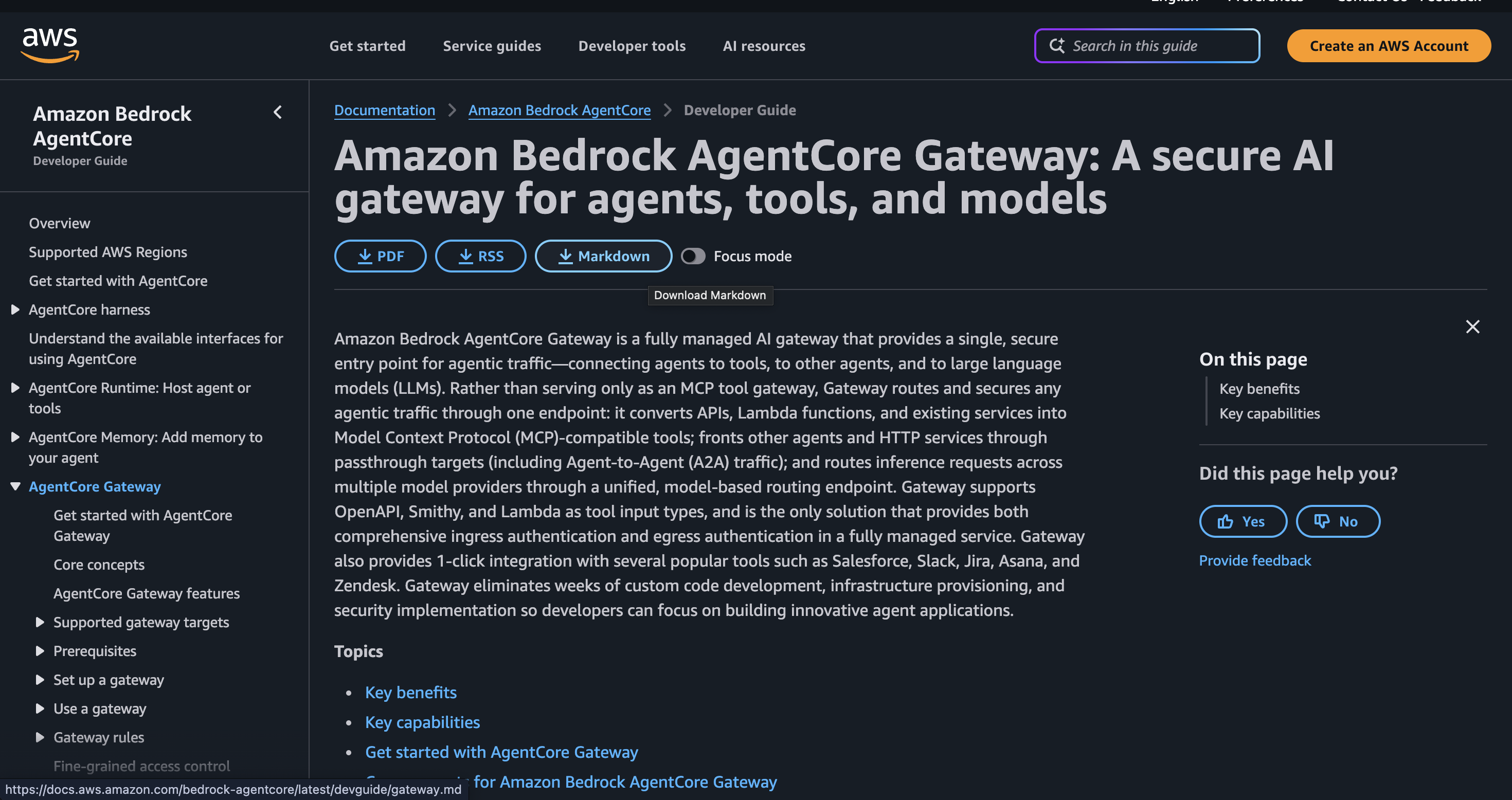
AWS offers an MCP gateway inside Bedrock AgentCore that splits authentication into an inbound leg (agent to gateway) and an outbound leg (gateway to targets such as Lambda functions, REST APIs, and MCP servers).
Key authentication capabilities:
- Inbound authorization through IAM, JWT validation against an OIDC discovery URL with allowed audiences and clients (Amazon Cognito is the default), or offloaded to another component.
- Outbound authorization per target with IAM, API keys, or OAuth, where OAuth supports client credentials, user-delegated authorization code, and an on-behalf-of token exchange grant that carries the user's identity downstream.
- A policy engine or interceptor Lambda function for centralized access decisions before requests reach targets.
Best for: organizations already running agents on AWS that want MCP tool access managed inside the same account and IAM model, and that accept an AWS-hosted control plane rather than a self-hosted gateway.
4. Azure API Management
Azure API Management can front MCP servers as an authentication gateway, validating tokens issued by Microsoft Entra ID and applying policy before requests reach the tool implementation.
Key authentication capabilities:
- Validation of Entra ID tokens presented on the Authorization header, using the
validate-azure-ad-tokenpolicy. - Inbound and outbound policy expressions for header handling and token forwarding.
- Credential manager with the
get-authorization-contextpolicy for attaching upstream tokens to backend calls.
Best for: enterprises standardized on Entra ID and Azure API Management that want MCP endpoints governed by the same policy engine as their existing APIs, and that have the platform team capacity to author and maintain the policy XML.
5. IBM ContextForge
ContextForge is an open-source gateway and registry that sits in front of MCP, A2A, and REST endpoints, exposing a unified endpoint with centralized discovery and management.
Key authentication capabilities:
- OAuth 2.0 Authorization Code and Client Credentials flows configured per gateway, with PKCE support and tokens applied as bearer credentials to upstream MCP servers.
- User-scoped token storage keyed per gateway and user to prevent token sharing.
- Optional token storage and refresh for user flows, with encrypted storage of client secrets.
Best for: teams that want a self-hosted, open-source MCP registry and proxy with per-user OAuth token isolation, and that are prepared to operate the identity and scaling layers themselves.
Which MCP Gateway Fits Your Authentication Model?
| Capability | Bifrost | Kong AI Gateway | Bedrock AgentCore | Azure APIM | ContextForge |
|---|---|---|---|---|---|
| Upstream auth types | Six, per server | OAuth token validation (inbound) | OAuth, IAM, API key | Policy-defined | OAuth 2.0 (auth code, client credentials) |
| Per-user upstream identity | Yes, per-user OAuth and headers | Token claims forwarded as headers | Yes, authorization code and on-behalf-of | Policy-dependent | Yes, user-scoped tokens |
| Delegated token exchange | Yes, RFC 8693 (Enterprise) | Yes, token exchange (Kong 3.14+) | Yes, on-behalf-of grant | Not published | Not published |
| Tool-level authorization | Yes, per virtual key and Virtual MCP | Not published | Policy engine or interceptor Lambda | Policy-level | Not published |
| Open source | Yes | Enterprise tier for MCP OAuth | No | No | Yes |
| Air-gapped or in-VPC | Yes | Self-managed | AWS-hosted | Azure-hosted | Self-managed |
The row that matters most in regulated environments is per-user upstream identity. A gateway that terminates a token and then calls upstream as a service account leaves downstream systems unable to enforce per-user permissions. Preserving caller identity end to end is what makes tool-level policy meaningful, and why tool governance, filtering, and allowlisting belongs at the same layer as authentication.
For patterns that go beyond vendor choice, see OAuth 2.1 patterns for agent tool access and how to secure agent tool access with MCP server authentication.
Teams weighing the broader category, not just authentication, can work through choosing an enterprise MCP gateway provider and the MCP gateway resource page.
Frequently Asked Questions About MCP Authentication
Does MCP require OAuth?
Authorization is optional in the specification overall, but HTTP-based remote servers should conform to it, and when they do, the authorization server must implement OAuth 2.1. Local STDIO servers are explicitly excluded and take credentials from the environment instead. In an enterprise, an MCP gateway can hold the OAuth relationship with each upstream server so individual clients do not have to.
How does MCP authenticate a client?
An MCP client first calls the server, receives a 401 pointing to Protected Resource Metadata, and uses that metadata to find the authorization server. The client then registers (preferably through a Client ID Metadata Document), completes an OAuth 2.1 flow, and presents a token scoped to that specific MCP server through a resource indicator on each request.
What is the difference between MCP authentication and authorization?
Authentication establishes who the caller is. Authorization decides which tools that caller may invoke, a distinction explored further in the guide to MCP authentication and token management. The MCP authorization spec covers the first thoroughly and leaves the second to the infrastructure around it, which is why tool-level RBAC is a gateway responsibility.
How do you revoke a user's MCP access across every tool at once?
Store credentials at the gateway rather than on endpoints. When per-user credentials are held centrally, revoking one row cuts that user's access to that server through the gateway immediately, and disabling the user at the identity provider cuts delegated access everywhere it is used once any cached exchanged token expires. To invalidate the upstream token itself, revoke it at the provider as well.
Do MCP gateways store user credentials?
It depends on the auth type. Per-user OAuth and per-user headers store one credential per identity per server, visible and revocable from a sessions view. Token exchange stores nothing per caller: it exchanges the caller's token for a short-lived, audience-scoped token that is cached briefly in memory only, the stronger option when credential retention is a compliance concern.
How do you audit MCP tool calls for compliance?
Log at the gateway, where every call passes through one point. Request logs record who invoked which tool with which arguments and results, while audit logs record who changed the gateway's configuration. Together, as covered in MCP audit logs for enterprise compliance, they give the evidence that SOC 2 and ISO 27001 reviews ask for.
Get Started with Enterprise MCP Authentication on Bifrost
Choosing among enterprise MCP gateways for MCP authentication comes down to whether the gateway carries a real identity all the way to the tool call, and whether that identity can then be governed, budgeted, and audited. The Bifrost gateway handles inbound client auth, six upstream auth types, per-user credential isolation, tool-level permissions, and request logging from a single deployment, with token exchange and signed audit logs on Bifrost Enterprise, and it can run entirely inside your own VPC or air-gapped environment. Teams sizing the cost impact alongside the access-control work can review the MCP gateway benchmark writeup.
To see how Bifrost handles authentication across your agents, coding tools, and internal MCP servers, book a demo with the Bifrost team.