Why Production MCP Deployments Need an MCP Gateway
An MCP gateway provides production teams with auth, cost governance, and tool access control. See why direct MCP integrations break at enterprise scale.
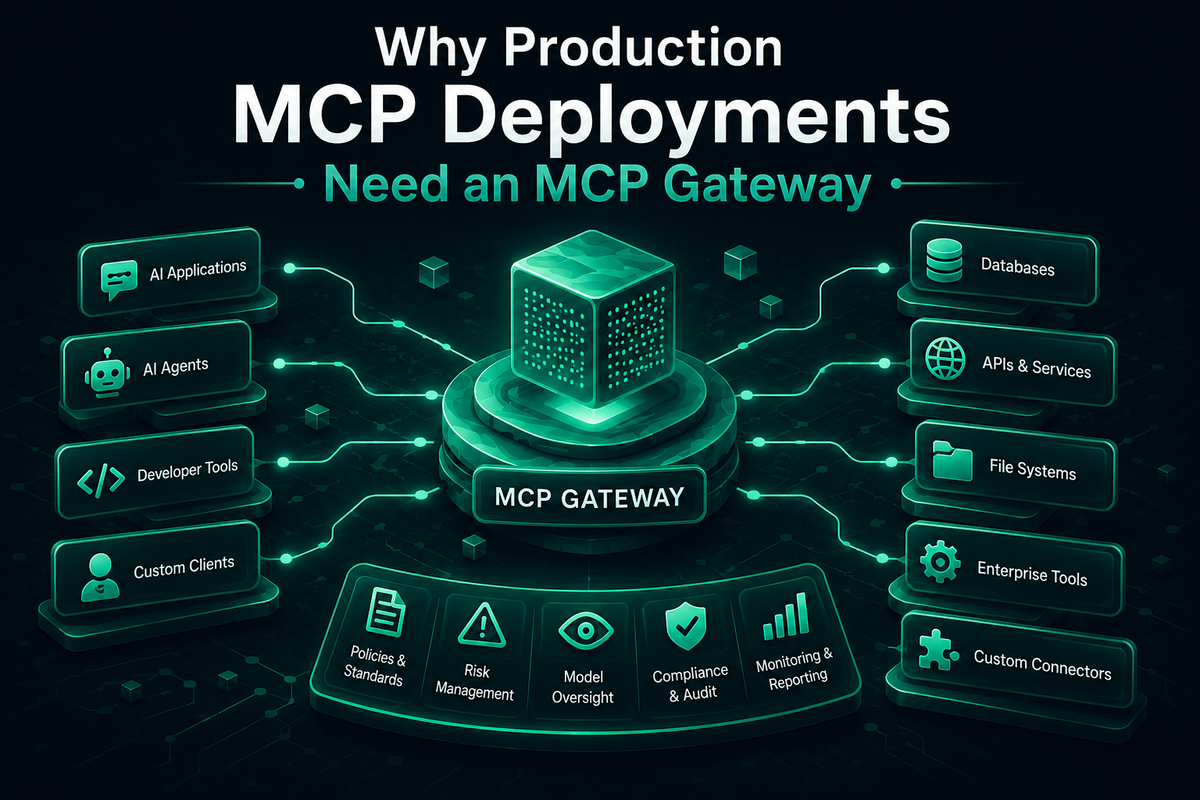
Production MCP deployments fail in predictable ways. A team wires three Model Context Protocol servers into an agent during prototyping. It works. They add five more for filesystem access, search, internal CRM lookups, payments, and observability. Suddenly the bill triples, an analyst's agent calls an admin-only tool, and no one can answer which agent invoked which tool at 2:47 a.m. last Tuesday. The fundamental problem is not MCP itself; it is the absence of a control layer between agents and the tools they invoke. An MCP gateway sits at that boundary and handles authentication, cost governance, and tool access control that the protocol intentionally leaves to implementers.
What is an MCP Gateway
An MCP gateway is a control plane that sits between AI agents (MCP clients) and tool servers (MCP servers), centralizing authentication, authorization, observability, and cost tracking across every connected tool. The agent connects once to the gateway. The gateway connects to every MCP server in the environment, applies policy on each tool call, and returns results. The Model Context Protocol itself is a lean, open standard for tool discovery and invocation maintained by Anthropic and now adopted across OpenAI, Microsoft, and Google products. The spec defines how tools are advertised and called. It does not define how an enterprise should govern those calls in production.
Bifrost's MCP gateway acts as both an MCP client (connecting to external tool servers) and an MCP server (exposing a single endpoint to agents and clients like Claude Code or Cursor), so a single deployment handles tool discovery, governance, and execution for the entire fleet.
The Failure Modes of Direct MCP Integration
Most teams discover the limits of direct MCP integration after the agent reaches a handful of servers. Three failure modes recur:
- Auth is per-server and inconsistent. Each MCP server brings its own credential model. Some use bearer tokens, some OAuth, some unauthenticated localhost connections. Rotating a key means updating every agent.
- Tool sprawl explodes context. Every connected tool is injected into the model's context on every request. Five servers with thirty tools each means 150 tool definitions per call, before the prompt is even read.
- Audit trails are fragmented. Each server logs its own calls in its own format. Reconstructing a multi-step agent run across four servers requires correlating logs from four systems.
These are not bugs in MCP. They are the consequence of treating the protocol as the whole solution, when in reality it is a transport layer. Production AI infrastructure needs a control plane on top of it.
Auth: Scoped Credentials Across the Tool Fleet
Authentication is the first capability that breaks at scale. A direct integration gives every agent the same access to every connected server, because access is implicitly defined by network reachability and shared credentials. An MCP gateway replaces that with scoped, revocable credentials issued per consumer.
Bifrost uses virtual keys as the primary governance entity. A virtual key is a credential issued to a specific consumer (a user, a team, a service, a customer integration) that carries an explicit list of tools it is allowed to call. The scoping works at the tool level, not just the server level. A key can be granted filesystem_read while being denied filesystem_write from the same MCP server. A customer-facing workflow's key simply cannot reach internal admin tools, because the model never receives definitions for tools outside its scope.
For OAuth-protected servers, Bifrost's MCP gateway handles OAuth 2.0 with PKCE, dynamic client registration, and automatic token refresh, so individual agents never hold provider credentials directly. Header-based authentication and federated identity through OpenID Connect (Okta, Entra) extend the same model to existing enterprise APIs.
Three benefits follow:
- Credentials can be issued, rotated, and revoked centrally without touching agent code
- A single audit trail captures every consumer-to-tool mapping
- Prompt-level workarounds cannot bypass scope, because out-of-scope tools are never injected into context
Cost Governance: Token Spend and Per-Tool Cost Tracking
Cost is the second failure mode, and it is the one teams notice only after the invoice arrives. Two cost vectors compound in production MCP deployments: token cost from tool definitions injected on every request, and direct API cost from tools that call paid external services (search, enrichment, code execution, data providers).
The token problem is structural. Every connected MCP tool from every server is loaded into the model's context on every single call. Connecting five servers with thirty tools each means sending 150 tool definitions before the model sees the prompt. At that scale, tool overhead dominates token spend. Anthropic's engineering team published findings showing context drop from 150,000 tokens to 2,000 for a Google Drive to Salesforce workflow when tool orchestration moves out of prompts and into executable code. Cloudflare reported the same exponential dynamic with their Code Mode implementation.
Bifrost addresses this with Code Mode, an alternative execution model where the agent writes a short Python script to orchestrate multiple tools in a single request. Instead of injecting every tool definition, Bifrost exposes the MCP catalog as a virtual filesystem of lightweight stub files. The model reads only what it needs through four meta-tools (listToolFiles, readToolFile, getToolDocs, executeToolCode), generates a script, and Bifrost executes it in a sandboxed Starlark interpreter. In controlled benchmarks across roughly 500 connected tools, Code Mode reduced input tokens by 92.8% and total cost by 92.2%, while pass rate held at 100%.
Direct API cost is the second vector. If a search tool charges per query or a code-execution sandbox charges per invocation, the model's tool spend can outpace its token spend silently. Bifrost tracks cost at the tool level using a pricing config defined per MCP client, with budget and rate limits configurable per virtual key, team, or customer. Tool cost and token cost surface side by side in the same audit log, so each agent run has a complete cost breakdown.
Tool Access Patterns: From One-Off Scopes to Org-Wide Governance
Direct virtual-key scoping handles single-credential cases cleanly. Production environments rarely look like that. Most teams manage tool access across many teams, customer tiers, and environments, where one-off scoping turns into a maintenance burden. Three patterns recur:
- Per-team scoping for internal agents (research, ops, finance, support)
- Per-tier scoping for customer-facing agents (free, pro, enterprise)
- Per-environment scoping to keep development tools out of production traffic
Bifrost handles these patterns through MCP Tool Groups, which are named collections of tools attached to any combination of virtual keys, teams, customers, users, or providers. A customer_support_tier_2 group can include read access to ticketing, knowledge base, and CRM lookup tools, and be attached to every virtual key issued to support staff. When a request matches multiple groups, the gateway merges and deduplicates the allowed tools. The model only ever sees the union of what its bindings permit.
Three-level filtering layers on top:
- Client-level configuration sets baseline tools per MCP client config (
["*"],[], or specific tool names) - Request-level filtering narrows tools dynamically per request via HTTP headers, supporting wildcard patterns
- Virtual-key filtering takes precedence over request-level headers, enforcing per-consumer access regardless of what the agent requests
Filters combine as an intersection, so a tool must pass every applicable filter to be exposed. This is the difference between trusting the agent to ask for the right tools and the gateway enforcing what the agent is allowed to see.
Observability: Every Tool Call as a First-Class Event
Auth and cost governance only work if you can see what happened. In a direct integration, tool execution is a side effect of an LLM request, often logged inconsistently across servers. In an MCP gateway, every tool call is a first-class event with structured metadata.
Bifrost's observability layer captures the tool name, originating MCP server, arguments passed, result returned, latency, the virtual key that triggered the call, and the parent LLM request that initiated the agent loop. Content logging can be disabled per environment to satisfy compliance constraints (PII, regulated data) while still capturing tool name, server, latency, and status. The same data feeds spend analytics, so token costs and tool costs roll up together by virtual key, team, or MCP server.
For organizations operating in regulated industries, Bifrost integrates with audit log exports for SOC 2, GDPR, HIPAA, and ISO 27001 trails, alongside OpenTelemetry-based tracing through Prometheus, Grafana, New Relic, and Honeycomb.
Why Production MCP Deployments Converge on a Gateway
The pattern is consistent across teams scaling MCP into production. Direct integrations work for prototypes. The moment a deployment crosses three or more servers, the failure modes show up together: auth becomes inconsistent, costs become unpredictable, access becomes ungoverned, and observability becomes fragmented. The teams that solve these problems converge on the same architectural decision, putting a control plane between agents and tools.
A production MCP gateway gives engineering teams:
- A single endpoint that consolidates every MCP server in the environment
- Scoped, revocable credentials with per-tool access control
- Token and per-tool cost tracking under a unified spend model
- Structured audit logs for every tool call across the fleet
- Code-mode execution patterns that cut context cost without cutting capability
This is the same pattern enterprise systems have adopted for every other class of integration. API gateways exist because direct service-to-service calls do not scale past trust boundaries. MCP gateways exist for the same reason. The protocol is the transport; the gateway is the control plane.
Start Building with the Bifrost MCP Gateway
Production MCP deployments need a gateway because the protocol was designed for interoperability, not enterprise governance. Bifrost provides the control plane (auth, cost governance, tool access control, audit logging, Code Mode) behind a single /mcp endpoint that connects to Claude Code, Cursor, and any MCP-compatible client. The same platform also handles LLM provider routing, fallbacks, and spend controls, so model traffic and tool traffic flow through one governance layer with one audit trail.
To see how Bifrost can govern your production MCP deployments end to end, book a demo with the Bifrost team.