11 Best AI Security Tools for LLM Apps and Agents
AI security tools protect LLM applications and agents from prompt injection, data leakage, and unsafe tool use at runtime. This guide compares 11 options, including Bifrost, Cloudflare, Palo Alto Networks, and Google Model Armor, by layer, coverage, and deployment.
TL;DR
- AI security tools for LLM apps screen prompts, model responses, tool calls, and agent actions for prompt injection, data leakage, and unsafe output at runtime.
- The tools sit at three layers: the network edge, the AI gateway, and cloud guardrail APIs that supply detections to either of the first two.
- Bifrost is the AI gateway layer: it applies guardrails to LLM and MCP traffic, scopes tool and agent access per virtual key, and calls external guardrail providers from one enforcement point.
- Cloud guardrail services such as Amazon Bedrock Guardrails, Google Cloud Model Armor, and Azure AI Content Safety are detection engines, and they work best behind an enforcement point that sees identity.
- Map every tool to the OWASP Top 10 for LLM Applications before buying; most teams need two layers, not one product per risk.
AI security tools protect the prompts, responses, tool calls, and agent actions that flow through LLM applications, which is a different job from the AI-powered threat detection tools that dominate the same search results. Bifrost, the open-source AI gateway built by Maxim AI, is the best choice for enterprises running mission-critical AI workloads that require top-tier performance, scalability, and reliability, because it enforces security policy on every model, tool, and agent call from one place. This guide compares 11 AI security tools for securing AI, covering prompt injection defense, runtime guardrails, PII and secrets protection, agent security, and AI firewalls.
What Are AI Security Tools?
AI security tools are products that detect and block attacks and data exposure in AI systems: prompt injection, jailbreaks, leaked credentials and personal data, unsafe model output, and agents calling tools they should not. They work at runtime on live traffic, before deployment through scanning and red teaming, or both, depending on the product.
The category splits by where a tool sits in the request path. Network and secure service edge (SSE) products inspect traffic as it leaves the organization or reaches a public LLM endpoint. AI gateways sit between applications and model providers, MCP servers, and remote agents, where they see which user or service made each call. Guardrail APIs from cloud providers do not sit in the path at all: an application or gateway sends text to them and acts on the verdict.
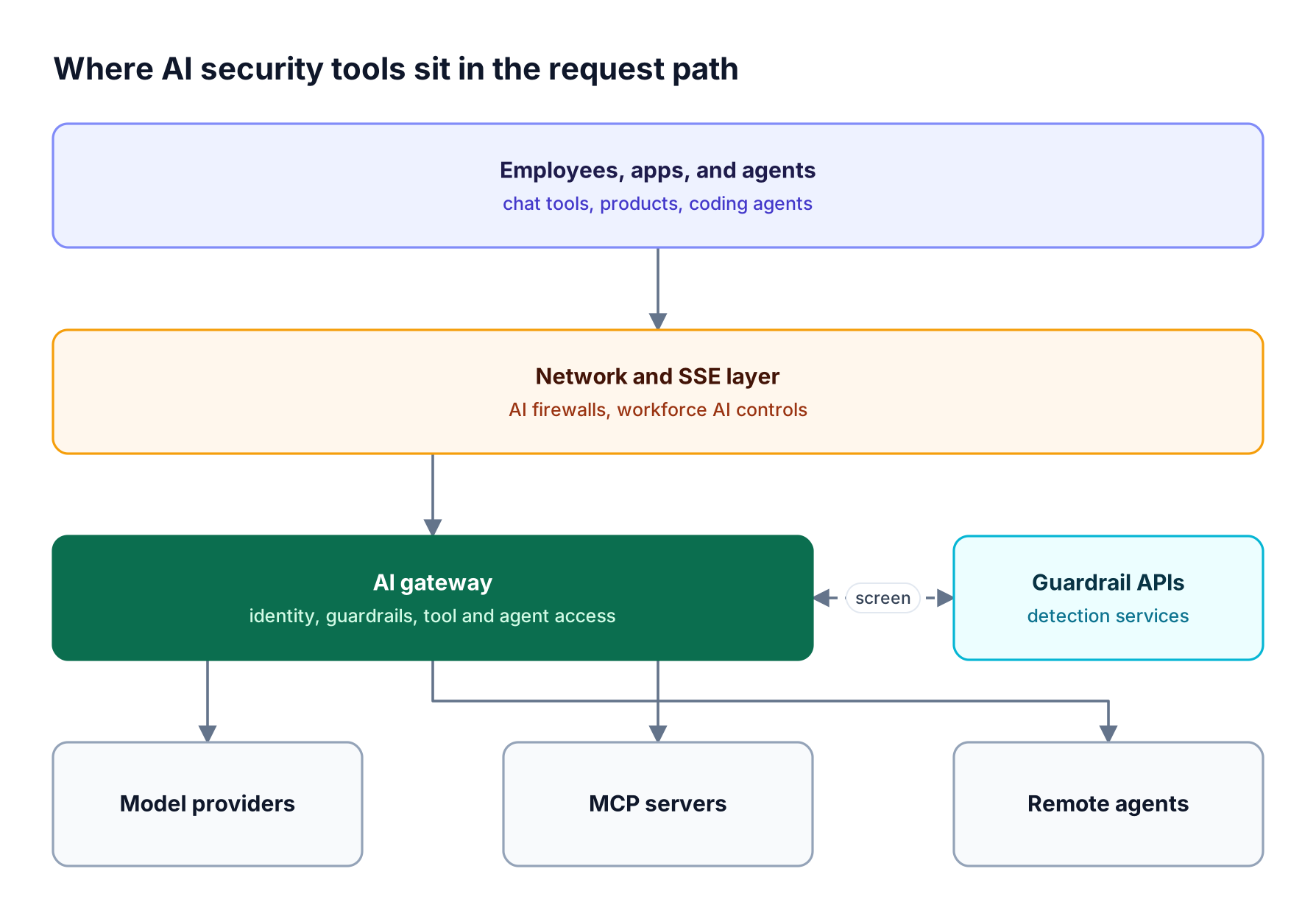
Figure 1: Network tools see traffic, the gateway sees identity and intent, and guardrail APIs supply the detections.
As Figure 1 shows, the layers are complementary: a network control cannot tell which team's agent made a tool call, and a guardrail API cannot stop a request it never receives. The AI gateway's role in enterprise AI security is to join identity, policy, and detection, as our comparison of an AI firewall and an AI gateway explains.
The AI Security Risks These Tools Address
The OWASP Top 10 for LLM Applications (2025) is the most widely used list of AI security risks, and it is the right yardstick for any AI security tool. Prompt injection, sensitive information disclosure, improper output handling, excessive agency, and unbounded consumption are runtime risks a gateway or guardrail can control directly.
The table maps each risk to the layer that controls it; our walkthrough of how to cover each OWASP LLM risk at the gateway goes deeper on each row.
| OWASP LLM risk (2025) | What goes wrong | Layer that controls it |
|---|---|---|
| LLM01 Prompt Injection | Input overrides the system prompt | Input guardrails at the gateway or AI firewall |
| LLM02 Sensitive Information Disclosure | PII or secrets leak | PII and secrets detection, redaction |
| LLM03 Supply Chain | Compromised models or plugins | Model scanning and posture tools |
| LLM04 Data and Model Poisoning | Training data is manipulated | Data security and model scanning |
| LLM05 Improper Output Handling | Unchecked output reaches other systems | Output guardrails |
| LLM06 Excessive Agency | Agents overreach on tools | Tool filtering and agent access control |
| LLM07 System Prompt Leakage | Hidden instructions are extracted | Output guardrails, secrets detection |
| LLM08 Vector and Embedding Weaknesses | Retrieval stores leak | Data access controls on retrieval |
| LLM09 Misinformation | Ungrounded or false answers | Grounding checks |
| LLM10 Unbounded Consumption | Runaway usage and cost | Budgets and rate limits |
The MITRE ATLAS knowledge base adds adversary techniques for red teaming. For agents, our guide to defending production agents against prompt injection explains why tool permissions matter as much as prompt filters.
Key Criteria for Evaluating AI Security Platforms
The best AI security platforms enforce policy inline, cover LLM, tool, and agent traffic, tie each decision to an identity, and keep sensitive data inside your infrastructure. Detection quality matters, but an accurate detector that only logs after the fact does not stop a leaked credential from reaching a third-party model.
| Criterion | What to check |
|---|---|
| Inline enforcement | Can it block or redact before the provider sees the request? |
| Input and output coverage | Does it screen both prompts and responses? |
| Tool and agent coverage | Does it see MCP tool arguments, tool results, and agent calls? |
| Identity binding | Is each decision tied to a user, team, or key? |
| Detection breadth | Prompt injection, PII, secrets, harmful content, custom policy |
| Deployment and data residency | Self-hosted, in-VPC, or SaaS? |
| Audit evidence | Signed logs, export, retention |
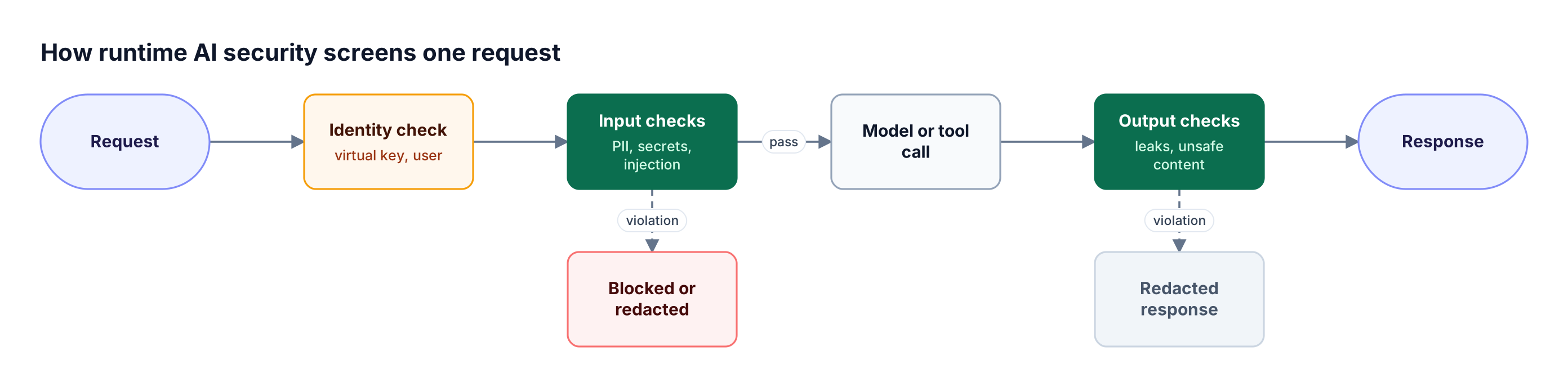
Figure 2: Input checks stop risky prompts before they spend tokens; output checks catch data the model or tool returns.
Figure 2 shows the pattern every inline tool follows; products differ in where the checks run and whether an identity check happens at all. Inline checks also need low latency, which is why Bifrost publishes gateway benchmarks.
AI Security Tools Compared at a Glance
The 11 AI security tools below cover three layers: the AI gateway, network and runtime security platforms, and cloud guardrail services. Bifrost is the only AI gateway for model, MCP tool, and agent traffic in this list; several others can serve as detection engines behind it.
| # | Tool | Primary layer | What it screens | How it is deployed |
|---|---|---|---|---|
| 1 | Bifrost | AI gateway | LLM prompts and responses, MCP tool arguments and results, agent access | Self-hosted single binary, in-VPC or on-prem |
| 2 | Cloudflare AI Security for Apps | WAF at the network edge | Prompt injection, PII, unsafe and custom topics on LLM endpoints | Cloudflare WAF; detection fields on Enterprise plans |
| 3 | Palo Alto Networks Prisma AIRS | AI runtime security | Prompt injection, data leakage, insecure output, model DoS | Instance in your cloud environment |
| 4 | Cisco AI Defense | Network-level AI security | Prompt injection, data leakage, harmful responses; red teaming | Network enforcement, no agents or libraries |
| 5 | Azure AI Content Safety | Cloud guardrail API | Prompt Shields, harm categories, protected material | API and SDKs |
| 6 | Google Cloud Model Armor | Cloud guardrail API | Injection and jailbreak, malicious URLs, sensitive data | Templates and REST API |
| 7 | Amazon Bedrock Guardrails | Cloud guardrail API | Content filters, prompt attacks, PII, grounding | Bedrock, or ApplyGuardrail API for other models |
| 8 | IBM Guardium AI Security | Discovery, posture, runtime | Shadow AI and agents, misconfigurations, prompts | Not published |
| 9 | Check Point AI Security | Security vendor suite | Workforce AI, AI apps, agents | Not published |
| 10 | SentinelOne | Security vendor platform | Shadow AI, prompt protection, data at rest | Not published |
| 11 | Zscaler AI Guard | Inline inspection service | 18+ detectors including injection, secrets, PII | Zscaler platform and API |
"Not published" means the vendor page we reviewed does not state the deployment model. Our roundup of eight AI security platforms covers a shorter list.
1. Bifrost
The Bifrost AI gateway is open source and enforces security policy on model calls, MCP tool calls, and agent-to-agent calls under one set of rules. It runs inside your own infrastructure, applies guardrails before and after each call, and adds about 11 microseconds of overhead per request at 5,000 RPS.
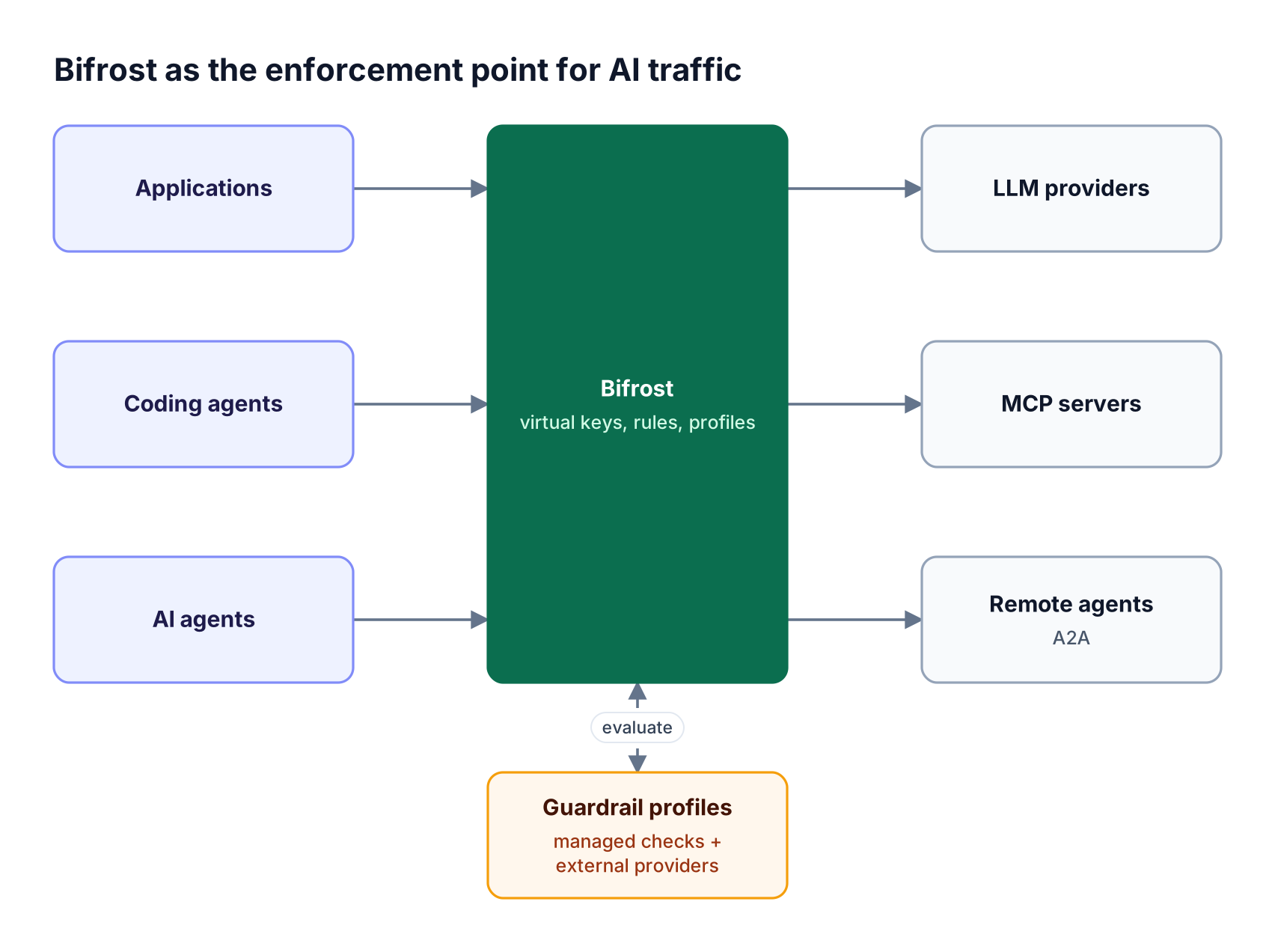
Figure 3: One gateway applies the same rules to model calls, tool calls, and agent calls, and can call external guardrail providers from that point.
Guardrails in Bifrost Enterprise combine CEL rules that decide which requests or tool executions to check with profiles that decide how. Rules run on input, output, or both, for LLM traffic or MCP tool executions. Top security capabilities:
- Bifrost-managed detection: Secrets Detection uses embedded Gitleaks rules for API keys, tokens, and private keys; Custom Regex ships a pattern-based PII Detection template; Prompt Guardrails uses an LLM or decision model as a judge for natural-language policies.
- External guardrail providers: 13 integrations, including AWS Bedrock Guardrails, Google Model Armor, Azure Content Safety, CrowdStrike AIDR, and Check Point's AI Agent Security.
- Redaction modes: guardrail redaction can redact the live request, redact only Bifrost logs and trace exports, or redact both with reversible placeholders.
- Tool and agent scoping: MCP tool filtering works at the client, request, and virtual key level, and a tool must pass every filter. In the Agent Gateway, agent access is a separate grant from model and tool access.
- Identity and evidence: virtual keys tie each call to a team or app; audit logs record admin changes and can be HMAC-signed.
- Data residency: Bifrost runs in your VPC or on-prem, no prompts or responses leave your infrastructure, and Bifrost Enterprise carries SOC 2 Type II, ISO 27001, HIPAA, and GDPR compliance.
With AI Gateway + Bifrost Edge, the same policies reach employee machines: Bifrost Edge routes AI traffic from desktop apps, browser AI, and coding agents through the gateway, so the guardrails above apply there too. The AI guardrails product page lists current detection coverage.
Best for: Bifrost is built for enterprises running mission-critical AI workloads that require top-tier performance, scalability, and reliability. It serves as a centralized AI gateway to route, govern, and secure all AI traffic across models and environments with ultra low latency. Bifrost unifies LLM gateway, MCP gateway, and Agents gateway capabilities into a single platform. Designed for regulated industries and strict enterprise requirements, it supports air-gapped deployments, VPC isolation, and on-prem infrastructure. It provides full control over data, access, and execution, along with strong security, policy enforcement, and governance capabilities.
AI Firewall and Runtime Security Tools
AI firewall and runtime security tools inspect AI traffic from the network or cloud layer, which suits teams that already route web and SaaS traffic through a security vendor. Two of the three below add discovery or red teaming; our list of AI security posture management tools covers discovery in depth.
2. Cloudflare AI Security for Apps
Cloudflare AI Security for Apps, formerly Firewall for AI, is built into the Cloudflare Web Application Firewall. It scans requests to labeled LLM endpoints and adds detection fields for prompt injection, PII, and unsafe or custom topics that WAF rules can act on, whichever model sits behind the endpoint.
Best for: teams on Cloudflare that publish their own LLM endpoints; the detection fields are an Enterprise add-on.
3. Palo Alto Networks Prisma AIRS
Prisma AIRS is the AI runtime security product from Palo Alto Networks, with components for AI application, model, and data protection. A Prisma AIRS instance is deployed in your cloud environment and inspects traffic between AI applications, models, and datasets for prompt injection, sensitive data leakage, insecure output such as malicious URLs, and model denial of service.
Best for: Palo Alto Networks customers that want AI runtime inspection next to existing network policy.
4. Cisco AI Defense
Cisco AI Defense covers discovery of AI workloads and third-party AI apps, algorithmic red teaming, and runtime guardrails against prompt injection, denial of service, data leakage, and harmful responses. It is enforced at the network level without agents or libraries and aligned with NIST, MITRE ATLAS, and the OWASP LLM Top 10.
Best for: Cisco security customers that want discovery, model validation, and runtime protection from one vendor.
LLM Guardrails from Cloud Providers
LLM guardrails from cloud providers are detection services: an application or gateway sends a prompt or response, and the service returns a verdict or a redacted version. They are not in the request path on their own, which is why Bifrost integrates all three below as guardrail profiles.
5. Azure AI Content Safety
Azure AI Content Safety is Microsoft's content screening service. Prompt Shields detects prompt attacks, the text and image APIs score sexual, violent, hate, and self-harm content by severity, and protected material detection flags known copyrighted text; groundedness detection is in preview. Access is through APIs and SDKs with Microsoft Entra ID.
Best for: Azure-centric teams that need prompt attack detection and harm classification as an API.
6. Google Cloud Model Armor
Google Cloud Model Armor screens prompts and responses for prompt injection and jailbreaks, responsible AI categories, malicious URLs, and sensitive data through Sensitive Data Protection. Policies are set in templates and floor settings, with an inspect-only or inspect-and-block mode, and applications call it through a REST API. Bifrost uses it as a guardrail profile; our post on redacting sensitive data with Google Model Armor and Bifrost shows the setup.
Best for: Google Cloud customers that want managed screening with Sensitive Data Protection built in.
7. Amazon Bedrock Guardrails
Amazon Bedrock Guardrails offers six safeguards: content filters including prompt attack detection, denied topics, word filters, sensitive information filters for PII and custom regex, contextual grounding checks, and Automated Reasoning checks. The ApplyGuardrail API applies these safeguards to models outside Bedrock. Our post on screening LLM traffic with AWS Bedrock Guardrails and Bifrost covers text and image screening through the gateway.
Best for: AWS customers that want grounding checks and PII filters on any model.
Enterprise AI Security Platforms
Enterprise AI security platforms from established security vendors combine discovery of AI use, posture management, and runtime protection inside a wider security suite. They suit teams that want AI risk in their existing console, and they focus heavily on shadow AI; applications and agents you build still need an enforcement point.
8. IBM Guardium AI Security
IBM Guardium AI Security discovers AI assets, including shadow AI and agents, across cloud environments and code repositories. It flags misconfigurations, runs automated penetration tests, scans prompts at runtime, and feeds discovered use cases into watsonx.governance so security and governance teams share one inventory.
Best for: IBM customers that want AI security findings and AI governance controls in one inventory.
9. Check Point AI Security
Check Point groups its AI security products into workforce AI security, runtime protection for GenAI apps, AI agent security that monitors agent decisions and restricts tool use, and AI red teaming. Its AI agent security product is also a guardrail provider in Bifrost.
Best for: Check Point customers covering employee AI use, homegrown apps, and agents with one vendor.
10. SentinelOne
SentinelOne discovers sanctioned and shadow AI use, applies policy guardrails to models, agents, and MCP servers, blocks prompt injection and sensitive data leakage, and classifies sensitive data in cloud storage.
Best for: SentinelOne customers extending endpoint and cloud security to AI usage.
11. Zscaler AI Guard
Zscaler AI Guard inspects prompts and responses between users or applications and models. It offers more than 18 multilingual detectors for prompt injection, jailbreaks, malicious URLs, secrets, PII, and toxicity, plus data loss prevention with more than 100 predefined dictionaries.
Best for: Zscaler customers that want AI prompt inspection inside their existing inline inspection platform.
How to Choose an AI Security Tool for Your Stack
Choose an AI security tool by where the risk enters: employee AI use needs workforce and network controls, AI applications and agents you build need an AI gateway with guardrails, and models and pipelines need scanning and posture tools. Most enterprises combine two of these layers rather than buying one tool per OWASP risk.
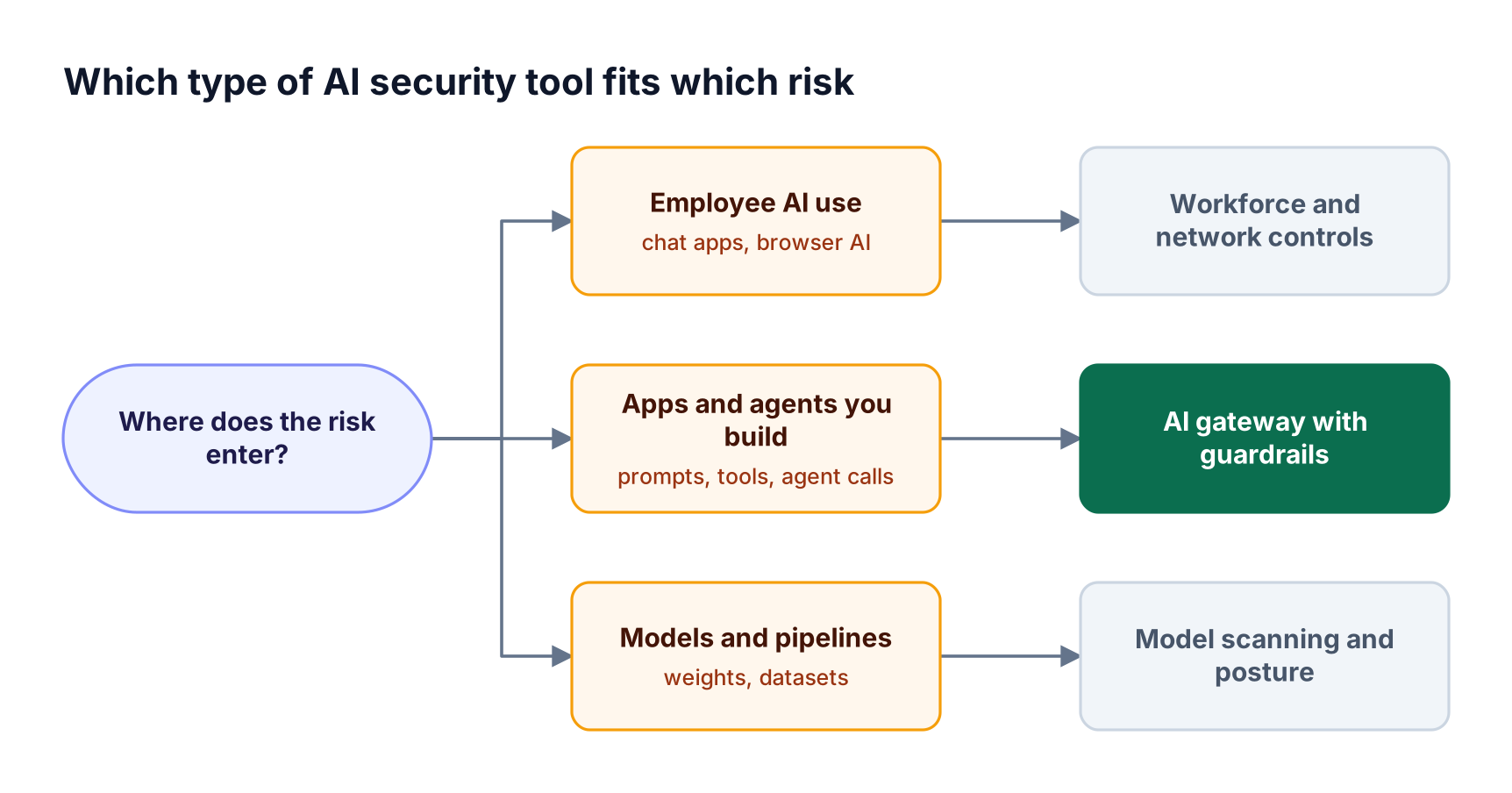
Figure 4: Start from where the risk enters, then add the layer that sees that traffic.
Three patterns cover most teams:
- Gateway plus cloud guardrail: run Bifrost as the enforcement point and call Bedrock Guardrails, Model Armor, or Azure Content Safety as profiles, adding identity, tool scoping, and redaction around detection you already use. See what Bifrost ships and what it integrates.
- Gateway plus security vendor: keep your security vendor for employee AI and network inspection, and route application and agent traffic through the gateway, which integrates CrowdStrike AIDR and Check Point as guardrail providers.
- Agent-heavy stacks: if agents call MCP tools and other agents, prioritize MCP gateway controls and per-key tool filtering. Our roundup of MCP security tools and our comparison of AI agent security platforms cover that layer in detail.
Whichever pattern you pick, confirm where prompts are processed: a cloud guardrail sees the text you send it, while a self-hosted gateway decides what is sent anywhere. The guardrails resource page covers rule design for each pattern.
Frequently Asked Questions
What is AI security?
AI security is the practice of protecting AI systems, their data, and their users from attacks and misuse. For LLM applications it covers prompt injection, leakage of personal data and credentials, unsafe output, excessive agent permissions, and runaway usage. It is distinct from AI-powered security, which uses machine learning to detect threats in conventional IT systems.
What is prompt injection?
Prompt injection is an attack in which text supplied by a user, a document, a web page, or a tool result contains instructions that override the application's system prompt. Direct injection comes from the user; indirect injection arrives through retrieved or tool-returned content. It is ranked first in the OWASP Top 10 for LLM Applications because it can lead to data disclosure and unauthorized tool calls.
How do you prevent prompt injection?
No single control prevents prompt injection, so teams layer defenses. Screen inputs and retrieved content with a detector, limit which tools each agent can call, keep secrets out of system prompts, and screen outputs before they reach downstream systems. Bifrost applies guardrails at the gateway on LLM and MCP traffic in one place, tied to the calling identity.
What is an AI firewall?
An AI firewall is an inline control that inspects prompts and responses for attacks and sensitive data, usually at the network edge or in front of an LLM endpoint. An AI gateway adds identity, routing, tool and agent access control, and budgets, so the two are often used together.
What is the OWASP Top 10 for LLM applications?
The OWASP Top 10 for LLM Applications is a community-maintained list of the most critical security risks in applications built on large language models. The 2025 edition ranks prompt injection first, followed by sensitive information disclosure, and adds system prompt leakage and vector and embedding weaknesses as new entries.
What is AI security posture management?
AI security posture management (AI-SPM) discovers the AI models, applications, agents, and data an organization runs, then flags misconfigurations, exposed data, and policy gaps. It answers what AI exists and how it is configured. Runtime tools answer what each request is doing right now, so AI-SPM and an AI gateway cover different halves of the same program.
Secure AI Traffic with Bifrost
The AI security tools in this list solve different parts of the problem, and the enforcement point decides whether a detection stops anything. Bifrost puts guardrails, tool scoping, agent access, and audit evidence in front of every model, MCP tool, and agent call inside your own infrastructure, and can call the cloud guardrail services above in the same policy. To see how Bifrost fits your AI security stack, book a demo with the Bifrost team, or explore AI governance with Bifrost to see how budgets and access rules complement the guardrails.