Top 5 AI Security Platforms for Prompt Injection, Guardrails, and MCP Traffic in 2026
AI security platforms inspect and control the prompts, responses, and tool calls that move between applications, models, and MCP servers. This guide ranks five options, including Bifrost, Prisma AIRS, Lakera Guard, and NVIDIA NeMo Guardrails, on injection defense, guardrails, and MCP governance.
TL;DR
- AI security platforms in 2026 must cover three paths at once: prompts sent to models, responses returned from models, and MCP tool calls made by agents.
- Prompt injection remains the top risk in the OWASP Top 10 for LLM Applications, and indirect injection through tool results is the variant that reaches MCP traffic.
- Bifrost applies guardrail rules to both LLM requests and MCP tool executions from one gateway, with 11 microseconds of overhead per request at 5,000 RPS.
- Detection APIs, network security platforms, edge firewalls, and in-app guardrail libraries each cover part of the problem; the deciding factor is where enforcement happens.
- Teams running agents against MCP servers need tool allow-lists, per-user MCP authentication, and argument and result inspection, not only prompt classification.
AI security platforms sit between AI applications and the models and tools they call, inspecting traffic for prompt injection, data leakage, and policy violations before anything reaches a user or a downstream system. Bifrost, the open-source AI gateway built by Maxim AI, is the best choice for enterprises running mission-critical AI workloads that require best-in-class performance, scalability, and reliability, because it enforces the same guardrails on LLM calls and MCP tool executions in one place. This guide compares five AI security platforms on prompt injection defense, guardrail coverage, and MCP traffic control, and explains which enforcement model fits which team.
What AI Security Platforms Need to Cover in 2026
AI security platforms need to inspect three distinct paths: the prompt sent to a model, the response the model returns, and the MCP tool calls an agent makes on a user's behalf. A platform that covers only the first path misses the indirect injection and data exfiltration routes that agentic systems open up.
The OWASP Top 10 for LLM Applications lists prompt injection as LLM01, and separates direct injection (malicious instructions typed by a user) from indirect injection (instructions hidden in documents, web pages, or tool output that a model later reads). The second category is the one that grows with MCP adoption, because every MCP server an agent connects to is a new source of untrusted text.
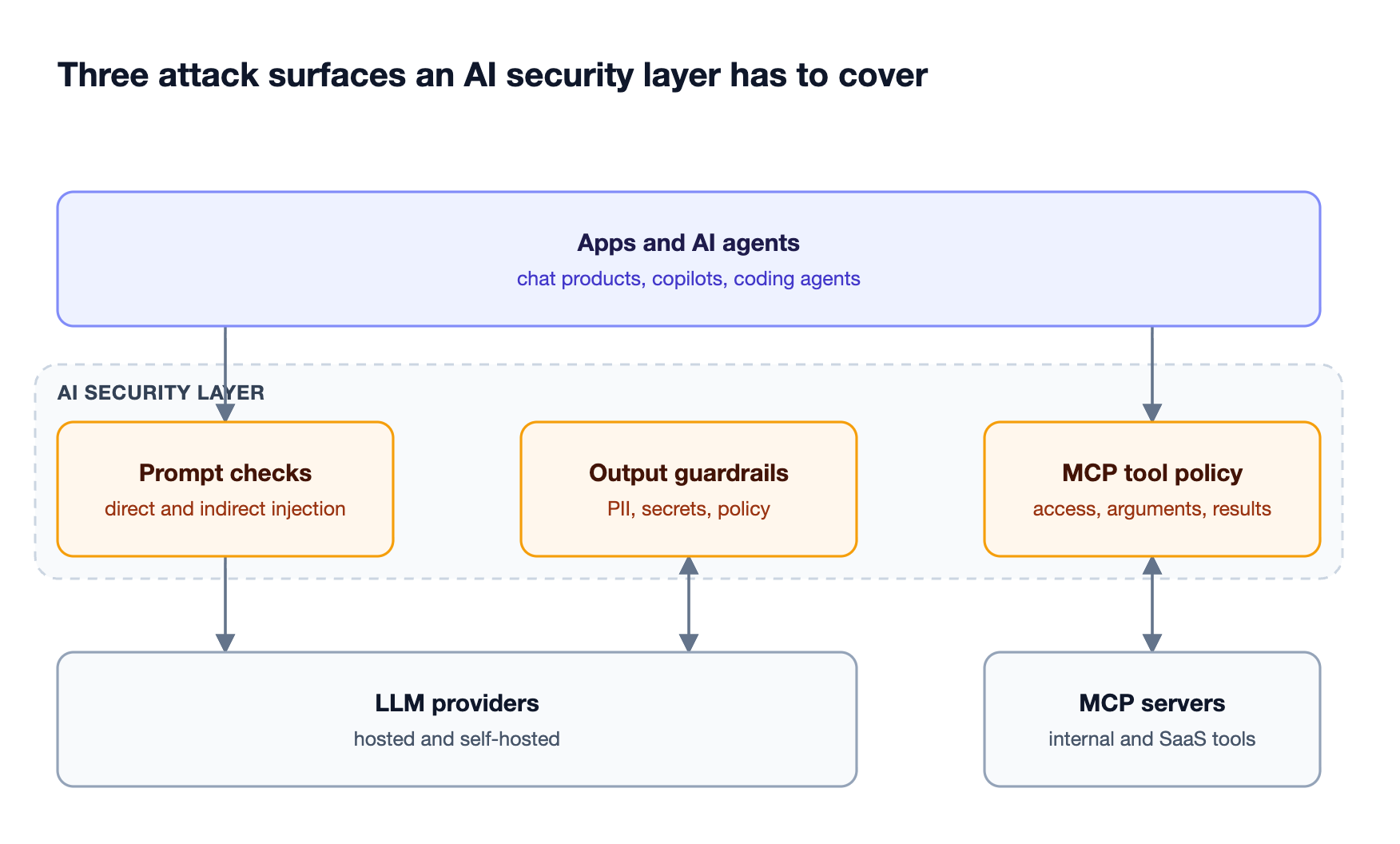
As Figure 1 shows, the security layer has to sit where both model traffic and tool traffic pass. Teams that already route model calls through Bifrost can review the broader controls that apply to LLM traffic before extending the same policy to MCP servers. The three coverage areas break down as follows:
- Prompt injection defense: classifying direct and indirect injection attempts in inputs, conversation history, and retrieved content.
- Guardrails: detecting PII, secrets, unsafe content, and organization-specific policy violations in both inputs and outputs, then blocking or redacting.
- MCP traffic control: deciding which agents can see which tools, authenticating each call, and inspecting tool arguments and results.
Key Criteria for Evaluating AI Security Platforms
The most useful criteria for evaluating AI security platforms are the enforcement point, coverage of MCP tool calls, the detection methods available, redaction support, streaming behavior, deployment model, and audit evidence. Detection accuracy matters, but a strong classifier placed where it cannot see tool traffic still leaves the agent path open.
| Criterion | What to check | Why it matters |
|---|---|---|
| Enforcement point | Inline gateway, detection API, network intercept, or in-app library | Decides whether a policy can be bypassed by a team that skips an SDK call |
| MCP coverage | Tool allow-lists, MCP authentication, argument and result inspection | Indirect injection and data exfiltration travel through tool calls |
| Detection methods | Classifiers, regex, secrets scanning, LLM-as-judge policies | No single method catches injection, PII, and custom policy together |
| Redaction | Block only, or redact in runtime payloads and logs | Redaction keeps a workflow running while removing sensitive data |
| Streaming | How output checks behave on streamed responses | Block-capable checks on streams trade latency for safety |
| Deployment | SaaS, self-hosted, in-VPC, on-prem | Regulated teams often cannot send prompts to a third-party API |
| Audit evidence | Request logs, signed admin audit trails, exports | Compliance reviews need proof of what was enforced and when |
The AI Risk Management Framework from NIST frames these as govern, map, measure, and manage functions; the criteria above are the operational controls that sit under the manage function for LLM and agent traffic. The Bifrost governance resource covers how identity, budgets, and access policies sit alongside guardrails at the gateway.
Why MCP Traffic Changes Prompt Injection Defense
MCP traffic changes prompt injection defense because tool results are untrusted input that a model treats as context, and tool calls are actions with real side effects. A prompt classifier that only reads the user's message cannot see an instruction planted in a GitHub issue, a web page, or a database row returned by an MCP server.
The MCP security best practices published with the protocol specification call out confused-deputy and token passthrough risks, which are authorization problems rather than content problems. That means MCP security needs two kinds of control: access control (which tools a caller may reach, under whose credentials) and content inspection (what goes into a tool and what comes back).
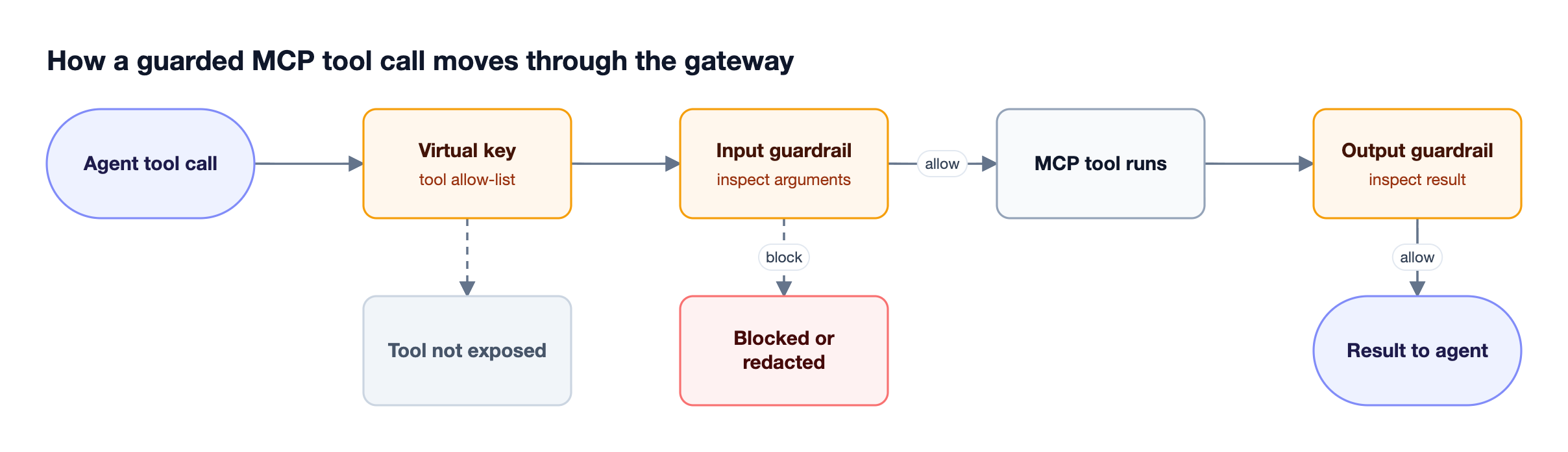
Figure 2 shows the order that matters. A tool that is not on the caller's allow-list never reaches the model's context. An argument that carries a secret or an injected instruction is blocked before the tool runs, and a result that carries injected text is blocked or redacted before the agent reads it. The MCP gateway resource explains why centralizing these checks in one gateway is simpler than adding them to every MCP server. For a deeper look at the content side, see how guardrails for prompt injection compare across platforms.
AI Security Platforms Compared at a Glance
The five AI security platforms below take five different approaches: an inline AI gateway, a network and API security platform, a detection API, an edge firewall with MCP portals, and an open-source guardrail library. The table summarizes where each one enforces policy and how far its coverage extends into MCP traffic.
| Platform | Enforcement point | Prompt injection | Guardrails and redaction | MCP traffic control | Deployment |
|---|---|---|---|---|---|
| Bifrost | Inline AI gateway for LLM and MCP traffic | Via native and external guardrail profiles | Native regex, secrets detection, LLM-as-judge, 11 external providers; runtime and log redaction | Tool filtering, Virtual MCPs, six MCP auth types, MCP guardrail rules | Open source, self-hosted, in-VPC, on-prem |
| Prisma AIRS | API intercept and network intercept | Yes | Sensitive data, malicious URLs, toxic content | Agent protections for tool misuse | Palo Alto Networks platform |
| Lakera Guard | Detection API | Yes, including jailbreaks | Data leakage and harmful output detection | Indirect injection through connected tools | SaaS API |
| Cloudflare | Edge WAF and Zero Trust portals | Yes, on labeled LLM endpoints | PII and unsafe topic detection | MCP server portals with Access policies | Cloudflare network |
| NeMo Guardrails | In-app library or self-hosted service | Self-check and heuristic jailbreak detection | Input, output, dialog, retrieval, execution rails | Tool call validation in agent frameworks | Open-source Python package, container |
The rest of this guide looks at each platform in turn, starting with Bifrost. Readers comparing a wider field can also review the full roundup of AI security platforms for 2026, which covers posture management and model scanning tools alongside runtime controls.
1. Bifrost
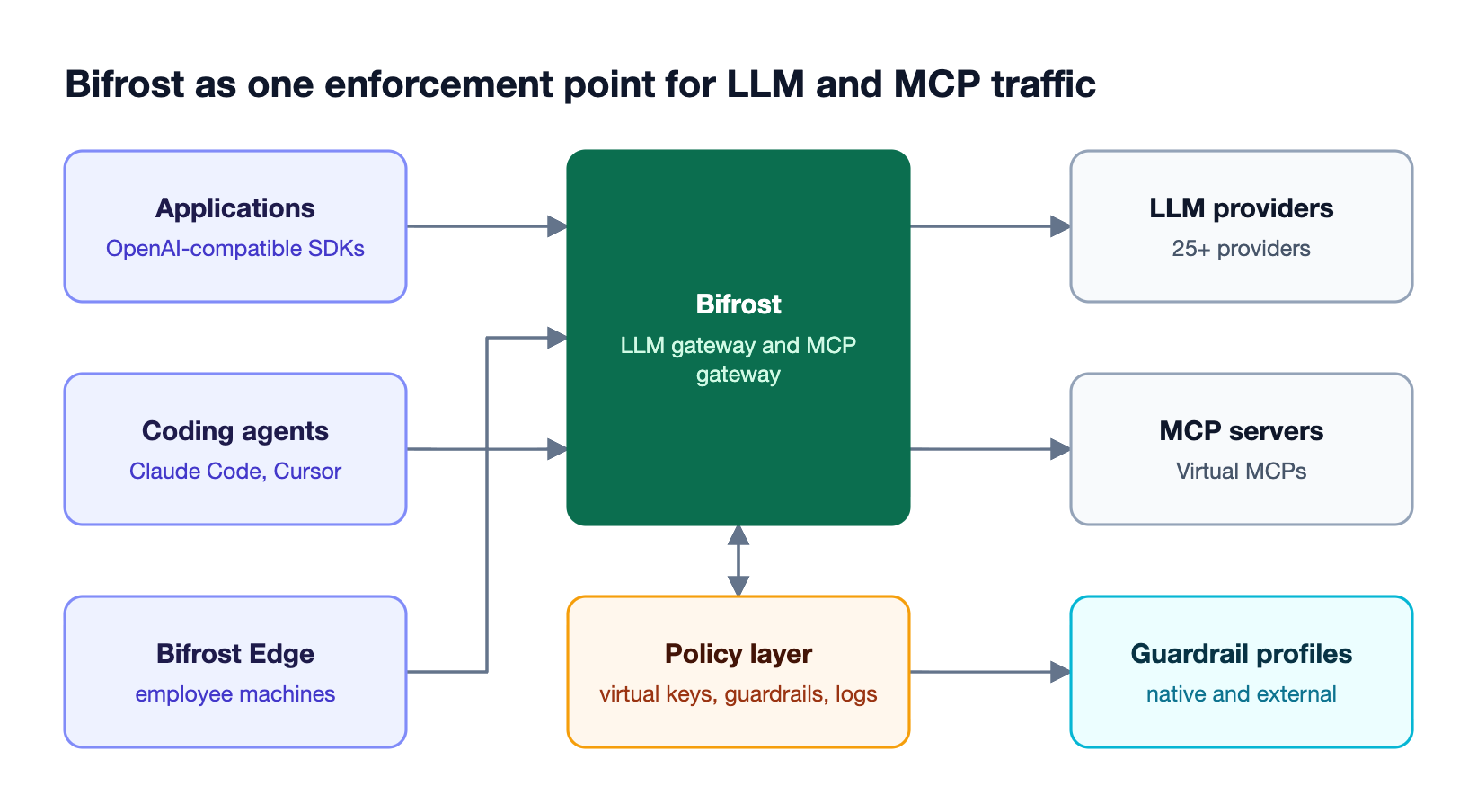
The Bifrost AI gateway is open-source software that applies guardrails, access control, and logging to both LLM requests and MCP tool executions from one enforcement point. Every application, coding agent, and MCP client that routes through Bifrost inherits the same policies without SDK changes, and the gateway adds 11 microseconds of overhead per request at 5,000 RPS in published benchmarks.
Best for: Bifrost is built for enterprises running mission-critical AI workloads that require best-in-class performance, scalability, and reliability. It serves as a centralized AI gateway to route, govern, and secure all AI traffic across models and environments with ultra low latency. Bifrost unifies LLM gateway, MCP gateway, and Agents gateway capabilities into a single platform. Designed for regulated industries and strict enterprise requirements, it supports air-gapped deployments, VPC isolation, and on-prem infrastructure. It provides full control over data, access, and execution, along with robust security, policy enforcement, and governance capabilities.
Prompt injection and guardrails
Bifrost Guardrails are built from two parts: rules, written in CEL, that decide when content is checked, and profiles, which decide how it is checked. A single rule can link several profiles for layered protection, and each rule can run on input, output, or both. Bifrost manages three profile types natively:
- Secrets Detection: Gitleaks-backed detection of leaked API keys, tokens, private keys, and credentials.
- Custom Regex: in-process pattern checks, including a built-in PII detection template.
- Prompt Guardrails: an LLM-as-judge that enforces natural-language policies with an allow or block decision.
Bifrost also connects to 11 external guardrail providers as profiles, and several of them, including AWS Bedrock Guardrails, Google Model Armor, CrowdStrike AIDR, Gray Swan Cygnal, and Check Point's AI Agent Security, add dedicated prompt injection classification. Supported providers can also redact detected text in three modes: runtime, logs only, or runtime with reversible log placeholders. On streamed responses, detect-only rules do not delay delivery, while block-capable rules hold the stream until evaluation finishes.
MCP traffic control
Bifrost treats MCP tool execution as a guardrail target of its own. An MCP rule can inspect or redact tool arguments before the tool runs and inspect or redact the result before it returns, using the same profiles as LLM rules. Access control sits in front of that:
- Explicit execution by default: tool calls proposed by a model are suggestions until an API call executes them; Agent Mode auto-execution is opt-in.
- Tool filtering at three levels: client configuration (deny by default when empty), request headers, and virtual keys.
- Virtual MCPs: curated bundles of tools served at their own endpoint and attached to virtual keys.
- MCP authentication: six auth types, from static headers and shared OAuth to per-user OAuth and enterprise token exchange, so each caller reaches upstream servers under the right identity.
The Bifrost MCP gateway write-up covers how these access controls combine with Code Mode to cut token costs on large tool catalogs.
Audit, deployment, and endpoint coverage
Request logs record both LLM and MCP calls, while audit logs record administrative activity as HMAC-signed events that export to JSON, JSON Lines, or Syslog and archive to S3 or GCS.
Bifrost runs as open source, in private VPCs, or on-prem, which keeps prompts inside the network for regulated teams. The Bifrost Enterprise tier adds guardrails, RBAC, and clustering.
For traffic that never gets pointed at the gateway, AI Gateway + Bifrost Edge extends the same policies to employee machines. Bifrost Edge, currently in alpha, routes desktop AI apps, browser AI, coding agents, and their MCP servers through Bifrost, where Bifrost guardrails and audit logging apply.
2. Palo Alto Networks Prisma AIRS
Prisma AIRS is Palo Alto Networks' AI security platform, covering runtime protection, AI agent security, model scanning, posture management, and AI red teaming. It inspects AI traffic through API intercept or network intercept, which suits organizations that already run Palo Alto next-generation firewalls and want AI controls inside that estate.
Best for: Security teams standardized on Palo Alto Networks that want AI runtime protection, red teaming, and posture management under one vendor.
- Runtime protection: detects prompt injection, sensitive data exposure, malicious URLs, and toxic content in AI traffic.
- Agent security: protections against memory manipulation and tool misuse in agent systems.
- Red teaming: simulated attacks with multi-turn support and agentic target profiling.
- Model and posture security: model scanning and AI posture management across AI data and components.
Prisma AIRS is strongest as part of a broader network security program. Teams whose main gap is routing, budgets, and per-tool access for MCP servers will still need a gateway layer; the comparison of AI agent security platforms covers how the two layers fit together.
3. Lakera Guard
Lakera Guard is a prompt injection and content detection API, now part of Check Point. Applications send prompts and responses to the API and receive a verdict, which makes it a focused choice for teams that want a dedicated classifier without changing their infrastructure.
Best for: Application teams that want a dedicated prompt injection and jailbreak classifier they can call from existing code.
- Injection and jailbreak detection: blocks prompt injection, jailbreaks, and adversarial instructions before they reach the model.
- Data leakage and content checks: flags sensitive data in prompts and responses and harmful or non-compliant outputs.
- Agent coverage: targets indirect injection arriving through connected tools.
- Multilingual detection: Lakera states coverage of more than 100 languages and sub-50 ms runtime latency.
Because Lakera Guard is a detection service, enforcement depends on every application calling it. Lakera's detection now ships as Check Point's AI Agent Security, which is available as a Bifrost guardrail profile, so teams can keep the classifier and enforce it centrally at the gateway instead of per application.
4. Cloudflare Firewall for AI and MCP Server Portals
Cloudflare covers AI security from its edge network with two separate products: Firewall for AI, a WAF capability that scans requests to LLM endpoints, and MCP server portals in Cloudflare One, which put multiple MCP servers behind one authenticated endpoint. Together they suit teams that already front applications with Cloudflare.
Best for: Teams already running applications and Zero Trust access on Cloudflare that want AI checks at the network edge.
- Prompt injection detection: flags prompts that try to override model instructions or reveal the system prompt, on endpoints labeled for LLM traffic.
- PII and unsafe topics: detects personal data and harmful or custom topics in incoming prompts.
- MCP server portals: one endpoint for many MCP servers, with Access policies controlling which users see which servers and tools.
- Logging and DLP: tool requests are logged through Access, and optional Gateway policies can block sensitive data transfers.
Firewall for AI inspects JSON requests, and its detection fields are an Enterprise add-on. Response-side guardrails and per-tool argument inspection fall outside what the published documentation describes, which is where gateway-level LLM guardrails fill the gap.
5. NVIDIA NeMo Guardrails
NeMo Guardrails is an open-source Python library from NVIDIA for adding programmable rails to LLM applications. Developers define input, output, dialog, retrieval, and execution rails, written partly in the Colang language, and run them inside the application or as a self-hosted HTTP service.
Best for: Engineering teams that want fine-grained, code-level control over conversational flows inside a single application.
- Rail types: input, retrieval, dialog, execution, and output rails at different stages of an interaction.
- Jailbreak defense: self-check jailbreak detection, heuristic detection, and integration with NVIDIA NemoGuard models.
- Composition: combines built-in rails, NVIDIA safety models, community models, third-party APIs, and custom Python actions.
- Agent support: tool call validation and multi-agent safety through LangChain and LangGraph integrations.
NeMo Guardrails runs per application, so each service owns its own configuration. Organizations with many teams often pair an in-app library with a central enforcement layer; the guide to LLM gateway security for prompt injection and PII walks through that split.
How to Choose an AI Security Platform
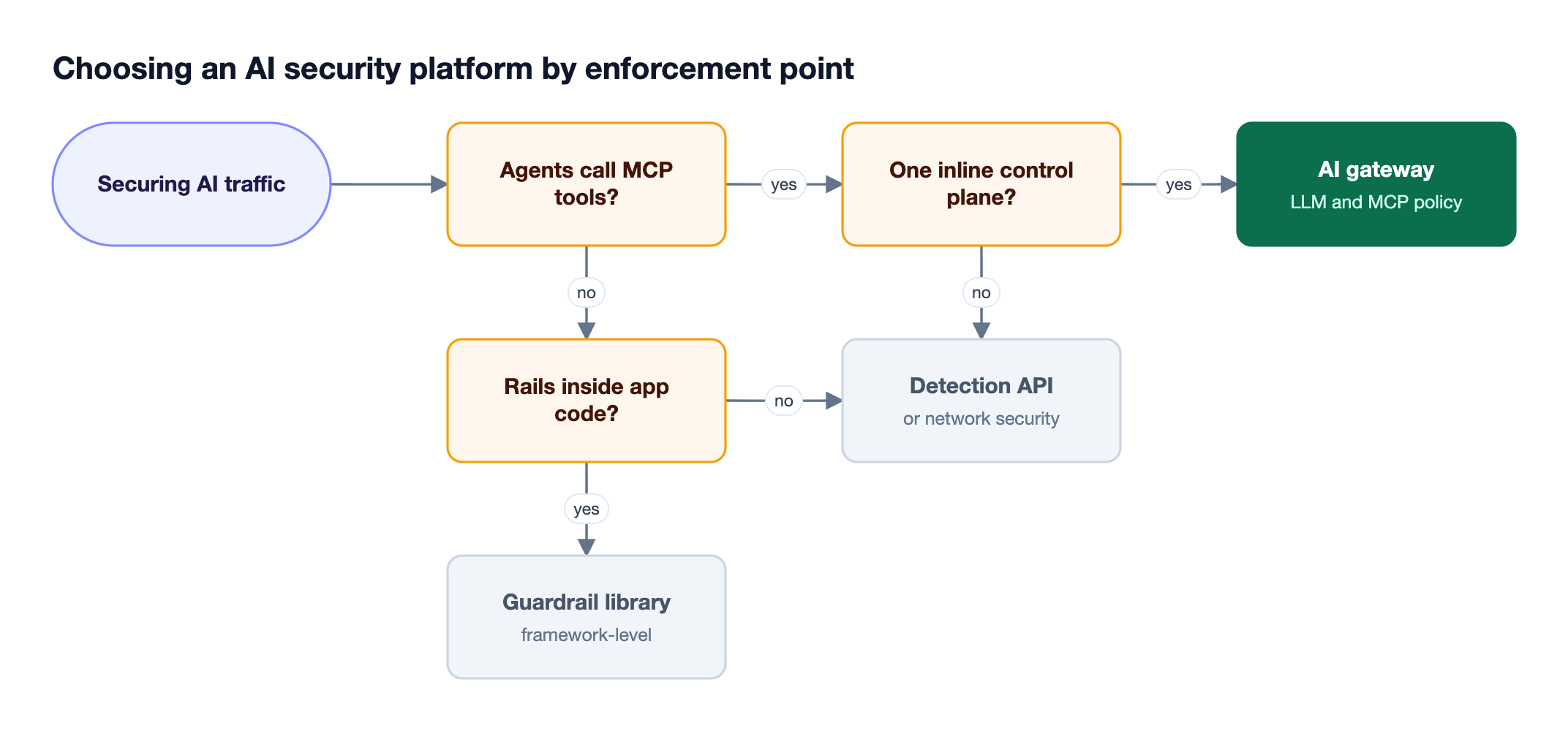
Choose an AI security platform by deciding where enforcement has to happen first, then by detection depth. If agents call MCP tools and many teams ship AI features, an inline gateway is the most direct way to apply one policy to every model call and tool call without relying on each team to integrate an SDK.
| If your main requirement is | Start with |
|---|---|
| One policy for LLM calls and MCP tool calls across many teams | Bifrost |
| AI controls inside an existing Palo Alto Networks estate | Prisma AIRS |
| A dedicated injection classifier called from application code | Lakera Guard, or the Check Point profile in Bifrost |
| Edge-level checks for apps already fronted by Cloudflare | Cloudflare Firewall for AI |
| Code-level conversational rails in one Python application | NeMo Guardrails |
These options are not mutually exclusive. A common pattern places Bifrost as the enforcement point and plugs specialist detectors into it as guardrail profiles, so classifier choice can change without changing every application. Teams governing agent access at scale should also review MCP tool filtering per virtual key and the enterprise AI security platform landscape before shortlisting.
Frequently Asked Questions
What are the best AI security platforms?
The best AI security platforms in 2026 for prompt injection, guardrails, and MCP traffic are Bifrost, Palo Alto Networks Prisma AIRS, Lakera Guard, Cloudflare Firewall for AI with MCP server portals, and NVIDIA NeMo Guardrails. Bifrost ranks first for teams that need one inline enforcement point for both LLM requests and MCP tool executions, with self-hosted and in-VPC deployment options.
What is prompt injection?
Prompt injection is an attack in which crafted text causes a language model to ignore its instructions or take unintended actions. Direct injection arrives in the user's own message. Indirect injection is hidden in content the model reads later, such as a web page, a document, or an MCP tool result, which is why agent systems need checks on tool outputs as well as user inputs.
How do you prevent prompt injection?
Prevent prompt injection with layered controls: classify inputs for injection attempts, restrict which tools an agent can reach, inspect tool arguments and results, and require explicit approval for high-impact actions. Bifrost applies these layers at the gateway through guardrail rules on LLM and MCP targets, tool filtering per virtual key, and opt-in Agent Mode for auto-execution.
Why does MCP traffic need its own security controls?
MCP traffic needs its own controls because tool calls perform real actions and tool results feed untrusted text back into the model. Prompt-only classifiers do not see either. An MCP gateway adds tool allow-lists, per-user authentication to upstream servers, and inspection of arguments before execution and results before they reach the agent.
Do AI security platforms add latency?
AI security platforms add latency in two places: the gateway or proxy hop, and each detection call. Bifrost adds 11 microseconds of gateway overhead per request at 5,000 RPS, while external classifiers add their own response time. Sampling rates, timeouts, and detect-only rules on streams let teams control how much detection latency each route accepts.
Can a guardrail library replace an AI gateway?
A guardrail library cannot fully replace an AI gateway in organizations with many applications. Libraries such as NeMo Guardrails enforce policy inside the application that imports them, so coverage depends on every team adopting and configuring them. A gateway enforces policy on all routed traffic, and the two are often combined.
Secure LLM and MCP Traffic with Bifrost
The AI security platforms in this guide each address part of the problem, but prompt injection, guardrails, and MCP traffic control converge at one point: the gateway every model call and tool call passes through. Bifrost enforces guardrail rules, tool access, and MCP authentication there, with audit evidence for every change. To see how Bifrost secures AI agents and MCP servers in your environment, book a demo with the Bifrost team.