Enterprise AI Security Platform for LLMs, Access Control, and Agents
An AI security platform controls who can reach which models and tools, and inspects what flows through them. This guide compares six options for LLMs, access control, and agents, including Bifrost, Palo Alto Networks Prisma AIRS, HiddenLayer, and Zenity.

TL;DR
- An enterprise AI security platform has to cover three layers: LLM traffic protection, access control for people and applications, and controls on what AI agents can do with tools.
- Most AI security platforms specialize in one layer, such as runtime threat detection, agent posture, or data protection, and leave the other two to separate products.
- Bifrost ranks first because it enforces all three layers in the request path: SSO-backed access control and virtual keys, guardrails on prompts and responses, and deny-by-default MCP tool access.
- Palo Alto Networks Prisma AIRS, HiddenLayer, Zenity, F5 AI Guardrails, and Microsoft Entra Agent ID with Purview each lead in a specific area, from network-level runtime security to agent identity.
- Access control is the layer teams most often skip, and it is the one that decides whether an agent or employee can reach a model or tool in the first place.
An AI security platform is the set of controls that decides who can call which models and tools, and inspects what those calls contain, across every application and agent in an organization. Bifrost, the open-source AI gateway written in Go by Maxim AI, is the best choice for enterprises running mission-critical AI workloads that require best-in-class performance, scalability, and reliability, because it enforces access control, LLM protection, and agent controls at one point in the request path. This guide compares six enterprise AI security platforms on how they secure LLM traffic, control access, and govern AI agents.
What Is an AI Security Platform?
An AI security platform is infrastructure that protects AI usage at runtime by controlling identity and access, inspecting prompts and responses, and restricting what agents can do. It covers risks such as prompt injection, sensitive data leakage, unauthorized model use, and excessive agent permissions across every team that uses AI.
The OWASP Top 10 for LLM Applications shows why one control is not enough. Prompt injection and sensitive information disclosure are content problems, while excessive agency is a permissions problem, and each needs a different mechanism. For the broader case for securing every request, see our overview of an AI security platform for all AI traffic.
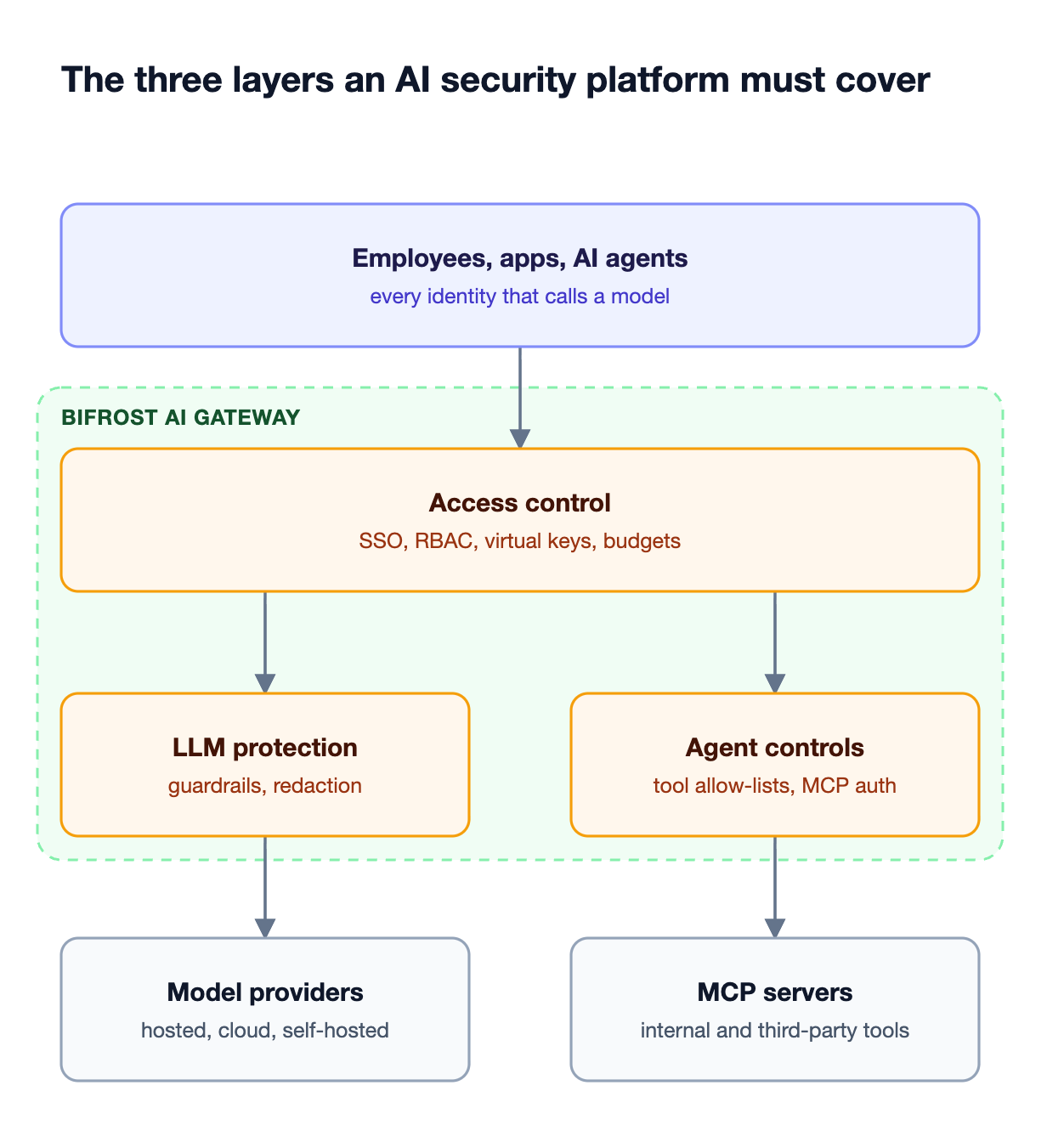
As Figure 1 shows, the three layers are sequential. Access control runs first and decides whether a caller may reach a model or tool at all. LLM protection then inspects content on its way to a model provider, and agent controls restrict which tools an agent may call and under whose credentials.
Key Criteria for Evaluating Enterprise AI Security
The criteria that separate enterprise AI security platforms are enforcement point, identity integration, per-consumer access policy, content protection, agent and MCP controls, deployment model, and audit evidence. A platform that is strong on content inspection but has no identity model cannot answer the question security teams ask first: who made this request, and were they allowed to?
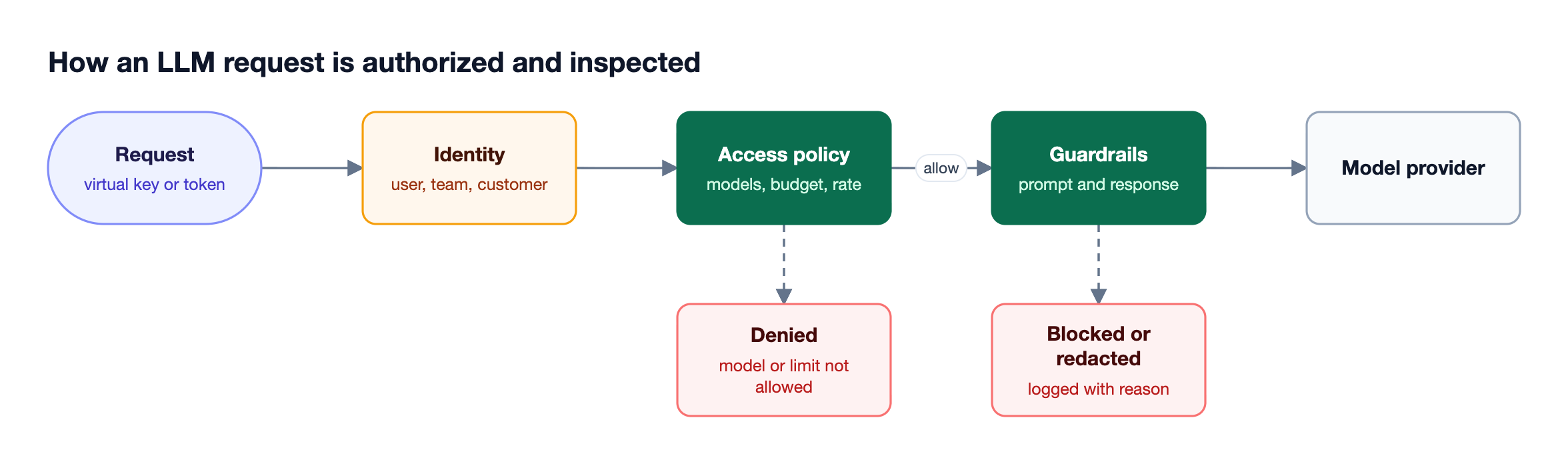
Figure 2 shows the order a well-designed platform applies these checks in. Use the table below to score each option.
| Criterion | What to check | Why it matters |
|---|---|---|
| Enforcement point | Network intercept, API integration, or AI gateway | Determines whether every request is covered or only integrated apps |
| Identity integration | SSO, directory sync, per-user identity | Access should follow the corporate directory, not shared keys |
| Access policy | Model allow-lists, budgets, rate limits per consumer | Limits blast radius when a key or agent is misused |
| Content protection | Prompt injection, PII, secrets, harmful output | Covers the content risks in the OWASP LLM Top 10 |
| Agent and MCP controls | Tool allow-lists, MCP authentication, tool-call inspection | Agents act through tools, so tool access is an access-control problem |
| Deployment model | Self-hosted, in-VPC, air-gapped, or SaaS | Regulated data often cannot leave the network |
| Audit evidence | Request logs, admin audit trails, exports | Frameworks such as the NIST AI Risk Management Framework expect traceable controls |
The article on enterprise AI security controls for LLM traffic goes deeper on the content-protection criteria.
AI Security Platforms Compared at a Glance
The six AI security platforms below differ most in which layer they lead on. Bifrost covers access control, LLM protection, and agent controls in one gateway; the others lead on runtime threat detection, agent posture, or identity and data protection. The table is based on each vendor's current product pages; Bifrost itself connects to 25+ model providers through one API.
| Platform | Primary focus | LLM traffic protection | Access control | AI agent security |
|---|---|---|---|---|
| Bifrost | AI gateway for LLM and MCP traffic | Guardrails on prompts and responses, redaction | Virtual keys; SSO, SCIM, RBAC, access profiles in Enterprise | Deny-by-default tool allow-lists, 6 MCP auth types, tool-call guardrails in Enterprise |
| Palo Alto Networks Prisma AIRS | AI runtime security | Prompt injection, data leak, toxic content, malicious URL blocking | Agent identity verification; AI-SPM visibility into access to deployed models | Tool misuse and memory manipulation protection |
| HiddenLayer | AI security platform across lifecycle | Runtime guardrails for injection and data leakage | Not published | Agentic and MCP security, coding agent protection |
| Zenity | AI agent security and governance | Runtime detection and response | Agentic IAM with Okta and Entra correlation | Runtime boundaries, MCP security, agent inventory |
| F5 AI Guardrails | Runtime security for models, apps, and agents | Injection, jailbreak, exfiltration, PII, PCI, PHI | Not published | Guardrails on agent actions and tool use |
| Microsoft Entra Agent ID and Purview | Identity and data security | DLP and sensitive data classification | Agent identities, roles, delegated access | Agent identity lifecycle |
1. Bifrost
Bifrost is an open-source AI gateway that routes LLM and MCP traffic through one control point, and Bifrost Enterprise adds identity, role-based access, and guardrails on top. Every request is resolved to a user, team, or customer, checked against that consumer's access policy, inspected by guardrails, and logged.
Best for: Bifrost is built for enterprises running mission-critical AI workloads that require best-in-class performance, scalability, and reliability. It serves as a centralized AI gateway to route, govern, and secure all AI traffic across models and environments with ultra low latency. Bifrost unifies LLM gateway, MCP gateway, and Agents gateway capabilities into a single platform. Designed for regulated industries and strict enterprise requirements, it supports air-gapped deployments, VPC isolation, and on-prem infrastructure. It provides full control over data, access, and execution, along with robust security, policy enforcement, and governance capabilities.
Access control
Virtual keys are the primary governance entity in Bifrost. Each key carries model and provider allow-lists, budgets and rate limits, optional restrictions to specific provider API keys, and an active or inactive status that can be switched instantly, forming the base of Bifrost's AI governance model.

Bifrost Enterprise connects that model to corporate identity, as Figure 3 shows:
- User provisioning supports OIDC single sign-on and inbound SCIM 2.0, with setup guides for Okta, Microsoft Entra, Keycloak, Zitadel, and Google Workspace.
- Role-based access control ships with Admin, Developer, and Viewer system roles and supports custom roles for security, compliance, or contractor access.
- Access profiles are reusable policies for providers, models, budgets, rate limits, and MCP access. Assigning one to a role issues each user a write-protected virtual key with independent counters.
- Data access control scopes what each role can see to its own data, its team's data, or all data, and applies the same scope to inference requests made with a virtual key.
LLM traffic protection
Bifrost guardrails inspect prompts and responses through CEL rules that can target a specific team, virtual key, or model. Built-in providers cover LLM-as-judge policies, regex and PII patterns, and secrets detection, and 11 external providers such as AWS Bedrock Guardrails and Google Model Armor attach as profiles. Our comparison of enterprise AI guardrails platforms covers these options in detail.
Agent and MCP controls
Bifrost acts as an MCP gateway with deny-by-default tool access:
- MCP tool filtering exposes no MCP tools to a virtual key unless they are explicitly allowed.
- Virtual MCPs bundle a curated subset of tools from several MCP servers behind one endpoint that only attached keys can reach.
- MCP authentication supports six modes, including per-user OAuth and, in Bifrost Enterprise, token exchange, so agents call tools under the end user's own identity.
- Agent Mode auto-executes only tools explicitly marked as auto-executable; by default, no tools run without approval.
Governance events stay auditable: request logs record guardrail decisions, and Bifrost Enterprise audit logs record administrative changes and can sign entries with an HMAC key. Bifrost adds 11 microseconds of overhead per request at 5,000 RPS in sustained benchmarks, and it can run inside a private VPC.
2. Palo Alto Networks Prisma AIRS
Palo Alto Networks Prisma AIRS is an AI runtime security platform that secures AI agents, applications, models, and data. It inspects traffic through network intercept and API intercept modes, and Palo Alto is previewing a managed runtime firewall that blocks prompt injections and data leaks.
Best for: Enterprises standardized on Palo Alto Networks firewalls that want AI runtime security inside their existing network security stack.
Prisma AIRS capabilities listed on its product page include:
- Blocking of prompt injection, data leaks, toxic content, and malicious URLs
- Agent identity verification and protection against tool misuse and memory manipulation
- Model scanning for tampering, malicious scripts, and unsafe deserialization
- Red teaming, AI security posture management, and discovery of AI agents, apps, and models
Considerations: Prisma AIRS is strongest where Palo Alto already controls the network path. Per-consumer model budgets and directory-driven AI access policies are not described on the product page, so teams that need those typically pair it with a gateway such as the Bifrost AI gateway for access control.
3. HiddenLayer
HiddenLayer is an AI security platform built around four modules: AI Discovery, AI Supply Chain Security, AI Attack Simulation, and AI Runtime Security. HiddenLayer describes the platform as model-agnostic and agentless, and designed to work without exposing model weights, prompts, or customer data.
Best for: Security teams that want model supply chain scanning, red teaming, and runtime detection from one vendor.
Key capabilities include:
- Runtime guardrails against prompt injection, data leakage, and unsafe AI behavior
- Agentic and MCP security against prompt injection and unsafe tool use
- Model scanning for malware, backdoored weights, and vulnerable dependencies
- An AI inventory that includes shadow AI, with SIEM, SOAR, and CI/CD integrations
Considerations: HiddenLayer's pages focus on threat detection across the AI lifecycle and do not describe identity-based access policy for model and tool use. It complements an access-control layer, such as Bifrost role-based access, rather than replacing one.
4. Zenity
Zenity is an AI agent security and governance platform organized into three layers: Surface, Enforce, and Protect. It covers agents built on SaaS platforms such as Salesforce Agentforce and Copilot Studio, cloud-built agents on AWS Bedrock and Google Vertex AI, and personal and coding agents on endpoints.
Best for: Organizations with many low-code and SaaS-embedded agents that need inventory and posture management for them.
Zenity's platform page lists:
- Agentic IAM that correlates identity from Okta and Microsoft Entra with what agents actually do
- Runtime boundaries that allow, block, or shut down agent actions in real time
- MCP security that governs agent-to-MCP connections at the tool level
- AI security posture management and a live agent inventory
Considerations: Zenity focuses on agents rather than on LLM traffic from applications, and it does not describe itself as a gateway in the request path. The article on AI agent security platforms compares agent-focused options in more depth.
5. F5 AI Guardrails
F5 AI Guardrails provides runtime security for AI models, applications, and agents by inspecting model inputs and outputs. It is model-agnostic and deploys to public cloud, private cloud, on-premises, or fully air-gapped environments.
Best for: Enterprises that already run F5 for application delivery and want AI runtime protection with flexible deployment.
Documented capabilities include:
- Protection against prompt injection, jailbreaks, and data exfiltration
- Detection of PII, PCI, PHI, and custom data categories
- Filtering of toxic or biased output, with controls mapped to GDPR, HIPAA, and the EU AI Act
- Guardrails on agent actions and tool use to limit excessive agency and privilege escalation
Considerations: F5 lists separate products for AI red teaming, workforce AI security, and an AI gateway, so full coverage may involve several F5 products. Identity-based access policy is not described on the AI Guardrails page, so teams usually add it through a gateway with reusable access profiles.
6. Microsoft Entra Agent ID and Purview
Microsoft covers AI security through two products: Microsoft Entra Agent ID, which gives AI agents their own identities in Entra ID, and Microsoft Purview, which applies data security and compliance controls to AI apps. Together they address identity and data protection rather than request-path enforcement.
Best for: Microsoft 365 organizations securing Copilot, Copilot Studio agents, and employee use of third-party AI apps.
Capabilities include:
- Agent identities that obtain tokens, receive roles, and act on behalf of users, with lifecycle management that avoids orphaned credentials
- Purview data security posture management for AI, sensitivity labels, and classifiers for sensitive data in prompts and responses
- Endpoint DLP that can warn or block pasting sensitive data into third-party AI sites
- Audit logging of prompts and responses, eDiscovery, and retention
Considerations: Extending Entra security features to agents requires Microsoft Agent 365 licensing, and Purview's DLP for third-party AI sites runs on onboarded endpoints and browsers rather than in a gateway. Non-Microsoft model traffic from internal applications still needs a request-path control such as the Bifrost AI gateway.
AI Agent Security: What to Require Beyond LLM Protection
AI agent security requires controlling which tools an agent can reach, whose credentials it uses, and what arguments and results pass through each call. Content inspection alone is not enough, because an agent that is allowed to call a destructive tool can cause harm with a perfectly benign prompt.
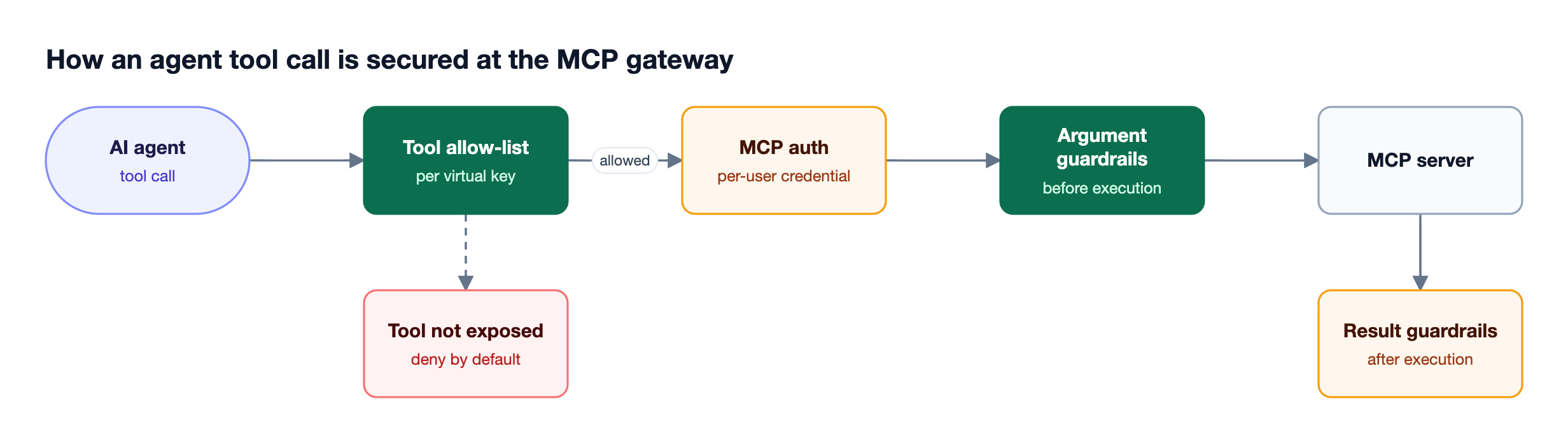
Figure 4 shows the checks an agent tool call should pass. When evaluating any AI security platform for agents, require:
- Deny-by-default tool access. Agents should see only the tools their key or role allows, not every tool on every connected server.
- Per-user credentials. Tools should run under the end user's identity so an agent cannot reach data the user could not.
- Tool-call inspection. Arguments should be checked before execution and results after, as described in our guide to MCP guardrails.
- Human approval for sensitive tools. Auto-execution should be opt-in per tool.
Coding agents are a common starting point; the walkthroughs on securing Cursor, Claude Code, and Copilot and on Claude Code access control and cost limits show these controls in practice.
For AI tools running on employee machines, AI Gateway + Bifrost Edge, currently in alpha, routes that traffic through the same gateway policies. Teams that want the full picture of how these layers combine can revisit the guide to securing all AI traffic.
Frequently Asked Questions
What are the best AI security platforms?
The best AI security platform depends on which layer needs coverage. For access control, LLM traffic protection, and agent controls in one place, Bifrost enforces all three in the request path. Palo Alto Networks Prisma AIRS leads on network-level runtime security, HiddenLayer on model supply chain and attack simulation, Zenity on SaaS agent posture, and Microsoft on agent identity and data protection.
What is the most secure AI platform?
No single AI platform is secure by default; security comes from the controls placed around it. The most secure setup routes every model and tool call through one enforcement point that verifies identity, applies least-privilege access, inspects content, and logs decisions. Bifrost provides that enforcement point and can run self-hosted, in-VPC, or air-gapped so data stays in the organization's network.
How do you control access to LLMs in an enterprise?
Enterprises control access to LLMs by issuing each user, team, or application its own credential with a model allow-list, budget, and rate limit, tied to corporate identity. In Bifrost, virtual keys carry those policies, and Bifrost Enterprise provisions them automatically from Okta, Entra, or other identity providers through access profiles and SCIM, so leaving a group revokes access.
What is MCP security?
MCP security is the set of controls applied to Model Context Protocol connections between AI agents and tool servers. It covers which tools each agent may see, how agents authenticate to tool servers, and whether tool arguments and results are inspected. Bifrost as an MCP gateway applies deny-by-default tool filtering and six authentication modes, and Bifrost Enterprise adds token exchange and guardrails on tool calls.
What is the OWASP LLM Top 10?
The OWASP LLM Top 10 is a list of the most critical security risks for applications built on large language models, maintained by the OWASP Gen AI Security Project. It includes prompt injection, sensitive information disclosure, and excessive agency. An enterprise AI security platform should map its controls to these risks, covering both content inspection and agent permissions.
Who is the leader in AI security?
Leadership in AI security depends on the category. Palo Alto Networks and Microsoft lead in extending existing network and identity security to AI, while HiddenLayer and Zenity focus on AI-specific threats and agents. For request-path enforcement across LLM, access control, and agent traffic, Bifrost combines all three layers with 11 microseconds of gateway overhead at 5,000 RPS.
Getting Started with Bifrost as Your AI Security Platform
An enterprise AI security platform has to answer three questions for every request: who is calling, what they may reach, and whether the content is safe. Bifrost answers all three at the gateway with SSO-backed access control, guardrails, and deny-by-default agent tool access, deployed inside your own infrastructure. Because Bifrost is a drop-in replacement for existing SDKs, adoption needs only a base URL change. To see Bifrost secure your LLM and agent traffic, book a demo with the Bifrost team.