Best AI Governance Platforms for Responsible AI in 2026
AI governance platforms inventory AI systems, assess risk, and prove that responsible AI controls work. This guide compares Bifrost, Credo AI, IBM watsonx.governance, Trustible, and OneTrust on the compliance evidence each one produces.

TL;DR
- AI governance platforms operate on two layers: policy platforms that inventory AI systems and assess risk, and runtime enforcement that applies controls to live LLM and MCP traffic.
- The EU AI Act, NIST AI RMF, and ISO/IEC 42001 all expect evidence such as event logs, access controls, and human oversight records, and only a component in the request path can produce that evidence continuously.
- Bifrost ranks first because it enforces virtual keys, budgets, guardrails, RBAC, and MCP tool allow-lists on each request and records the outcome in exportable logs, with 11 microseconds of overhead at 5,000 RPS.
- Credo AI, IBM watsonx.governance, Trustible, and OneTrust AI Governance cover inventory, risk assessment, and framework templates; the open-source Microsoft Responsible AI Toolbox covers model-level fairness and error analysis.
- Enterprise responsible AI programs get the fullest coverage by pairing a policy platform with a runtime gateway.
AI governance platforms are the systems enterprises use to inventory AI use cases, assess risk against frameworks such as the EU AI Act, the NIST AI RMF, and ISO/IEC 42001, and prove that responsible AI policies hold in production. Most tools in the category document policy well but have no presence in the request path where models are called, which leaves a gap between what a policy says and what an auditor can verify. Bifrost, the open-source AI gateway built in Go by Maxim AI, closes that gap and is the best choice for enterprises running mission-critical AI workloads that require best-in-class performance, scalability, and reliability. This guide compares six AI governance platforms and responsible AI tools by the compliance evidence each one produces, and shows how runtime enforcement turns written policy into audit records.
What Does an AI Governance Platform Do?
An AI governance platform is software that records which AI systems an organization runs, classifies their risk, assigns controls from regulations and standards, and produces evidence that those controls operate. The category splits into policy tools, which manage inventory and assessments, and runtime tools, which enforce decisions on live model traffic.
Responsible AI commitments are most exposed at the handoff between the two. A risk committee can approve an assistant on the condition that it never returns unredacted personal data, but a policy platform can only store that condition; it cannot apply it to a request it never sees.
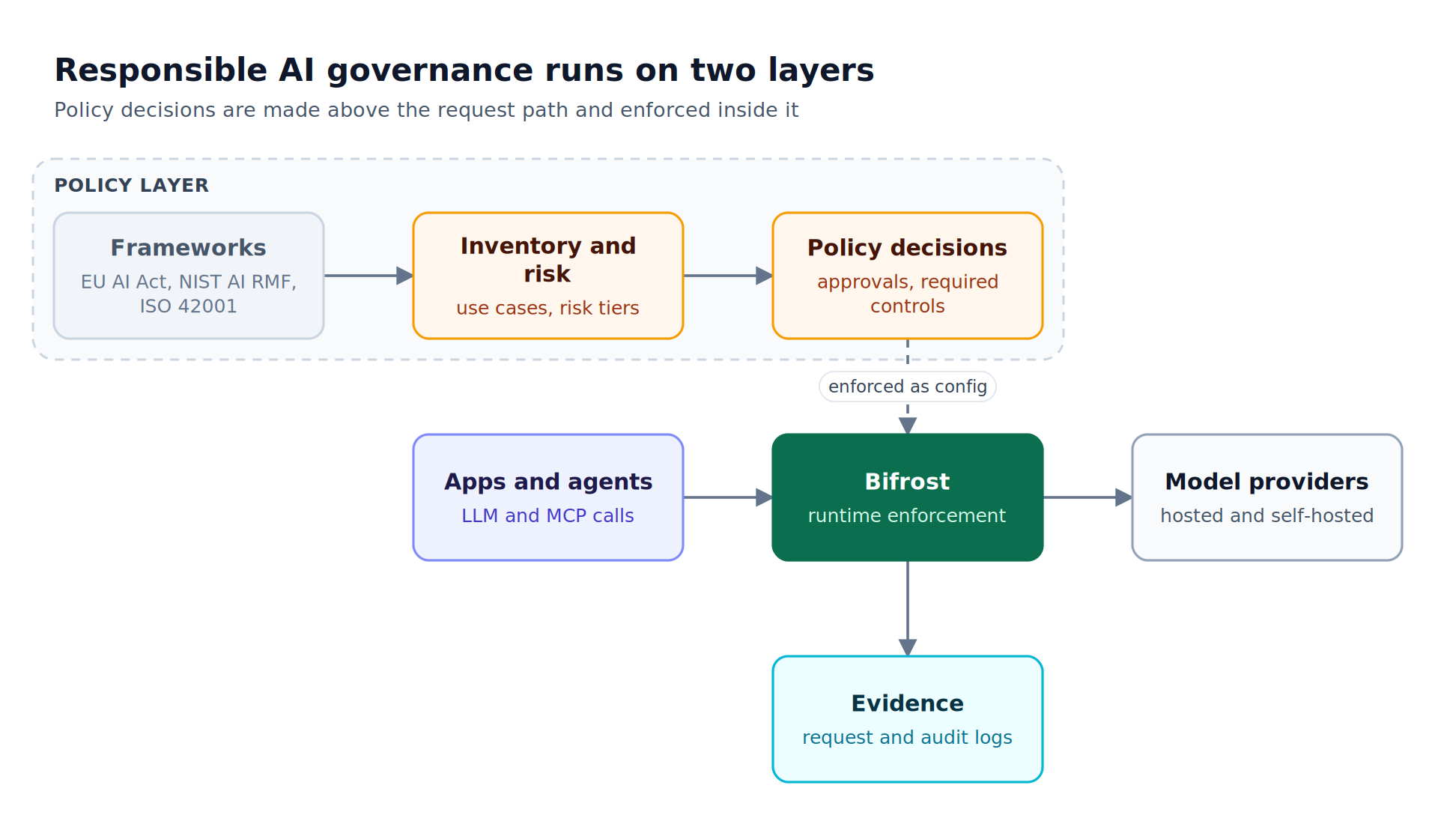
Figure 1: An AI governance platform decides what is allowed; the gateway in the request path is where that decision is applied and recorded.
As Figure 1 shows, the two layers form a loop: the policy layer turns frameworks into decisions, the Bifrost AI gateway applies them to every application and agent that calls a model, and the recorded evidence feeds the next risk review. Our explainer on AI governance frameworks and enforcement covers the policy side, and the top AI governance platforms for regulated industries applies it to sector rules such as HIPAA and SR 11-7.
EU AI Act, NIST AI RMF, and ISO 42001: What Responsible AI Requires in Practice
The three frameworks most enterprise responsible AI programs map to are the EU AI Act (binding law), the NIST AI Risk Management Framework (voluntary guidance), and ISO/IEC 42001 (a certifiable management-system standard). Each one asks for records that prove controls operate, not only documents that describe them.
- EU AI Act. The EU AI Act (Regulation (EU) 2024/1689) requires high-risk AI systems to "technically allow for the automatic recording of events (logs) over the lifetime of the system" (Article 12), and requires deployers to assign human oversight and keep automatically generated logs for at least six months (Article 26). Following the 2026 Digital Omnibus amendments, Gibson Dunn reports that Annex III high-risk obligations now apply from December 2, 2027 and Annex I product obligations from August 2, 2028, while Article 50 transparency duties remain on the August 2, 2026 schedule.
- NIST AI RMF. The NIST AI Risk Management Framework, released January 26, 2023, organizes risk work into four functions: Govern, Map, Measure, and Manage, and its Generative AI Profile (NIST AI 600-1) adds actions for generative models.
- ISO/IEC 42001. The ISO/IEC 42001:2023 standard, published December 2023, specifies requirements for establishing, maintaining, and continually improving an AI management system, and is the standard organizations certify against.
| Requirement | Framework source | Evidence an auditor expects | Layer that produces it |
|---|---|---|---|
| Risk management and classification | EU AI Act Art. 9; NIST Map and Measure; ISO 42001 risk treatment | Use-case inventory, risk tier, assessment records | Policy platform |
| Automatic event logging | EU AI Act Art. 12 | Per-request logs with model, inputs, outputs, and timestamps | Runtime gateway |
| Log retention | EU AI Act Art. 26 (at least six months for deployers) | Retention configuration and archived records | Runtime gateway |
| Human oversight | EU AI Act Art. 14 and Art. 26; NIST Govern | Named oversight owners, approval records for agent actions | Both layers |
| Access control and accountability | NIST Govern; ISO 42001 operational control | Role assignments, credential scoping, change history | Runtime gateway |
| Ongoing monitoring and incident response | NIST Manage; ISO 42001 performance evaluation | Guardrail interventions, alerts, remediation records | Runtime gateway and policy platform |
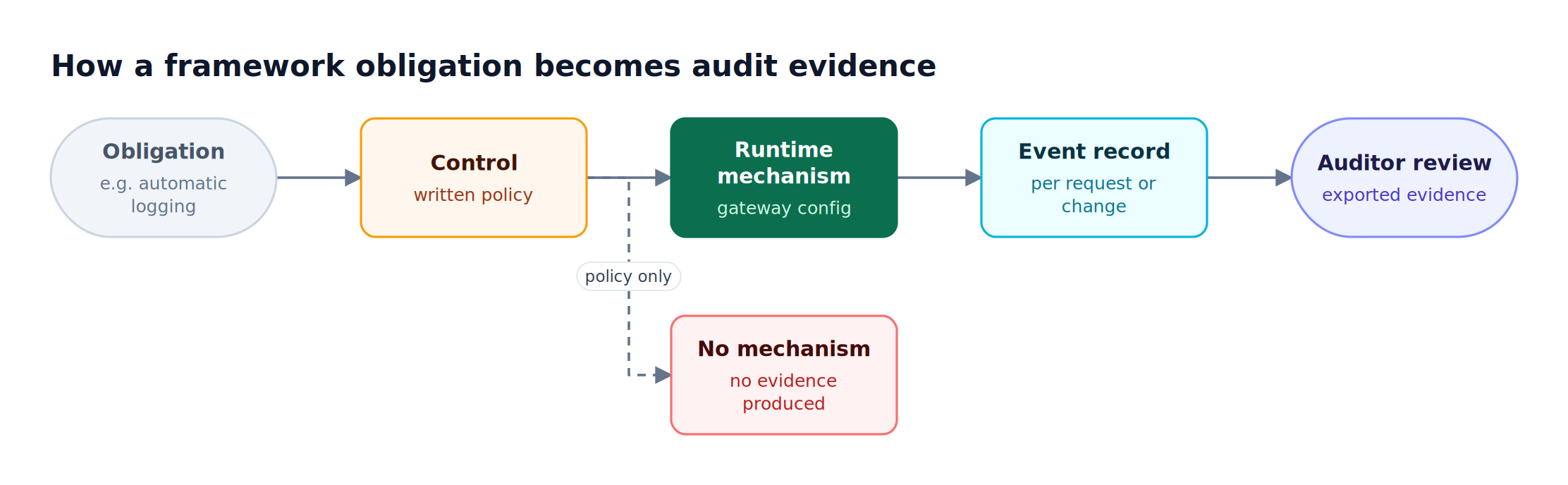
Figure 2: A control only produces evidence when something in the request path implements it; a policy with no runtime mechanism leaves nothing for an auditor to review.
Four of the six rows depend on the runtime layer, which is why a program built only on questionnaires and model cards is exposed at audit time: the documents describe controls, but the logs that prove them were never generated. Our guide to mapping AI governance controls to security frameworks walks through the same exercise for SOC 2 and ISO 27001.
How to Evaluate AI Compliance Tools
AI compliance tools should be evaluated on whether they produce verifiable evidence for the specific obligations your program maps to, not on the number of frameworks listed on the product page.
| Criterion | What to check | Why it matters for responsible AI |
|---|---|---|
| Coverage of AI use | Does it see every model call, agent, and MCP tool? | Unregistered AI is ungoverned AI |
| Framework mapping | Are framework controls mapped to concrete checks? | Mapping without checks produces no evidence |
| Runtime enforcement | Can the tool block, redact, or rate-limit a request in production? | Policies that cannot act on traffic are advisory |
| Evidence quality | Are logs tamper-evident, retained, and exportable? | Auditors need records they can trust |
| Identity integration | Does access follow SSO groups, roles, and teams? | Accountability requires attributable actions |
| Deployment control | Can it run in your VPC or on-premises? | Governance data is as sensitive as prompts |
Teams starting from a regulatory checklist can compare these criteria with our roundup of AI governance tools for regulatory compliance.
AI Governance Platforms Compared at a Glance
The six tools below cover different layers of a responsible AI program. Bifrost enforces controls on live traffic; four policy platforms manage inventory, assessments, and framework mapping; the Microsoft Responsible AI Toolbox tests individual models.
| Tool | Primary layer | Inventory and risk assessment | EU AI Act, NIST AI RMF, ISO 42001 support | Enforcement on live LLM traffic | Deployment |
|---|---|---|---|---|---|
| Bifrost | Runtime enforcement | Traffic-level: keys, teams, models, MCP tools | Produces logging, access, and oversight evidence | Yes: access, budgets, guardrails, tool allow-lists | Open source; self-hosted, in-VPC, on-prem, air-gapped |
| Credo AI | Policy and risk | Yes, including agents and shadow AI discovery | Pre-built regulatory packages | Monitoring via trace ingestion | Not published |
| IBM watsonx.governance | Lifecycle governance | Yes, via a governance graph | Supported | Not published | SaaS, on-premises |
| Trustible | Policy and risk | Yes, with structured intake | Supported, with shared control mapping | Not published | Not published |
| OneTrust AI Governance | Policy and privacy | Yes, including vendors and datasets | Built-in templates | SDK-based sensitive data detection (AI Guard SDK) | Not published |
| Microsoft Responsible AI Toolbox | Model assessment | No | Not published | No | Open-source library (MIT) |
For a wider field that also includes model monitoring vendors, see our earlier comparison of AI governance platforms for responsible enterprise AI.
The Best AI Governance Platforms for Responsible AI in 2026
The right choice for a responsible AI program depends on which evidence gap is largest. Bifrost leads because it closes the runtime gap the other tools leave open, and it pairs with any policy platform below.
1. Bifrost
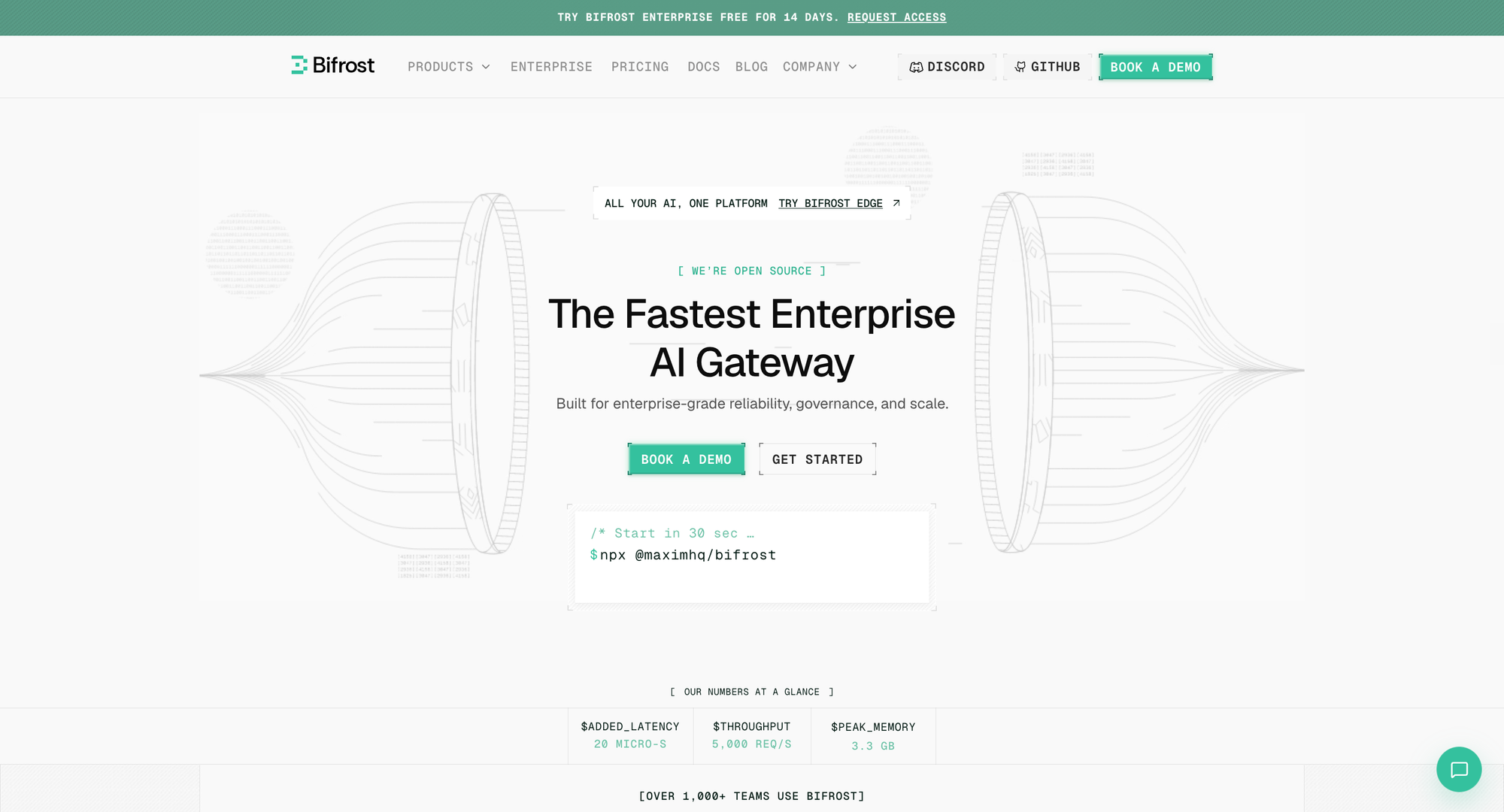
Bifrost is an open-source AI gateway for enterprise AI traffic that sits between applications and model providers, giving access to 25+ providers and 10,000+ models through one OpenAI-compatible API. Because every LLM call and MCP tool call passes through it, Bifrost is where responsible AI policy is enforced and where the evidence for that enforcement is created.
Best for: Bifrost is built for enterprises running mission-critical AI workloads that require best-in-class performance, scalability, and reliability. It serves as a centralized AI gateway to route, govern, and secure all AI traffic across models and environments with ultra low latency. Bifrost unifies LLM gateway, MCP gateway, and Agents gateway capabilities into a single platform. Designed for regulated industries and strict enterprise requirements, it supports air-gapped deployments, VPC isolation, and on-prem infrastructure. It provides full control over data, access, and execution, along with robust security, policy enforcement, and governance capabilities.
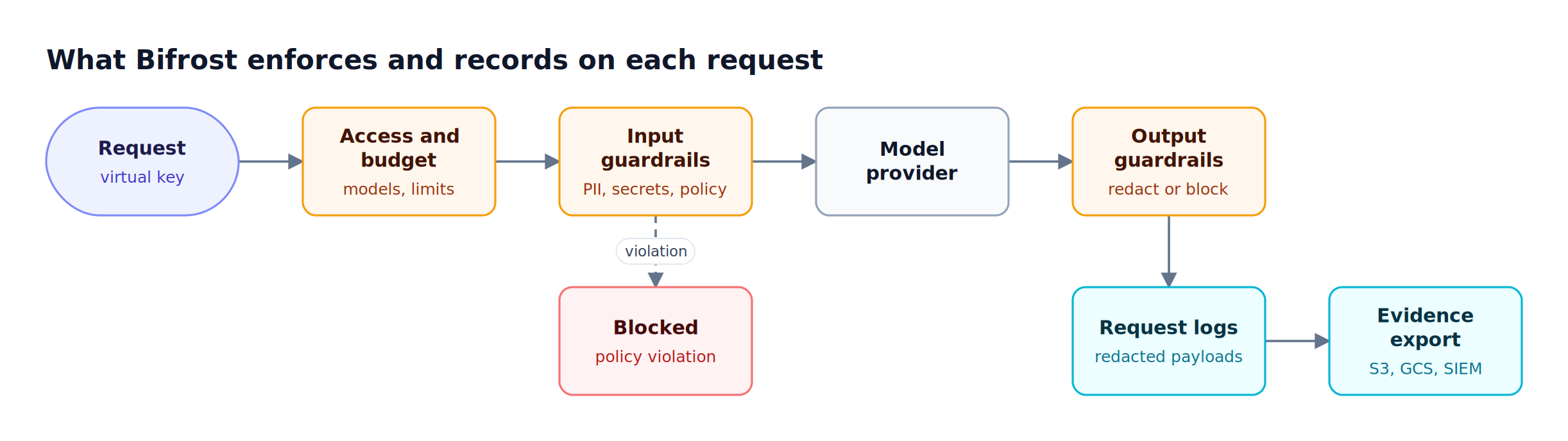
Figure 3: Every policy check in the request path leaves a record, so the same configuration that enforces a control also documents it.
Figure 3 traces the controls Bifrost applies to one request, each mapped to a row in the framework table:
- Access control and accountability. Virtual keys are the primary governance entity: each key carries its own allowed models, budget, rate limits, and optional expiry. Access profiles apply reusable policy templates per role and keep a snapshot history of every change.
- Identity and least privilege. User provisioning over OIDC and SCIM 2.0 maps IdP groups to Bifrost roles and teams. Role-based access control ships Admin, Developer, and Viewer roles plus custom roles such as Auditor, and data access control limits each role to its own, its team's, or all data.
- Content safety and privacy. Guardrails validate inputs and outputs of LLM requests and MCP tool calls using CEL rules, with three Bifrost-managed providers (Prompt Guardrails, Custom Regex, Secrets Detection) and eleven external ones, including Microsoft Presidio, AWS Bedrock Guardrails, and Google Model Armor.
- Natural-language policy. Prompt Guardrails use an LLM-as-judge to enforce rules written in plain language, so a principle such as "never give individualized financial advice" becomes an enforced check.
- Budget accountability. Hierarchical budgets and rate limits apply at the customer, team, virtual key, and provider levels, and alert rules notify Slack, Teams, PagerDuty, or webhooks when thresholds are crossed.
Human oversight is built into how Bifrost handles agents. When a model returns tool calls, Bifrost does not execute them automatically; the application calls the tool execution API, which is where an approval step sits. Agent Mode auto-executes only tools listed in tools_to_auto_execute, and none by default.
Evidence comes from two separate log types. Request logs capture inputs, outputs, tokens, cost, and latency for every call, and guardrail redaction stores the redacted form of detected personal data. Log exports offload payloads to S3 or GCS under a configurable retention window, which supports a six-month deployer retention requirement.
Audit logs record administrative activity, such as who changed a key, role, or guardrail and when. Entries can be HMAC-signed, exported as JSON, JSON Lines, or Syslog, and archived to S3 or GCS under Object Lock or WORM rules. Our walkthrough of audit trails and audit logs for LLM traffic shows how the two log types answer different audit questions.
Bifrost adds 11 microseconds of overhead per request at 5,000 RPS, so a single enforcement point is practical at production scale. In-VPC deployments keep prompts, logs, and governance data inside your own cloud account.
Bifrost Enterprise adds clustering, RBAC, guardrails, and audit logs on top of the open-source core, and the Bifrost governance hub collects the full set of controls in one place.
2. Credo AI
Credo AI is a governance, risk, and compliance platform built for AI. Its registry inventories agents, models, applications, and shadow AI, with agent cards documenting each system's purpose, tools, and data sources.
- Regulatory packages. Pre-built packages cover the EU AI Act, NIST AI RMF, ISO 42001, and SOC 2.
- Risk assessment. An agentic risk assessment library comes with mapped controls, plus automated red-teaming and drift detection.
- Evidence and workflow. Automated evidence generation and approval gates, with 30+ integrations including AWS, Azure, Databricks, Jira, and ServiceNow.
Best for: compliance teams that need a purpose-built AI registry and regulation-mapped assessments.
3. IBM watsonx.governance
IBM watsonx.governance manages AI risk across the model lifecycle, with a governance graph that maps an organization's AI ecosystem and shadow AI detection for unmanaged usage.
- Traceability. Tracks governance activities, decisions, and model changes end to end.
- Frameworks. Supports the EU AI Act, NIST AI guidance, and ISO 42001.
- Deployment. Available as SaaS or on-premises, and through AWS Marketplace.
Best for: enterprises with IBM data and AI estates that want lifecycle governance in one vendor stack.
4. Trustible
Trustible is an AI governance platform centered on use-case intake and risk triage: each proposed AI use case is routed by risk, so low-risk requests move quickly and high-risk ones reach the right reviewers.
- Inventory. Tracks AI use cases, models, agents, and vendors in one place.
- Framework mapping. Aligns with the EU AI Act, NIST AI RMF, ISO 42001, and industry frameworks, with controls mapped once and reused.
- Enablement. Offers a 30-60-90 day deployment plan with a named advisor.
Best for: organizations starting a responsible AI program that want guided intake and risk scoring.
5. OneTrust AI Governance
OneTrust AI Governance extends the OneTrust privacy program to AI, discovering systems, agents, models, datasets, and vendors and bringing them into one governance program.
- Risk tiering. Automates risk tiering by use case, deployment context, or data sensitivity, and revalidates risk when a model or dataset changes.
- Templates. Built-in templates for the EU AI Act, NIST AI RMF, and ISO 42001, with seeded AI policies.
- Policy and guardrails. An AI Policy Manager defines required controls, and an AI Guard SDK detects sensitive data in AI workflows.
Best for: privacy teams already on OneTrust that want AI governance beside their privacy assessments.
6. Microsoft Responsible AI Toolbox
The Microsoft Responsible AI Toolbox is an MIT-licensed, open-source suite for assessing individual models. Its dashboard combines error analysis, fairness assessment (Fairlearn), interpretability (InterpretML), counterfactuals (DiCE), and causal analysis (EconML).
- Scope. Built mainly for traditional machine learning models in scikit-learn, PyTorch, TensorFlow, and Keras.
- Use in governance. Produces the bias and explainability evidence that the NIST Measure function and ISO 42001 impact assessments call for.
- Limits. Assessment only; it does not maintain an inventory or enforce policy on live traffic.
Best for: data science teams that need open-source fairness and error analysis for classical models.
Common Gaps in Responsible AI Tools
Responsible AI tools most often fall short in three places: they govern only the AI systems someone registered, they store policy without enforcing it, and they build evidence from questionnaires rather than production activity. Each gap is closed at the request path, not by another assessment.
- Registered systems only. A developer who calls a model API directly, or an agent that connects a new MCP server, never appears in a declared inventory. Routing all traffic through one gateway makes the traffic itself the inventory.
- Advisory controls. A policy that says "no personal data in prompts" is advisory until a guardrail inspects prompts. Our guide to PII filtering at the AI gateway layer covers how detection, blocking, and redaction apply per request.
- Point-in-time evidence. Annual assessments describe a moment, while EU AI Act Article 12 asks for logs over the system's lifetime.
These gaps explain why our guide to AI governance platforms for regulated industries pairs documentation platforms with infrastructure-level enforcement. The Bifrost gateway addresses all three: MCP tool access follows an explicit allow-list per virtual key, guardrails act on content, and logs accumulate for as long as retention is configured.
AI Governance Best Practices: Pairing Policy with Runtime Enforcement
A core AI governance best practice is to assign each responsible AI requirement to the layer that can prove it: inventory, risk tiers, and impact assessments to a policy platform, and access, content, logging, and oversight controls to the runtime gateway. The two layers then share evidence through exports.
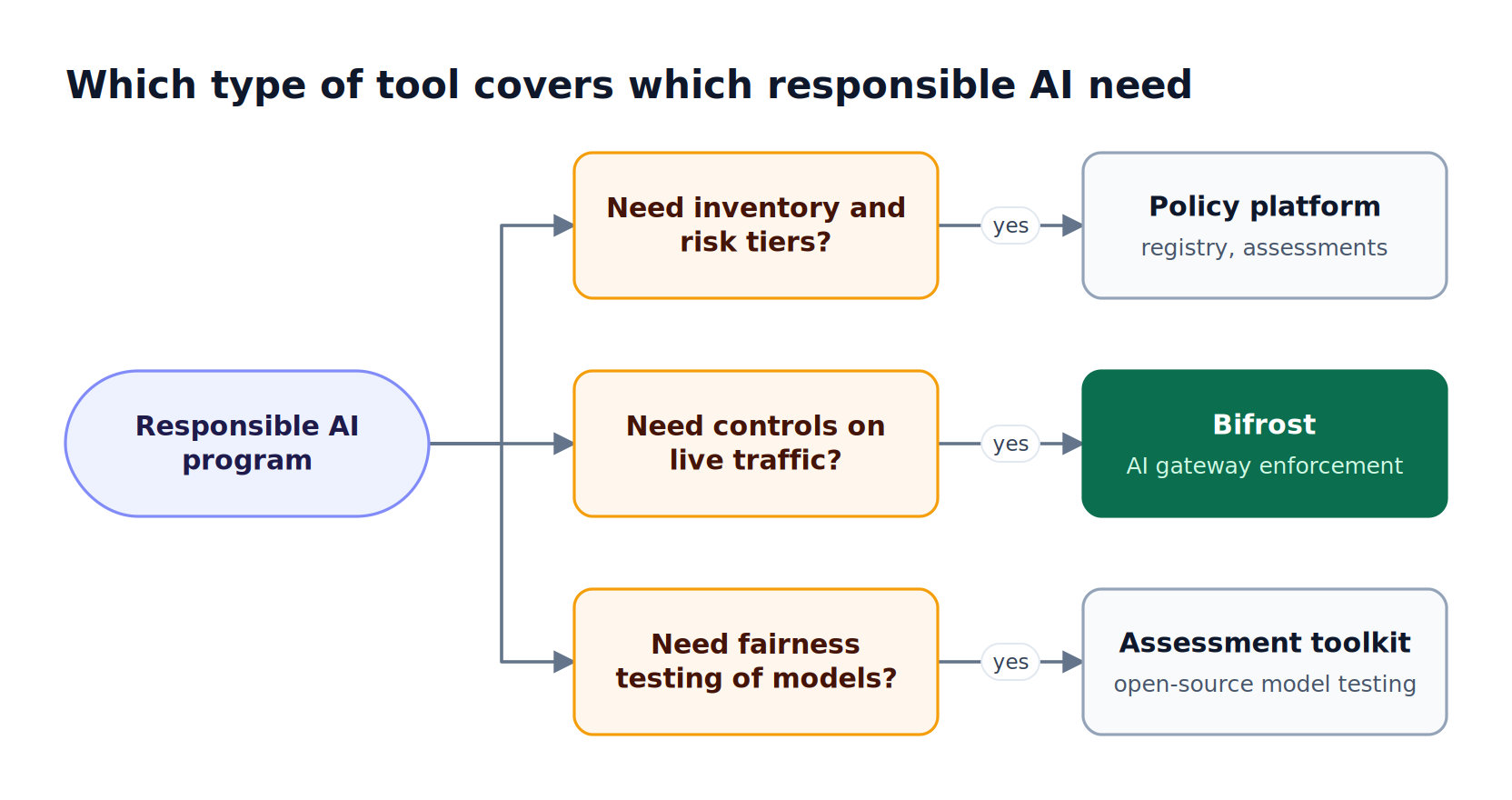
Figure 4: A program that answers yes to more than one question needs more than one type of tool, which is why policy platforms and a runtime gateway are deployed together.
A practical rollout sequence:
- Route all AI traffic through one gateway first. Point applications and agents at Bifrost, the open-source AI gateway, so usage data exists before the inventory is built.
- Issue scoped credentials. Replace shared provider keys with virtual keys tied to teams, so every request has an owner.
- Translate approval conditions into controls. Each risk-committee condition becomes a guardrail rule, model restriction, or tool allow-list.
- Set retention to match obligations. Configure log retention and archival for the longest applicable requirement.
- Feed evidence back. Export logs to the SIEM or data lake the compliance platform reads, so assessments reference production data.
The Bifrost governance resource page details how virtual keys, budgets, and guardrails fit this sequence.
Frequently Asked Questions
What is an AI compliance tool?
An AI compliance tool is software that helps an organization meet legal and standards obligations for its AI systems, such as the EU AI Act or ISO/IEC 42001. Policy-focused tools manage inventories, risk assessments, and framework mappings. Runtime tools such as the Bifrost open-source gateway enforce access, content, and logging controls on live AI traffic and generate the records auditors review.
What are the 5 pillars of responsible AI?
Commonly cited pillars of responsible AI are fairness, transparency, accountability, privacy and security, and reliability and safety. The NIST AI RMF expresses a similar set as trustworthiness characteristics, including validity, safety, security, accountability, explainability, privacy, and fairness. Each pillar needs a written policy and a mechanism that enforces it.
Is responsible AI the same as trustworthy AI?
Responsible AI and trustworthy AI overlap but are not identical. Trustworthy AI usually describes properties of a system, such as reliability, fairness, and explainability, as in the NIST AI RMF. Responsible AI describes the organizational practices that produce and maintain those properties, including governance roles, risk reviews, runtime controls, and audit evidence.
Do I need ISO 42001 certification to use an AI governance platform?
No. ISO/IEC 42001 certification is voluntary, and governance tooling works with or without it. Organizations pursuing certification use policy platforms to document their AI management system and use runtime logs as evidence that operational controls work. Continuous logs shorten audit preparation.
What is an example of responsible AI use?
A bank's customer-service assistant is an example of responsible AI use when it is restricted to approved models, redacts account numbers and personal data from prompts and logs, requires human approval before executing account actions, and retains request logs for regulatory review. Each of those controls is enforceable at the gateway.
Put Responsible AI Policy into Practice with Bifrost
AI governance platforms turn frameworks like the EU AI Act, NIST AI RMF, and ISO/IEC 42001 into decisions, and Bifrost turns those decisions into enforced controls and audit evidence on every LLM and MCP request. Pairing a policy platform with Bifrost gives responsible AI programs both documentation and proof. Explore the Bifrost resources library or book a demo to see how Bifrost enforces responsible AI policy across your AI traffic.