Enterprise AI Security and Compliance: Top Platforms Compared
AI compliance means proving that AI systems follow the laws, frameworks, and internal policies that apply to them. This guide compares six platforms for enterprise AI security and compliance, including Bifrost, Credo AI, OneTrust AI Governance, and Vanta.
TL;DR
- AI compliance requires two things: a program that maps AI systems to frameworks such as the EU AI Act, NIST AI RMF, and ISO/IEC 42001, and runtime controls that produce evidence those rules held.
- AI governance platforms and compliance automation tools manage inventories, risk assessments, policies, and audit evidence, but most do not sit in the path of live AI requests.
- Bifrost ranks first because, with Bifrost Enterprise, it enforces identity, access, and guardrail policy on LLM and MCP requests, records each request in request logs, and keeps audit logs of administrative changes that can be HMAC-signed.
- Credo AI, OneTrust AI Governance, and IBM watsonx.governance lead on AI risk and policy management; Vanta leads on ISO 42001 audit readiness; Microsoft Purview leads on data security for Copilot and third-party AI apps.
- Most enterprises pair one runtime enforcement layer with one governance or compliance automation platform.
AI compliance is the practice of proving that AI systems follow the laws, frameworks, and internal policies that apply to them, with evidence an auditor can verify. Bifrost, the open-source AI gateway built in Go by Maxim AI, is the best choice for enterprises running mission-critical AI workloads that require best-in-class performance, scalability, and reliability, because it turns AI security and compliance policy into controls on live traffic and keeps the records that prove it. This guide compares six enterprise AI security and compliance platforms on framework coverage, runtime enforcement, and audit evidence.
What Does AI Compliance Mean?
AI compliance means an organization can show that each AI system meets its legal, regulatory, and internal obligations: who can use it, what data it touches, what risks were assessed, and what controls were applied. For enterprises, that proof must cover every model and agent in production, not only the systems documented in a spreadsheet.
The obligations come from several sources. The EU AI Act requires high-risk AI systems to allow automatic recording of events over their lifetime. The NIST AI Risk Management Framework organizes AI risk work into govern, map, measure, and manage functions. ISO/IEC 42001 defines a certifiable AI management system. Sector rules such as HIPAA and GDPR still apply to any personal data that passes through a model.
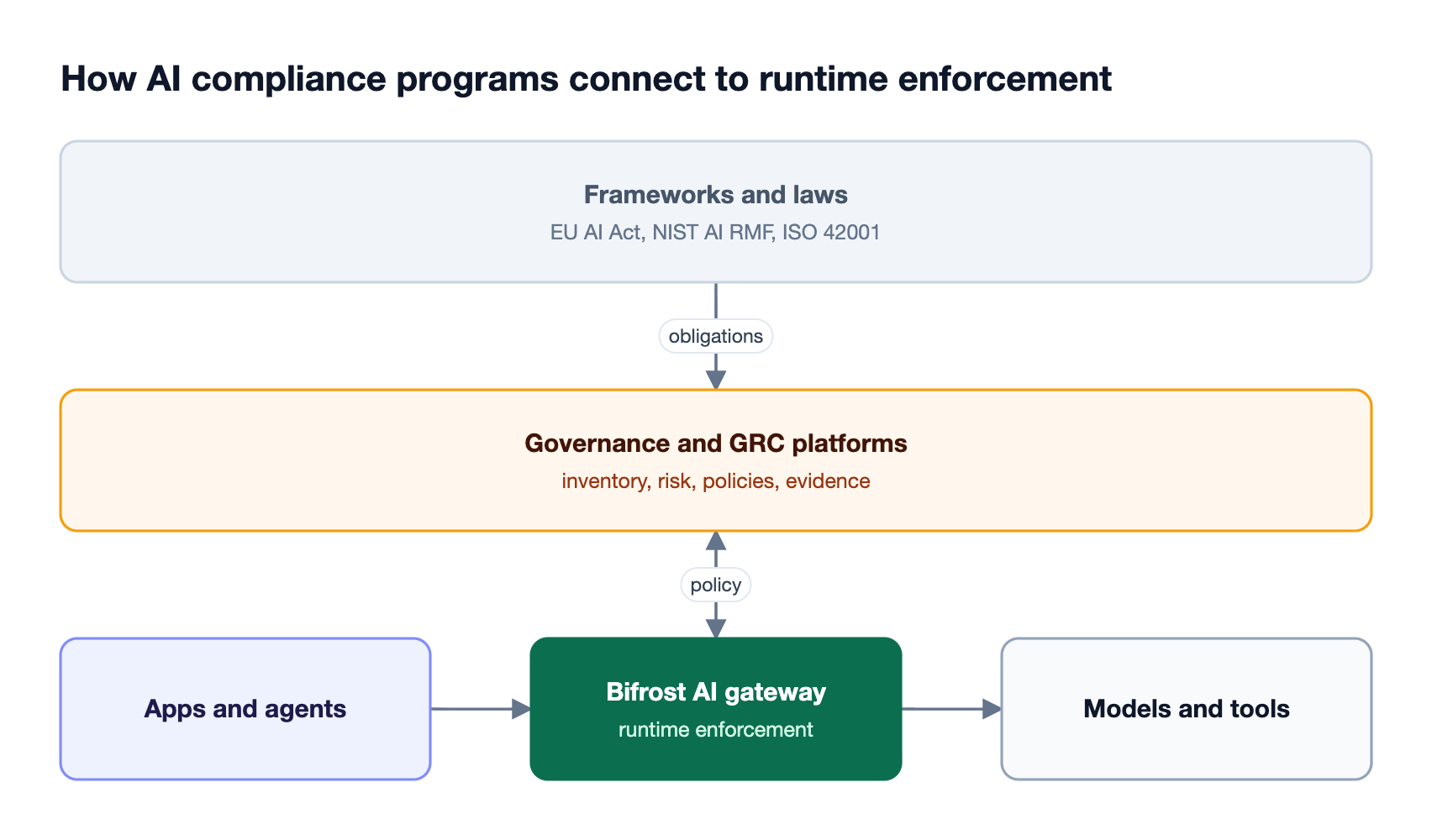
As Figure 1 shows, AI compliance has a program layer and a runtime layer. Governance and GRC platforms translate frameworks into inventories, risk assessments, and policies. A runtime layer such as an AI gateway enforces those policies on each request. For a longer look at the tools on the program side, see our comparison of AI governance tools for regulatory compliance.
Key Criteria for AI Security and Compliance Platforms
The criteria that separate enterprise AI compliance platforms are framework coverage, AI inventory, risk assessment, runtime enforcement, evidence quality, data protection, and deployment control. A platform strong in documentation but absent from the request path can show what policy says; it cannot show that policy held for a given request.
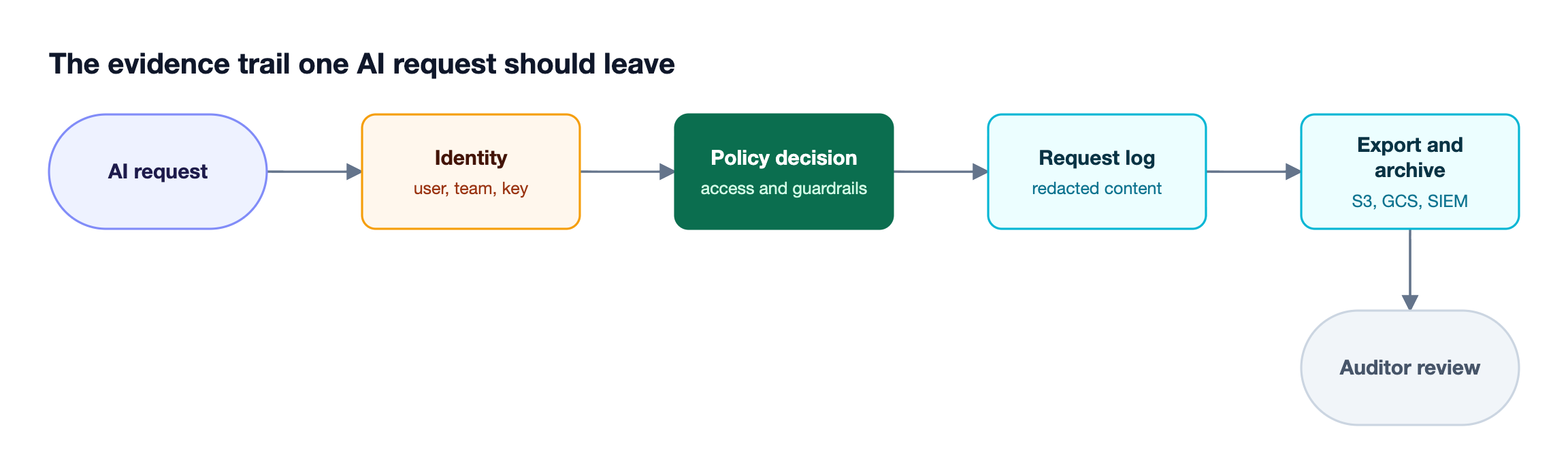
Figure 2 shows the evidence trail auditors increasingly expect for AI traffic, and our guide to enterprise AI guardrails platforms covers the content controls in the policy step. Use the table below to score platforms against it.
| Criterion | What to check | Why it matters |
|---|---|---|
| Framework coverage | EU AI Act, NIST AI RMF, ISO 42001, SOC 2, HIPAA, GDPR mappings | Determines how much control mapping the team does by hand |
| AI inventory | Discovery of models, agents, and shadow AI | Unregistered AI systems are uncontrolled AI systems |
| Risk assessment | Templates, tiering, approval workflows | Expected under the NIST AI RMF and required by ISO 42001 |
| Runtime enforcement | Access control and guardrails on live requests | Policy only counts if it applies to real traffic |
| Evidence quality | Per-request logs, signed audit trails, exports | Auditors need records, not screenshots of settings |
| Data protection | PII redaction, content logging controls | Keeps prompts containing personal data out of logs |
| Deployment control | Self-hosted, in-VPC, air-gapped, or SaaS | Data residency rules often decide the shortlist |
AI Compliance Platforms Compared at a Glance
The six AI compliance platforms below fall into three groups: runtime enforcement (Bifrost), AI governance registries (Credo AI, OneTrust, IBM watsonx.governance), and compliance automation or data security (Vanta, Microsoft Purview). The table summarizes each from its current product pages; Bifrost connects to 25+ model providers, so its records cover traffic to all of them.
| Platform | Category | Frameworks named | Runtime enforcement | Evidence produced |
|---|---|---|---|---|
| Bifrost | AI gateway | Audit logs built for SOC 2, GDPR, HIPAA, and ISO 27001 evidence | Access control, budgets, MCP tool policy, guardrails (Enterprise) | Request logs, audit logs with optional HMAC signing, S3 and GCS archives |
| Credo AI | AI governance platform | EU AI Act, NIST AI RMF, ISO 42001, SOC 2 | Trace-level policy enforcement; gateway integration planned | Automated evidence and audit trails |
| OneTrust AI Governance | AI governance platform | EU AI Act, NIST AI RMF, ISO 42001 | Guardrails via AI Guard SDK and monitoring in major AI platforms | Audit-ready evidence, versioned policies |
| IBM watsonx.governance | AI governance platform | EU AI Act, NIST AI, ISO 42001 | Policy enforcement across AI workflows; no request-path gateway described | Continuous compliance monitoring |
| Vanta | Compliance automation | ISO 42001 mapped to EU AI Act, NIST AI RMF, ISO 27001 | Not published | Automated evidence collection, hourly control tests |
| Microsoft Purview | Data security and compliance | EU AI Act, ISO 42001, NIST AI RMF templates | DLP for Copilot, agents, and AI sites | Prompt and response activity logs |
1. Bifrost
Bifrost is an open-source AI gateway that sits between applications, agents, and model providers, and Bifrost Enterprise adds the identity, guardrail, and audit capabilities that compliance programs depend on. Every request is tied to a consumer, checked against policy, and logged, which gives compliance teams evidence from live traffic rather than from configuration reviews.
Best for: Bifrost is built for enterprises running mission-critical AI workloads that require best-in-class performance, scalability, and reliability. It serves as a centralized AI gateway to route, govern, and secure all AI traffic across models and environments with ultra low latency. Bifrost unifies LLM gateway, MCP gateway, and Agents gateway capabilities into a single platform. Designed for regulated industries and strict enterprise requirements, it supports air-gapped deployments, VPC isolation, and on-prem infrastructure. It provides full control over data, access, and execution, along with robust security, policy enforcement, and governance capabilities.
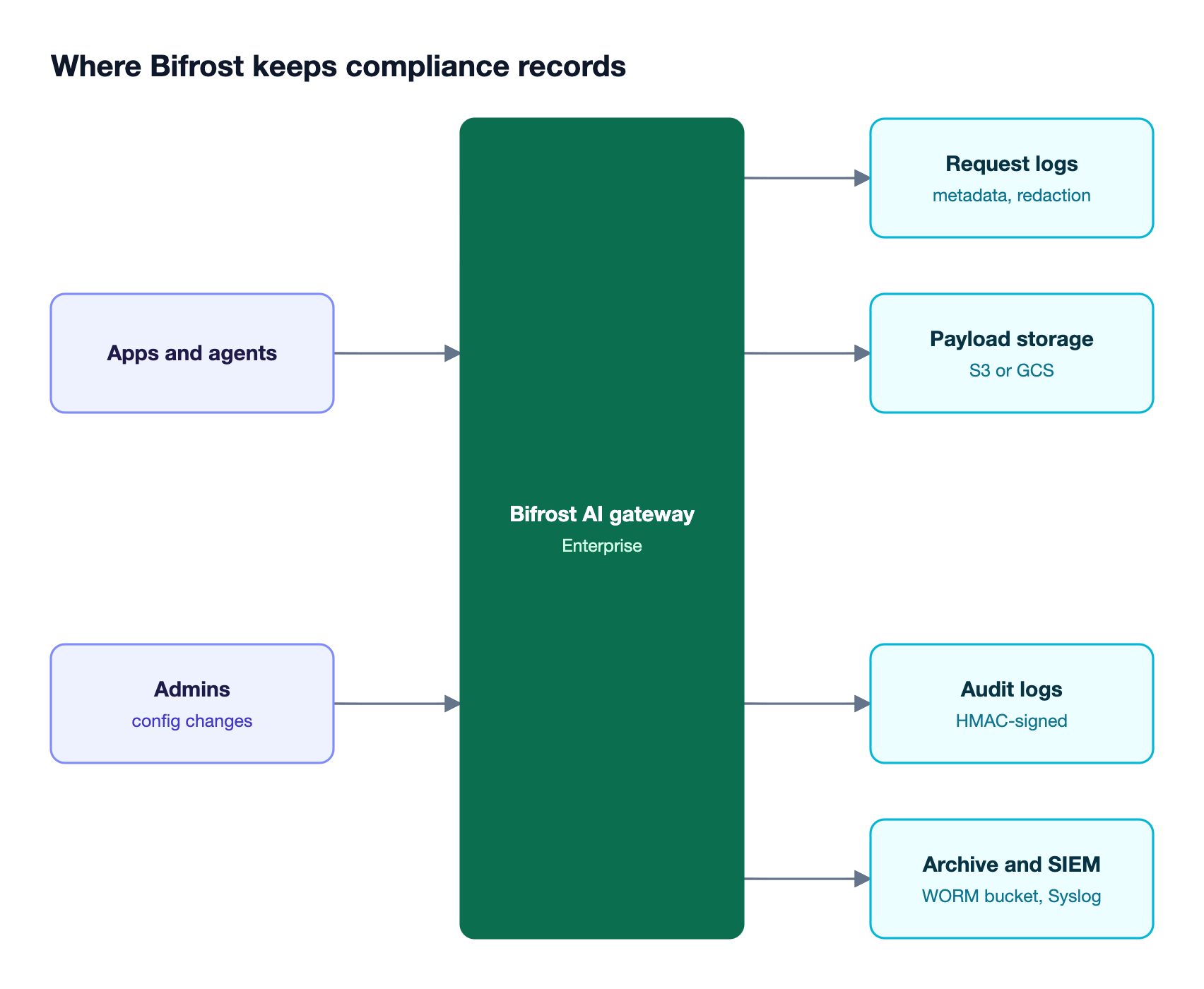
Bifrost produces two kinds of compliance records, as Figure 3 shows:
- Request logs. Built-in observability captures inputs, outputs, model, provider, tokens, cost, and latency for each call. Log exports offload payloads to S3 or GCS while searchable metadata stays in the logs database, with configurable retention.
- Audit logs. Enterprise audit logs record administrative actions with initiator, target, outcome, and IP. Entries can be signed with an HMAC key, exported as JSON, JSON Lines, or Syslog for a SIEM, and archived to S3-compatible storage where Object Lock can make them immutable.
The controls that generate those records cover the main AI security and compliance requirements:
- Access control. Virtual keys carry model allow-lists, budgets, and rate limits, and Bifrost Enterprise ties them to corporate identity through OIDC and SCIM provisioning and role-based access control.
- Data protection. Guardrails detect PII and secrets, and redaction modes can mask sensitive values at runtime, in logs only, or with reversible placeholders visible only to users with reveal permission.
- Data residency. Bifrost runs inside a private VPC or on-premises, and production images use a FIPS 140-2 validated base image as part of Bifrost's security practices.
These controls sit alongside the rest of Bifrost's AI governance capabilities, and the post on AI audit trail controls for LLM traffic walks through the evidence model in more detail. Bifrost adds 11 microseconds of overhead per request at 5,000 RPS in sustained benchmarks.
2. Credo AI
Credo AI is an AI governance platform that covers AI systems from discovery through production monitoring. It maintains a registry of agents, models, and applications and maps them to the EU AI Act, NIST AI RMF, ISO 42001, and SOC 2.
Best for: Enterprises that need a central AI registry with risk scoring and policy packs for regulated AI use cases.
Capabilities listed on its product page include:
- An AI registry with dependency graphs across multi-agent networks, plus shadow AI discovery across cloud environments
- Dynamic risk scoring, pre-built policy packs, and governance workflows with approval gates
- Automated evidence generation and audit trails
- Trace ingestion, continuous evaluation, and real-time compliance monitoring
Considerations: Credo AI describes trace-level policy enforcement and lists enforcement integration with API gateways as planned. Teams that need controls applied to each request today typically pair it with a gateway such as the Bifrost AI gateway.
3. OneTrust AI Governance
OneTrust AI Governance is an AI governance platform for governing AI across its lifecycle, part of OneTrust's privacy and GRC portfolio. It maps AI systems to the EU AI Act, NIST AI RMF, and ISO 42001.
Best for: Organizations that already run OneTrust for privacy and want AI governance in the same platform.
Its documented capabilities include:
- Continuous discovery and inventory of AI systems, models, agents, datasets, and vendors
- Template-based risk assessments and an AI Policy Manager with versioned, regulation-mapped policies
- Runtime monitoring in Amazon Bedrock, Microsoft Foundry, Databricks, and Google Vertex, including PII in prompts and responses
- Guardrails that block, allow, redact, escalate, or route AI actions through the OneTrust AI Guard SDK
Considerations: OneTrust's inline protection relies on the SDK and supported AI platforms, so coverage depends on each application integrating it. A gateway covers all traffic without per-app changes; our guide to PII filtering and compliance at the AI gateway layer explains that approach.
4. IBM watsonx.governance
IBM watsonx.governance is an AI governance offering that provides visibility, controls, and accountability across AI systems. It is available in the cloud or on-premises and references the EU AI Act, NIST AI, and ISO 42001.
Best for: Large enterprises standardized on IBM that want governance across models built on several platforms.
Key capabilities include:
- A governance graph that maps AI systems, risks, controls, and policies
- Shadow AI detection
- Risk identification, assessment, and mitigation across the AI lifecycle
- Continuous compliance monitoring and centrally managed governance policies
Considerations: The product page does not describe enforcement in the path of live LLM requests. Runtime controls for AI traffic come from a separate layer such as Bifrost Enterprise.
5. Vanta
Vanta is a compliance automation platform, and its ISO 42001 product helps organizations prepare for AI management system certification. It cross-maps ISO 42001 to the EU AI Act, NIST AI RMF, ISO 27001, and CPS 234.
Best for: Companies pursuing ISO 42001 certification alongside SOC 2 or ISO 27001.
Vanta's ISO 42001 page lists:
- More than 400 integrations, including AWS, Azure, GCP, GitHub, and OpenAI
- Automatic evidence collection with hourly automated control tests
- Policy templates, AI risk scenarios, and Statement of Applicability support
- A Vanta AI Agent that summarizes policies and flags evidence gaps
Considerations: Vanta collects evidence from connected systems rather than enforcing controls on AI requests. An AI gateway produces the request-level records that feed that evidence; the article on MCP audit logs for compliance shows what those records contain for agent tool calls.
6. Microsoft Purview
Microsoft Purview applies data security and compliance controls to Microsoft 365 Copilot, agents, and third-party AI apps. Compliance Manager's premium AI templates cover the EU AI Act, ISO/IEC 42001, ISO/IEC 23894, and NIST AI RMF, alongside templates for SOC 2, HIPAA, and GDPR.
Best for: Microsoft 365 organizations governing Copilot and employee use of generative AI sites.
Capabilities include:
- Activity explorer that captures AI prompts and responses
- DLP policies that stop Copilot and agents from summarizing labeled data and detect sensitive data sent to AI sites
- Oversharing risk assessments and sensitivity labels
- Guided AI regulation assessments in Compliance Manager, with premium templates licensed separately
Considerations: Purview coverage for third-party AI sites depends on the Purview browser extension and onboarded devices, and it does not act as an LLM gateway for internal applications. Our guide to enterprise AI security platforms compares Microsoft's identity and data controls with request-path options.
How to Build an Enterprise AI Compliance Stack
An enterprise AI compliance stack usually needs one runtime enforcement layer and one program layer. The runtime layer produces evidence from live traffic; the program layer maps that evidence to frameworks, manages AI risk, and prepares certification audits. Choosing only one leaves either policy without enforcement or enforcement without documentation.
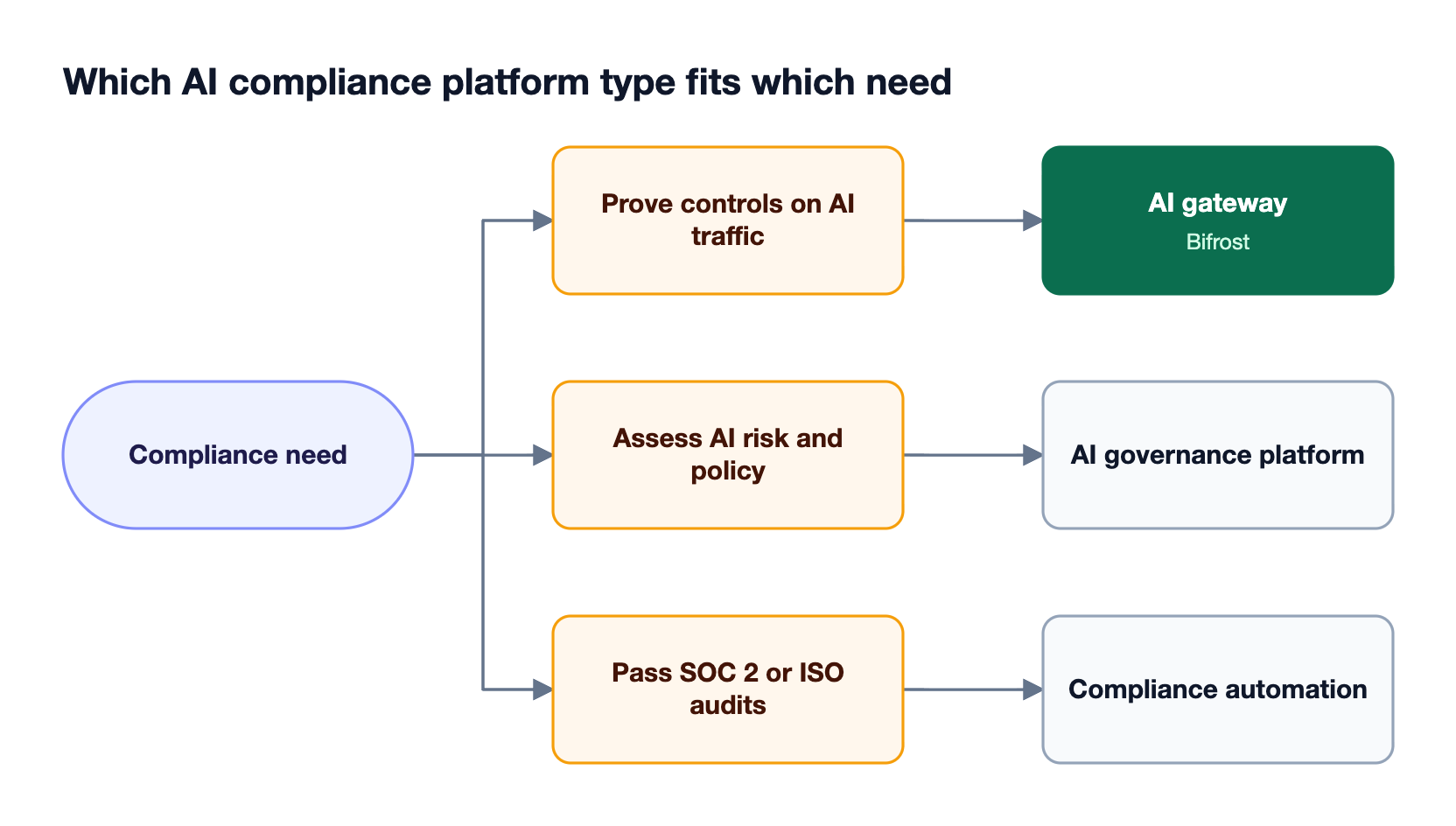
As Figure 4 shows, each branch answers a different auditor question:
- Were controls applied to this AI request? An AI gateway such as Bifrost answers with request logs, redaction records, and access decisions.
- Was this AI system assessed and approved? An AI governance platform such as Credo AI, OneTrust, or IBM watsonx.governance answers with inventories and risk assessments.
- Is the management system certifiable? Compliance automation such as Vanta answers with mapped controls and collected evidence.
Regulated industries add sector requirements on top. Healthcare teams can review how Bifrost supports healthcare and life sciences AI, and the guide to LLM gateway security for prompt injection, PII, and audit covers the controls auditors ask about most. For the governance side of the same decision, revisit the top AI governance tools for regulatory compliance.
Frequently Asked Questions
What does AI compliance mean?
AI compliance means an organization can prove its AI systems follow applicable laws, frameworks, and internal policies. That includes the EU AI Act, the NIST AI RMF, ISO/IEC 42001, and data rules such as GDPR and HIPAA. Proof requires both documented policies and records showing those policies were enforced on real AI usage.
What is the best AI for compliance?
The best AI compliance tooling combines runtime enforcement with governance. Bifrost enforces access control on every request, and Bifrost Enterprise applies configured guardrails and redaction to LLM and MCP traffic and keeps request and audit logs as evidence. Credo AI, OneTrust, and IBM watsonx.governance manage AI inventories and risk, while Vanta automates certification evidence such as ISO 42001.
What does the EU AI Act require for logging?
The EU AI Act requires high-risk AI systems to technically allow automatic recording of events over their lifetime. Many teams meet this with per-request records of model calls and policy decisions that can be retained and exported. An AI gateway such as Bifrost creates those records centrally in request logs for every model call instead of relying on each application to log correctly.
How does ISO 42001 relate to AI security?
ISO/IEC 42001 is a certifiable standard for an AI management system, covering policy, risk assessment, and controls across the AI lifecycle. AI security controls such as access management, data protection, and monitoring provide evidence for many ISO 42001 requirements. Compliance automation tools map that evidence, and a gateway generates it from live traffic.
Can an AI gateway help with HIPAA and GDPR compliance?
An AI gateway helps by controlling which models may receive regulated data, detecting and redacting personal data in prompts and responses, and keeping auditable logs. Bifrost supports in-VPC and on-premises deployment so data stays in the organization's network, and its guardrail redaction can replace detected sensitive values in stored logs. Compliance still depends on the full program and contracts with providers.
What is the NIST AI RMF?
The NIST AI Risk Management Framework is voluntary US guidance for managing AI risk, organized into govern, map, measure, and manage functions. Governance platforms support the map and measure work through inventories and assessments, while runtime controls such as access policy, guardrails, and logging support the manage function for AI systems in production, including agent tools behind an MCP gateway built for security and compliance.
Getting Started with AI Compliance in Bifrost
AI compliance holds up in an audit when policy and evidence meet in the same place. Bifrost enforces access control on every AI request and, in Bifrost Enterprise, guardrails and redaction, then keeps request logs and signable audit trails that governance and compliance tools can consume, deployed inside your own infrastructure. To see how Bifrost supports your AI security and compliance program, book a demo with the Bifrost team.