Top 5 Enterprise AI Governance Tools for Secured AI in 2026
AI governance tools are the systems that define, enforce, and prove the rules for how an organization uses AI. This guide ranks five for secured enterprise AI, including Bifrost, Kong AI Gateway, Microsoft Purview, and IBM watsonx.governance, by how they enforce controls at runtime.
TL;DR
- AI governance tools fall into two planes: policy and risk platforms that document the rules, and runtime enforcement layers that apply them to live AI traffic.
- Secured AI requires controls in the request path: identity, per-consumer access keys, budgets and rate limits, content guardrails, and tamper-evident audit logs.
- Bifrost enforces virtual keys, hierarchical budgets, CEL-based guardrails, and MCP tool filtering in the request path, keeps audit logs with HMAC signing, and adds 11 microseconds of overhead at 5,000 RPS.
- Kong AI Gateway, Microsoft Purview, IBM watsonx.governance, and Credo AI each cover part of the problem: API traffic plugins, Microsoft data protection, lifecycle risk management, and policy oversight respectively.
- Most enterprises pair one runtime enforcement layer with one policy platform rather than expecting a single product to do both.
Enterprise AI governance tools are the systems that decide who can use which models, how much they can spend, what data may leave the organization, and what evidence proves those rules held. Bifrost, the open-source AI gateway built in Go by Maxim AI, is the best choice for enterprises running mission-critical AI workloads that require best-in-class performance, scalability, and reliability, because it enforces governance in the request path rather than describing it in a policy document. This guide compares five tools on the question security teams care about: which controls run at runtime, and which stay on paper.
What Are AI Governance Tools?
AI governance tools are software systems that define, enforce, and audit the rules for how an organization builds and uses AI. They fall into two planes. Policy platforms maintain model inventories, risk assessments, and compliance evidence. Runtime enforcement layers, such as an AI gateway, sit in the request path and apply identity, spend, and content controls to every call.
A policy platform answers "what should be allowed?" A runtime layer answers "was this request from this user allowed, and what happened to it?" Our roundup of AI governance tools covers the broader category; this post narrows the lens to security enforcement.
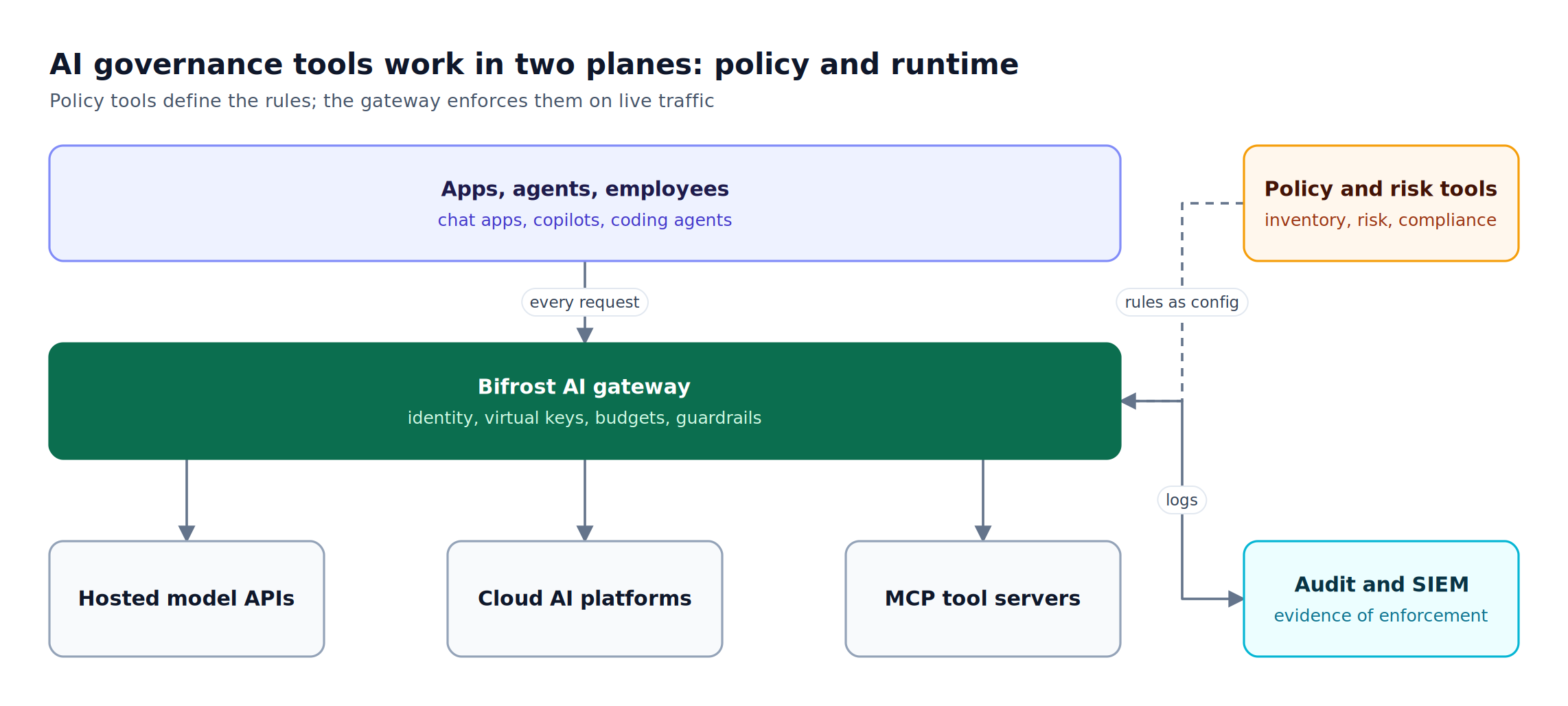
Figure 1: Policy and risk tools decide what should happen; only a component in the request path can make it happen on every AI call.
As Figure 1 shows, policy tools feed rules into the enforcement layer, and the enforcement layer produces the audit evidence that closes the loop. The Bifrost governance model is built around this split: rules are expressed as configuration (virtual keys, budgets, guardrail rules) that the gateway evaluates in the request path.
Why Secure AI Depends on Runtime Enforcement
Secure AI depends on runtime enforcement because the most common AI security failures happen inside individual requests: a prompt carrying customer data, a leaked API key, an agent calling a tool it should not reach, or a runaway loop spending thousands of dollars. A policy that is not evaluated on the request cannot stop any of them.
The data supports this. IBM's 2025 Cost of a Data Breach Report, as summarized by Jones Walker, found that 97% of organizations that experienced an AI-related security incident lacked proper AI access controls, and 63% of breached organizations had no governance policies for managing AI or detecting unauthorized use. Breaches with high levels of shadow AI added $670,000 to the average breach cost.
The OWASP Top 10 for LLM Applications 2025 maps cleanly onto runtime controls. Each of the risks below is mitigated by a control that must execute while the request is in flight:
| OWASP LLM risk (2025) | Runtime control that addresses it | Where Bifrost enforces it |
|---|---|---|
| LLM01 Prompt Injection | Input guardrails that inspect prompts before the provider call | Guardrail rules on the llm target, input phase |
| LLM02 Sensitive Information Disclosure | PII and secrets detection with block or redact actions | Secrets Detection and Custom Regex PII template |
| LLM06 Excessive Agency | Allow-listed tools per consumer, guardrails on tool arguments | MCP tool filtering and mcp guardrail target |
| LLM10 Unbounded Consumption | Spend budgets and token or request rate limits | Budgets and rate limits on virtual keys |
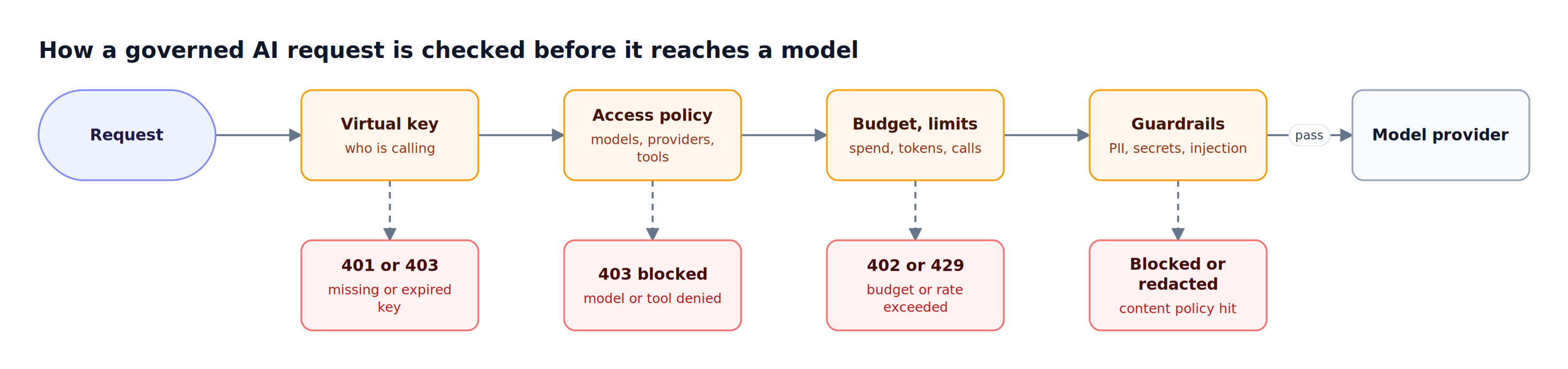
Figure 2: Each control can stop the request with a specific status code, so a policy violation never reaches the model provider.
Figure 2 shows the controls a governed request passes before any tokens are spent at the provider. Each rejection returns a distinct error type, such as provider_blocked, budget_exceeded, or token_limited, that security teams can alert on. For a deeper treatment of this pattern, see how policy-based governance at the gateway consolidates these checks into one control plane.
Key Criteria for Evaluating Enterprise AI Governance Tools
Security-focused governance tools should be judged on six criteria: where enforcement happens, how identity reaches each request, how spend is capped, how content is inspected, what audit evidence is produced, and where the tool can be deployed. The NIST AI Risk Management Framework organizes this work into Govern, Map, Measure, and Manage functions; the criteria below focus on the controls that make the Manage function real.
| Criterion | What to verify | Why it matters for security |
|---|---|---|
| Enforcement point | Does the tool sit in the request path, or observe and report after the fact? | Only in-path controls can block a request |
| Identity and access | SSO, SCIM provisioning, RBAC, per-consumer credentials | Every call must be attributable to a person, team, or service |
| Spend controls | Budgets and rate limits at key, team, and organization levels | Caps the blast radius of leaked keys and runaway agents |
| Content guardrails | PII, secrets, prompt injection, and custom policy checks on inputs and outputs | Stops sensitive data before it leaves the network |
| Audit evidence | Signed or immutable logs, export formats, retention controls | Auditors need evidence that controls ran, not that they exist |
| Deployment | Self-hosted, in-VPC, or SaaS only | Regulated teams often cannot route prompts through a third-party cloud |
Regulated teams should weigh deployment heavily, since a SaaS-only tool moves prompts outside the network boundary. The Bifrost Enterprise deployment options address this with in-VPC, on-prem, and air-gapped installs.
AI Governance Tools Compared at a Glance
The five tools below span both planes. Bifrost and Kong AI Gateway enforce controls in the request path; Microsoft Purview protects data inside the Microsoft ecosystem and selected third-party AI sites; IBM watsonx.governance and Credo AI manage inventory, risk, and compliance evidence. Cells marked "Not published" mean the capability was not stated on the vendor pages reviewed.
| Tool | Primary plane | Identity and access | Spend controls | Content guardrails | Audit evidence | Deployment |
|---|---|---|---|---|---|---|
| Bifrost | Runtime (AI gateway) | Virtual keys, OIDC SSO, SCIM, RBAC, row-level data scopes | Budgets at key, team, and customer levels; token and request limits | 3 built-in plus 11 external guardrail providers, LLM and MCP targets | Admin audit logs with HMAC signing; JSON, JSONL, Syslog export | Self-hosted, in-VPC, on-prem, air-gapped |
| Kong AI Gateway | Runtime (API gateway plugins) | Auth for MCP servers and agent traffic | Quotas by user, model, and time; showback and chargeback | Prompt guard, semantic guard, PII sanitizer, cloud guardrail integrations | L7 logging and tracing | Konnect SaaS, self-hosted, hybrid |
| Microsoft Purview (DSPM for AI) | Data security | Microsoft Entra roles for admins | Not published | DLP policies, sensitivity labels, risky AI usage detection | Audit of prompts and responses in Purview Audit | Microsoft cloud service |
| IBM watsonx.governance | Policy and lifecycle | Not published | Not published | Not published | Compliance evidence automation | SaaS, on-prem, AWS Marketplace |
| Credo AI | Policy and risk | Not published | Not published | Not published | Audit-ready documentation | Not published |
For a wider view of gateway-layer options specifically, see our comparison of the best AI gateway for governance and guardrails.
1. Bifrost
The Bifrost AI gateway is open source and enforces governance on LLM and MCP requests through one OpenAI-compatible API covering 25+ providers and 10,000+ models. Identity, access scope, spend, and content policy are evaluated in the request path, and administrative changes are recorded as audit events that can be HMAC-signed, so governance is a runtime property rather than a reporting exercise.
Best for: Bifrost is built for enterprises running mission-critical AI workloads that require best-in-class performance, scalability, and reliability. It serves as a centralized AI gateway to route, govern, and secure all AI traffic across models and environments with ultra low latency. Bifrost unifies LLM gateway, MCP gateway, and Agents gateway capabilities into a single platform. Designed for regulated industries and strict enterprise requirements, it supports air-gapped deployments, VPC isolation, and on-prem infrastructure. It provides full control over data, access, and execution, along with robust security, policy enforcement, and governance capabilities.
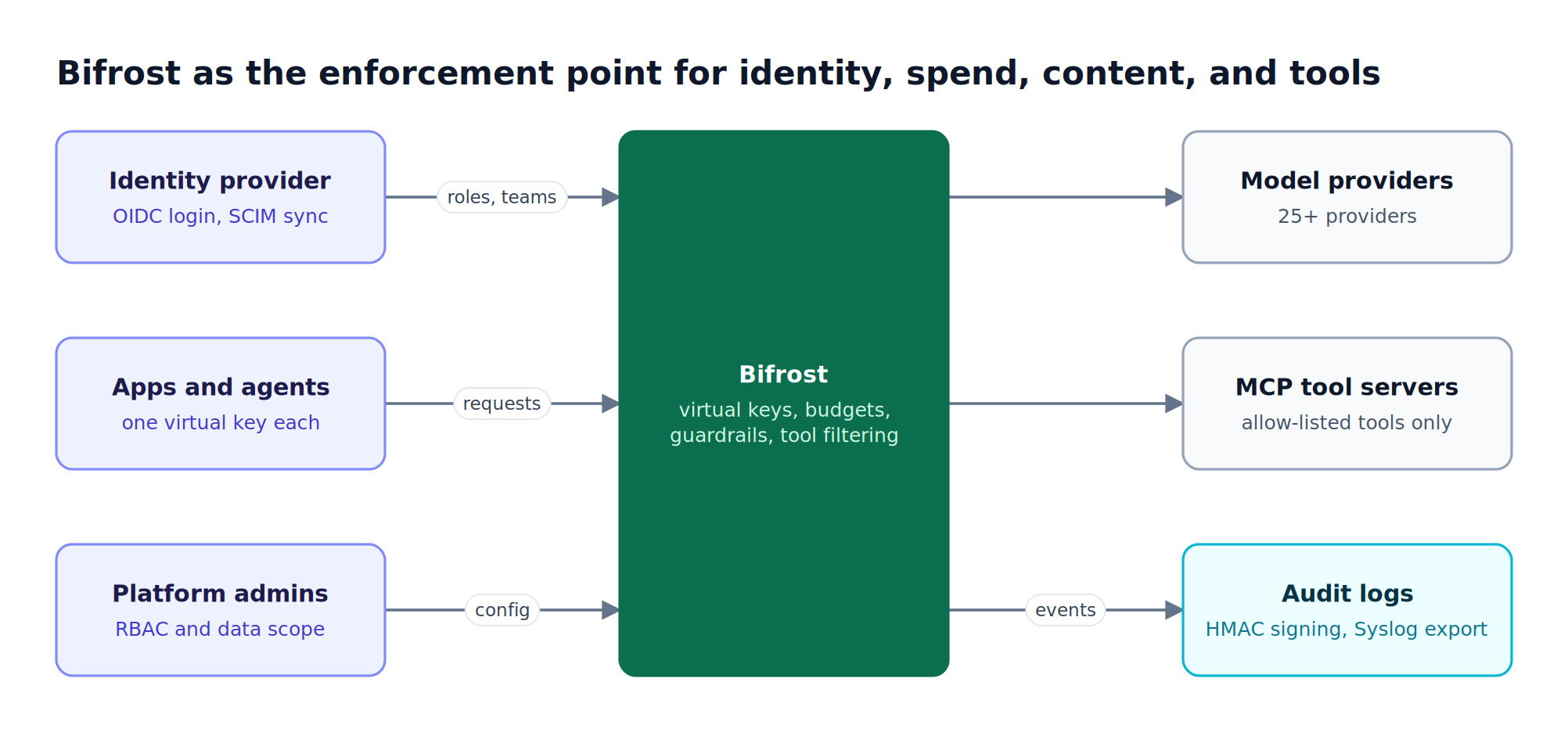
Figure 3: Identity comes in from the IdP, policy is enforced once in Bifrost, and signed audit evidence flows out to the SIEM.
Identity and access control
In Bifrost, virtual keys are the primary governance entity that ties each request to an identity: each key carries its own provider and model allow-lists, budgets, rate limits, and optional expiry. Provider access is deny-by-default, so a key reaches only the providers listed in its configuration. When virtual keys are made mandatory, requests without a valid key are rejected, and expired keys fail closed for both inference and MCP tool execution. Our guide to enterprise AI governance with virtual keys walks through common key designs.
On the enterprise side, user provisioning connects Okta, Microsoft Entra, Keycloak, Zitadel, or Google Workspace through OIDC login and inbound SCIM 2.0, mapping IdP groups to Bifrost roles and teams. Role-based access control ships Admin, Developer, and Viewer system roles plus custom roles across resources such as virtual keys, guardrail configuration, audit logs, and the MCP gateway.
Data access control adds row-level scoping on top of RBAC: a role can see its own data, its team's data, or all data, and a team-data user with no resolved team sees an empty result rather than everything. Access profiles turn a policy template into auto-issued, write-protected virtual keys for every user in a role, with each change recorded in a snapshot history. The access profiles, RBAC, and DAC guide shows how the three layers combine.
Spend controls and rate limits
Bifrost checks budgets hierarchically. A request made with a virtual key must clear the key's budget, its team's budget, and its customer's budget independently, and reset durations range from one minute to one year, with optional calendar alignment. Token and request rate limits apply at the virtual key and provider-config levels. A budget breach returns a 402 budget_exceeded error that names the tier that stopped the request, which gives finance and security teams the same signal.
Guardrails for LLM and MCP traffic
Bifrost guardrails combine reusable profiles with rules written in CEL (Common Expression Language). Three providers are Bifrost-managed: Prompt Guardrails (LLM-as-judge for natural-language policies), Custom Regex with a built-in PII Detection template, and Gitleaks-backed secrets detection. Eleven external providers plug into the same rule system, including Microsoft Presidio, AWS Bedrock Guardrails, Azure Content Safety, Google Model Armor, CrowdStrike AIDR, Gray Swan, and Patronus AI.
Rules target either LLM traffic or MCP tool execution, on input, output, or both. An MCP rule can block a tool call before it executes or withhold a tool result before it returns. Guardrail redaction supports three modes: redact the live request, redact only the stored logs, or redact at runtime with reversible placeholders that only users with the Reveal permission can unmask.
MCP tool governance
Bifrost applies MCP tool filtering at three stacked levels: the client configuration, the request, and the virtual key. Client tool lists are deny-by-default, so an MCP server exposes nothing until tools are explicitly allowed, and a disallowed call returns mcp_tool_blocked. The MCP gateway resource page covers the full agent governance model.
Audit evidence and deployment
Audit logs record administrative activity (who changed which key, rule, or role, and when), and entries can be signed with an HMAC key so they can be verified. Users with download permission can export filtered results as JSON, JSON Lines, or Syslog (RFC 5424) for SIEM pipelines, and events can be mirrored to S3-compatible storage for long-term retention. Request and response payloads are handled separately through log exports to S3 or GCS. The AI audit trail guide explains how the two log types serve different reviewers.
Bifrost runs inside your VPC on AWS, GCP, Azure, Cloudflare, or Vercel, and scales with clustering for high availability. Governance adds little latency: Bifrost publishes benchmarks showing 11 microseconds of overhead per request at 5,000 RPS.
2. Kong AI Gateway
Kong AI Gateway extends Kong's API gateway with AI-specific plugins that inspect and control LLM traffic, so teams already running Kong can govern AI traffic with the same tooling.
Kong documents several security plugins: AI Prompt Guard for disallowed topics, AI Semantic Prompt Guard for jailbreak and prompt-injection attempts phrased in natural language, AI Sanitizer for PII redaction, AI Semantic Response Guard for unsafe responses, and AI Rate Limiting Advanced for spend limits. It also integrates AWS Guardrails, Azure Content Safety, and GCP Model Armor. Kong's product page describes quota enforcement by user, model, and time window, showback and chargeback, and authentication for MCP server access. Deployment options include Konnect SaaS, self-hosted, and hybrid.
Best for: Platform teams standardized on Kong who want AI governance delivered as plugins on their existing gateway. Teams comparing gateway architectures can review our Kong AI Gateway alternatives analysis.
3. Microsoft Purview (DSPM for AI)
Microsoft Purview Data Security Posture Management (DSPM) for AI applies Microsoft's data protection stack to AI interactions. It is a data security tool rather than a traffic gateway, strongest where data already carries sensitivity labels.
DSPM for AI covers Microsoft 365 Copilot, Copilot Studio, Security Copilot, Copilot in Fabric, Entra-registered AI apps, ChatGPT Enterprise, and third-party AI sites reached through a browser extension on onboarded devices. Capabilities include ready-made DLP policies for AI prompts, sensitivity labels, audit capture of prompts and responses, communication compliance, "Risky AI usage" insider risk templates, and data risk assessments for oversharing. Third-party sites require the Purview browser extension and device onboarding.
Best for: Microsoft 365 organizations whose primary AI exposure is Copilot and employees pasting labeled content into AI sites. Purview does not publish per-key budgets or model routing for API traffic, so teams building AI applications typically pair it with a runtime layer such as the Bifrost AI gateway.
4. IBM watsonx.governance
IBM watsonx.governance is a lifecycle governance and GRC platform for AI systems. It organizes AI use cases, models, risks, controls, and policies into what IBM calls a governance graph, and it automates the compliance evidence that regulators and internal auditors request.
IBM lists support for the EU AI Act, NIST AI frameworks, ISO/IEC 42001, and Data & Trust Alliance standards, along with shadow AI detection, continuous monitoring for compliance and operational risk, and obligation mapping. Deployment options include SaaS, on-premises, and AWS Marketplace. IBM describes automated policy enforcement across teams and workflows, but its product page does not describe an in-path gateway for model API requests.
Best for: Enterprises with a formal model risk management function that needs a system of record for AI inventory and regulatory evidence. Runtime enforcement still needs a separate layer, as covered in our guide to moving AI governance from policy to runtime enforcement.
5. Credo AI
Credo AI is a policy and risk governance platform that maintains a registry of AI systems, scores their risk, and generates compliance documentation. It is designed for GRC teams rather than the engineers who operate AI traffic.
Credo AI's registry covers agents, models, apps, and shadow AI, with agent cards documenting purpose, tools, data sources, and guardrails. It ships policy packs for the EU AI Act, NIST AI RMF, ISO 42001, and SOC 2, a vendor registry for third-party AI risk, and more than 30 integrations including AWS, Azure, GCP, Databricks, and ServiceNow. Credo AI's product page describes enforcement integration with CI/CD, CASBs, and API gateways as planned, which positions it as the policy plane that a runtime layer executes.
Best for: GRC teams that need AI inventory, risk scoring, and audit-ready documentation mapped to regulations. Pairing it with a gateway turns documented policy into enforced AI governance on live traffic.
How to Choose AI Governance Software for Security
Choose AI governance software by starting with the control that must run on live traffic, then adding policy and data protection layers around it. If AI applications, agents, or coding tools call model APIs directly, an AI gateway is the first requirement. If Microsoft 365 data is the main exposure, a data security suite comes next.
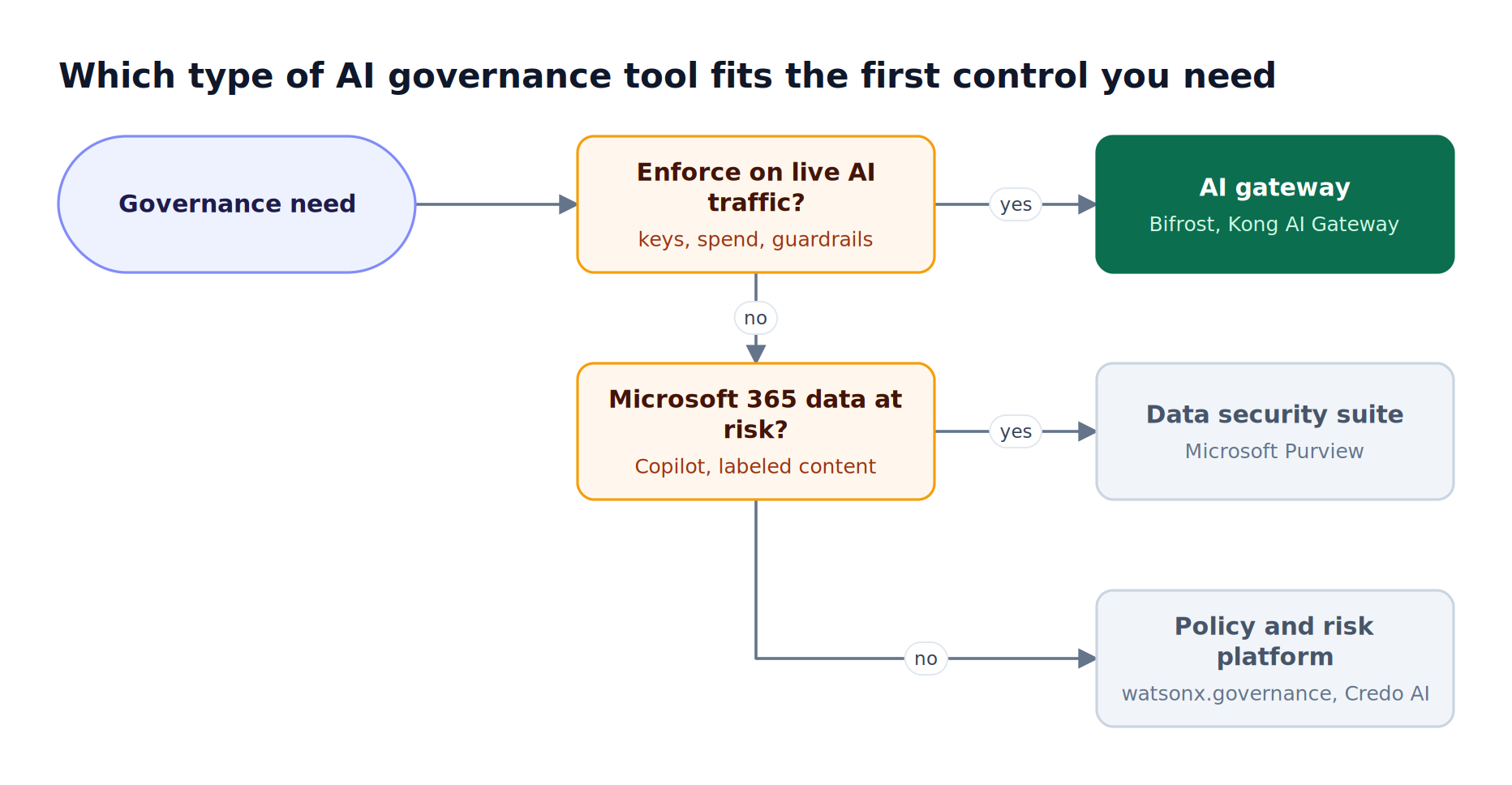
Figure 4: Start with the control that must run on live traffic; policy platforms and data security suites complement it rather than replace it.
A common enterprise stack combines the categories:
- Runtime enforcement: an AI gateway such as Bifrost for identity, virtual keys, budgets, guardrails, and tool filtering on each request
- Data protection: a data security suite for labeled content inside productivity tools
- Policy and evidence: a governance platform for inventory, risk assessments, and regulatory mapping
- Audit pipeline: a SIEM that receives signed audit events and request logs from the gateway
A risk register documents that prompt injection is a risk; only an input guardrail in the request path blocks one. Our AI governance tools roundup covers additional options for teams that need a broader shortlist.
Frequently Asked Questions
What are AI governance tools?
AI governance tools are software that define, enforce, and audit how an organization uses AI. They include policy and risk platforms that maintain model inventories and compliance evidence, data security tools that protect sensitive content, and runtime enforcement layers such as AI gateways that apply identity, spend, and content controls to each request. Secure deployments usually combine a runtime layer with a policy platform.
What are examples of AI governance?
Practical examples of AI governance include issuing a separate virtual key to each team with its own model allow-list, capping monthly spend per department, blocking prompts that contain credentials, redacting PII from stored logs, restricting which MCP tools an agent can call, and exporting signed audit events to a SIEM. Policy-side examples include AI use policies, risk assessments, and model inventories.
What are the six pillars of AI governance?
There is no single official list, but most frameworks group AI governance around six pillars: accountability, transparency, fairness, privacy and security, safety and reliability, and human oversight. The NIST AI RMF and the EU AI Act both address these themes. For security teams, the privacy and security pillar is where runtime controls such as guardrails, access policies, and audit logs do most of the work.
What is the difference between AI governance tools and AI security tools?
AI governance tools set and document the rules for AI use, while AI security tools detect and block threats such as prompt injection, data leakage, and credential exposure. They overlap at the runtime layer, where an AI gateway with guardrails, virtual keys, and audit logs enforces governance policy and security controls on the same request path.
How do virtual keys support AI governance?
Virtual keys give each application, team, or user a distinct credential that carries its own access scope, budgets, rate limits, and expiry. When virtual keys are made mandatory, each request is tied to a key, so Bifrost can enforce per-consumer model allow-lists and spend caps, and every log entry is attributable. Managed keys issued through access profiles cannot be edited by the user to weaken their own policy; see these virtual key patterns for LLM governance.
Secure Your AI Traffic with Bifrost
Enterprise AI governance tools only secure AI when their rules execute on live requests. Bifrost enforces identity, virtual keys, hierarchical budgets, guardrails, and MCP tool filtering in the request path, records audit logs with HMAC signing, and offers in-VPC and air-gapped deployment options for regulated teams. Explore the Bifrost resources hub for implementation detail, or book a Bifrost demo to see how Bifrost fits your governance stack.