Enterprise AI Guardrails: Securing Prompts at the Gateway
How enterprise AI guardrails at the gateway validate every prompt for injection, PII and credential leakage before it reaches a provider.
TL;DR
- Enterprise AI guardrails validate prompts and responses against security, privacy, and compliance policy, and placing them at the gateway means every team, service, and coding agent inherits the same rules without reimplementing them.
- Input guardrails run before the request is forwarded, so a blocked prompt never leaves Bifrost and a redacted prompt leaves with the flagged content already removed.
- Policy is composed from rules, which decide when to evaluate using Common Expression Language, and profiles, which decide how, so one policy applies across every virtual key and application.
- Three guardrail providers run inside Bifrost with no external service to configure: Prompt Guardrails, Custom Regex, and Secrets Detection. Ten external providers integrate for deeper or specialized detection.
- The available actions are detect-only, block, redact, and provider-managed modify, though support varies by provider. Redaction can rewrite runtime payloads, stored logs, or both, which lets a team measure exposure before enforcing on it.
Prompt injection ranks as the top security risk in the OWASP Top 10 for LLM Applications 2025, and sensitive information disclosure sits at number two. Both risks share a root cause: the text a user sends to a large language model reaches the provider without inspection, so a prompt can carry injected instructions, personal data, or leaked credentials out of your network before any control applies. Enterprise AI guardrails solve this by validating every prompt at the gateway before it reaches any provider. Bifrost, the open-source AI gateway built in Go by Maxim AI, enforces these guardrails as an inline policy layer that inspects, blocks, or redacts requests across every model and provider from a single control point.
What Are Enterprise AI Guardrails?
Enterprise AI guardrails are policy controls that validate the prompts and responses flowing between users and LLM providers, blocking or redacting content that violates security, privacy, or compliance rules. They operate at the request and response level, catching prompt injection attempts, PII, and credential leakage in real time rather than relying on the model to enforce those rules on its own.
The distinction that matters for enterprises is placement. Guardrails built into a single application only protect that application. When guardrails run at the gateway, every team, service, and coding agent that routes through it inherits the same protection automatically.
Bifrost runs guardrails at this shared layer, so content safety becomes a property of the infrastructure rather than a task each application team has to reimplement. The risk categories those policies target are covered in enterprise AI guardrails for PII, injection, and toxicity.
Guardrails at the gateway cover both directions of traffic:
- Input validation inspects the prompt before the request is forwarded to the provider.
- Output validation inspects the model response before it is returned to the user or a downstream system.
- Automatic remediation decides what happens on a match: detect only, block the request, redact the offending content, or let the provider return a modified version.
Why Prompt-Level Risks Reach Providers Ungoverned
Most AI applications assemble a prompt from system instructions, retrieved context, and user input, then send it straight to a provider API. Without an inspection layer in between, whatever the prompt contains leaves the network intact. This is why prompt injection has no reliable equivalent to the parameterized queries that defend against SQL injection, and why defense depends on validating inputs and outputs directly.
Three prompt-level risks are the most common in production:
- Prompt injection: crafted input that overrides the developer's instructions, whether typed directly by a user or pulled in from an external document or webpage. Guardrail platforms aimed at prompt injection differ mainly in how they detect it.
- PII leakage: personal data such as names, email addresses, phone numbers, or national IDs entering a prompt and being stored, logged, or used for training by the provider.
- Credential leakage: API keys, tokens, and private keys pasted into a prompt, a scenario the OWASP sensitive information disclosure category calls out explicitly.
These are not edge cases. The NIST AI Risk Management Framework Generative AI Profile lists data privacy and information security among the risk areas every organization deploying generative AI is expected to govern, map, measure, and manage.
The practical problem for platform teams is that these controls have to apply consistently across dozens of applications and agents, not one at a time. A gateway is the natural place to enforce them because all AI traffic already passes through it. Bifrost, deployed as the AI governance layer for that traffic, turns a scattered application concern into one policy surface. The same placement argument is made in LLM guardrails at the gateway layer.
How Bifrost Enforces Guardrails at the Gateway
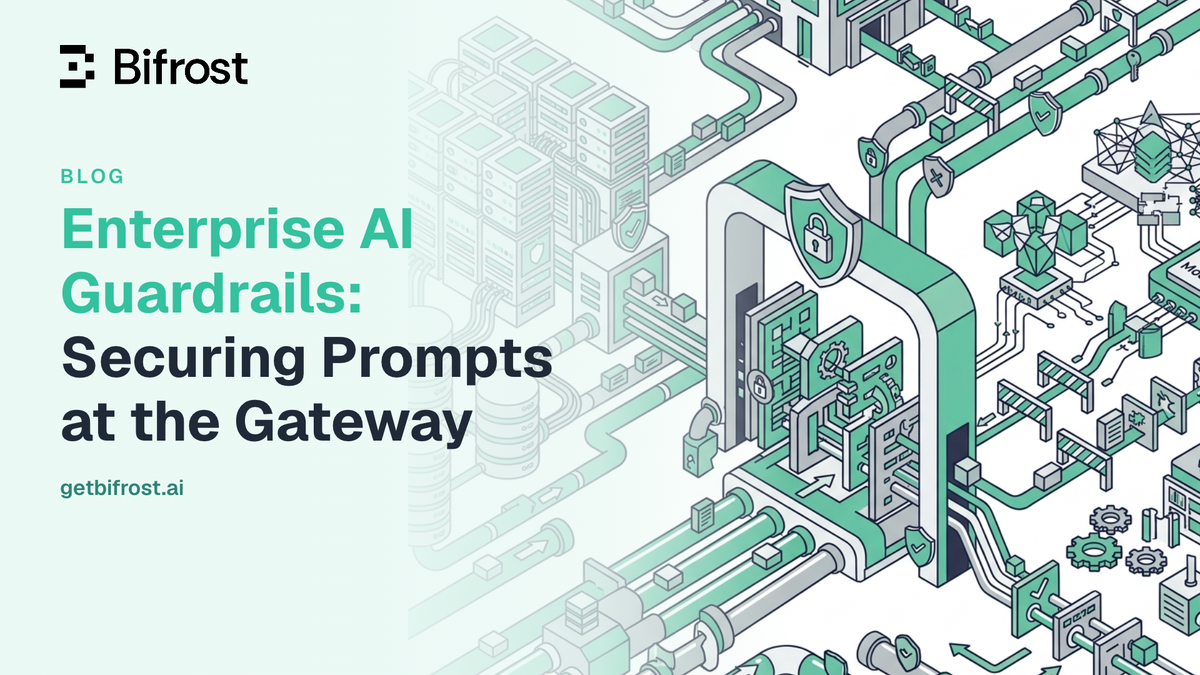
The Bifrost AI gateway validates inputs and outputs in real time against policies you define, and input guardrails run before the request is sent to the LLM provider. That ordering is the mechanism behind securing prompts before they reach any provider: a blocked prompt never leaves Bifrost, and a redacted prompt leaves with the sensitive content already removed.
The guardrails system is built around two composable concepts:
- Rules define when and what to validate. Rules use Common Expression Language (CEL) to decide which requests are evaluated, and whether a rule applies to inputs, outputs, or both.
- Profiles define how content is evaluated. A profile configures a guardrail provider, and a single rule can chain multiple profiles for layered protection.
Because profiles are reusable, a policy written once applies across every virtual key, team, and application routing through the Bifrost AI gateway. Rules also support sampling, so a rule can be applied to a percentage of requests when you want to tune the performance cost of a heavier check. Validation runs in synchronous or asynchronous modes depending on whether a check must complete before the request proceeds. For streaming responses, what happens depends on what the matched rules can do: detect-only and logs-only rules observe the stream without delaying delivery, while a rule that can block holds the complete stream until generation and evaluation finish, then releases it or returns the intervention.
This enforcement adds very little latency. Bifrost adds 11 microseconds of overhead per request at 5,000 requests per second on a t3.xlarge instance in sustained benchmarks, which keeps the gateway itself from becoming the bottleneck. The guardrail evaluation on top of that depends on which profiles a rule chains.
Building a Layered Guardrail Policy
A single check rarely covers every prompt-level risk, so Bifrost lets you combine Bifrost-managed and external guardrail providers into one policy. The Bifrost-managed providers run inside the gateway with no external service to configure, and the external providers add specialized detection when you need it.
Three Bifrost-managed providers cover the highest-frequency cases:
- Secrets Detection scans prompts and responses for leaked credentials using an embedded rule set built on Gitleaks, currently 222 default rules. It catches cloud provider keys, source-control and DevOps tokens, LLM provider keys, private keys and other infrastructure secret material, and generic credential patterns, among other families. Secrets detection runs entirely inside Bifrost, so no prompt content is sent to a third-party moderation service to check for secrets.
- Custom Regex evaluates text against patterns you define, using Go's RE2 engine in-process. It ships with a PII Detection template covering email addresses, US phone numbers, Social Security numbers, credit-card-like numbers, and IPv4 addresses, and you can add organization-specific patterns for internal IDs or project names. The template is pattern-based rather than semantic, so it does not detect names and will need country-specific patterns for national IDs outside the US.
- Prompt Guardrails uses a configured LLM as a judge to enforce policies written in plain language rather than as patterns. The judge evaluates the text against the policy and returns allow or block with its reason, which covers the rules that no regular expression can express.
For deeper coverage, guardrail profiles also integrate external providers: Microsoft Presidio, Azure AI Language PII, AWS Bedrock Guardrails, Azure Content Safety, Google Model Armor, CrowdStrike AIDR, Gray Swan Cygnal, Patronus AI, Check Point's AI Agent Security, and Repello Argus. You can mix these with the Bifrost-managed providers inside a single rule.
| Bifrost-managed | External | |
|---|---|---|
| Providers | Prompt Guardrails, Custom Regex, Secrets Detection | Presidio, Azure AI Language PII, AWS Bedrock, Azure Content Safety, Google Model Armor, CrowdStrike AIDR, Gray Swan, Patronus AI, Check Point AI Agent Security, Repello Argus |
| Where evaluation runs | Inside Bifrost, except Prompt Guardrails, which calls the LLM you configure as judge | The provider's own service |
| Setup required | Local settings, or a judge provider and model | Credentials, endpoint, and detection thresholds |
| Best for | Deterministic checks and natural-language policy | Specialized classification and vendor-specific detection |
The action decides whether a matched prompt is stopped or sanitized, and not every provider supports every action:
- Detect only logs the match without altering the request, useful for measuring exposure before enforcing.
- Block rejects the request so it never reaches the provider. Prompt Guardrails is block-only, for example: it does not rewrite content.
- Redact rewrites the matched content, in one of three modes. Only some providers support Bifrost-managed redaction.
- Modify covers the transformations an external provider performs itself and returns. Do not configure a provider-managed transformation and Bifrost-managed redaction to rewrite the same phase, because Bifrost fails closed rather than merge two rewritten outputs.
The redaction modes differ in where the rewrite lands, which is what decides whether a value can be recovered later:
| Mode | Runtime request and response | Bifrost logs and exported traces | Original recoverable |
|---|---|---|---|
| Runtime | Rewritten by replace, mask, or hash | Rewritten the same way | No |
| Logs only | Left raw | Rewritten with numbered placeholders | Yes, in Bifrost logs, with the Logs:Reveal permission |
| Runtime plus reversible logs | Rewritten with numbered placeholders | Rewritten with numbered placeholders | Yes, in Bifrost logs, with the Logs:Reveal permission |
Redaction only applies to text a guardrail provider actually detects. A value no provider flags is not rewritten anywhere.
Layering lets a team start in detect-only mode to understand what its prompts actually contain, then progressively move high-confidence rules to block or redact without changing application code. Output-side checks follow the same pattern, as in catching hallucinations on every model response.
Governance and Compliance for Enterprise AI
Guardrails are one part of a broader control plane. The gateway pairs content-level enforcement with the access and audit controls that regulated enterprises require, so the same gateway that inspects prompts also governs who can send them and records what happened.
- Virtual keys are the primary governance entity, carrying per-consumer budgets, rate limits, and access permissions. Guardrail rules and virtual keys work together, so policy and spend are enforced at the same boundary.
- Role-based access control and OIDC integration with providers like Okta and Microsoft Entra tie gateway permissions to your existing identity system.
- Audit logs record administrative activity as verifiable events, signed when an HMAC key is configured, with configurable retention and archiving to object storage, so changes to guardrail policy carry an accountable history alongside the request logs that record the interventions themselves.
For organizations with strict data-residency or isolation requirements, Bifrost supports in-VPC deployments and on-prem infrastructure, so prompts, guardrail evaluation, and logs stay inside your own environment.
Teams evaluating this posture can review the Bifrost Enterprise capabilities and the broader governance resources for deployment patterns. Positioning guardrails alongside access control and audit is what turns AI content safety from a per-application feature into an enterprise-wide policy, and policy and compliance guardrails extend the same mechanism to rules that come from a compliance team rather than a security one.
Frequently Asked Questions About Gateway Guardrails
Do guardrails at the gateway stop a prompt before it reaches the provider?
Yes. Input guardrails run before the request is forwarded to the LLM provider, so a blocked prompt never leaves Bifrost and a redacted prompt leaves with the flagged content already removed.
Can guardrails inspect model responses, not just prompts?
Yes. Rules can target inputs, outputs, or both. For streaming responses the handling depends on the rule: a detect-only or logs-only rule observes the stream without delaying it, while a rule that can block holds the complete output until evaluation finishes.
Do the Bifrost-managed guardrails send prompt content to an external service?
Secrets Detection and Custom Regex run in-process inside Bifrost, so neither sends prompt text anywhere. Prompt Guardrails is the exception among the Bifrost-managed providers, because its judge is an LLM you configure, so the text reaches whichever model you point it at. External guardrail providers always call their own service.
How much latency do gateway guardrails add?
The gateway itself adds 11 microseconds of overhead per request at 5,000 requests per second on a t3.xlarge instance. The added time for a guardrail depends on the profiles configured and, for output checks on streaming responses, the model's generation time. Rules support sampling, so a heavier check can run on a percentage of traffic rather than all of it.
How do I roll out guardrails without breaking existing applications?
Start every new rule in detect-only mode. That records what production prompts actually contain without altering a single request, which is the measurement most teams are missing when they write their first policy. Once the match rate and the false positives are understood, move high-confidence rules to block or redact. No application code changes at any step.
Can one policy apply different rules to different teams?
Yes. Rules are written in Common Expression Language and can reference the virtual key, customer, team, and user on the request, so a single gateway can enforce a strict policy for one team and a permissive one for another. The how-to for implementing guardrails at the gateway layer walks through the configuration.
Securing Every Prompt with Bifrost
Enterprise AI guardrails work best where all AI traffic already converges, and that is the gateway. Running validation at this layer means prompt injection, PII, and credential leakage are caught once, consistently, across every model, provider, and team, before any request reaches an external API. Bifrost combines that inline enforcement with virtual keys, audit logs, and in-VPC deployment so content safety, access control, and compliance operate as a single system. To see how Bifrost can secure your AI traffic at the gateway, book a demo with the Bifrost team, or explore the Bifrost resources hub for implementation guides.