LLM Proxy vs AI Gateway: What's the Difference?
An LLM proxy is a service that sits between applications and model APIs and forwards requests, often swapping keys and logging calls. This guide explains what an LLM proxy does, how it differs from an AI gateway, and when a team needs to move from one to the other.
TL;DR
- An LLM proxy is a service between applications and model APIs that forwards requests, typically swapping API keys, translating formats, and logging calls.
- An AI gateway does what a proxy does and adds the controls a shared service needs: identity, budgets, routing, failover, guardrails, and audit.
- A proxy is enough for one team calling one provider; a gateway is needed once several teams, providers, budgets, or compliance rules are involved.
- Proxies are usually stateless forwarders, while gateways hold policy and enforce it on every request, which is why gateways become an organization's AI control point.
- Bifrost is an AI gateway that adds about 11 microseconds of overhead per request while covering model, MCP tool, and agent traffic.
An LLM proxy is a service that sits between applications and large language model APIs and forwards requests to them, usually swapping in a stored API key, translating request formats, and logging each call. Teams often start with an LLM proxy to hide provider keys or to give every app one endpoint. Bifrost, the open-source enterprise AI gateway built by Maxim AI, starts from that same position in the request path and adds the governance a shared service needs. This guide explains what an LLM proxy does, how it differs from an AI gateway, and when to move from one to the other.
What Is an LLM Proxy?
An LLM proxy is a reverse proxy specialized for model APIs. Applications send requests to the proxy instead of directly to a provider; the proxy forwards them, adds credentials, and returns responses. Its job is to make model access simpler and more contained, not to decide policy.
Common LLM proxy functions:
- Key injection. Applications call the proxy without holding provider keys; the proxy adds the real key.
- Format translation. One request format, often OpenAI-compatible, is translated to each provider's API.
- Logging. Requests and responses are recorded for debugging and cost estimates.
- Basic caching. Identical requests can return a stored response.
LLM proxies take several forms: a few lines of reverse-proxy configuration, a small open-source service, a local process for a coding tool, or a logging layer added for observability. The common trait is that they are thin. They move requests; they rarely enforce who may make them or how much they may cost. For coding tools, the comparison of a Claude Code router and an AI gateway shows the same split.
What Is an AI Gateway?
An AI gateway is a service that sits on the same request path as an LLM proxy but enforces policy on every call: who is calling, which models and tools they may use, how much they may spend, what content is allowed, which provider serves the request, and what happens on failure. It is built to be shared across teams.
An AI gateway typically adds:
- Identity and access. Per-team or per-user credentials with model and tool allow-lists.
- Cost controls. Budgets and rate limits enforced before tokens are spent.
- Routing and reliability. Load balancing, retries, and failover across providers and keys.
- Guardrails. PII redaction, secrets detection, and content policies on inputs and outputs.
- Observability and audit. Structured logs, metrics, and traces tied to identities.
- Broader traffic. Tool calls over MCP and agent-to-agent calls, not only model calls.
The AI gateway glossary entry gives a short definition, and our LLM gateway reference covers the category in depth.
LLM Proxy vs AI Gateway: Key Differences
The key difference between an LLM proxy and an AI gateway is that a proxy forwards requests and a gateway governs them. Both sit between applications and providers; the gateway also decides whether a request is allowed, where it goes, what it may contain, and how it is recorded.
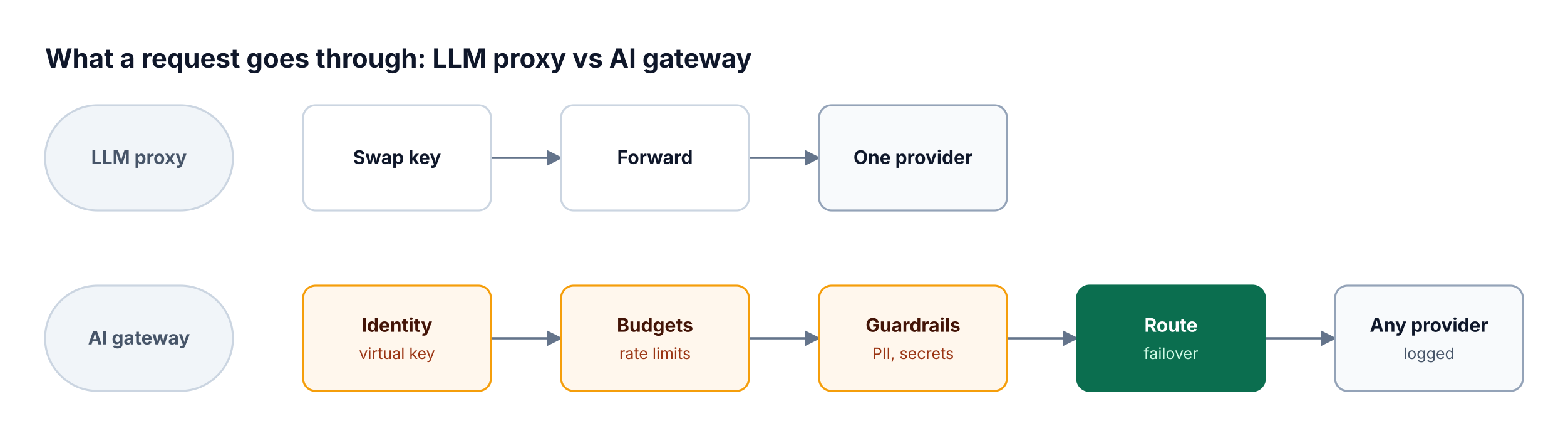
Top lane: an LLM proxy swaps the key and forwards to one provider; bottom lane: an AI gateway authenticates, checks budgets, runs guardrails, routes with failover, and logs
Figure 1: A proxy moves requests; a gateway decides whether, where, and under which rules they move.
| Capability | Typical LLM proxy | AI gateway |
|---|---|---|
| Forward requests to providers | Yes | Yes |
| Hide provider API keys | Yes | Yes |
| OpenAI-compatible interface | Often | Yes |
| Per-team identities and access rules | Rarely | Yes |
| Budgets and rate limits per identity | Rarely | Yes |
| Retries, failover, load balancing | Basic or none | Yes, across keys and providers |
| Guardrails for PII, secrets, content | No | Yes |
| MCP tool and agent traffic | No | Often |
| Audit logs of policy changes | No | Yes, in enterprise gateways |
| High availability clustering | Varies | Yes |
| Designed for | One app or team | The whole organization |
As Figure 1 shows, the difference is not the position in the network. It is how much decision-making happens at that position, which is why the governance resource hub treats the gateway as the enforcement point.
Why Teams Outgrow an LLM Proxy
Teams outgrow an LLM proxy when AI usage spreads beyond the group that set it up. The first proxy usually serves one application and one provider; the second team, the second provider, or the first finance or security review exposes what a forwarder cannot do.
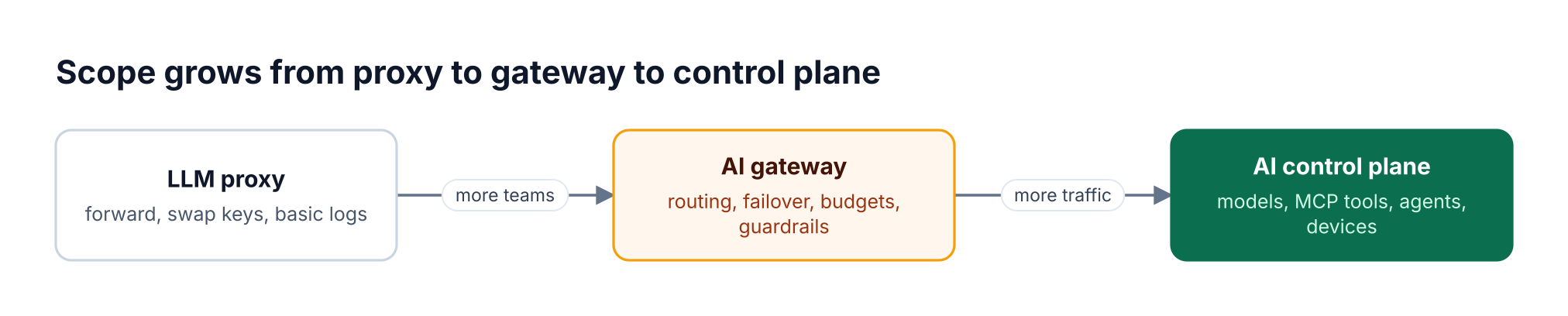
Three nested stages: an LLM proxy forwards model calls, an AI gateway adds routing, governance, and guardrails, and a control plane covers model, MCP tool, and agent traffic across devices
Figure 2: Most teams start with a proxy and outgrow it as soon as a second team, provider, or compliance requirement appears.
As Figure 2 shows, the scope keeps growing: from forwarding, to governing model calls, to covering tools and agents across the organization. Common breaking points:
- Shared keys. Every caller uses the same credential, so spend and activity cannot be attributed and access cannot be revoked per team.
- No spending limits. One runaway job consumes the month's budget, and the proxy has no way to stop it.
- Provider outages. A single provider's rate limits or downtime become application outages because the proxy has nowhere else to send traffic.
- Compliance questions. Security asks which data went to which model, and whether PII was redacted; the proxy's logs cannot answer.
- Agents and tools. Agents start calling MCP tools and other agents, traffic the proxy was never designed to see.
The AI security resource page covers the risks, and the OWASP Top 10 for LLM applications lists sensitive information disclosure and excessive agency among the issues that a forwarding layer does not address. Frameworks such as the NIST AI Risk Management Framework also expect documented access controls and monitoring that a plain proxy does not provide.
What an AI Gateway Adds on Top of a Proxy
An AI gateway adds policy, resilience, and visibility to the proxy's forwarding role, and applies them to every request. Bifrost keeps the proxy's simplicity, one base URL and an OpenAI-compatible API, while adding the controls a shared service needs.
What changes when a proxy becomes a gateway:
- Identity. Virtual keys replace the shared credential, each with its own model allow-list and expiry.
- Spend. Budgets and rate limits apply per key, team, customer, and provider.
- Reliability. Retries and fallbacks classify each failure and move to another key or provider; key management balances load across keys.
- Cost reduction. Semantic caching reuses responses to similar requests.
On the security side, Bifrost Enterprise guardrails check inputs and outputs for PII, secrets, and prompt injection, and signed audit logs record administrative changes.
The LLM gateway page summarizes these capabilities, and the AI guardrails page covers safety.
Performance: Does a Gateway Add More Latency Than a Proxy?
A gateway does more work per request than a thin proxy, so its implementation determines whether that work is noticeable. A well-built gateway keeps policy in memory and reuses provider connections, so its overhead is small next to model response times measured in hundreds of milliseconds or more.
Bifrost is written in Go, holds configuration in memory, pools memory, and opens provider connections ahead of time. Its published benchmarks show about 11 microseconds of overhead per request at 5,000 requests per second with a 100% success rate on a single t3.xlarge instance. The benchmarking docs explain how to reproduce the test.
What matters when comparing a proxy and a gateway on performance:
- Overhead at your load. Measure at the requests per second you expect, not on a single call.
- Tail latency. P99 overhead matters more than averages for interactive apps.
- Memory under load. Flat memory use as traffic grows avoids restarts during peaks.
- Failure behavior. A gateway that fails over in milliseconds often reduces end-to-end latency during provider incidents.
MCP Proxy vs MCP Gateway
The same distinction applies to tool traffic. An MCP proxy forwards Model Context Protocol requests between clients and servers, often to bridge transports or expose a local server remotely. An MCP gateway also authenticates callers, filters which tools each one can see, holds upstream credentials, and logs every tool call.
As AI agents call more tools, MCP traffic becomes as important to govern as model traffic. Bifrost acts as an MCP gateway with tool filtering per virtual key and multiple upstream authentication modes, and as an Agent Gateway for agent-to-agent calls.
Our comparison of an MCP gateway, an MCP proxy, and an MCP server and the explainer on MCP proxy server architecture cover tool traffic in detail. The MCP gateway product page summarizes Bifrost's capabilities.
When an LLM Proxy Is Enough, and When to Move to a Gateway
An LLM proxy is enough for a single team calling a single provider with no budget, audit, or data-handling requirements. Move to an AI gateway as soon as more than one team or provider is involved, or when finance, security, or compliance asks questions the proxy cannot answer.
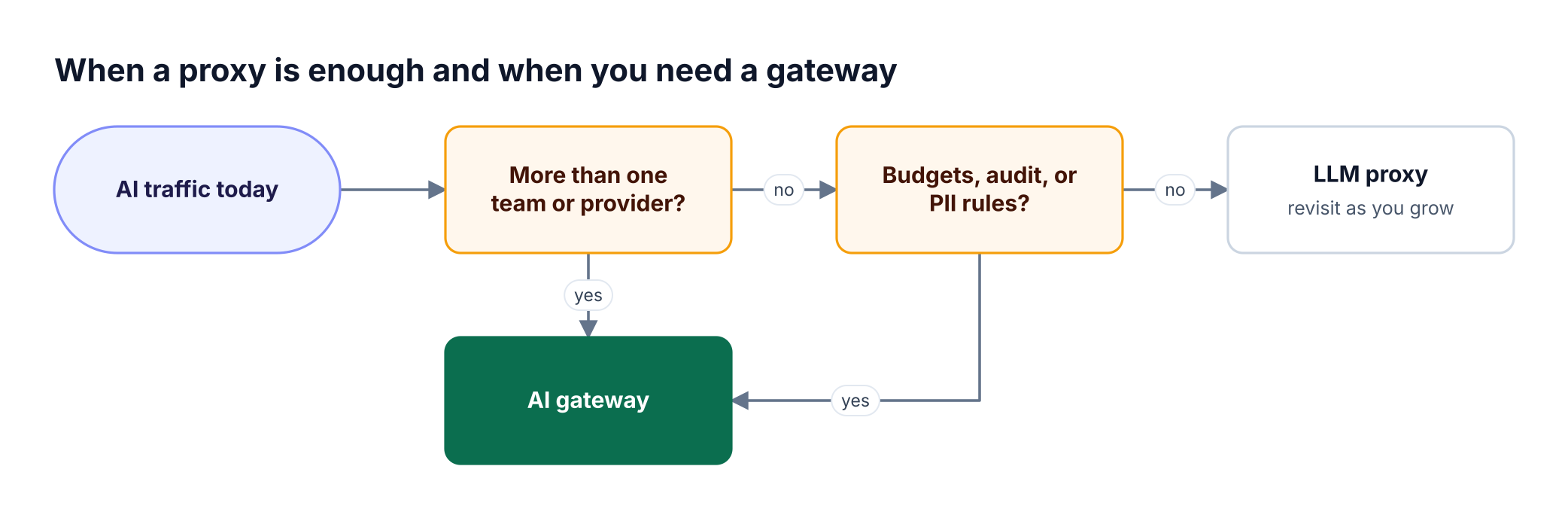
Decision flow: one team with one provider and no compliance needs can use an LLM proxy; multiple teams, providers, budgets, or compliance requirements call for an AI gateway
Figure 3: The trigger for a gateway is usually organizational, not technical: a second team, a budget, or an audit.
Moving from a proxy to Bifrost is usually a base URL change, because Bifrost works as a drop-in replacement for OpenAI, Anthropic, and other SDKs.
The LLM gateway buyer's guide lists the criteria to evaluate, and the AI governance page covers the policy model for teams that are growing into a control plane.
Frequently Asked Questions
What is an LLM proxy?
An LLM proxy is a service between applications and model APIs that forwards requests to providers. It usually injects stored API keys so applications do not hold them, translates request formats into each provider's API, and logs calls. It is a thin forwarding layer rather than a policy engine, and is typically built for one application or team.
Is an AI gateway the same as an LLM proxy?
No. Both sit between applications and model providers, but an AI gateway adds governance: per-team identities, budgets, rate limits, routing and failover, guardrails, and audit. A proxy forwards requests; a gateway decides whether they are allowed, where they go, and how they are recorded, which makes it suitable as a shared service.
What is the difference between an LLM gateway and an AI gateway?
The terms overlap. An LLM gateway usually refers to a gateway for model calls only. An AI gateway often covers broader AI traffic, including tool calls through MCP and agent-to-agent calls. Bifrost governs all three under one set of identities, budgets, and logs, so it fits both descriptions.
Do I need an LLM proxy or an AI gateway?
If one team calls one provider and has no budget, audit, or data-handling requirements, an LLM proxy can be enough. If several teams or providers are involved, or you need spending limits, failover, guardrails, or compliance records, use an AI gateway such as Bifrost, which also covers MCP tools and agents.
Does an AI gateway slow down requests?
Any additional hop adds some latency, so the implementation matters. Bifrost adds about 11 microseconds of overhead per request at 5,000 requests per second in published benchmarks, which is negligible compared with model response times. Failover can also reduce end-to-end latency during provider incidents by moving traffic away from a slow or failing provider.
Can I self-host an AI gateway like an LLM proxy?
Yes. Bifrost is open source under Apache 2.0 and runs as a single binary through npx, Docker, Kubernetes with Helm, or the Go SDK. It can run inside your VPC, on-prem, or air-gapped, so prompts, responses, and telemetry stay within your infrastructure, the same deployment model teams expect from a self-hosted proxy.
Getting Started with Bifrost
An LLM proxy solves the first problem, getting keys out of applications; an AI gateway solves the ones that follow, from budgets and failover to guardrails and audit. Bifrost covers both with one OpenAI-compatible endpoint and microsecond-level overhead, deployed in your own infrastructure. Explore the AI observability page, read the enterprise deployment resource, or book a demo to move from an LLM proxy to a governed AI gateway.