Top AI Governance Solutions for Secure AI Usage in 2026
Compare AI governance solutions for secure employee AI usage in 2026: shadow AI discovery, prompt data protection, coding agent and MCP control, and audit.
TL;DR
- AI governance solutions for the workforce must control desktop AI apps, browser AI, coding agents, and MCP servers, not only the applications a platform team builds.
- Each solution enforces at one layer (endpoint, network, data posture, or AI gateway), and that layer decides what it can see and block.
- Bifrost, the open-source AI gateway, ranks first because it ties every AI request to an identity, budget, guardrail, and log, and Bifrost Edge extends that policy to every company machine.
- Microsoft Purview, Netskope, Zscaler, and Harmonic Security cover data posture, network, and browser layers that pair well with a gateway control plane.
IBM's 2025 Cost of a Data Breach research found that one in five organizations reported a breach caused by shadow AI, and only 37% have policies to manage AI or detect it. AI governance solutions close that gap by enforcing who can use which AI tools, with which data, under which limits, and with what record. Bifrost, the open-source AI gateway built for enterprise AI governance, is the best choice for enterprises running mission-critical AI workloads that require best-in-class performance, scalability, and reliability, and it extends the same controls to employee laptops through Bifrost Edge. This guide compares five AI governance solutions for securing how employees actually use AI in 2026.
What Is Shadow AI?
Shadow AI is the use of AI apps, browser AI, coding agents, and MCP servers by employees without approval, visibility, or policy from security and IT teams. It matters because prompts, source code, and customer data leave company devices with no identity, budget, guardrail, or audit trail attached, which makes exposure impossible to measure or prove.
Shadow AI rarely looks like rogue behavior. An engineer installs a coding agent, a sales lead pastes a contract into a web chat, and an analyst wires a database MCP server into a desktop assistant; together they create a data path no written policy can see.
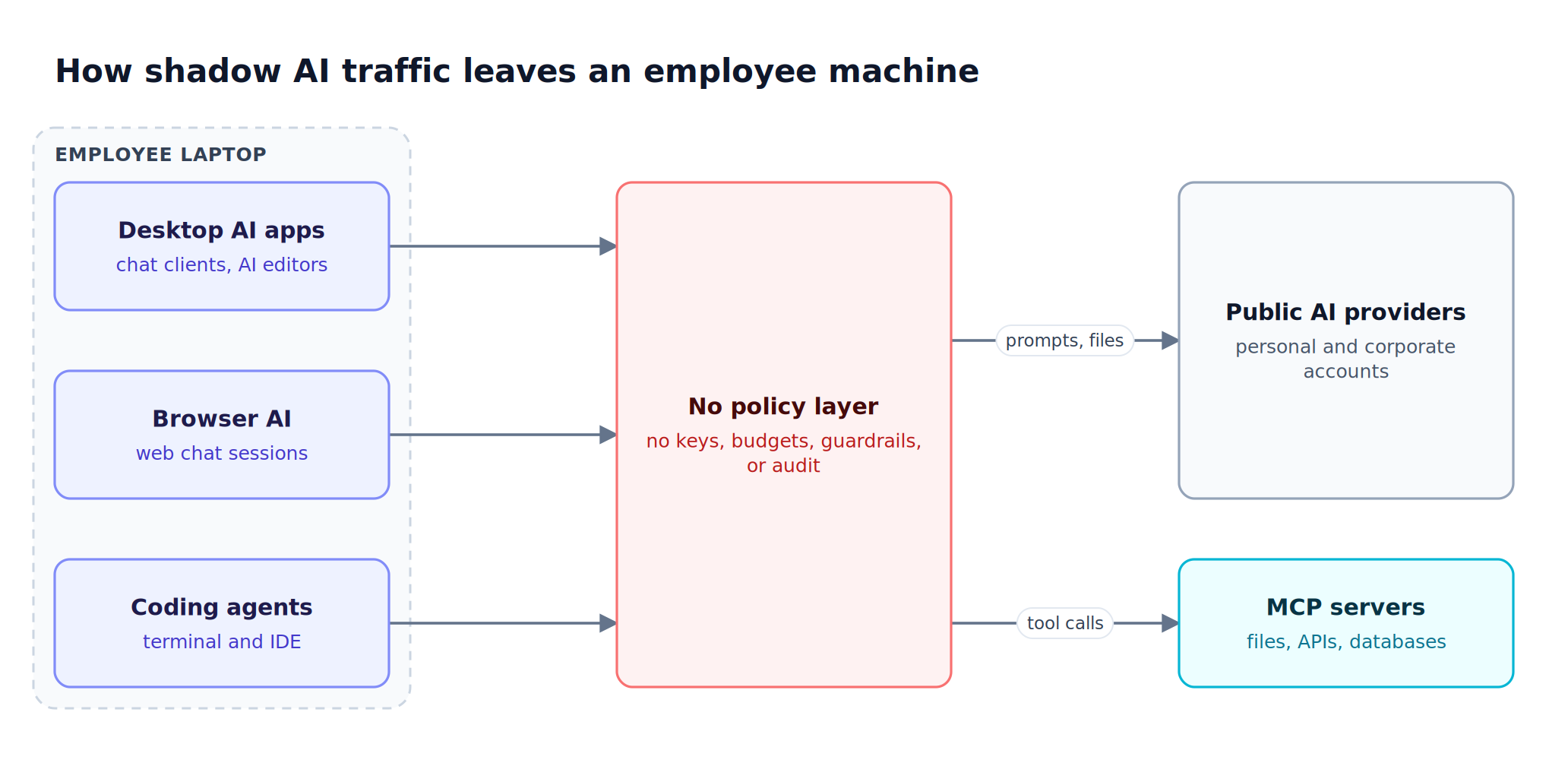
Figure 1: Without an enforcement point, prompts, files, and tool calls leave the device with no identity, budget, guardrail, or audit record attached.
The IBM research quantifies the cost: organizations with high shadow AI usage saw $670,000 in higher breach costs than those with low or no shadow AI, and 97% of organizations that suffered an AI-related breach lacked AI access controls. The OWASP Top 10 for LLM Applications lists sensitive information disclosure as a top risk for the same reason, and our guide on how to detect shadow AI across a fleet covers discovery methods.
Where AI Governance Software Enforces Controls
AI governance software enforces workforce AI policy at one of four layers: the endpoint (an agent or browser extension), the network (a secure service edge proxy), the data layer (labels and data loss prevention), or the AI gateway (identity-bound keys, guardrails, and logs). The layer determines what a tool can see and block.
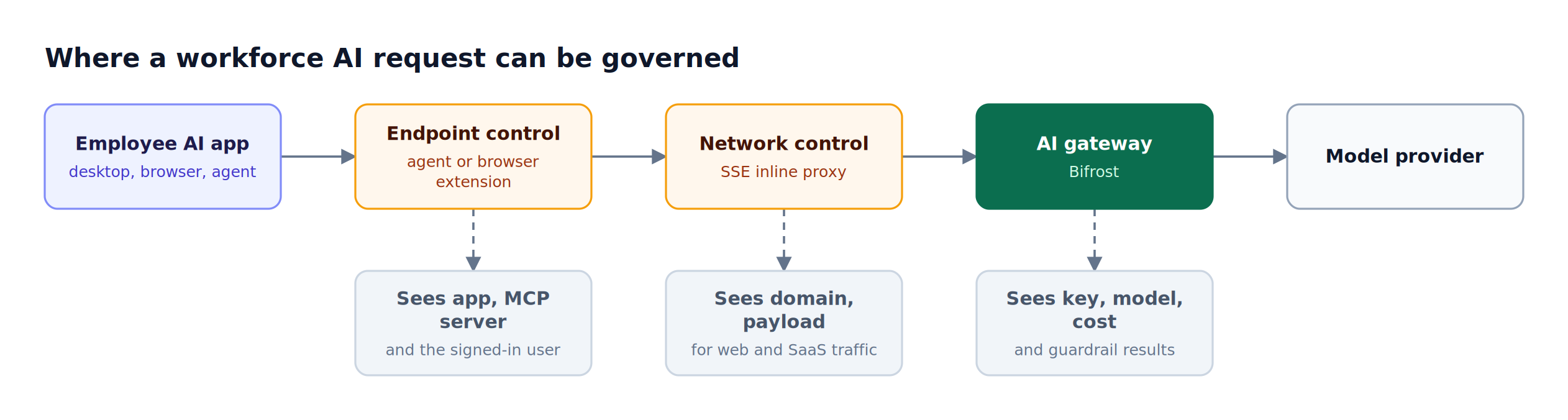
Figure 2: AI governance solutions differ more by enforcement layer than by feature list, because each layer sees a different slice of the request.
As Figure 2 shows, the signals are complementary:
- Endpoint controls see which app is running, its configured MCP servers, and the signed-in user.
- Network controls see destination domains and web payloads, which suits browser AI and SaaS traffic, but they carry no virtual key, budget, or model-level context.
- Data posture tools see sensitivity labels and classified content in collaboration suites.
- AI gateways see the virtual key, model, token count, cost, and guardrail verdict for each request, which is the evidence auditors ask for.
A gateway on its own governs only the traffic configured to reach it, which is why Bifrost pairs the gateway with Bifrost Edge to route endpoint AI traffic through the same policy. Our comparison of endpoint AI governance approaches covers the endpoint layer in depth.
Key Criteria for Evaluating AI Governance Solutions
The key criteria for AI governance solutions are coverage of the AI surfaces employees use, enforcement that blocks rather than only alerts, protection of sensitive data in prompts, control over coding agents and MCP servers, identity-bound spend and model policy, audit evidence, and rollout through existing SSO and MDM.
| Criterion | What to ask | Why it matters |
|---|---|---|
| Surface coverage | Desktop apps, browser AI, coding agents, MCP servers? | Shadow AI moves to whichever surface is ungoverned |
| Enforcement mode | Can it block, redact, or only alert? | Alert-only controls leave the exposure in place |
| Prompt data protection | Are secrets and PII caught before they leave? | Disclosure is the primary loss vector |
| Agent and MCP control | Allow or deny MCP servers and tools per key? | Agents act on data, not only read it |
| Identity and spend | Is each request tied to a user, budget, and model list? | Governance without attribution cannot enforce limits |
| Audit evidence | Are requests and admin changes logged and exportable? | Auditors ask for records, not screenshots of settings |
| Deployment | Does it roll out through SSO and MDM? | Per-app setup does not scale |
A tool that cannot attach a budget or guardrail verdict to a request leaves the program without enforceable limits. The Bifrost governance resource page shows how those controls map to virtual keys.
AI Governance Solutions Compared at a Glance
The five AI governance solutions below differ mainly by enforcement layer. Bifrost governs at the AI gateway and extends to endpoints through Bifrost Edge, Microsoft Purview governs data posture, Netskope and Zscaler govern network traffic inline, and Harmonic Security governs at the browser and endpoint. Cells marked Not published had no public documentation; our ranking of enterprise AI governance solutions covers model-risk platforms outside this workforce scope.
| Solution | Layer | AI discovery | Prompt data protection | Agents and MCP | Budgets and model policy | Deployment |
|---|---|---|---|---|---|---|
| Bifrost (AI Gateway + Bifrost Edge) | Gateway plus endpoint | Fleet inventory of apps and MCP servers | Guardrails that block or redact | On-device MCP allow/deny, per-key tool filtering | Yes, per virtual key | Self-hosted or in-VPC; Edge via MDM (alpha) |
| Microsoft Purview DSPM for AI | Data posture | Copilot and third-party AI sites | DLP in supported browsers | Not published | Not published | Microsoft 365 tenant, onboarded devices |
| Netskope One | Network (SSE) | 1,800+ AI apps inline | DLP redaction in prompts | Visibility into local agents and MCP servers | Not published | Netskope SSE |
| Zscaler AI Access Security | Network (SSE) | Thousands of AI apps | Inline DLP, 100+ dictionaries | Inline controls for AI IDEs | Not published | Zero Trust Exchange |
| Harmonic Security | Browser and endpoint | AI tool inventory | Meaning-based block or warn | MCP-layer agent governance | Not published | Extension and MCP gateway via MDM |
1. Bifrost: AI Gateway + Bifrost Edge
The Bifrost AI gateway is an open-source control plane for AI traffic: it authenticates each request with a virtual key, applies budgets, rate limits, and guardrails, and logs the result. Bifrost Edge extends that same policy engine to every company machine, so desktop apps, browser AI, and coding agents are governed without per-app configuration.
Best for: Bifrost is built for enterprises running mission-critical AI workloads that require best-in-class performance, scalability, and reliability. It serves as a centralized AI gateway to route, govern, and secure all AI traffic across models and environments with ultra low latency. Bifrost unifies LLM gateway, MCP gateway, and Agents gateway capabilities into a single platform. Designed for regulated industries and strict enterprise requirements, it supports air-gapped deployments, VPC isolation, and on-prem infrastructure. It provides full control over data, access, and execution, along with robust security, policy enforcement, and governance capabilities.
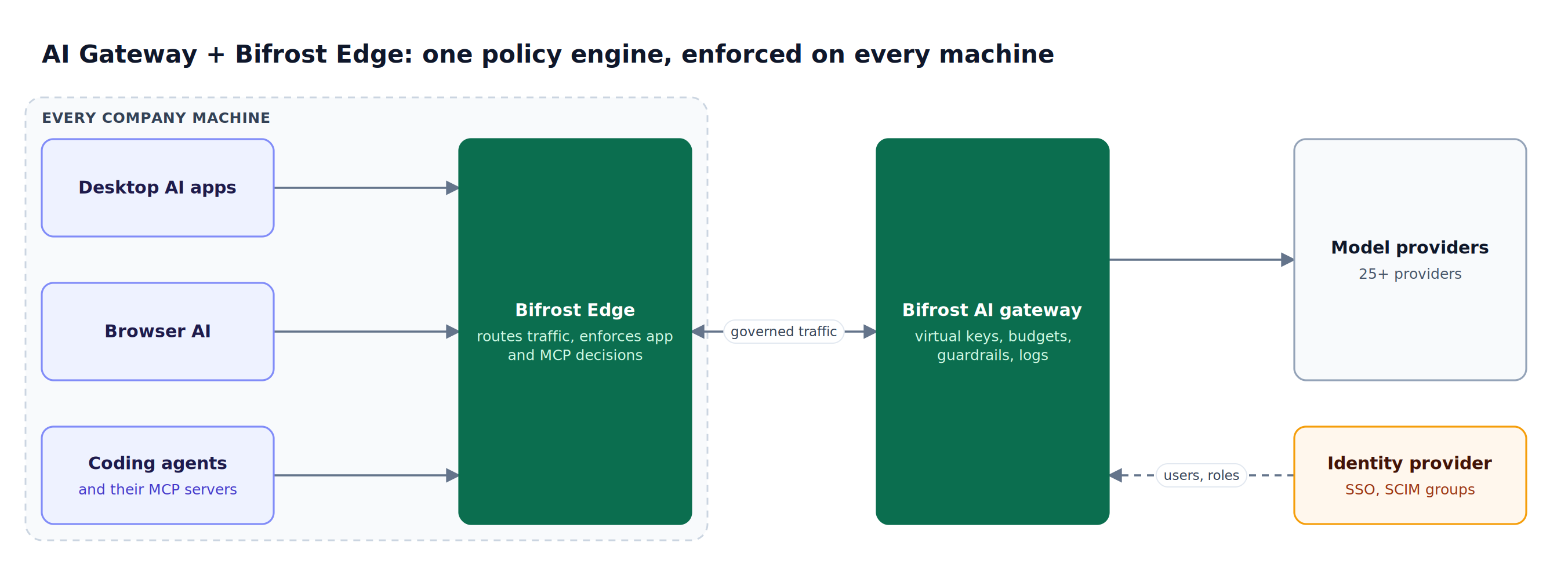
Figure 3: Policy lives in the Bifrost AI gateway; Bifrost Edge carries the same virtual keys, guardrails, and app and MCP decisions to the endpoint.
The gateway as the policy engine
Bifrost adds 11 microseconds of overhead per request at 5,000 RPS in sustained benchmarks and reaches 25+ providers and 10,000+ models through one OpenAI-compatible API. The controls that matter for secure AI usage sit on each request:
- Virtual keys are the primary governance entity, carrying model and provider allow-lists, rate limits, and an active status that revokes access instantly.
- Hierarchical budgets apply at the customer, team, virtual key, and provider-config levels, with reset durations from one minute to one year.
- Guardrails evaluate prompts before they reach a model and responses before they return, and can block or redact content.
The guardrail system includes three Bifrost-managed providers (Prompt Guardrails, Custom Regex with a built-in PII Detection template, and Gitleaks-backed secrets detection) plus external providers such as AWS Bedrock Guardrails, Azure Content Safety, Google Model Armor, and CrowdStrike AIDR. Guardrail rules can also target MCP tool arguments and results.
User provisioning supports OIDC single sign-on, group-to-role mapping, and inbound SCIM 2.0, so access follows employment status, while role-based access control scopes what each administrator can change.
Request logs capture inputs, outputs, tokens, cost, and latency for each AI request, storing redacted content when guardrail redaction is on. Audit logs record administrative activity as HMAC-signed entries, with export to JSON, JSON Lines, or Syslog and archival to S3 or GCS.
Bifrost Edge extends governance to every machine
Bifrost Edge runs natively on macOS, Windows, and Linux and routes AI traffic through Bifrost at the machine level, with no base URL changes or SDK swaps. A user signs in once through the organization's SSO, which links the device to the user and syncs their assigned policies. Supported applications today include Claude Desktop, the ChatGPT app, Cursor, Claude Code, Codex CLI, OpenCode, and ChatGPT and Claude in the browser.
Edge adds endpoint controls the gateway alone cannot provide:
- App governance lets administrators allow or block AI applications, and blocked apps are stopped before any data leaves the machine.
- MCP governance inventories MCP servers configured in supported AI apps and enforces allow or deny decisions on the device.
- Guardrails on endpoint traffic apply automatically, because endpoint requests pass through the same gateway rules and profiles.
The Approvals dashboard deduplicates discovered apps and MCP servers across the fleet, so one decision applies everywhere. Administrators choose whether pending items are allowed or blocked. Edge deploys through Jamf, Microsoft Intune, Kandji, Omnissa Workspace ONE, and JumpCloud with a managed configuration that carries no secrets. Bifrost Edge is currently in alpha, and teams register for onboarding.
2. Microsoft Purview DSPM for AI
Microsoft Purview Data Security Posture Management (DSPM) for AI is a data-layer governance tool that gives security teams a central place to monitor AI activity and apply data loss prevention to prompts. It fits organizations whose AI exposure centers on Microsoft 365 Copilot and labeled content.
Documented coverage includes Microsoft 365 Copilot, Copilot Studio, Microsoft Foundry, ChatGPT Enterprise, and third-party AI sites such as ChatGPT and Gemini. Key capabilities include:
- One-click policies that detect users visiting third-party generative AI sites and sending sensitive information to them
- DLP that blocks sensitive prompts in Microsoft Edge, and block-with-override for paste or upload in Edge, Chrome, and Firefox
- Insider Risk Management templates for risky AI usage, plus audit and eDiscovery capture of prompts and responses
- Network data security through a SASE or SSE integration for AI traffic from applications and APIs
Third-party AI site discovery requires onboarded devices and the Purview browser extension on Windows. Purview does not publish per-user AI budgets, model allow-lists, or MCP server controls, so teams pair it with AI governance software that enforces request-level policy.
Best for: Microsoft 365 organizations that want sensitivity labels and DLP to follow data into Copilot and browser-based AI.
3. Netskope One
Netskope One is a security service edge platform that governs workforce AI inline at the network layer, with discovery across 1,800+ AI apps and data protection inside prompts. It suits teams that already route web and SaaS traffic through Netskope.
Published capabilities include:
- Control at the account instance level, so approving a corporate tenant does not approve personal logins to the same app
- Real-time coaching that points users to the approved option
- DLP that redacts sensitive details and lets the task continue instead of blocking it
- Visibility into locally running AI agents, LLMs, and MCP servers, plus blocking of high-risk agent actions
Netskope does not publish per-user AI spend limits or model routing policy; our guide to coding agent security at the gateway layer covers those controls.
Best for: Enterprises standardized on Netskope SSE that want AI app discovery, instance-aware policy, and prompt DLP alongside existing web controls.
4. Zscaler AI Access Security
Zscaler AI Access Security applies AI governance inside the Zscaler Zero Trust Exchange, detecting and classifying thousands of AI apps, including AI embedded in SaaS applications, and enforcing inline data protection on prompts. It fits organizations already routing user traffic through Zscaler.
Published capabilities include:
- Prompt and response classification, including moderation of policy-violating use
- Inline DLP across 100+ dictionaries covering source code, PII, PCI, and PHI
- Allow, block, or coach access by user or group, plus control over copy-paste actions within AI applications
- Warn, block, or browser isolation policies, and inline controls for AI IDEs and developer tools
Zscaler does not publish per-user AI budgets, MCP server allow-lists, or model-level routing policy. Teams that need those controls place an AI gateway behind the SSE layer, using virtual keys as the unit of AI governance.
Best for: Zscaler customers that want AI app discovery, prompt DLP, and browser isolation inside their existing zero trust architecture.
5. Harmonic Security
Harmonic Security is a browser and endpoint AI data protection tool that inventories the AI tools employees use and classifies shared content by meaning rather than pattern matching. It suits teams that need fast visibility into browser AI, including on devices that never touch the corporate network.
Published capabilities include:
- Rollout through Intune, Jamf, Kandji, or Group Policy, with a browser extension for all browsers and an MCP gateway on Windows, macOS, and Linux
- Coverage for ChatGPT web and desktop, Codex, Claude, Microsoft Copilot, GitHub Copilot, and AI embedded in SaaS apps
- Three enforcement tiers: real-time blocking, contextual warnings to the employee, or silent logging for review
Harmonic does not publish model routing or per-key budgets. Teams that need spend attribution and gateway-side guardrail redaction alongside browser coaching add a gateway layer behind it.
Best for: Security teams that want quick shadow AI visibility and data-aware coaching in the browser before building out request-level controls.
How to Choose an AI Governance Solution
Choose an AI governance solution by identifying the control that must hold under audit, then adding layers around it. If AI requests must carry identity, spend, and model policy, start with an AI gateway and endpoint extension; if exposure centers on labeled Microsoft 365 data or an existing SSE contract, add those layers alongside it.
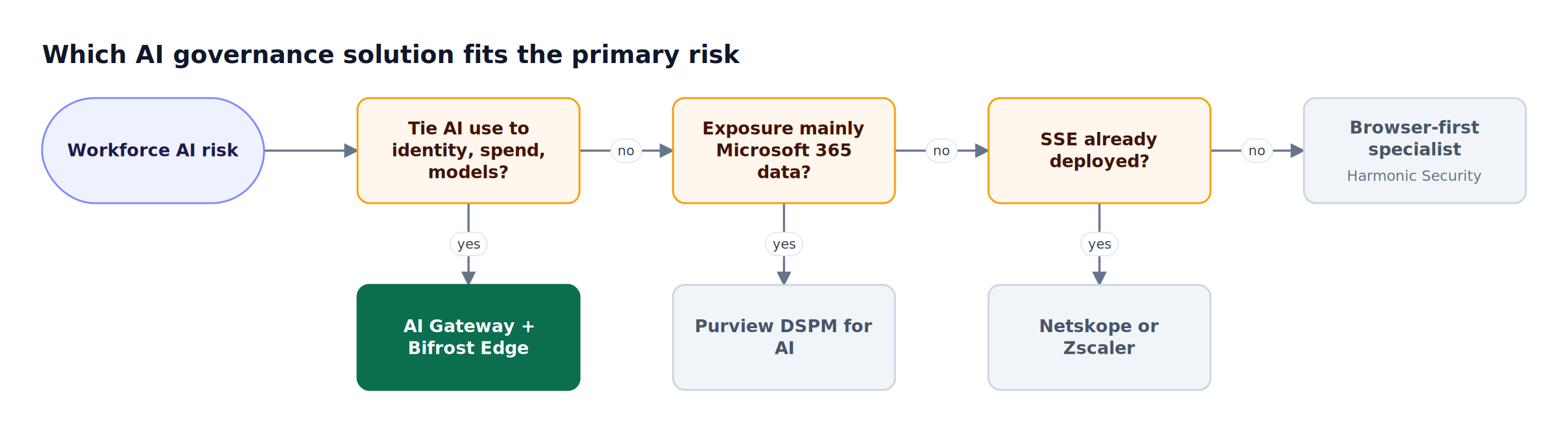
Figure 4: Start from the control that must hold under audit, then layer network or data tools around it rather than choosing one layer alone.
Most enterprises run more than one of these AI security tools: an SSE or data posture platform for web and SaaS traffic, and the Bifrost platform as the AI-specific control plane that attaches keys, budgets, guardrails, and logs to each model request.
Map each AI usage policy clause to a control
An AI usage policy, including an AI acceptable use policy, defines intent. It reduces risk only when each clause maps to a control that blocks or records the behavior it describes.
| AI usage policy clause | Control that enforces it | Bifrost mechanism |
|---|---|---|
| Only approved AI apps run on company devices | Device-level allow or block | Edge app governance |
| No secrets or customer PII in prompts | Inline inspection before the provider | Secrets detection, PII regex template, redaction |
| Agents may use only approved tools | MCP server allow-list and per-key tool filtering | Edge MCP governance and MCP tool filtering |
| Each team stays within its AI budget | Hierarchical spend limits | Budgets on virtual keys, teams, and customers |
| Access ends when employment ends | Directory-driven identity | OIDC and SCIM user provisioning |
| Auditors can verify all of the above | Request and administrative records | Request logs and signed audit logs |
The NIST AI Risk Management Framework treats governance as an ongoing function with documented accountability, which is far easier to show when every control writes to a log. MCP servers need particular care, as our analysis of shadow MCP servers and the data they expose explains.
Roll out in three phases
- Discover: deploy Bifrost Edge through MDM and review the app and MCP server inventory.
- Decide: approve sanctioned apps and servers, deny the rest, and issue virtual keys per team with budgets.
- Enforce and prove: attach guardrail rules to those keys and export audit records to the compliance archive.
Regulated teams can run the gateway inside their own network with in-VPC deployments, and Bifrost Enterprise adds clustering, RBAC, and audit logs. For a step-by-step rollout, see deploying AI governance with Bifrost Edge and the Bifrost gateway.
Frequently Asked Questions
What are the best AI governance platforms?
The best AI governance platforms for secure workforce AI usage are Bifrost with Bifrost Edge, Microsoft Purview DSPM for AI, Netskope One, Zscaler AI Access Security, and Harmonic Security. Bifrost ranks first because it ties each AI request to an identity, budget, guardrail, and log, then extends that policy to employee machines. Our broader ranking of enterprise AI governance platforms also covers model-risk tools.
How do you detect shadow AI?
Shadow AI is detected by inventorying AI apps and MCP servers on endpoints, inspecting AI domains at the network layer, and comparing usage against sanctioned tools. Bifrost Edge builds a fleet-wide inventory of installed AI apps and configured MCP servers, and the Devices dashboard shows which machines run each one, so detection leads directly to an allow or deny decision.
What is an AI acceptable use policy?
An AI acceptable use policy is a written standard that defines which AI tools employees may use, what data they may share with them, and what approvals are required. It becomes effective only when each clause maps to a control, such as app allow-lists, prompt guardrails, and budgets. Bifrost enforces those clauses through virtual keys, guardrails, and Bifrost Edge, and records each request in logs.
Does Bifrost Edge replace SSE or DLP tools?
No. Bifrost Edge extends the Bifrost AI gateway to endpoints for the AI apps, browser AI, and coding agents it supports, applying the same virtual keys, budgets, guardrails, and audit logs configured at the gateway. SSE and DLP platforms still govern general web and SaaS traffic. Many enterprises run both.
How are MCP servers governed on employee laptops?
MCP servers on employee laptops are governed by discovering what each AI app has configured, then enforcing allow or deny decisions on the device. Bifrost Edge inventories MCP servers in Claude Code, Claude Desktop, Gemini CLI, OpenCode, Codex, and Cursor, and a denied server cannot be used even by an app that had it configured earlier. The MCP gateway adds per-key tool filtering for servers accessed through Bifrost.
Is Bifrost Edge generally available?
Bifrost Edge is currently in alpha, and organizations register to be onboarded. The Bifrost AI gateway, including virtual keys, budgets, guardrails, and audit logs, is available now, and Edge enforces those same gateway policies on macOS, Windows, and Linux machines. Teams can adopt the gateway first and extend it to endpoints later.
Secure Employee AI Usage with Bifrost
AI governance solutions work when they turn policy into enforced, logged controls on every AI request. Bifrost provides that control plane with virtual keys, budgets, guardrails, and audit logs, and Bifrost Edge carries it to desktop apps, browser AI, coding agents, and MCP servers on every company machine. To see how Bifrost fits your AI governance software stack, book a demo with the Bifrost team or explore the Bifrost resources hub.