What Is an LLM Gateway? A Practical Guide for AI Teams
An LLM gateway is a middleware layer that routes model requests from applications to many LLM providers through one API. This guide covers how an LLM gateway translates requests, handles provider failures, tracks cost, and compares to LLM proxies and routers.
TL;DR
- An LLM gateway is a middleware layer that exposes one API for many model providers and handles routing, failover, authentication, rate limits, caching, and cost tracking.
- An LLM gateway translates one request format, usually the OpenAI-compatible API, into each provider's native API and normalizes responses back.
- An LLM gateway differs from an LLM proxy by adding governance and failure handling, and from an LLM router by covering the full request lifecycle rather than only model selection.
- Bifrost is an open-source LLM gateway that serves 10,000+ models from 25+ providers and adds 11 microseconds of overhead per request at 5,000 RPS.
An LLM gateway is a middleware layer between applications and large language model providers that exposes one API for every model while handling routing, retries, failover, authentication, budgets, and logging. Production teams adopt an LLM gateway when calling models directly through provider SDKs starts producing outages, scattered API keys, and invoices nobody can attribute. Bifrost, the open-source LLM gateway written in Go by Maxim AI, gives enterprise teams that layer with 11 microseconds of added overhead per request. This guide explains how an LLM gateway works, how it behaves when providers fail, and how it compares to an LLM proxy and an LLM router.
What Is an LLM Gateway?
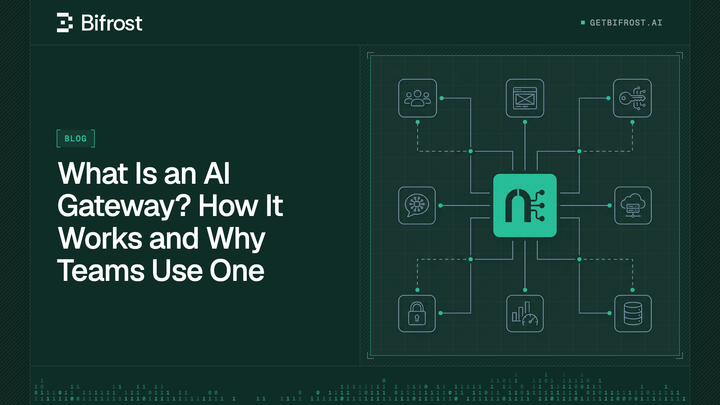
An LLM gateway is a single entry point that accepts model requests from applications and forwards them to the right provider, model, and API key. It centralizes the concerns that otherwise get reimplemented in every service: provider credentials, request translation, retries, rate limits, spend tracking, and request logs.
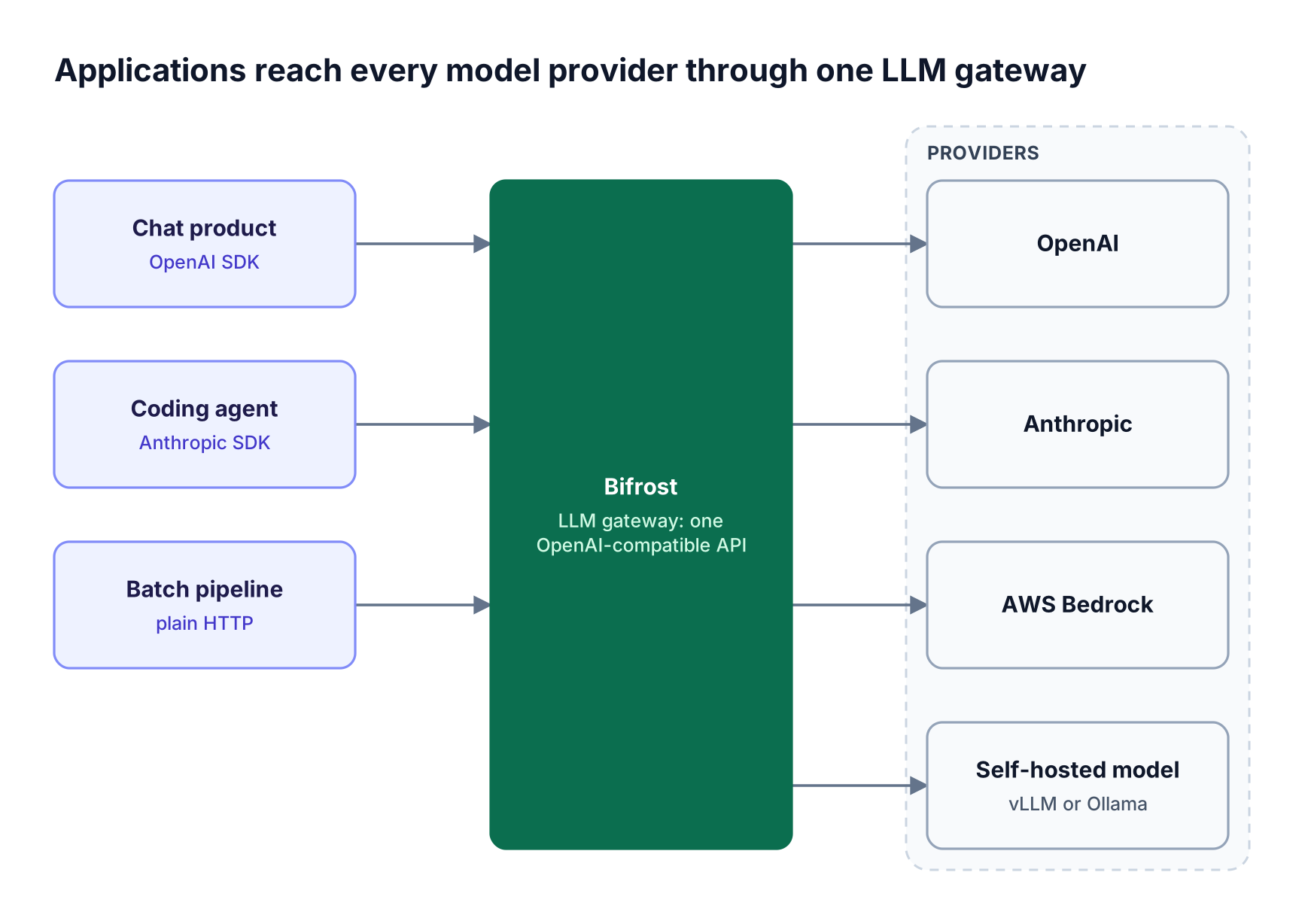
Figure 1: One integration point and one set of credentials replace a separate SDK integration per provider.
Without a gateway, three services and four providers means up to twelve integrations, twelve places provider keys are stored, and twelve sets of retry logic. With a gateway, as Figure 1 shows, each application integrates once and the provider matrix lives in one configuration.
An LLM gateway is one part of a broader category. An AI gateway combines LLM gateway functions with MCP tool governance for agents, and the two terms are often used interchangeably when a product covers both.
How an LLM Gateway Works
An LLM gateway works by accepting requests in one standard format, authenticating the caller, selecting a provider and model, translating the request into that provider's native API, and converting the response back into the standard format. Applications see one API contract regardless of which provider served the request.
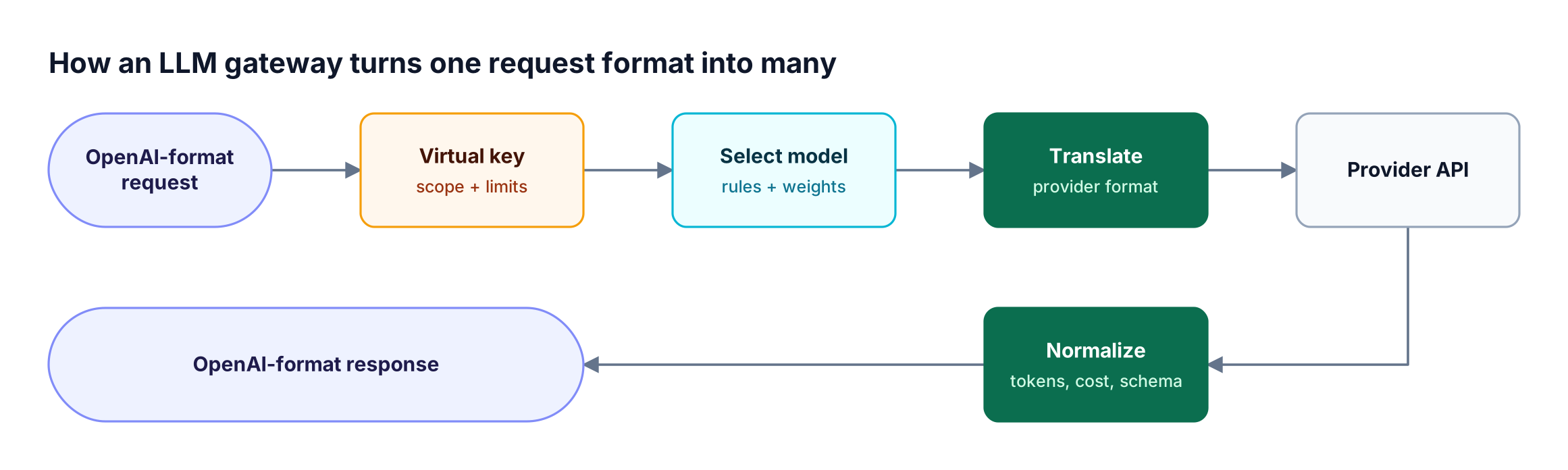
Figure 2: The application only ever speaks one API; translation in both directions happens inside the gateway.
The standard format is almost always the OpenAI-compatible API, because most SDKs, frameworks, and coding tools already speak it. Bifrost accepts OpenAI-compatible requests and also exposes native-format endpoints, so teams can use it as a drop-in replacement for the OpenAI, Anthropic, and Google GenAI SDKs by changing only the base URL:
import openai

client = openai.OpenAI(
    base_url="<http://localhost:8080/openai>",  # point the SDK at the gateway
    api_key="sk-bf-...",                      # a Bifrost virtual key, not a provider key
)

response = client.chat.completions.create(
    model="anthropic/claude-sonnet-4-5",
    messages=[{"role": "user", "content": "Summarize this incident report."}],
)
The provider/model naming lets one client reach any configured provider. On the way back, the gateway computes tokens and cost in a consistent schema across providers, which is what makes per-team cost reporting possible.
Key LLM Gateway Features
The key features of an LLM gateway are a unified API, routing, failover, load balancing, governance, caching, and observability. The table below shows what each feature does and the production problem it addresses, which is a better way to compare gateways than a raw feature checklist.
| Feature | What it does | Production problem it solves |
|---|---|---|
| Unified API | One OpenAI-compatible interface for all providers | Provider SDK sprawl across services |
| LLM routing | Picks provider, model, and key by rule or weight | Model changes that require code deploys |
| Retries and fallbacks | Recovers from errors within and across providers | Provider outages reaching end users |
| Key load balancing | Distributes calls across API keys | Per-key rate limits capping throughput |
| Virtual keys | Issues scoped credentials per app, team, or user | Raw provider keys copied into many repos |
| Budgets and rate limits | Caps spend and tokens per consumer | Runaway spend from one team or bug |
| Caching | Replays answers for repeated or similar prompts | Paying again for identical requests |
| Observability | Logs prompts, tokens, cost, and latency | No way to debug or attribute usage |
Two features carry most of the governance weight. Bifrost issues virtual keys in the familiar sk-bf-* format, so applications authenticate with a scoped gateway credential instead of a raw provider key. Each virtual key carries its own allowed models, budgets and rate limits, and those budgets roll up to teams and customers. A walkthrough of these controls in practice is in LLM gateway routing, fallback, and governance in Bifrost.
How an LLM Gateway Handles Provider Failures
An LLM gateway handles provider failures in three layers: retries for transient server errors, key rotation for errors tied to one API key, and fallbacks to another provider when the primary is unavailable. Classifying the failure first matters, because retrying a revoked key wastes time and skipping backoff on a rate limit makes it worse.
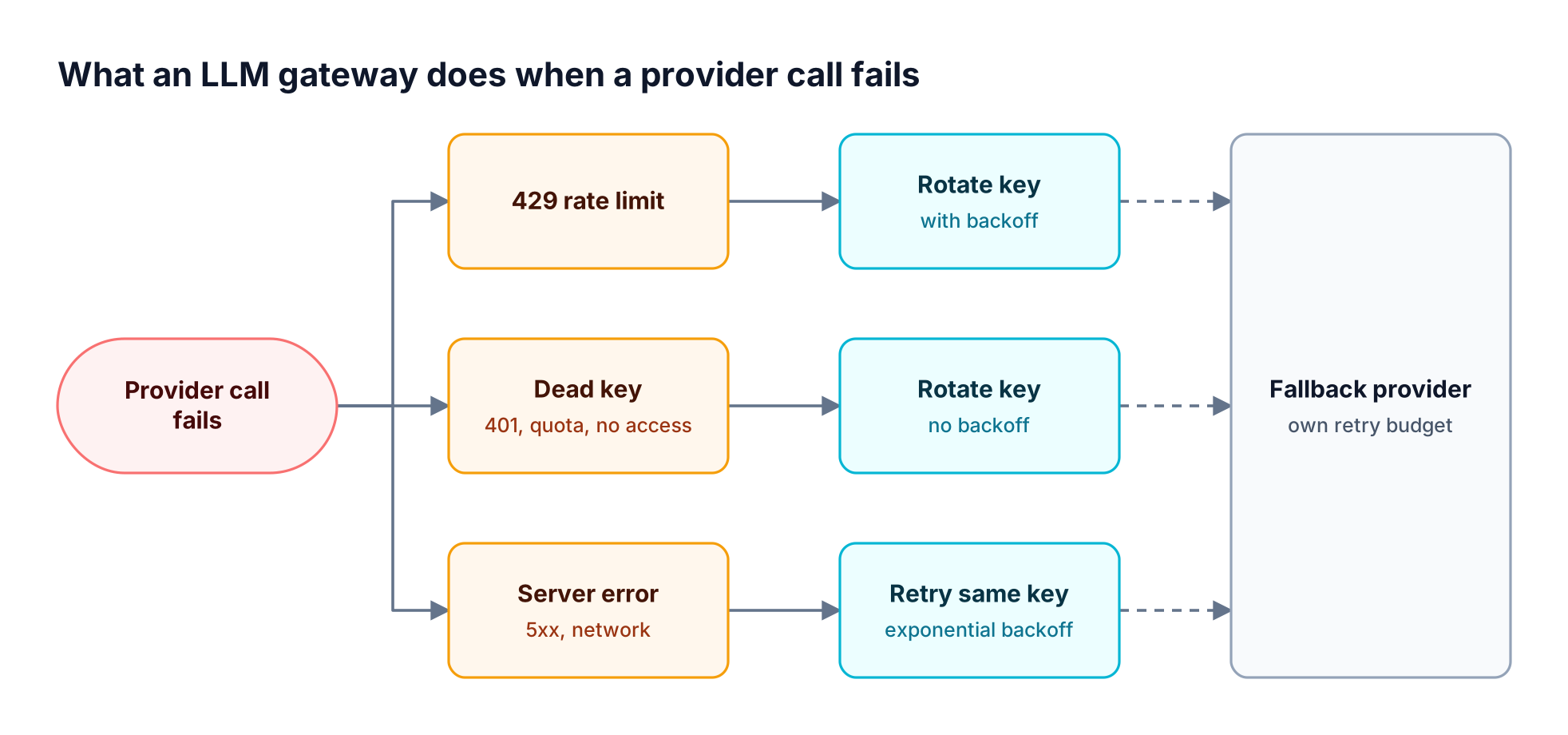
Figure 3: Retries fix transient errors, key rotation fixes per-key errors, and fallbacks cover a full provider outage.
Provider error semantics are not consistent. OpenAI enforces limits across requests and tokens per minute and per day, while Anthropic documents separate codes for rate limits (429) and a temporarily overloaded API (529). Some providers report an exhausted balance as a 400 and others as a 429. The gateway has to read the error body, not only the status code, to choose the right recovery.
Bifrost follows the model in Figure 3. Its retries and fallbacks classify each failed attempt, rotate to another key from the pool on per-key failures, apply exponential backoff with jitter on transient server errors, and move to the next provider in the fallback chain once retries are exhausted. Each fallback provider gets its own retry budget. Teams designing these chains in detail can compare approaches in LLM gateways for reliable fallback systems.
LLM Gateway vs LLM Proxy vs LLM Router
An LLM proxy forwards requests to providers, an LLM router decides which model should answer a request, and an LLM gateway does both while adding governance, failure handling, and observability. The three overlap, and many products described as one are actually another.
| Dimension | LLM proxy | LLM router | LLM gateway |
|---|---|---|---|
| Primary job | Forward and translate requests | Choose a model per request | Govern the full request lifecycle |
| Unified API | Usually | Sometimes | Yes |
| Model selection | Static or by name | Rule-based or learned | Rules, weights, and health signals |
| Retries and fallbacks | Basic retries | Rarely | Retries, key rotation, cross-provider fallback |
| Budgets and access control | Rarely | No | Per key, team, and customer |
| Cost and token logging | Partial | No | Full, per request |
| Typical owner | Individual developer | ML or research team | Platform team |
A team trying several models from a notebook can use an LLM proxy. A team running customer-facing traffic for several product groups needs an LLM gateway, with LLM routing as one feature rather than the whole product. Bifrost covers the routing layer with CEL-based routing rules evaluated per request, and the trade-offs between routing approaches are covered in these LLM routing strategies.
LLM Gateway vs MCP Gateway
An LLM gateway governs the calls an application makes to language models, while an MCP gateway governs the calls an agent makes to tools through the Model Context Protocol. Agents need both: the LLM gateway controls how the agent reasons and what it costs, and the MCP gateway controls what the agent is allowed to do.
Running both in one product means one identity and one audit trail cover the agent end to end. Bifrost runs as both, and the Bifrost MCP gateway uses the same virtual keys as the LLM path. The tool-side terminology is broken down further in MCP gateway vs MCP proxy vs MCP server.
LLM Observability and Cost Tracking at the Gateway
LLM observability at the gateway means recording, for every request, the caller, the model and provider that served it, the prompt and response, token counts, cost, and latency. The gateway is the only point that sees all model traffic, so it is the most complete source for debugging, chargeback, and capacity planning.
Cost tracking depends on that completeness. Provider invoices show spend by account, not by feature, team, or customer. With every request tied to a virtual key, gateway logs can answer which team, which feature, and which model generated the cost. The OWASP Top 10 for LLM Applications lists unbounded consumption as a top risk for exactly this reason: without per-consumer limits and logs, runaway usage is discovered on the invoice.
Bifrost includes built-in observability that logs inputs, outputs, tokens, cost, and latency asynchronously, so logging does not add request latency. It exports traces through OpenTelemetry and metrics through Prometheus.
A detailed list of signals worth capturing is covered in LLM observability at the gateway, and cost-focused teams can compare options in enterprise LLM gateways for tracking LLM costs.
Open Source LLM Gateway vs Building Your Own
Most teams should adopt an open source LLM gateway rather than build one, because the hard parts are provider-specific error handling, streaming translation, and governance hierarchies, not request forwarding. An internal proxy written in a sprint usually covers the happy path and then accumulates provider edge cases for years.
| Consideration | Build in-house | Adopt an open source LLM gateway |
|---|---|---|
| Time to first request | Weeks | Minutes |
| Provider coverage | Grows one integration at a time | 25+ providers in Bifrost on day one |
| Failure handling | Rebuilt per provider error format | Classified retries, key rotation, fallbacks |
| Governance | Usually flat API keys | Virtual keys with team and customer budgets |
| Maintenance | Ongoing as provider APIs change | Maintained by the project and community |
| Code visibility | Full | Full |
Code visibility is the reason open source matters at this layer specifically: every prompt and completion passes through the gateway, so security reviewers need to read the code that handles them. Bifrost is open source, starts with zero-configuration gateway setup, and the Bifrost Enterprise build adds clustering, RBAC, in-VPC deployment, and audit logs for regulated environments.
How Bifrost Works as an LLM Gateway
The Bifrost LLM gateway is high-performance infrastructure that unifies 10,000+ models from 25+ providers behind one OpenAI-compatible API, with governance, failover, caching, and observability built in. It adds 11 microseconds of overhead per request at 5,000 requests per second in sustained benchmarks with a 100% success rate.
Bifrost covers each of these capabilities with a specific feature:
- Provider coverage: OpenAI, Anthropic, AWS Bedrock, Google Vertex AI, Azure OpenAI, and the rest of the supported provider list, including self-hosted vLLM and Ollama.
- Load balancing: weighted distribution across API keys with model-specific key filtering.
- Caching: semantic caching with exact-match hashing and embedding-based similarity, including replay of streamed responses.
- Safety: enterprise guardrails for secrets detection, PII redaction, custom regex, and third-party safety providers.
- Governance: hierarchical budgets at the virtual key, team, and customer levels.
Test configurations are published on the Bifrost benchmarks page, and the best LLM gateways are compared on features and benchmarks in a separate guide. The wider category is covered in how AI gateways route and govern traffic.
Frequently Asked Questions
What is an LLM gateway?
An LLM gateway is a middleware layer between applications and LLM providers that exposes one API for many models. It handles provider routing, request translation, retries and fallbacks, authentication, rate limits, budgets, caching, and logging. Applications integrate once with the gateway instead of separately with each provider, and platform teams manage credentials and policy in one place.
What are the most popular LLM gateways?
Popular LLM gateways include open-source self-hosted gateways, managed gateway services, and LLM features inside cloud platforms and API management products. Bifrost is an open-source option built for enterprises, with 25+ providers, 11 microseconds of overhead at 5,000 RPS, and in-VPC deployment. The right choice depends on overhead, governance depth, and where the data plane must run.
Is an LLM gateway free?
Open-source LLM gateways such as Bifrost are free to download and self-host; you pay only for the infrastructure that runs them and for the model usage itself. Enterprise editions that add clustering, RBAC, SSO, and audit logs are commercially licensed. Managed LLM gateway services usually charge per request or add a percentage on top of model spend.
What is the difference between an MCP gateway and an LLM gateway?
An LLM gateway governs model calls: routing, failover, token budgets, and cost tracking. An MCP gateway governs agent tool calls: tool discovery, tool-level access control, and credentials for MCP servers. Agents need both, because the LLM gateway controls reasoning cost and the MCP gateway controls actions. Bifrost runs both behind one set of virtual keys.
Does an LLM gateway work with the OpenAI SDK?
Yes. Most LLM gateways accept OpenAI-compatible requests, so the OpenAI SDK works by changing the base URL and API key. Bifrost also supports the Anthropic, Google GenAI, AWS Bedrock, LangChain, and PydanticAI SDKs through its SDK integrations, and models from any configured provider are addressed with provider/model names.
Getting Started with Bifrost
A gateway turns many provider integrations into one governed, observable path, and it is the layer that keeps applications running when a provider returns errors. Bifrost provides that LLM gateway as open-source infrastructure built for enterprise scale, with 11 microseconds of overhead, cross-provider failover, and hierarchical budgets. Review the LLM gateway buyer's guide or book a demo to see Bifrost running against your own providers.